
LM – Project RENEW established a mobile outreach program to provide prostheses, orthotics and education to explosive remnants of war survivors in the remote communities of Vietnam.
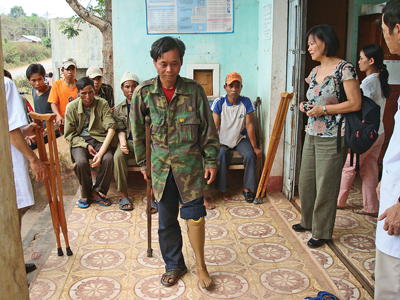
Susan Eckey, Former Deputy Director General for Humanitarian Affairs, Norwegian Ministry of Foreign Affairs, visits with the P&O team.
Photo courtesy of Dang Quang Toan/Project RENEW.
According to a 2014 report compiled by Vietnam’s Department of Labour, Invalids and Social Affairs, Quang Tri province currently has 37,292 persons with disabilities, 13,023 of whom were disabled by Agent Orange and 5,094 by explosive remnants of war (ERW).1,2,3 Disabled persons living in rural areas often live in poverty and do not have access to basic services. For those with injuries resulting from unexploded ordnance (UXO), prosthetics are difficult to obtain. Tiếp tục đọc “Project RENEW’s Prosthetics and Orthotics Mobile Outreach Program”

 People inspect damage at a site hit by what activists said were barrel bombs dropped by forces loyal to Syria’s President Bashar al-Assad in Aleppo’s district of al-Sukari on March 7, 2014. (Hosam Katan/Reuters)
 CVD
CVD 