Despite objections from some lawmakers and human rights advocates, the White House is considering selling U.S. weapons to Hanoi — for the first time since the war.
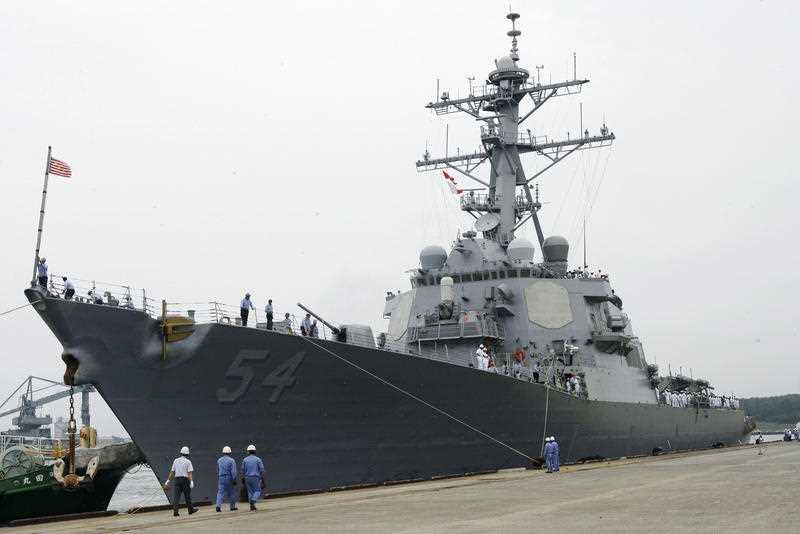
The White House appears poised to end a ban on arms sales to Vietnam in time for a landmark visit by President Barack Obama later this month, despite misgivings from some lawmakers and human rights advocates.
The step would carry crucial symbolism in the growing contest for influence between China and the United States in the Western Pacific and also for America’s relationship with Hanoi that has come full circle since the dark days of the Vietnam War. Tiếp tục đọc “U.S. Likely to Lift Ban on Arms Sales to Vietnam”→
Tổng thống Mỹ Barack Obama thăm chính thức Việt Nam ngày 22-25/5 theo lời mời của lãnh đạo Việt Nam, thông cáo Bộ Ngoại giao Việt Nam hôm nay cho biết.
45.000 m3 đất sân bay Đà Nẵng được tẩy sạch dioxin
Kết quả lấy mẫu xét nghiệm tại sân bay quốc tế Đà Nẵng do cơ quan Phát triển Quốc tế Mỹ (USAID) và Bộ Quốc phòng Việt Nam thực hiện cho thấy đất, bùn đã được tẩy sạch dioxin.
Ngày 3/5, Đại sứ Mỹ tại Việt Nam, ngài Ted Osius và Thứ trưởng Bộ Quốc phòng Việt Nam, Thượng tướng Nguyễn Chí Vịnh đã cùng công bố kết quả xử lý thành công đất nhiễm dioxin tại sân bay Đà Nẵng, trong khuôn khổ dự án được Bộ Quốc phòng Việt Nam và USAID quản lý. Phó Thủ tướng Vũ Đức Đam đã đến dự.
TTCT– Ở “Trung tâm trưng bày hoạt động khắc phục hậu quả bom mìn” (Mine Action Visitor Center – MAVC) tại Quảng Trị có một quả bom hiện vật, phần vỏ thép bị xé rách, tạo hình như dáng đứng đau thương và nhẫn nại của một con người trên vùng đất quá nổi tiếng vì đạn bom này.
Nguyễn Thị Diệu Linh bên quả bom chôn 42 năm ở nhà ông Nguyễn Vũ -Ngô Xuân Hiền
Dismayed at China’s tactics in the South China Sea, U.S. senators from both parties on Wednesday demanded the White House show more resolve with Beijing and ratchet up U.S. naval patrols near disputed islands in the strategic waterway.
Recent developments in the South China Sea are a serious cause for concern for Southeast Asian states, which have a huge interest in ensuring the safety and security of these waters given their importance for international shipping. Ongoing militarisation in the disputed waters increases the risks of unintended military confrontations, threatening regional stability.
Is Vietnam diverting its civilian know-how to create an indigenous nuclear weapons program? Not yet, says the CSS’ Oliver Thränert, but increased tensions or overt conflict with China could lead Hanoi to develop its own nuclear deterrent.
By Oliver Thränert for Center for Security Studies (CSS)
ISN – For many years, the international nuclear non-proliferation regime has been in deep crisis. This became apparent most recently when the ninth Review Conference of the Parties to the Treaty on the Non-Proliferation of Nuclear Weapons (NPT) in May 2015 ended without a common final document. At the same time, a number of threshold countries are planning to begin using nuclear energy for peaceful purposes. In a time of increasing international tensions, some of them might build on know-how acquired through their civilian programs to safeguard their national security needs through a nuclear weapons program in the near future. Vietnam is an interesting case in point. Irrespective of certain delays in the development of its peaceful nuclear program, the country has progressed quite far. At the same time, it is engaged in an increasingly precarious conflict with its main neighbor, nuclear-armed China. Currently, there are no signs of a Vietnamese nuclear weapons program. In the framework of the nuclear non-proliferation regime, the country is a model of transparency and cooperation. But it is uncertain whether this will always remain the case. On the contrary, Hanoi might change its policy if the conflict with China should come to a head while the NPT continues to be weakened.
Vietnam’s strategic situation
Vietnam might complete its first nuclear reactor within a few years, ahead of ambitious neighbors such as Indonesia or Malaysia. The country’s main motivations are its growing energy requirements and the desire to diversify its energy sources. Considerations of prestige may also be a factor. As a threshold nation, Vietnam aims to achieve the same level as Asia’s developed nations. With a view to China, Hanoi probably also wishes to demonstrate the high level of global confidence that the country enjoys in sensitive matters of security policy. Tiếp tục đọc “Nonproliferation and Nuclear Energy: The Case of Vietnam”→
TTO – Nhiều người cho rằng sau vụ nổ kinh hoàng ở Hà Đông, dân kinh doanh phế liệu là vỏ bom mìn ở “chợ bom” xã Diễn Hồng, huyện Diễn Châu tỉnh Nghệ An đã biết sợ.
Phế liệu bom mìn tại các cơ sở kinh doanh phế liệu ở Diễn Hồng năm 2005 – Ảnh: Vũ Toàn
Sau vụ nổ kinh hoàng ở Hà Đông (Hà Nội), chúng tôi tìm đến “chợ bom” ở xã Diễn Hồng, huyện Diễn Châu (Nghệ An) – nơi mà trước đây sắt, thép phế liệu, trong đó có bom, đạn đều được họ mua tuốt luốt (bài “Chợ… bom” , Tuổi Trẻ ngày 25-5-2005). Tiếp tục đọc ““Chợ bom” đã bớt cưa bom”→
The large crater caused by the blast in Hanoi on March 19. Photo: Minh Chien
thanhniennews: The Ministry of Public Security has found traces of explosives and bomb debris at the site of a blast in Hanoi on Saturday that killed four people, injured 10 others and damaged more than 120 houses.
The explosion at about 3.10 p.m. at a scrap metal trading business seriously tore through 36 houses and damaged 95 others, and left a large crater in Van Phu residential area, Ha Dong District, the police said. Many vehicles along the street were damaged too.
Although the police was yet to officially pinpoint the cause of the blast, they speculated that it was ignited when the shop owner tried to cut open a bomb using a blow torch.
One of the perished victims was Pham Van Cuong, 42, who had rent the house for his scrap metal shop since 2013 and reportedly often used a blow torch to cut large scrap metal pieces, police said.
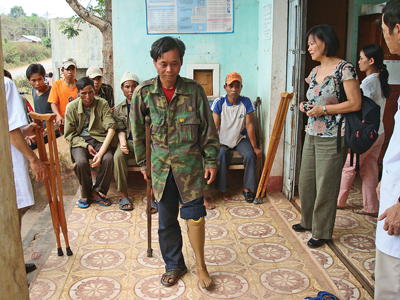
LM – Project RENEW established a mobile outreach program to provide prostheses, orthotics and education to explosive remnants of war survivors in the remote communities of Vietnam.
Susan Eckey, Former Deputy Director General for Humanitarian Affairs, Norwegian Ministry of Foreign Affairs, visits with the P&O team.
Photo courtesy of Dang Quang Toan/Project RENEW.
According to a 2014 report compiled by Vietnam’s Department of Labour, Invalids and Social Affairs, Quang Tri province currently has 37,292 persons with disabilities, 13,023 of whom were disabled by Agent Orange and 5,094 by explosive remnants of war (ERW).1,2,3 Disabled persons living in rural areas often live in poverty and do not have access to basic services. For those with injuries resulting from unexploded ordnance (UXO), prosthetics are difficult to obtain. Tiếp tục đọc “Project RENEW’s Prosthetics and Orthotics Mobile Outreach Program”→
(LLCT) – Cho đến khi kết thúc Chiến tranh lạnh, Mỹ vẫn coi châu Âu là trọng điểm chiến lược. Từ khi Bush (cha) lên cầm quyền, đồng thời với tăng cường thêm lực lượng ở châu Âu, Mỹ bắt đầu chuyển trọng tâm chiến lược toàn cầu sang khu vực châu Á – Thái Bình Dương (CATBD) với mục đích duy trì địa vị siêu cường trong thế kỷ mới. Chiến lược đối với CATBD của chính quyền B.Clintơn bắt đầu rõ nét hơn. Bản tuyên bố toàn diện nhất về chính sách mới đối với khu vực đã được Winston Lord trình bày trước Ủy ban Đối ngoại Thượng viện: Đối với Mỹ, không có khu vực nào quan trọng hơn CATBD và không có khu vực nào khác có tầm quan trọng như thế đối với Mỹ trong thế giới mới.
Editor’s note: It was 1954, and the surrounded French garrison was facing defeat in what would become known as the First Indochina War. What happened next has been a source of controversy for decades. The author of a 2013 Pulitzer Prize-winning book on Vietnam gives his view, drawing on the array of materials that have slowly emerged.
thebulletin – It is one of the most tantalizing questions of the long and bloody struggle for Vietnam: Did US Secretary of State John Foster Dulles in the spring of 1954 offer French foreign minister Georges Bidault two atomic bombs for use against Viet Minh positions near the beleaguered French garrison at Dien Bien Phu in remote northwestern Vietnam? For decades historians have investigated the matter, with no consensus emerging. But what does the evidence actually say? The time is right for a fresh look.
At first glance, it might seem odd that the United States would even contemplate providing large-scale military aid to the French army; after all, what did America care if imperial France lost one of its colonies in remote Asia? But this was the depths of the Cold War. Anxious to prevent the “fall” of another Asian nation to communism soon after the so-called “loss of China” and a bloody three-year stalemated war against communist forces in Korea, the United States was willing to send weaponry to aid the French—even if there was considerable doubt among experts as to how committed Viet Minh leader Ho Chi Minh really was to advancing the cause of global communism. (“Isn’t he first and foremost a nationalist?” many analysts speculated.) Ultimately, the United States had gambled on staying with the imperial status quo and propping up a repressive French regime in Indochina, to the point that by early 1954 Washington covered the lion’s share of the cost of the war effort. Tiếp tục đọc ““We might give them a few.” Did the US offer to drop atom bombs at Dien Bien Phu?”→
Transnationalizing Viet Nam Community, Culture, and Politics in the Diaspora
Kieu-Linh Caroline Valverde
“Bridging Asian Studies and Asian American Studies, Transnationalizing Viet Nam is a rich and nuanced study of transnational linkages between Viet Nam and its diaspora in the United States. Through fascinating case studies of Vietnamese popular music productions, Internet virtual communities, diasporic art and community politics, Kieu-Linh Caroline Valverde provides a rare glimpse into how Vietnamese have connected their worlds and made meanings for themselves.”
—Yen Le Espiritu, Professor of Ethnic Studies, University of California, San Diego
temple.edu – Vietnamese diasporic relations affect—and are directly affected by—events in Viet Nam. In Transnationalizing Viet Nam, Kieu-Linh Caroline Valverde explores these connections, providing a nuanced understanding of this globalized community. Valverde draws on 250 interviews and almost two decades of research to show the complex relationship between Vietnamese in the diaspora and those back at the homeland.
Arguing that Vietnamese immigrant lives are inherently transnational, she shows how their acts form virtual communities via the Internet, organize social movements, exchange music and create art, find political representation, and even dissent. Valverde also exposes how generational, gender, class, and political tensions threaten to divide the ethnic community.
Transnationalizing Viet Nam paints a vivid picture of the complex political and personal allegiances that exist within Vietnamese America and shape the relations between this heterogeneous community and its country of origin.






 CVD
CVD 