Sudan Humanitarian Update (21 December 2023)

UNOCHA.org

SITUATION OVERVIEW

Eight months after fighting between the Sudanese Armed Forces (SAF) and the Rapid Support Forces (RSF) erupted in mid-April, more than 6.9 millionpeople have fled their homes, taking refuge inside and outside the country, with children representing about half of the people displaced. Sudan is now the country with the largest number of displaced people and the largest child displacement crisis in the world.
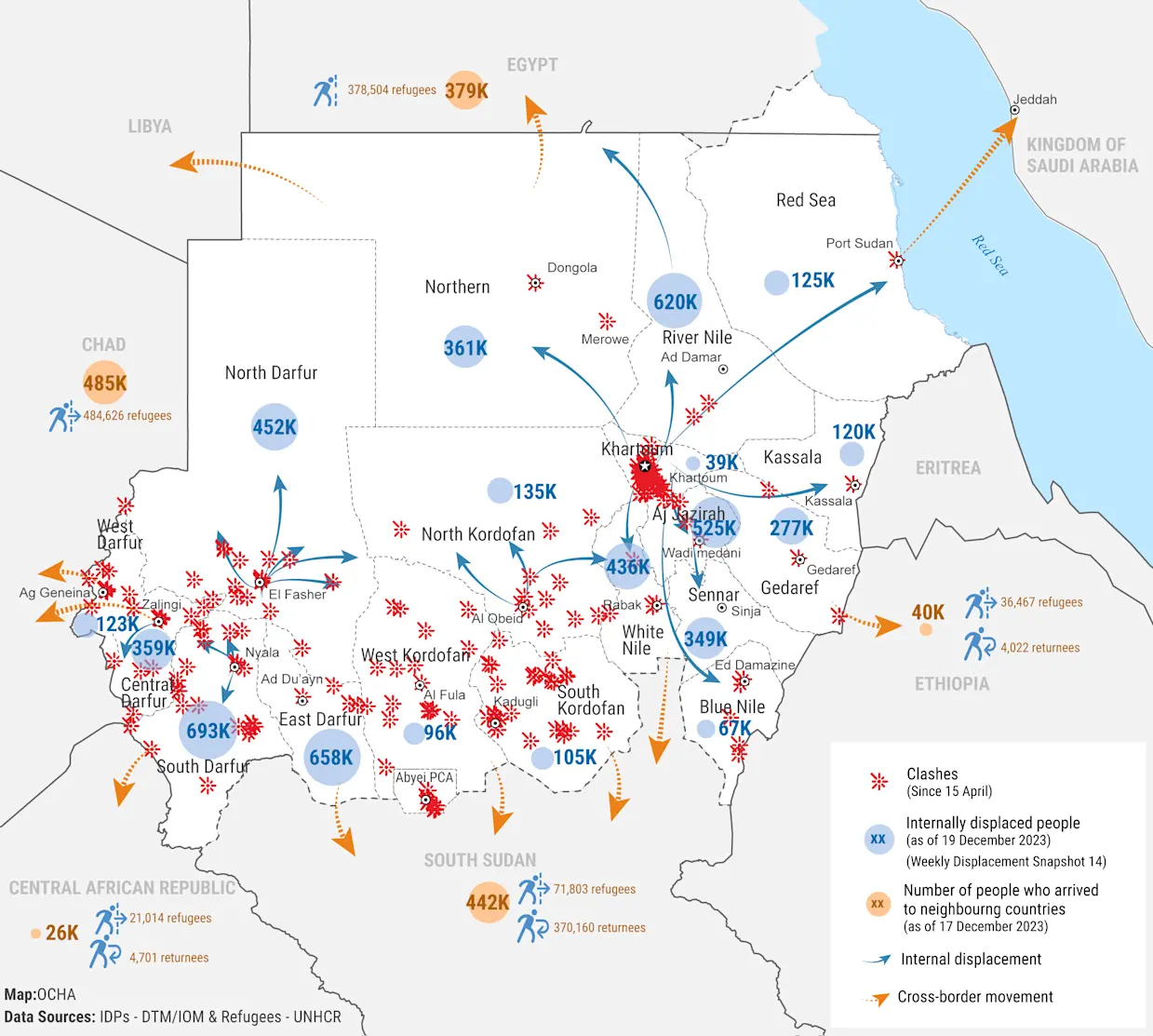
According to the International Organization for Migration Displacement Tracking Matrix (IOM DTM) Sudan Weekly Displacement Snapshot (13), more than 5.5 million people have been displaced within Sudan since April 2023. People have been displaced in 6,089 locations across the country’s 18 states, an increase of 115,000 people and 160 locations in one week. The highest proportions of IDPs have been observed across South Darfur (13 per cent), East Darfur (12 per cent), River Nile (11 per cent), Aj Jazirah (9 per cent), and North Darfur (8 per cent). THE IDPs were initially displaced from 11 states. The majority of IDPs – 3.5 million people or 64 per cent of the total – have been reportedly displaced from Khartoum State; followed by South Darfur (17 per cent), North Darfur (9 per cent), Central Darfur (4 per cent), West Darfur (3 per cent) and other states. In addition, about 1.4 million people crossed into neighbouring countries since 15 April, according to UNHCR.

The total number of people displaced within Sudan is likely to increase further when the estimated 250,000-300,000 people who have been newly displaced from Wad Medani and surrounding areas in Aj Jazirah State over the past few days are registered and verified in the locations where they have sought shelter and assistance.

About 250,000-300,000 people displaced from Wad Medani and surrounding areas, Aj Jazirah State

Tiếp tục đọc “Sudan Humanitarian Update (21 December 2023)”
Đằng sau việc Sudan ra lệnh trục xuất 15 nhà ngoại giao UAE

ANTG – Thứ Tư, 20/12/2023, 14:38

Theo SUNA – hãng thông tấn chính thức của Sudan, Bộ Ngoại giao Sudan đã tuyên bố 15 nhân viên của đại sứ quán Các Tiểu vương quốc Arab Thống nhất (UAE) là những người không được chào đón và ra lệnh cho họ rời khỏi đất nước này.

Các nhà ngoại giao UAE có 48 giờ để rời khỏi Sudan, tuyên bố này được phát ra vài tuần sau khi tướng cấp cao của Sudan cáo buộc UAE hỗ trợ đối thủ RSF. Tháng trước, Yasser al-Atta, tướng cấp cao và cấp chỉ huy thứ hai của tổng tư lệnh quân đội Sudan Abdel Fattah al-Burhan, đã cáo buộc UAE gửi hàng tiếp tế cho lực lượng hỗ trợ nhanh bán quân sự (RSF). Atta tuyên bố UAE đã gửi hàng tiếp tế qua các sân bay ở Uganda, Chad và Cộng hòa Trung Phi.

UAE đáp lại Sudan bằng cách tuyên bố rằng họ đã “liên tục kêu gọi giảm leo thang, ngừng bắn và bắt đầu đối thoại ngoại giao”. Trong khi đó, vào tháng 8, UAE đã bác bỏ một báo cáo của Wall Street Journal cho rằng vũ khí được tìm thấy trong các chuyến hàng viện trợ của họ tới Sudan và nói rằng nước này “không đứng về bên nào trong cuộc xung đột hiện tại”.

Xe bọc thép bị tiêu diệt bên những thi thể được che phủ trên đường phố el-Geneina, Tây Darfur, tháng 6/2023. Ảnh: AFP Tiếp tục đọc “Đằng sau việc Sudan ra lệnh trục xuất 15 nhà ngoại giao UAE”

Sudan conflict: how China and Russia are involved and the differences between them

theconversation.com

Published: June 8, 2023 12.44pm BST

As clashes continue between the Sudanese military and rapid support forces, the current and historic role of foreign governments in Sudanese affairs is under close examination.

Unsurprisingly, the Sudan conflict has amplified concerns from the US and other countries about the roles Russia and China are playing in Sudan specifically, and in Africa.

Researchers had been concerned that Beijing’s loans for infrastructure and development to countries including Sudan might be “debt-trap diplomacy”, a predatory attempt to acquire key foreign infrastructure such as ports.

Analysts had previously suggested the implications of China’s growing military engagement with Africa including establishing naval bases and its use of security contractors are examples of Beijing wanting to expand its military power and political influence abroad.

Others have suggested that Russian activity in Africa could be a return to Soviet-era levels of influence through arms sales, joint military exercises, and installing their own set of security contractors to train the Sudanese military.

The Wagner Group, a high profile group of Russian mercenaries, has denied any involvement in events in Sudan, saying in a post on Telegram: “Due to the large number of inquiries from various foreign media about Sudan, most of which are provocative, we consider it necessary to inform everyone that Wagner staff have not been in Sudan for more than two years.”

China favours stability

Our work for PeaceRep, an international research consortium led by Edinburgh law school, suggests that the US and Europe should be cautious about lumping Russia and China’s goals in Africa together. It found that Beijing and Moscow are taking different approaches. China has its own set of interests, but its approach appears to fundamentally favour stability.

As a result, China is keener to work with the broader international community on issues such as peacekeeping and mediation of conflicts. Conversely, Russia pursues its interests in Africa without as much cooperation with international institutions.

Our new report looks at the available data for pre-war Sudan to see how well claims from scholars and commentators match Russia and China’s behaviour.

We consolidated data from the United Nations, Stockholm International Peace Research Institute, the AidData research lab on Chinese and Russian engagement with Sudan, as well as news reports to examine how well the arguments from scholars and policymakers hold up.

Tiếp tục đọc “Sudan conflict: how China and Russia are involved and the differences between them”

Sudan conflict leaves health system in ‘total collapse’

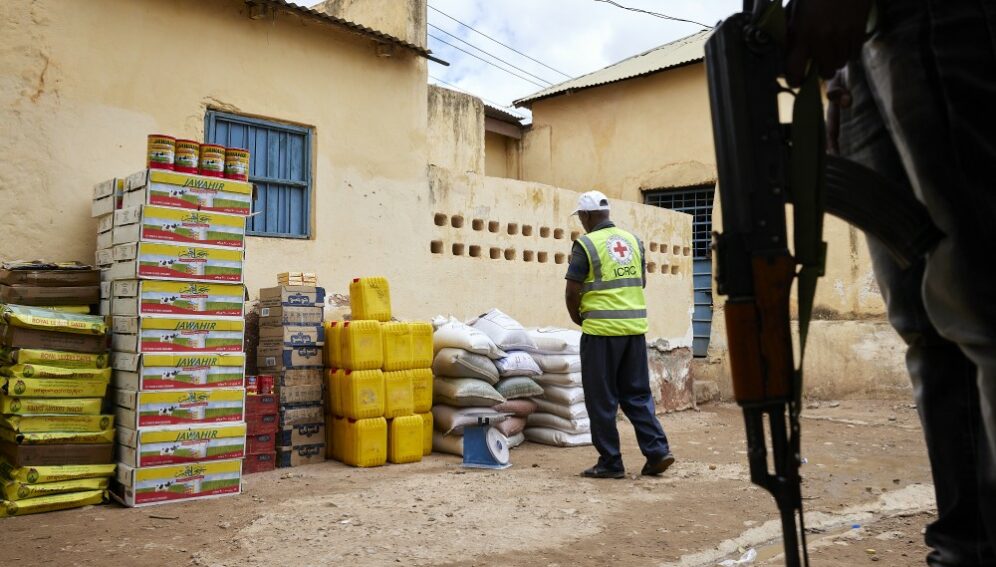
Red Cross teams at the border areas in Egypt, Chad and Ethiopia provide basic health services to the displaced people

Red Cross teams at the border areas in Egypt, Chad and Ethiopia provide basic health services to the displaced people. Copyright: ICRC

Science.dev

Speed read

  • Hundreds killed, thousands wounded in Sudan fighting
  • Thirteen hospitals bombed, 19 forcibly evacuated
  • Damage to health system could be felt for decades – WHO

By: Mouttasem Albarodi

Sudan’s health system is disintegrating under the weight of the fighting raging in the country since mid-April, doctors and health officials warn, with the damage expected to last for decades.

Health and relief institutions say the conflict threatens to become a humanitarian catastrophe as tens of thousands flee for safety to neighbouring South Sudan, Chad, Egypt and Ethiopia amid intense fighting between the army and militia.

Services have ceased in more than 70 per cent of hospitals in areas hit by the clashes in a number of Sudanese states, Sudan’s doctors’ syndicate said Tuesday (25 April). In total, 13 of the hospitals were bombed, while 19 others forcibly evacuated.

“We are in a state of total collapse,” said Atiya Abdullah Atiya, a key member of the syndicate, in a phone call to SciDev.Net.

“Our drug stocks are depleted, health institutions have been destroyed, and our medical teams have been killed in battle.”

The shortage of staff and medical supplies and constant power outages threaten to shut down the remaining functioning hospitals, while the number of victims of the ongoing clashes continues to rise, according to Atiya.

Fighting erupted on 15 April in the capital Khartoum between the army and a paramilitary group known as the Rapid Support Forces. A fragile US-brokered ceasefire which came into effect Tuesday was due to end later today (Thursday), with negotiations ongoing.

Tiếp tục đọc “Sudan conflict leaves health system in ‘total collapse’”

Why Sudan’s conflict matters to the rest of the world

By The Associated Press April 21, 2023

Fighting in Sudan between forces loyal to two top generals has put that nation at risk of collapse and could have consequences far beyond its borders.

Both sides have tens of thousands of fighters, foreign backers, mineral riches and other resources that could insulate them from sanctions. It’s a recipe for the kind of prolonged conflict that has devastated other countries in the Middle East and Africa, from Lebanon and Syria to Libya and Ethiopia.

RELATED COVERAGE

The fighting, which began as Sudan attempted to transition to democracy, already has killed hundreds of people and left millions trapped in urban areas, sheltering from gunfire, explosions and looters.

A look at what is happening and the impact it could have outside Sudan.

WHO IS FIGHTING?

Gen. Abdel Fattah Burhan, head of the armed forces, and Gen. Mohammed Hamdan Dagalo, the leader of a paramilitary group known as the Rapid Support Forces that grew out of Darfur’s notorious Janjaweed militias, are each seeking to seize control of Sudan. It comes two years after they jointly carried out a military coup and derailed a transition to democracy that had begun after protesters in 2019 helped force the ouster of longtime autocrat Omar al-Bashir. In recent months, negotiations were underway for a return to the democratic transition.

Tiếp tục đọc “Why Sudan’s conflict matters to the rest of the world”

‘Is this justice?’: why Sudan is facing a multibillion-dollar bill for 9/11 – podcast

The families of some 9/11 victims are still pursuing compensation from those complicit in the attacks – but is Sudan, already ravaged by years of US sanctions, really the right target?

the guardian – Mon 12 Sep 2022 05.00 BST

Written and read by Nesrine Malik, produced by Jessica Beck and Cheyanne Bryan. The executive producer was Danielle Stephens

This article was originally published in August 2021.

Archive: The Guardian, ITV news

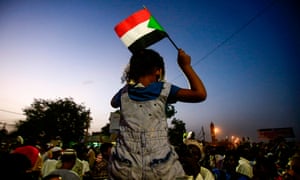
A Sudanese child waves a national flag as she sits atop the shoulders of a man during a late demonstration demanding a civilian body to lead the transition to democracy, outside the army headquarters in the Sudanese capital Khartoum on April 12, 2019. - Sudanese protestors vowed on April 12 to chase out the country's new military rulers, as the army offered talks on forming a civilian government after it ousted president Omar al-Bashir. (Photo by ASHRAF SHAZLY / AFP)ASHRAF SHAZLY/AFP/Getty Images
 Photograph: Ashraf Shazly/AFP/Getty Images

Tiếp tục đọc “‘Is this justice?’: why Sudan is facing a multibillion-dollar bill for 9/11 – podcast”

U.S. Push to Halt Genocide in South Sudan Unravels at United Nations

U.S. Push to Halt Genocide in South Sudan Unravels at United Nations

Faced with a dire U.N. warning of a possible genocide in South Sudan, the United States was set this week to finally embrace an arms embargo against the world’s newest country to ratchet down the military might of its warring parties and, potentially, help spare the lives of hundreds of thousands of civilians caught in the crossfire of worsening civil war. Tiếp tục đọc “U.S. Push to Halt Genocide in South Sudan Unravels at United Nations”