Trump’s Top Diplomat Would Bring Complex History With China From Exxon Days

Bloomberg

December 14, 2016, 12:00 PM EST December 14, 2016, 7:15 PM EST
  • Tillerson also has years of expertise dealing with China
  • Exxon has operated with Vietnam in disputed South China Sea

https://www.bloomberg.com/api/embed/iframe?id=815f976b-7392-42db-816e-6b8b165a38fd
Can’t Imagine Tillerson Being in Putin’s Pocket: Nye

President-elect Donald Trump’s pick for top U.S. diplomat comes with Chinese geopolitical entanglements. In his favor is years of dealing with some of the country’s biggest oil companies.

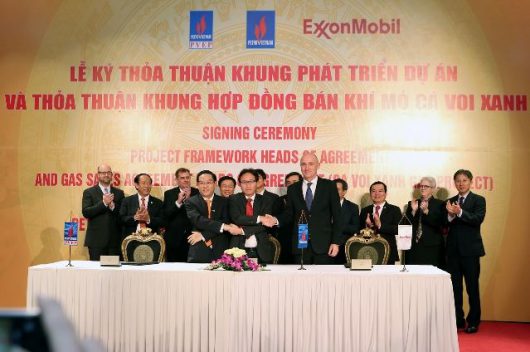
As chief executive officer of Exxon Mobil Corp. since 2006, Rex Tillerson has seen his company snared in territorial disputes in the South China Sea. An exploration venture with Vietnam has brought it into the cross hairs of China, one of the countries claiming the disputed waters. Tiếp tục đọc “Trump’s Top Diplomat Would Bring Complex History With China From Exxon Days”

Thayer background briefing: Vietnam – Exxon Mobil sign Agreements to Develop Vietnam’s Largest Gas Project


Background Briefing:
Vietnam: Exxon Mobil Signs
Agreements to Develop

Vietnam’s Largest Gas Project
Carlyle A. Thayer
January 16, 2017
[client name deleted]

Could you please provide some background and an assessment of reports that
ExxonMobile signed an agreement with PetroVietnam last week during the visit of
Secretary of State John Kerry to Vietnam. What is the significance of this deal? Tiếp tục đọc “Thayer background briefing: Vietnam – Exxon Mobil sign Agreements to Develop Vietnam’s Largest Gas Project”

Peak oil in the South China Sea (part 2)

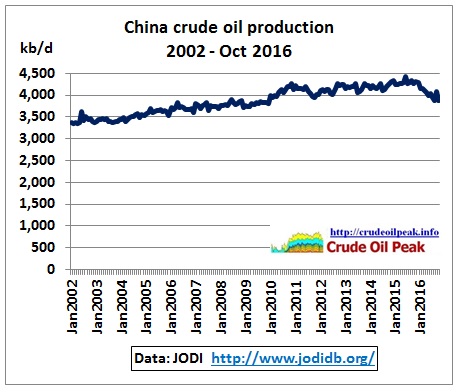
China’s crude oil production has apparently peaked and is back to where it was at the beginning of 2010.

Fig 1: China’s crude oil production http://www.jodidb.org/

Tiếp tục đọc “Peak oil in the South China Sea (part 2)”

Peak oil in the South China Sea (part 1)

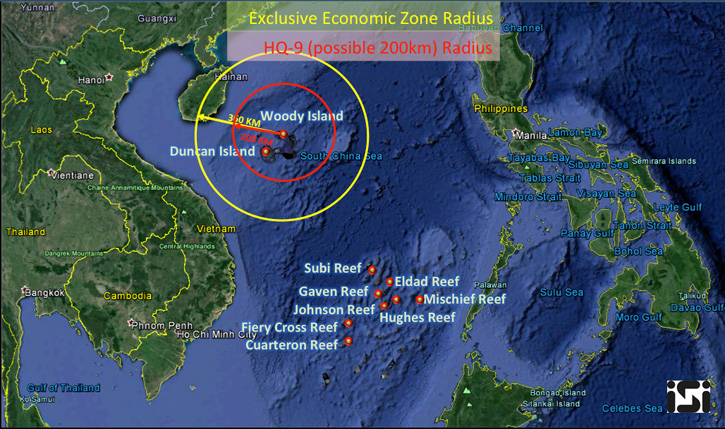
The recent deployment of missile launchers and jet fighters on Woody Island of the Paracel islands have put the spotlight on the South China Sea (SCS).

Fig 1: The 200 mile Economic Exclusion Zone claimed by China around Woody Island and the overlapping 108 nm range of the HQ-9 SAM system. Image via ISI. [Image Sat International]   http://defense-update.com/20160218_woody_island_hq9.html

In this post, we focus on oil production around the SCS. Tiếp tục đọc “Peak oil in the South China Sea (part 1)”

Global power sector emissions to peak in 2026: Report

Last update 12:01 | 16/06/2017

Global emissions of greenhouse gases from the power sector are expected to peak in 2026, but will still be some way above levels needed to limit temperature rises in line with the Paris climate agreement, research showed on Thursday.

Global emissions of greenhouse gases, power sector, electric vehicles
FILE PHOTO: Steam and other emissions are seen coming from a power station in Wollongong, south of Sydney, Australia, November 17, 2009.

Overall, $10.2 trillion will be invested in new global power generation between 2017 and 2040, with renewable power sources such as wind and solar accounting for almost three quarters of that, a report by Bloomberg New Energy Finance (BNEF) said.

By 2040, global emissions are expected to be 4 percent below 2016’s levels, but an additional $5.3 trillion investment in renewable power would be needed by 2040 to keep rising global temperatures below 2 degrees Celsius (3.6 degrees Fahrenheit). Tiếp tục đọc “Global power sector emissions to peak in 2026: Report”

Global demand for coal falls in 2016 for second year in a row

UK leads trend away from coal, with use down 52.5%, while China continues to consume less of the dirtiest fossil fuel

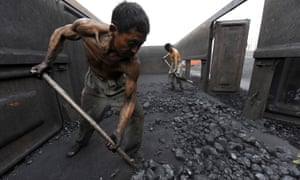
Workers shovel coal at a storage depot in Hefei, China
Workers shovel coal at a storage depot in Hefei, China, where consumption fell for the third year in a row in 2016. Photograph: Jianan Yu/Reuters

Global demand for coal has fallen for the second consecutive year, according to a BP study, helped by the US and China burning less of the dirtiest fossil fuel.

The UK was described as the “most extreme example” of the trend away from coal, which has resulted in use of the fuel returning to levels not seen since the start of the industrial revolution.

The 1.7% fall in worldwide consumption in 2016 marks a striking reversal of fortune for coal, which was the largest source of energy demand growth until four years ago, BP said.

https://interactive.guim.co.uk/charts/embed/jun/2017-06-13T14:16:10/embed.html

Presenting the 66th edition of BP’s annual statistical review of energy, the oil company’s chief economist, Spencer Dale, said: “It feels to me like we’re seeing a decisive break with coal, relative to the past. I think the big story here is coal getting squeezed.”

In the US, coal has been crowded out in power generation by cheaper, cleaner gas from the fracking boom and even US coal executives believe Donald Trump’s promise to bring back jobs in the industry cannot succeed. Tiếp tục đọc “Global demand for coal falls in 2016 for second year in a row”

E5 bio-fuel to replace RON 92

vietnamnews

Update: June, 12/2017 – 09:00

People have their motorbikes fuelled at a petrol station on Trần Quang Khải Street, Hà Nội. — VNS Photo Thái Hà

HÀ NỘI — Việt Nam will replace RON 92 petrol with E5 bio-fuel from the beginning of next year.

Accordingly, the supply of RON 92 petrol will be halted in all localities across the country. This was announced by the Government Office following the latest decision passed by Deputy Prime Minister Trịnh Đình Dũng concerning the bio-fuel development project and the roadmap for shifting to bio-fuel mixed with fossil fuels. Tiếp tục đọc “E5 bio-fuel to replace RON 92”

Kiến nghị của các tổ chức xã hội dân sự Việt Nam về Chiến lược Năng lượng của AIIB – Ngân hàng Đầu tư Cơ Sở hạ tầng Châu Á

Hà Nội, Ngày 07 tháng 06 năm 2017

Kính gửi các thành viên Hội đồng quản trị Ngân hàng Đầu tư Cơ Sở hạ tầng Châu Á (AIIB),

Chúng tôi, những tổ chức xã hội dân sự hoạt động vì sự phát triển bền vững ở Việt Nam, trân trọng gửi tới quý vị mối quan tâm và kiến nghị về một số điểm liên quan tới Chiến lược Năng lượng của AIIB được đưa ra trong Bản thảo gần đây.

Trước hết, chúng tôi đánh giá rất cao hoạt động tham vấn của AIIB nhằm thông báo và lấy ý kiến của các bên liên quan về việc xây dựng Chiến lược Năng lượng của Ngân hàng.  Đồng thời, chúng tôi cũng rất ủng hộ mục tiêu mà Chiến lược đưa ra:

“Chiến lược được xây dựng dựa trên các nguyên tắc cơ bản của sáng kiến Năng lượng Bền vững cho Tất cả mọi người (SE4ALL), Chương trình Nghị sự 2030 vì sự phát triển bền vững, và Hiệp đinh Paris (Hộp 1). Chiến lược này đưa ra khung hỗ trợ của Ngân hàng đối với các quốc gia đối tác: (i) phát triển và nâng cấp cơ sở hạ tầng năng lượng đồng thời hỗ trợ các quốc gia chuyển dịch sang cơ cấu năng lượng giảm phát thải các bon; và (ii) đạt được các mục tiêu và cam kết trong các sáng kiến toàn cầu.”[1]

Tiếp tục đọc “Kiến nghị của các tổ chức xã hội dân sự Việt Nam về Chiến lược Năng lượng của AIIB – Ngân hàng Đầu tư Cơ Sở hạ tầng Châu Á”

Ngừng bán xăng khoáng RON 92 từ đầu năm 2018

VE – Thứ năm, 8/6/2017 | 14:37 GMT+7

Doanh nghiệp sẽ chỉ bán 2 loại xăng là xăng khoáng RON 95 và xăng sinh học E5 RON 92 từ 1/1 năm sau.

Văn phòng Chính phủ vừa có thông báo kết luận của Phó thủ tướng Trịnh Đình Dũng tại cuộc họp về việc thực hiện Đề án phát triển nhiên liệu sinh học và lộ trình áp dụng tỷ lệ phối trộn nhiên liệu sinh học với nhiên liệu truyền thống.

ngung-ban-xang-khoang-ron-92-tu-dau-nam-2018

Từ đầu năm 2018 sẽ chỉ bán xăng E5 và RON 95 trên thị trường. Ảnh: Ngọc Thành

Tiếp tục đọc “Ngừng bán xăng khoáng RON 92 từ đầu năm 2018”

Renewables 2017 Global Status Report 

Renewables 2017 Global Status Report 
Launched today  – 7 June

Another Record Breaking Year for Renewable Energy:  More renewable energy capacity for less money

Additions in installed renewable power capacity set new records in 2016, with 161 gigawatts (GW) installed, increasing total global capacity by almost 9% over 2015, to nearly 2,017 GW. Solar PV accounted for around 47% of the capacity added, followed by wind power at 34% and hydropower at 15.5%.

Renewables are becoming the least cost option. Recent deals in Denmark, Egypt, India, Mexico, Peru and the United Arab Emirates saw renewable electricity being delivered at USD 0.05 per kilowatt-hour or less. This is well below equivalent costs for fossil fuel and nuclear generating capacity in each of these countries. Winners of two recent auctions for offshore wind in Germany have done so relying only on the wholesale price of power without the need for government support, demonstrating that renewables can be the least cost option.
Tiếp tục đọc “Renewables 2017 Global Status Report “

Why is it important to use renewablwe energy?

renewableenergysources

WHY IS IT IMPORTANT TO USE RENEWABLE ENERGY?

Fossil-based fuels (oil, coal, and natural gas) currently provide about 85% of all the energy use both in US and worldwide. We all know that these resources are being constantly depleted and can’t be replaced within any practical time span. People often wonder how long exactly would they last? The remaining amount of a particular resource is often characterized by so-called Reserves-to-Production ratio (R/P). In plain language, R/P basically gives us the length of time the reserves would last if their usage continue at the current rate. Here are estimated world total R/P ratios for the main conventional fuels: oil – 46 years, natural gas – 58 years, coal – 118 years. Of course, the usage is constantly changing and once in a while new deposits are found. That’s why the above numbers are corrected every year. Tiếp tục đọc “Why is it important to use renewablwe energy?”

Lazard’s Levelized Cost of Energy Analysis – December 2016

Summary Considerations

Lazard has conducted this study comparing the levelized cost of energy for various conventional and Alternative Energy generation technologies in order to understand which Alternative Energy generation technologies may be cost – competitive with conventional generation technologies, either now or in the future, and under various operating assumptions, as well as to understand which technologies are best suited for various applications based on locational requirements, dispatch characteristics and other factors. We find that Alternative Energy technologies are complementary to conventional generation
technologies, and believe that their use will be increasingly prevalent for a variety of reasons, including RPS requirements, carbon regulations, continually improving economics as underlying technologies improve and production volumes increase, and government subsidies in certain regions.

In this study, Lazard’s approach was to determine the levelized cost of energy, on a $/MWh basis, that would provide an after – tax IRR to equity holders equal to an assumed cost of equity capital. Certain assumptions (e.g., required debt and equity returns, capital structure, etc.) were identical for all technologies, in order to isolate the effects of key differentiated inputs such as investment costs, capacity factors, operating costs, fuel costs (where relevant) and other important metrics on the levelized cost of energy. These inputs were originally developed with a leading consulting and engineering firm to the Power & Energy Industry, augmented with Lazard’s commercial knowledge where relevant. This study (as well as previous versions) has benefited from additional input from a wide variety of industry participants.

Lazard has not manipulated capital costs or capital structure for various technologies, as the goal of the study was to compare the current state of various generation technologies, rather than the benefits of financial engineering. The results contained in this study would be altered by different assumptions regarding capital structure (e.g., increased use of leverage) or capital costs (e.g., a willingness to accept lower returns than those assumed herein).

Key sensitivities examined included fuel costs and tax subsidies. Other factors would also have a potentially significant effect on the results contained herein, but have not been examined in the scope of this current analysis. These additional factors, among others, could include: capacity value vs. energy value; stranded costs related to distributed generation or otherwise; network upgrade, transmission or congestion costs; integration costs; and costs of complying with various environmental
regulations (e.g., carbon emissions offsets, emissions control systems).

The analysis also does not address potential social and environmental externalities, including, for example, the social costs and rate consequences for those who cannot afford distribution generation solutions, as well as the long-term residual and societal consequences of various conventional
generation technologies that are difficult to measure (e.g., nuclear waste disposal, environmental impacts, etc.).

Download: L A Z A R D ‘ S L E V E L I Z E D C O S T O F E N E R G Y A N A L Y S I S

Hydro vs. Wind vs. Solar Power?

Linkedin

 Introduction

Electricity is energy produced by behavior of electrons and protons. Electrical energy or power is not actually or potentially supplied by nature; it has to be produced or generated by various secondary means, converting one form of energy into another. In the modern world, there is an unending need for energy to power electrical appliances, such as fans, lights, communication infrastructures, machines and computing systems, and other devices operated by electrical energy. Nowadays, power can be generated from several renewable and non-renewable energy sources, including fossil fuels, nuclear, geothermal, solar, wind, hydro, wood, biomass, and more.

Tiếp tục đọc “Hydro vs. Wind vs. Solar Power?”

Low Costs of Solar Power & Wind Power Crush Coal, Crush Nuclear, & Beat Natural Gas

Cleantechnica

December 25th, 2016 by

 We already published a great article from Nexus Media regarding Lazard’s new report showing the extremely low (and falling) costs of solar power and wind power. However, I’ve been wanting to highlight these awesome new findings since Larmion shared the updated report with us earlier this month, and I want to break out the amazing news in 5 specific ways.

Tiếp tục đọc “Low Costs of Solar Power & Wind Power Crush Coal, Crush Nuclear, & Beat Natural Gas”

Khánh Hòa: Investors interested in solar power projects

vietnamnews

Update: June, 02/2017 – 18:41

Solar energy projects in Khánh Hòa Province are attracting investors’ interest. — Photo evn.com.vn
Viet Nam News KHÁNH HÒA – Investors have shown interest in the solar energy sector in the central coastal province of Khánh Hòa, with some 10 solar projects applying for investment licences in the province.

Three projects in the field have been approved, according to the provincial Department of Planning and Investment.

One is a 70ha plant in Cam Thịnh Đông Commune, Cam Ranh City, with capacity of 60MW. It is invested by the Sông Giang Hydropower SJC at a total cost of more than VNĐ2 trillion (US$88 million). Tiếp tục đọc “Khánh Hòa: Investors interested in solar power projects”