The Countries Buying Fossil Fuels from Russia in 2023

visualcapitalist.com

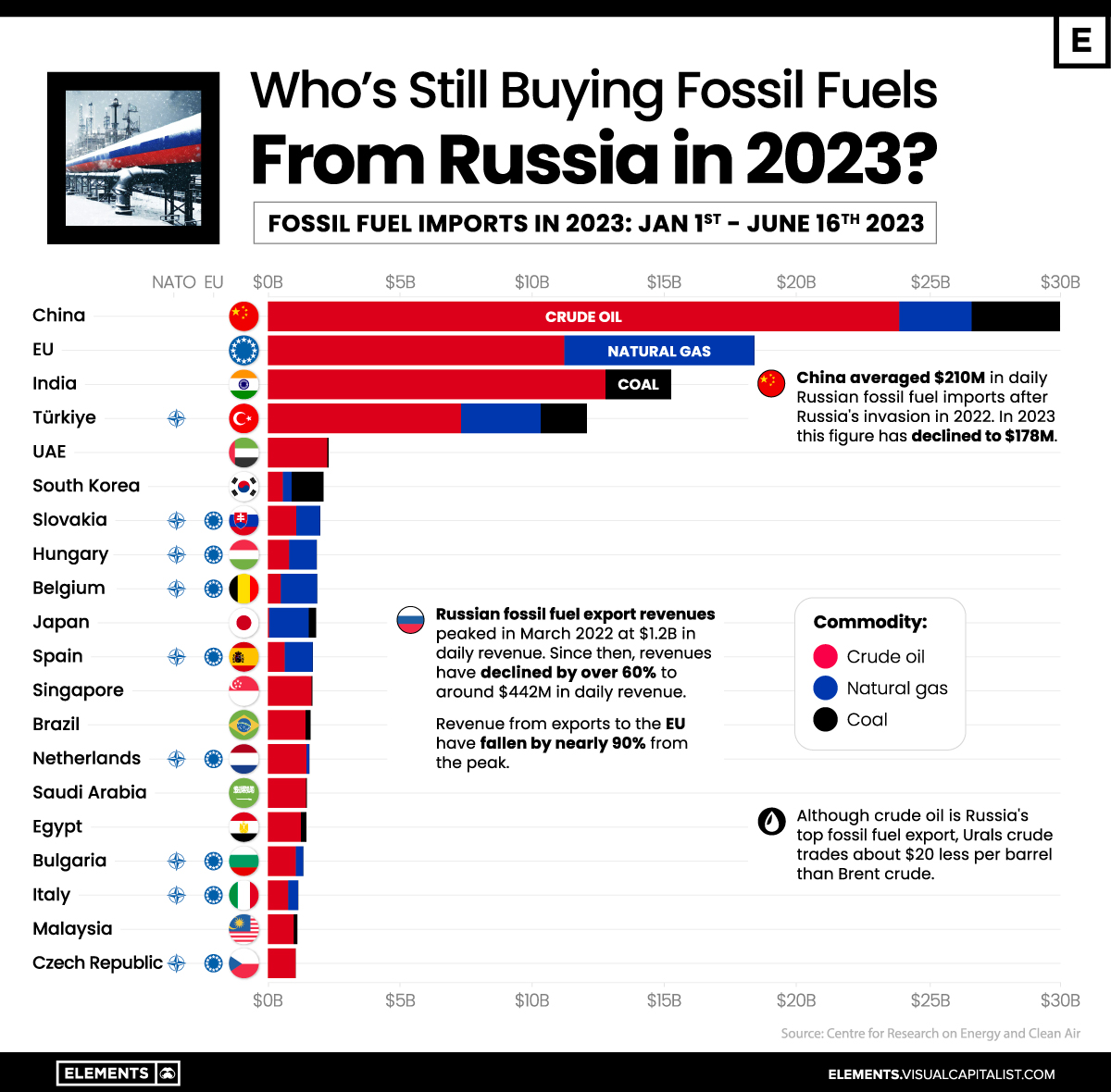
While Russia’s revenues from fossil fuel exports have declined significantly since their peak in March of 2022, many countries are still importing millions of dollars a day worth of fossil fuels from Russia.

Revenue from fossil fuels exported to the EU has declined more than 90% from their peak, but in 2023 the bloc has still imported more than $18 billion of crude oil and natural gas so far.

This graphic uses data from the Centre for Research on Energy and Clean Air (CREA) to visualize the top-importing countries of fossil fuels from Russia so far this year.

China Remains Russia’s Top Fossil Fuel Importer

China continues to be Russia’s top buyer of fossil fuels, with imports reaching $30 billion in 2023 up until June 16, 2023.

With nearly 80% of China’s fuel imports being crude oil, Russia’s average daily revenues from Chinese fossil fuel imports have declined from $210 million in 2022 to $178 million in 2023 largely due to the falling price of Russian crude oil.

Following China are EU nations collectively, which despite no longer importing coal from Russia since August of 2022, still imported $18.4 billion of fossil fuels in a 60/40 split of crude oil and natural gas respectively.

CountryRussian Fossil Fuel Imports* (Total)Crude OilNatural GasCoal
🇨🇳 China$30B$23.9B$2.7B$3.3B
🇪🇺 EU$18.4B$11.2B$7.2B$0
🇮🇳 India$15.2B$12.8B$0$2.5B
🇹🇷 Türkiye$12.1B$7.3B$3B$1.7B
🇦🇪 UAE$2.3B$2.3B$0$0
🇰🇷 South Korea$2.1B$0.6B$0.3B$1.2B
🇸🇰 Slovakia$2.0B$1.1B$0.9B$0
🇭🇺 Hungary$1.9B$0.8B$1.1B$0
🇧🇪 Belgium$1.9B$0.5B$1.4B$0
🇯🇵 Japan$1.8B$0$1.5B$0.3B
🇪🇸 Spain$1.7B$0.6B$1.1B$0
🇸🇬 Singapore$1.7B$1.7B$0$0
🇧🇷 Brazil$1.6B$1.4B$0$0.2B
🇳🇱 Netherlands$1.6B$1.5B$0.1B$0
🇸🇦 Saudi Arabia$1.5B$1.4B$0$0
🇪🇬 Egypt$1.4B$1.3B$0$0.2B
🇧🇬 Bulgaria$1.3B$1.1B$0.3B$0
🇮🇹 Italy$1.2B$0.8B$0.4B$0
🇲🇾 Malaysia$1.1B$1.0B$0$0.1B
🇨🇿 Czech Republic$1.0B$1.1B$0$0

*Over the time period of Jan 1, 2023 to June 16, 2023 in U.S. dollars

After China and the EU bloc, India is the next-largest importer of Russian fossil fuels, having ramped up the amount of fossil fuels imported by more than 10x since before Russia’s invasion of Ukraine, largely due to discounted Russian oil.

Türkiye is the only other nation to have imported more than $10 billion worth of Russian fossil fuels in 2023, with every other country having imported fewer than $3 billion worth of fuels from Russia this year.

Navigating the Crude Reality of Oil Exports

Although crude oil is Russia’s chief fossil fuel export, the nation’s Urals crude traded at a $20 per barrel discount to Brent crude throughout most of 2023. While this discount has narrowed to around $16 following Russia’s announcement of further oil export cuts of 500,000 bpd (barrels per day), the price of Urals crude oil remains just 40 cents below the $60 price cap put in place by G7 and EU nations.

Tiếp tục đọc “The Countries Buying Fossil Fuels from Russia in 2023”

Is Australia quietly quitting the LNG business?

oxfordenergy.org

One of the major investors in Australian LNG, INPEX, has recently suggested that the country is quietly quitting the LNG business. This is in the context of increasing government regulation, including the possibility of gas intended for LNG projects being diverted into the domestic market. The federal government has responded by reassuring major buyers that Australia will continue to be a reliable LNG supplier.

However, there are a number of fundamental challenges for the government in living up to its promise. First, Australian gas reserves are not being replaced, with some important legacy gas fields reaching the end of their lives. This includes both LNG and domestic gas fields. This leads to the possibility that shortfalls in the domestic market will have to be met by diversions from LNG projects that also face gas supply challenges. Second, the LNG projects are significant CO2 emitters and many Australian gas fields, including those with the potential to backfill LNG, contain significant volumes of CO2. The new federal government has adopted more ambitious emissions reduction targets. Third, coal-fired generation is being closed faster than it can be replaced with renewables, increasing demand for gas in key periods such as winter and pushing up gas prices.

Tiếp tục đọc “Is Australia quietly quitting the LNG business?”

Dầu Nga lách cấm vận ra sao? – 3 kỳ

Dầu Nga lách cấm vận ra sao? – Kỳ 1: Lách qua ‘khe cửa’ của châu Âu

TT – 20/04/2023 13:38 GMT+7 – BẢO ANH

Sau khi bị Liên minh châu Âu (EU) cấm cửa, dầu mỏ Nga tìm đến những khách hàng khác. Song bằng một cách nào đó, dầu mỏ Nga vẫn lách qua được khe cửa của châu Âu.

Tàu chở dầu Yang Mei Hu (Trung Quốc) đang đậu tại trạm dầu thô ở thành phố Nakhodka, Nga vào tháng 6-2022 – Ảnh: Reuters

Trong báo cáo hằng tháng vừa công bố hồi giữa tháng 4, Cơ quan Năng lượng quốc tế (IEA) cho biết hoạt động xuất khẩu dầu thô và các sản phẩm dầu mỏ của Nga đã tăng trong tháng 3-2023 lên mức cao nhất kể từ tháng 4-2020, cụ thể đã tăng thêm 600.000 thùng mỗi ngày, lên tổng cộng 8,1 triệu thùng/ngày. Sự gia tăng này đã nâng doanh thu ước tính của Nga từ xuất khẩu dầu mỏ lên 12,7 tỉ USD vào tháng 3-2023.

Giới quan sát cho rằng trong bối cảnh các nước phương Tây áp dụng những biện pháp trừng phạt nhằm vào dầu mỏ Nga vì cuộc xung đột Nga – Ukraine, lẽ ra lượng dầu Nga xuất khẩu sẽ giảm đi. Vậy rốt cuộc lượng dầu xuất khẩu tăng đáng kể như trên đã cập bến nơi nào?

Tiếp tục đọc “Dầu Nga lách cấm vận ra sao? – 3 kỳ”

ASEAN Taxonomy for Sustainable Finance – Version 2

asean.org

ASEAN FINANCE SECTORAL BODIES RELEASE ASEAN TAXONOMY FOR SUSTAINABLE FINANCE
VERSION 2
The ASEAN Taxonomy Board (ATB), representing ASEAN finance sectoral bodies, today took the next
step towards meeting the Paris Agreement commitments, with the release of the ASEAN Taxonomy
for Sustainable Finance Version 2 (Version 2). While the first version laid out the broad framework of
the ASEAN Taxonomy, Version 2 consists of the (a) complete Foundation Framework comprising
detailed methodologies for assessing economic activities; and (b) Technical Screening Criteria (TSC)
for the first focus sector ie Electricity, Gas, Steam and Air Conditioning Supply sector (Energy sector)
under the Plus Standard. TSCs for other focus sectors will be published in the subsequent versions of
the ASEAN Taxonomy. Version 2 builds on the conceptual thinking of the multi-tiered framework
outlined in Version 1. The multi-tiered framework is intended to facilitate transition of ASEAN Member
States (AMS) recognising the diversity in economic development, financial sector, and infrastructure
maturity.
Through the Foundation Framework which adopts a principles-based approach, users are now able to
qualitatively assess economic activities using guiding questions, decision trees and use cases for all
the four environmental objectives(EOs) and three essential criteria (EC). The environmental objectives
and essential criteria, as well as guiding questions that make up the Foundation Framework are
designed to be readily applicable to all AMS as well as stakeholders in the financial sector and business
enterprises. Using the guiding questions, activities are classified as Green, Amber or Red.
The Plus Standard adopts a more advanced assessment and methodology that is based on specific TSC
and science-based thresholds in classifying activities. To further encourage and recognise transition
efforts by businesses, the Plus Standard contains Amber Tier 2 and Amber Tier 3 classifications which
will be retired over time. This is in addition to the Green tier that is aligned with other relevant
international taxonomies and benchmarked to the 1.50C Paris Agreement target.
.
Version 2 also highlights the importance of social aspects in the Taxonomy, by incorporating it as the
ASEAN Taxonomy’s third EC, alongside “Do No Significant Harm” (DNSH) and “Remedial Measures to
Transition” (RMT). In combination with other features such as the expansion of the “Do No Significant
Harm” criteria, common building blocks are established to enable an orderly and just transition and
foster sustainable finance adoption by ASEAN countries.
In considering ASEAN’s specific circumstances, the Taxonomy recognises efforts to the early
retirement of coal-fired power plants. A global first for a regional taxonomy, the ATB has thoroughly
considered how and where coal phase-outs (CPOs) can play a role in decarbonisation in support of the
Paris Agreement goals and when approached correctly, provides a powerful tool for transition.

The ASEAN Taxonomy Version 2 can be found at the following websites: • Association of Southeast Asian Nations – https://asean.org/wpcontent/uploads/2023/03/ASEAN-Taxonomy-Version-2.pdf

Saudi Arabia và Iran: Bán anh em xa…

SÁNG ÁNH 25/03/2023 13:32 GMT+7

TTCTSaudi Arabia làm lành với Iran mở ra hy vọng về một Trung Đông bớt đi những tang thương bom đạn.

4 h sáng 14-9-2019, quân Houthi (thân Iran) từ Yemen bắn qua Saudi 25 máy bay không người lái, có lẽ giá thành là 15.000 USD một chiếc, tức tổng trị giá 375.000 USD. 19 chiếc trúng đích là khu Nhà máy dầu Abqaiq-Khurais, làm tê liệt sản xuất trong hai tuần. 

Khu nhà máy này chiếm 1/2 sản xuất dầu của Saudi (mà dầu của Saudi thì chiếm 5% của thế giới) – khoảng 5,7 triệu thùng/ngày.

Cuộc tấn công khiến Saudi mất 365 triệu đô la một ngày với giá dầu lúc đó là 64 USD/thùng. Tuy dần dà cũng khắc phục được, thị trường chứng khoán Saudi mất ngay 40 tỉ USD. 

Tiếp tục đọc “Saudi Arabia và Iran: Bán anh em xa…”

Tái cơ cấu ngành Công thương: Loại bỏ bao cấp, độc quyền ngành năng lượng

Đề án tái cơ cấu ngành Công thương đến năm 2030 nêu rõ, kiên quyết loại bỏ bao cấp, độc quyền, thiếu minh bạch ngành năng lượng.

baogiaothong.vn

Phó Thủ tướng Chính phủ Trần Hồng Hà vừa ký Quyết định 165/QĐ-TTg phê duyệt Đề án tái cơ cấu ngành Công Thương giai đoạn đến năm 2030.

Mục tiêu tổng quát của Đề án là tái cơ cấu ngành Công thương nhằm thúc đẩy chuyển dịch cơ cấu nền kinh tế, nâng cao năng suất, chất lượng, giá trị gia tăng và năng lực cạnh tranh của ngành…

Với mục tiêu này, Bộ Công thương cũng được đề ra từng nhiệm vụ cụ thể, bao gồm: Tái cơ cấu ngành công nghiệp, tái cơ cấu ngành năng lượng, tái cơ cấu lĩnh vực xuất nhập khẩu, tái cơ cấu thị trường trong nước và hội nhập kinh tế quốc tế.

tái cơ cấu ngành công thương: loại bỏ bao cấp, độc quyền ngành năng lượng

Tiếp tục đọc “Tái cơ cấu ngành Công thương: Loại bỏ bao cấp, độc quyền ngành năng lượng”

Trợ cấp nhiên liệu đi ngược xu hướng phát triển bền vững

Song Hảo – Thứ Bảy, 10/09/2022

(KTSG) – Đức đã quyết định tăng thêm 40 tỉ euro (40 tỉ đô la) cho trợ cấp năng lượng để giúp người dân đỡ gánh nặng chi tiêu trong mùa đông khắc nghiệt sắp tới. Trong khi đó, Indonesia lại quyết định tăng giá nhiên liệu thêm 30% sau khi lo ngại ngân khố không kham nổi.

Hai chính sách có vẻ trái chiều của hai nền kinh tế lớn nhất EU và ASEAN buộc các nhà quan sát nhìn lại mặt trái của chính sách trợ cấp nhiên liệu. Liệu người nghèo có được bảo vệ tốt hơn trong các chính sách này và liệu các gói trợ cấp như vậy có đang song hành với trào lưu năng lượng sạch trên toàn cầu.

Tiếp tục đọc “Trợ cấp nhiên liệu đi ngược xu hướng phát triển bền vững”

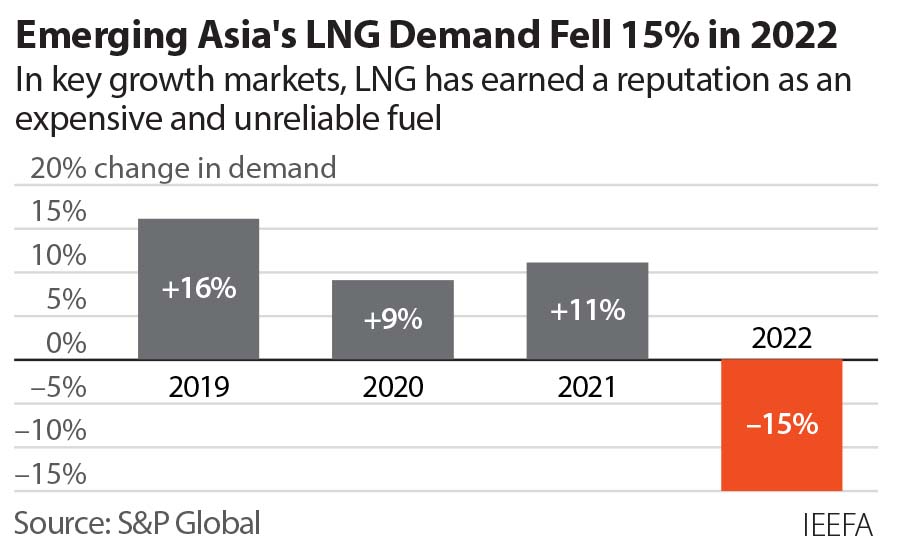
Turmoil in global LNG markets is curbing long-term demand growth

February 15, 2023, IEEFA


Key Takeaways:

Russia’s invasion of Ukraine upended global LNG markets last year—spurring Europe to buy record amounts of LNG, and pushing prices to their highest level ever

In Asia, LNG has earned a reputation as an expensive and unreliable fuel source, clouding future demand

The EU is taking aggressive steps to trim gas consumption, which could render new LNG import capacity unneeded

Although LNG markets may remain tight for several years, the global LNG market will see a wave of new projects coming online in 2025-27—potentially leading to a supply-demand mismatch and financial risks for LNG suppliers and traders

_________

Tiếp tục đọc “Turmoil in global LNG markets is curbing long-term demand growth”

Big Oil’s Big Lies: How the industry denied global warming – 2 parts

Big Oil’s Big Lies: How the industry denied global warming – Part 1 | People and Power

Big Oil’s Big Lies: How the industry denied global warming – Part 2 | People and Power

Al Jazeera English – 9-2-2023

More than 40 years ago, the world’s largest and most profitable oil companies began to understand the effects their products were having on our climate. Their own scientific research told them so – well before it became common knowledge.

But for the next four decades – time we could have better spent transitioning to greener forms of energy – they sought to discredit and downplay evidence of global warming and the calamities it would lead to; wildfires, rising sea levels, extreme storms and much else besides. Tiếp tục đọc “Big Oil’s Big Lies: How the industry denied global warming – 2 parts”

The Nord Stream gas pineline leaks the worst ever greenhouse gas event? Why it happened and what are the damages to the climate?

*Nord Stream is a network of natural gas pipelines run under the Baltic Sea from Russia to Germany

Nord Stream gas leaks may be biggest ever, with warning of ‘large climate risk’

theguardian.com

‘Colossal amount’ of leaked methane, twice initial estimates, is equivalent to third of Denmark’s annual CO2 emissions or 1.3m cars

gas leak bubbling to surface of Baltic Sea
Scientists estimate the leaks could release up to 400,000 tonnes of methane into the atmosphere. Photograph: Danish Defence/AFP/Getty

Seascape: the state of our oceans is supported by

Scientists fear methane erupting from the burst Nord Stream pipelines into the Baltic Sea could be one of the worst natural gas leaks ever and pose significant climate risks.

Neither of the two breached Nord Stream pipelines, which run between Russia and Germany, was operational, but both contained natural gas. This mostly consists of methane – a greenhouse gas that is the biggest cause of climate heating after carbon dioxide.

Tiếp tục đọc “The Nord Stream gas pineline leaks the worst ever greenhouse gas event? Why it happened and what are the damages to the climate?”

Hợp tác cấp vùng về thương mại điện năng

IUCN – 06 Th12, 2022

Trong lúc việc phát triển và mở rộng năng lượng mặt trời và gió sẽ là yếu tố quan trọng giúp Việt Nam giảm tiêu thụ than và đáp ứng yêu cầu trong lộ trình thực hiện các cam kết tại COP26, thì việc tăng cường nhập khẩu điện từ các nước láng giềng là một giải pháp bổ sung. Trong Kế hoạch Phát triển Điện lực 8 của Việt Nam (PDP 8) ban hành tháng 4 năm 2022 đã đưa ra dự đoán lượng điện nhập khẩu sẽ tăng từ 572 MW vào năm 2020 lên khoảng 4.000 MW vào năm 2025.

content hero image

Photo: A solar project invested by Trung Nam Group © Trung Nam Group

Tương lai thì nguồn điện nhập khẩu vào Việt Nam phần lớn sẽ đến từ CHDCND Lào và có thể từ Campuchia. Tuy nhiên, cách thức Việt Nam tham gia thương mại điện năng với các nước láng giềng này sẽ có ảnh hưởng trực tiếp đến việc phát triển các dự án phát điện ở các quốc gia này. Phần lớn nguồn điện năng mà Việt Nam nhập khẩu từ CHDCND Lào đến từ các đập thủy điện và các đập này có thể có tác động tiêu cực đáng kể cho Việt Nam.

Tiếp tục đọc “Hợp tác cấp vùng về thương mại điện năng”

Political declaration on establishing the Just Energy Transition Partnership with Viet Nam

GOV.UK

Published 14 December 2022

  1. The Governments of the Socialist Republic of Viet Nam, together with the International Partners Group, consisting of the European Union, the United Kingdom of Great Britain and Northern Ireland, the United States of America, Japan, the Federal Republic of Germany, the Republic of France, the Italian Republic, Canada, the Kingdom of Denmark and the Kingdom of Norway;
  2. Recognising the need to accelerate action towards the objectives and long-term goals of the United Nations Framework Convention on Climate Change (UNFCCC) and the Paris Agreement, including through the implementation of the Glasgow Climate Pact, to minimise the worst adverse impacts of climate change for countries, people and the environment;
  3. Noting that limiting global warming to 1.5°C to mitigate the worst adverse impacts of climate change requires rapid, deep and sustained reductions in global greenhouse gas emissions, including reducing global carbon dioxide emissions by 45% by 2030 relative to the 2010 level and to net zero around mid-century as well as deep reductions in other greenhouse gas emissions, emphasising climate change adaptation and achieving net zero emissions as an opportunity for sustainable development;
  4. Recognising that for Viet Nam, as an independent, sovereign and fast developing lower middle income country heavily affected by the impacts of climate change, it will be key to embrace the opportunities brought about by the fast decreasing cost of renewable energies as an opportunity for sustainable development and to tackle related challenges such as poverty, inequality and unemployment, which are exacerbated by the impact of the COVID-19 pandemic and climate change, and that vulnerable groups and some important economic sectors may be impacted by the energy transition, including thermal electricity generation, coal mining, heavy industry and transport;
  5. Recognising the need for new, predictable, long-term and sustainable support from partner countries, multilateral organisations and investors in finance, technology and capacity building for Viet Nam to exploit fully the opportunities of the transition in accordance with the national framework of public debt and external debt management to contribute significantly to the implementation of the NDC of Viet Nam, its commitment to reach to net zero greenhouse gas emissions by 2050 and its development orientation to become a high-income developed country by 2045;
  6. Tiếp tục đọc “Political declaration on establishing the Just Energy Transition Partnership with Viet Nam”

Analysis: Can Indonesia ditch coal and improve lives with new green deal?

reuters.com

By Michael Taylor

  • Summary
  • Indonesia secures $20 billion worth of pledges
  • Improving lives just as important as closing coal power plants
  • Training workforce for green energy is key to ‘just transition’

KUALA LUMPUR, Nov 18 (Thomson Reuters Foundation) – After clinching one of the largest-ever climate finance deals to shutter its coal-fired power plants early, Indonesia needs to work out how to make sure communities that will be impacted by the shift to renewable energy do not lose out, analysts said.

A coalition of rich nations pledged $20 billion of public and private finance to help Indonesia retire its coal power plants sooner than planned, the United States, Japan and other partners said this week

The Indonesia Just Energy Transition Partnership (JETP), which involves providing grants and concessional loans over a three- to five-year period linked to cuts in emissions from the power sector, is based on a similar deal made with South Africa last year.

Tommy Pratama, executive director of Indonesian policy think-tank Traction Energy Asia, said a “just transition” that benefits local communities is vital for the green deal’s success.

“The key decisions about how the funding is spent must be open and transparent with the full involvement of acknowledged experts, affected local communities and civil society groups,” said Pratama in an interview.

Tiếp tục đọc “Analysis: Can Indonesia ditch coal and improve lives with new green deal?”

EU and international partners launch ground-breaking partnership on just energy transition with Indonesia

ec.europe.eu

Today, the President of Indonesia, Joko Widodo, the President of the European Commission, Ursula von der Leyen , on behalf of the EU, and the leaders of the International Partners Group (IPG), which is jointly led by the United States and Japan and includes Canada, Denmark, France, Germany, Italy, Norway and the United Kingdom, launched a Just Energy Transition Partnership (JETP) with Indonesia . The launch takes place in connection with an event within the framework of the Partnership for Global Infrastructure and Investment (PGII) at the G20 summit, which takes place on 15-16 November 2022 in Bali.

In a joint statement , Indonesia and international partners have announced their commitment to meeting ground-breaking climate targets and related financing. This is done to support the Asian country in an ambitious and fair energy transition, which is in line with the goals of the Paris Agreement and which contributes to keeping the global warming limit of 1.5 °C within reach.

Tiếp tục đọc “EU and international partners launch ground-breaking partnership on just energy transition with Indonesia”

Gasoline vendors back in business on cities’ streets

VNE – By Ngoc Thanh, Thanh Tung, Hoai Thu   November 6, 2022 | 12:07 pm GMT+7

The sight of street-side hawkers of gasoline has returned to Hanoi and Ho Chi Minh City after several decades, as gas stations continue to report shortages.

Gasoline vendors back in business on cities' streets

A fuel station on Thuy Khue Road in Hanoi’s Tay Ho District has put up a sign that reads “waiting for inventory.” Residents have to look elsewhere to fuel their vehicles.

Gasoline vendors back in business on cities' streets

Near a fuel station on Yen Phu Road in the capital city, a man pours gasoline into containers to sell at VND25,000-30,000 ($1.01-1.21) per liter, 10-32% higher than retail prices at gas stations.

Tiếp tục đọc “Gasoline vendors back in business on cities’ streets”