13 March 2026, London: Military tensions in West Asia are beginning to disrupt maritime traffic through the Strait of Hormuz, raising serious concerns for global energy markets, fertilizer supplies and vulnerable economies. In a rapid assessment titled “Strait of Hormuz disruptions: Implications for global trade and development,” UN Trade and Development (UNCTAD) has highlighted the potential risks posed by interruptions in one of the world’s most critical trade corridors.
The Strait of Hormuz carries nearly one quarter of global seaborne oil trade, along with large volumes of liquefied natural gas and fertilizers. Any disruption in this narrow passage therefore has immediate consequences for global energy prices, maritime transport costs and agricultural input supply chains.
“Steady and pragmatic decarbonisation, rapid clean-energy expansion combined with cautious emission targets, continued coal use to protect energy security and industrial growth.”
China’s leadership has published a draft of its 15th five-year plan setting the strategic direction for the nation out to 2030, including support for clean energy and energy security.
The plan sets a target to cut China’s “carbon intensity” by 17% over the five years from 2026-30, but also changes the basis for calculating this key climate metric.
– Trong kỳ trước, Tạp chí Năng lượng Việt Nam đã có bài viết đề xuất việc rà soát toàn diện các yêu cầu của IAEA về phát triển nguồn nhân lực trong mối quan hệ chặt chẽ, mang tính tương hỗ với 18 vấn đề hạ tầng then chốt của chương trình điện hạt nhân quốc gia. Tiếp nối định hướng này, bài viết dưới đây tập trung phân tích vai trò và trách nhiệm của Chính phủ ở Giai đoạn 1 của chương trình điện hạt nhân, với trọng tâm là khởi động hạ tầng an toàn. Cách tiếp cận này phù hợp với khuyến nghị của IAEA. Theo đó, an toàn hạt nhân không phải là một lĩnh vực độc lập, mà là kết quả tổng hợp của chính sách, khuôn khổ pháp lý – thể chế, năng lực con người, trong đó vai trò định hướng và bảo đảm của Chính phủ ở Giai đoạn 1 có ý nghĩa quyết định.
As global supply chains pivot towards low-emissions production, Australia will need to lead, or risk being left behind. The country’s challenge is not a lack of technology, capital, or ambition. It’s a gap in policy architecture. Without bankable demand, Australia’s most promising clean commodity projects – green iron, sustainable aviation fuel, and clean ammonia – remain stuck at the starting line.
To meet that challenge, we propose a new demand-side policy model: the Clean Commodities Trading Initiative (CCTI) – a flagship example of green energy statecraft. At its heart is a new tool for national transformation: Clean Commodity Credits that reward innovation and emissions savings.
A market-friendly mechanism to kickstart large-scale clean production.
Green energy statecraft is a strategic approach to governance that uses the clean energy transition to simultaneously advance a nation’s economic, environmental, social, and geostrategic goals. Unlike conventional industry policy, which focuses on domestic market corrections, statecraft treats clean energy as key to national security and prosperity – used to build alliances, secure supply chains, boost productivity, and shape global rules.
The European Union, China, Japan, and South Korea are all pursuing variations of green energy statecraft. Australia must do the same – on its own terms, with tools suited to its advantages, institutions, and budget.
Châu Âu chìm trong khủng hoảng năng lượng. Các công ty châu Âu đang dần chuyển hướng sang Mỹ. Người Mỹ thì lợi dụng điều này để bán khí thiên nhiên hóa lỏng (LNG) cho châu Âu với giá cao.
Không còn lựa chọn nào khác, châu Âu đang bắt đầu xây dựng các bến cảng lớn để tiếp nhận hàng từ Mỹ. Thế nhưng, sau đó, Mỹ tuyên bố đình chỉ các dự án LNG và sẽ không cung cấp cho châu Âu trong những năm tới.
Tổng thống Mỹ Joe Biden ngày 26/1 công bố lệnh tạm dừng xây dựng các kho cảng xuất khẩu LNG mới. Theo dữ liệu do tổ chức quốc tế Cedigaz công bố, trong năm 2023, Mỹ là nước xuất khẩu LNG hàng đầu thế giới. Theo Nhà Trắng, khoảng một nửa lượng xuất khẩu LNG vào năm 2023 được xuất khẩu sang châu Âu, do lục địa này đã chấm dứt việc nhập khẩu khí đốt của Nga kể từ khi nổ ra cuộc xung đột tại Ukraine.
South Africa’s state power company Eskom is battling a legacy of neglect, mismanagement and state capture as it struggles to bring an end to rolling blackouts that have severely damaged businesses and the economy
(KTSG) – “Rủi ro đáng lo ngại nhất khi nó không rõ ràng và không đáng lo khi nó quá rõ ràng”
James Grant
Từ nhiều năm nay, dầu được coi là loại tài sản mang tính kinh tế vĩ mô và quan trọng từ góc nhìn địa chính trị. Nó thường bị ảnh hưởng bởi chiến tranh, chính sách tiền tệ và sức khỏe của nền kinh tế. Khí đốt thì thường bị ảnh hưởng nhiều bởi những biến động trong một khu vực nhất định vì vận chuyển khí đốt thường phức tạp hơn là vận chuyển dầu. Nhưng với chuỗi cung ứng hiện tại, khí đốt cũng bắt đầu bị ảnh hưởng bởi các sự kiện toàn cầu.
(Dân trí) – Thiếu điện trong giai đoạn từ ngắn hạn đến dài hạn (từ 2024 đến 2050) là nguy cơ hiện hữu. Trong 6 chỉ tiêu đảm bảo an ninh năng lượng quốc gia, có 3 chỉ tiêu biến động theo chiều hướng bất lợi.
Nhận định này được Đoàn giám sát của Ủy ban Thường vụ Quốc hội đưa ra trong báo cáo giám sát chuyên đề “Việc thực hiện chính sách, pháp luật về phát triển năng lượng giai đoạn 2016-2021”. Đây là nội dung được cho ý kiến tại phiên họp của Ủy ban Thường vụ Quốc hội sáng 12/10.
3/6 chỉ tiêu về an ninh năng lượng “biến động bất lợi”
Đoàn giám sát cho biết trong giai đoạn 2016-2021, ngành điện đã đạt nhiều kết quả đáng ghi nhận.
Sản lượng điện sản xuất toàn hệ thống hàng năm đều tăng trưởng, năm sau cao hơn năm trước, đảm bảo cung cấp điện cơ bản đầy đủ. Hệ thống điện vận hành an toàn, ổn định.
A year ago, Russia stopped supplying gas to the EU through the Nord Stream pipeline to hurt the bloc for its overwhelming support for Ukraine. The weaponization of its gas supplies has ended up hurting Moscow more
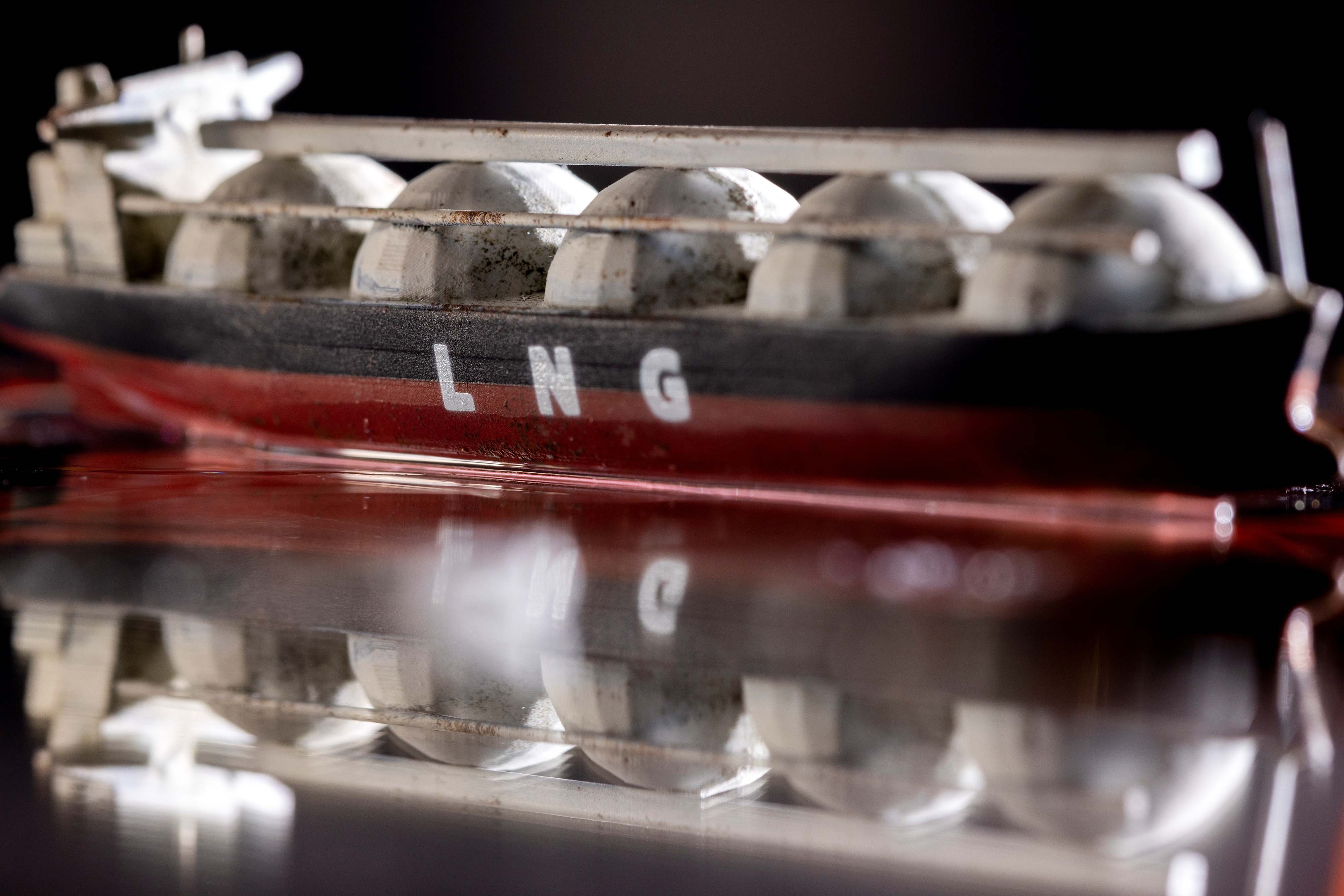
Model of LNG tanker is seen in this illustration taken May 19, 2022. REUTERS/Dado Ruvic/Illustration/File Photo
Electricity-hungry Vietnam looks to become LNG importer
First plant fuelled from imported gas unlikely pre-2026
Investors, Hanoi at odds over volumes, price of power sales
Bold plans exposed to volatile LNG prices as demand grows
HANOI, July 17 (Reuters) – Vietnam received its first shipment of liquefied natural gas this month, a milestone for the energy-hungry country, but various hurdles mean it could take years for imported gas to ease the country’s long-running power shortages.
Disagreement over pricing, plant construction delays and lack of supply contracts are dogging the Southeast Asian manufacturing hub’s adoption of LNG, hampering its ambitions to make imported gas a major fuel, industry insiders say.
Vietnam’s urgent need to boost electricity supply, laid bare by recent rolling blackouts, has raised concerns among foreign investors about whether Vietnam can remain a reliable option to diversify manufacturing away from China.
Half the businesses in a June poll by the European Chamber of Commerce in Vietnam said the power crisis had hurt investment plans. Some were considering alternatives or pausing spending on factories.
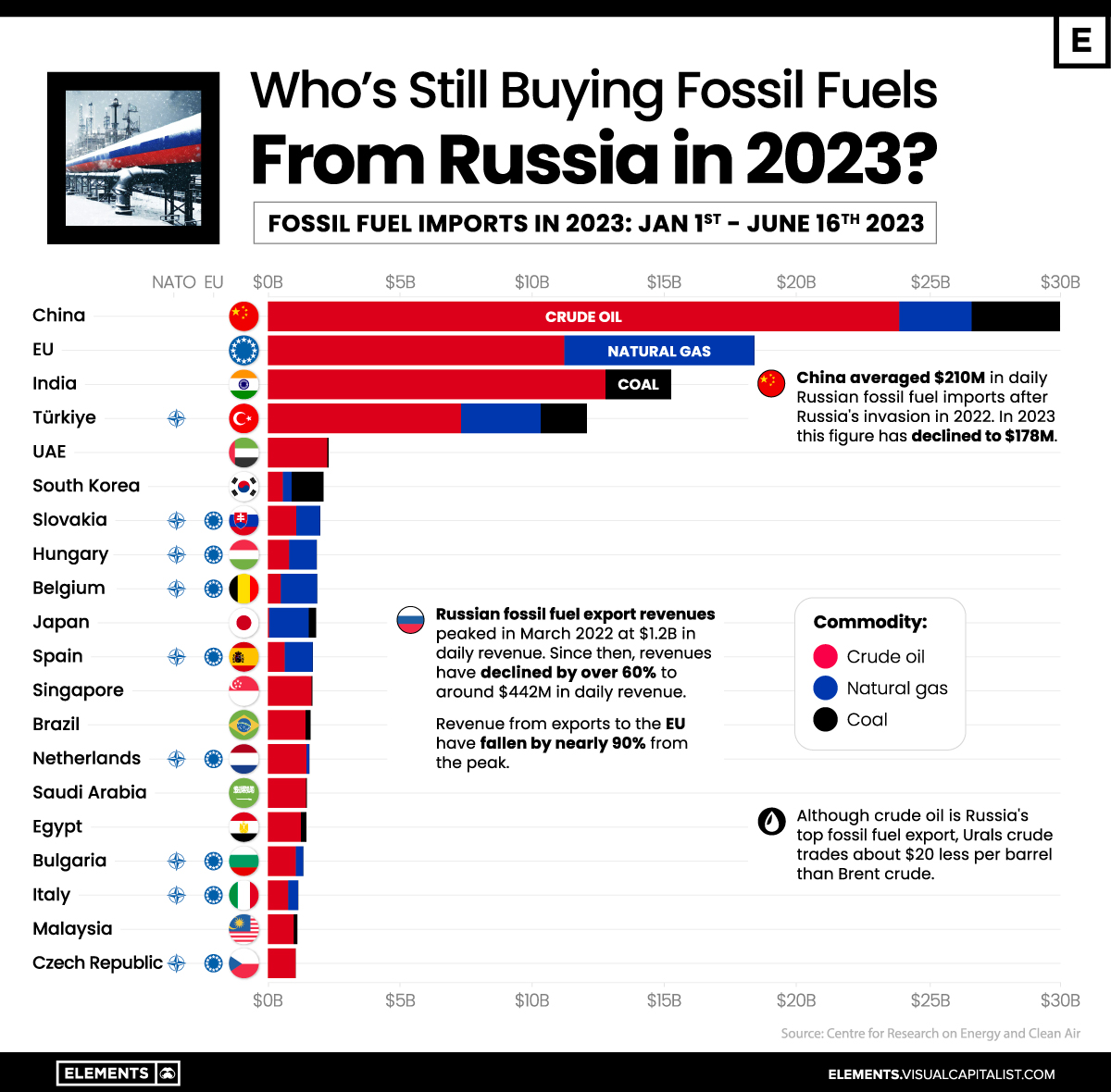
While Russia’s revenues from fossil fuel exports have declined significantly since their peak in March of 2022, many countries are still importing millions of dollars a day worth of fossil fuels from Russia.
Revenue from fossil fuels exported to the EU has declined more than 90% from their peak, but in 2023 the bloc has still imported more than $18 billion of crude oil and natural gas so far.
This graphic uses data from the Centre for Research on Energy and Clean Air (CREA) to visualize the top-importing countries of fossil fuels from Russia so far this year.
China Remains Russia’s Top Fossil Fuel Importer
China continues to be Russia’s top buyer of fossil fuels, with imports reaching $30 billion in 2023 up until June 16, 2023.
With nearly 80% of China’s fuel imports being crude oil, Russia’s average daily revenues from Chinese fossil fuel imports have declined from $210 million in 2022 to $178 million in 2023 largely due to the falling price of Russian crude oil.
Following China are EU nations collectively, which despite no longer importing coal from Russia since August of 2022, still imported $18.4 billion of fossil fuels in a 60/40 split of crude oil and natural gas respectively.
Country
Russian Fossil Fuel Imports* (Total)
Crude Oil
Natural Gas
Coal
China
$30B
$23.9B
$2.7B
$3.3B
EU
$18.4B
$11.2B
$7.2B
$0
India
$15.2B
$12.8B
$0
$2.5B
Türkiye
$12.1B
$7.3B
$3B
$1.7B
UAE
$2.3B
$2.3B
$0
$0
South Korea
$2.1B
$0.6B
$0.3B
$1.2B
Slovakia
$2.0B
$1.1B
$0.9B
$0
Hungary
$1.9B
$0.8B
$1.1B
$0
Belgium
$1.9B
$0.5B
$1.4B
$0
Japan
$1.8B
$0
$1.5B
$0.3B
Spain
$1.7B
$0.6B
$1.1B
$0
Singapore
$1.7B
$1.7B
$0
$0
Brazil
$1.6B
$1.4B
$0
$0.2B
Netherlands
$1.6B
$1.5B
$0.1B
$0
Saudi Arabia
$1.5B
$1.4B
$0
$0
Egypt
$1.4B
$1.3B
$0
$0.2B
Bulgaria
$1.3B
$1.1B
$0.3B
$0
Italy
$1.2B
$0.8B
$0.4B
$0
Malaysia
$1.1B
$1.0B
$0
$0.1B
Czech Republic
$1.0B
$1.1B
$0
$0
*Over the time period of Jan 1, 2023 to June 16, 2023 in U.S. dollars
After China and the EU bloc, India is the next-largest importer of Russian fossil fuels, having ramped up the amount of fossil fuels imported by more than 10x since before Russia’s invasion of Ukraine, largely due to discounted Russian oil.
Türkiye is the only other nation to have imported more than $10 billion worth of Russian fossil fuels in 2023, with every other country having imported fewer than $3 billion worth of fuels from Russia this year.
Navigating the Crude Reality of Oil Exports
Although crude oil is Russia’s chief fossil fuel export, the nation’s Urals crude traded at a $20 per barrel discount to Brent crude throughout most of 2023. While this discount has narrowed to around $16 following Russia’s announcement of further oil export cuts of 500,000 bpd (barrels per day), the price of Urals crude oil remains just 40 cents below the $60 price cap put in place by G7 and EU nations.
Tiêu thụ điện tăng vọt vì nắng nóng dẫn đến thiếu điện được cả Bộ Công thương và ngành điện cùng giải thích khi cắt điện luân phiên. Thế nhưng, có một thực tế là điện lực phía bắc từ mấy năm qua không có dự án mới nào. Ngay cả công suất dự phòng khi thiếu điện cũng không còn.
Hết công suất dự phòng
Giữa tháng 5 vừa qua, khi một vài nơi ở TP.HCM bị cắt điện, báo chí hỏi ngành điện có phải vào mùa cắt điện luân phiên không, Tổng công ty Điện lực TP.HCM và Tập đoàn Điện lực VN (EVN) khẳng định chỉ khắc phục sự cố kỹ thuật… và các ngày sau đó lịch cắt điện cũng được hoãn lại. Từ đó, ngành điện cả nước vào cuộc “gồng” mình chống… cắt điện. May mắn miền Nam cũng vào mùa mưa, trời mát hơn hẳn và áp lực thiếu điện cũng giảm.
Nguy cơ thiếu điện không chỉ xảy ra trong những tháng nắng nóng này
Kinhtedothi – Tình trạng cắt điện luân phiên tại các địa phương đang khiến hoạt động sản xuất, kinh doanh của doanh nghiệp đảo lộn, ngưng trệ, chi phí đội lên cao… Để đảm bảo duy trì sản xuất, doanh nghiệp mong muốn ngành điện có phương án cân đối nguồn điện ưu tiên cho những ngành đặc thù.
Sản xuất ngưng trệ, đội chi phí
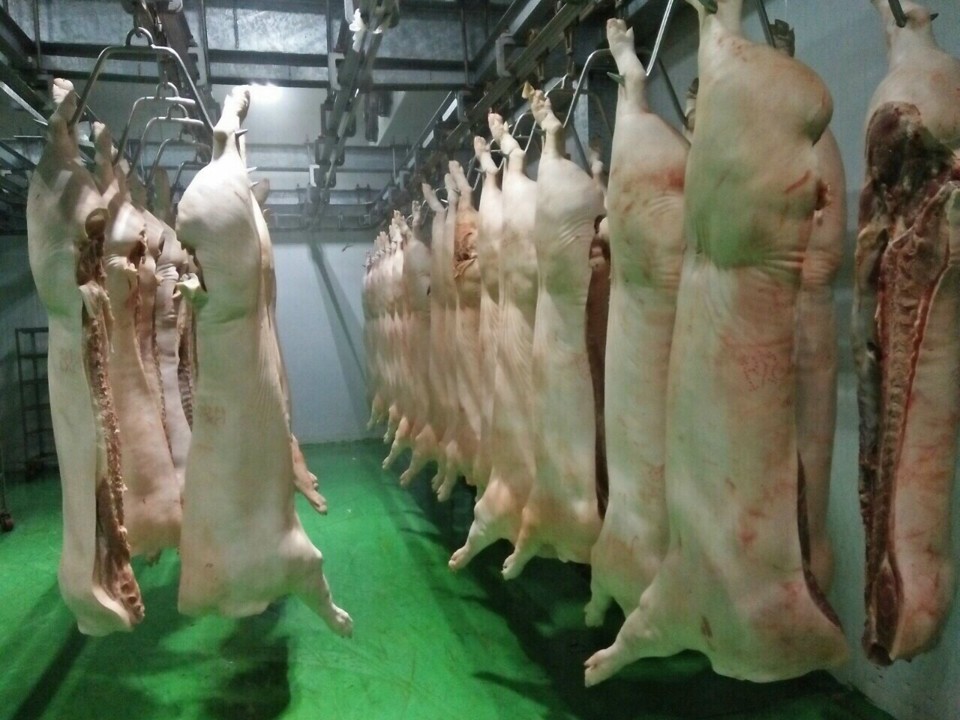
Những ngày này, anh Nguyễn Văn Chữ – Chủ tịch chuỗi thực phẩm sạch Organic Green như ngồi trên đống lửa khi nhìn vào lịch cắt điện luân phiên dày đặc. Bởi doanh nghiệp của anh hoạt động trong lĩnh vực sản xuất, chế biến và kinh doanh thực phẩm sạch, vì vậy nguồn điện rất cần cho các kho bảo quản thực phẩm tươi sống.
Anh Chữ chia sẻ, mặc dù cơ sở đã trang bị máy phát điện nhưng chỉ đủ duy trì một số hoạt động cơ bản và khu văn phòng, không đảm bảo được hệ thống cấp đông, bảo quản sản phẩm. Nếu mất điện lâu, doanh nghiệp có thiệt hại tới hàng chục tỷ đồng. Bởi mặt hàng thực phẩm tươi sống cần được bảo quản trong nhiệt độ thấp, nếu không được bảo quản sẽ bị giã đông và ảnh hưởng chất lượng.
Kho bảo quản thực phẩm tại chuỗi thực phẩm Organic Green
Ngoài ra, cũng vì mất điện, nên nhà máy sản xuất thức ăn chăn nuôi của doanh nghiệp này cũng phải tạm dừng hoạt động. Ngừng hoạt động khiến công ty không đủ hàng giao cho các đại lý. “Lịch cắt điện không phải chỉ luân phiên 1-2 tiếng, mà cắt cả ngày cả đêm, nên ảnh hưởng nghiêm trọng đến hoạt động sản xuất kinh doanh của Công ty” – anh Chữ bức xúc.
Long power cuts made life harder for residents and enterprises in suburban areas of Hanoi amid the scorching weather on Saturday.
Residents sought ways to escape the heatwave while many enterprises suspended their operations during the blackouts.
In particular, part of Lai Yen Commune, Hoai Duc District suffered a power outage, causing many enterprises and business establishments to close.
The Trung Yen gas station in the Lai Yen Industrial Cluster in the namesake commune erected the ‘out of gasoline’ sign from the early morning until afternoon on Saturday due to the power cut.
Hue, a chef in the Lai Yen Industrial Cluster, said it was extremely hot during power cuts and she could not prepare meals for workers.
Two ventilation fans, an evaporative cooler, and an industrial fan are normally needed while she is cooking.
“I cannot cook without electricity. I have to buy noodles for workers. After the meal, they cannot do anything [as there is no power],” she complained.



 China
China EU
EU India
India Türkiye
 UAE
UAE South Korea
 Slovakia
 Hungary
 Belgium
 Japan
Japan Spain
Spain Singapore
 Brazil
 Netherlands
 Saudi Arabia
 Egypt
Egypt Bulgaria
 Italy
Italy Malaysia
 Czech Republic
 CVD
CVD 