
Chuyên mục: Môi trường – Environment
Urbanization worsens environment along Huong River
Last update 08:28 | 03/10/2017
VietNamNet Bridge – Along Huong River, from mountain to estuary, the environment is at risk of being disrupted by natural disasters and urbanization.

With its geographic characteristics, Thua Thien Hue has played an important role in the development of Vietnam.
More than 350 years ago, on the banks of the Perfume River, there was an urban area called Kim Long-Kieng Hue, the capital of Dang Trong kingdom (an area of Vietnamese southwards expansion during the 17th century Trinh–Nguyen War). Tiếp tục đọc “Urbanization worsens environment along Huong River”
World Bank to cease financing upstream oil and gas after 2019
December 12, 2017 / 7:58 AM
Reuters Staff
PARIS (Reuters) – The World Bank will no longer finance upstream oil and gas projects after 2019, apart from certain gas projects in the poorest countries in exceptional circumstances, it said on Tuesday, drawing praise from environmental groups. Tiếp tục đọc “World Bank to cease financing upstream oil and gas after 2019”
Đà Nẵng beaches face worst erosion in decades
vietnamnews Update: December, 08/2017 – 16:00


 |
| Temporary concrete blocks are set up to prevent beach erosion in Đà Nẵng City. — VNS Photo Công Thành |
Viet Nam News ĐÀ NẴNG — A 500m section of beach in Ngũ Hành Sơn District of the central city of Đà Nẵng has been seriously eroded by uninterrupted rain and rising sea waves in the last two months.
Water has approached an under-construction resort and washed away 500m of sand on the beach.
The owner of the Song Đà Nẵng beach villa project set up a line of concrete blocks to limit the erosion, but it continued to reach towards the villas. Tiếp tục đọc “Đà Nẵng beaches face worst erosion in decades”
Great migration of Red Crabs to Christmas Island
Tens of millions of red crabs live on Christmas Island, a small Australian territory near Indonesia. Each year, in sync with the lunar phases, they migrate en masse from the forest to the sea. It’s stunning to watch.
Tiếp tục đọc “Great migration of Red Crabs to Christmas Island”
Tây Nguyên giao rừng tràn lan – 4 bài
- Bài 1: Rừng cộng đồng bị… “cộng đồng” phá!
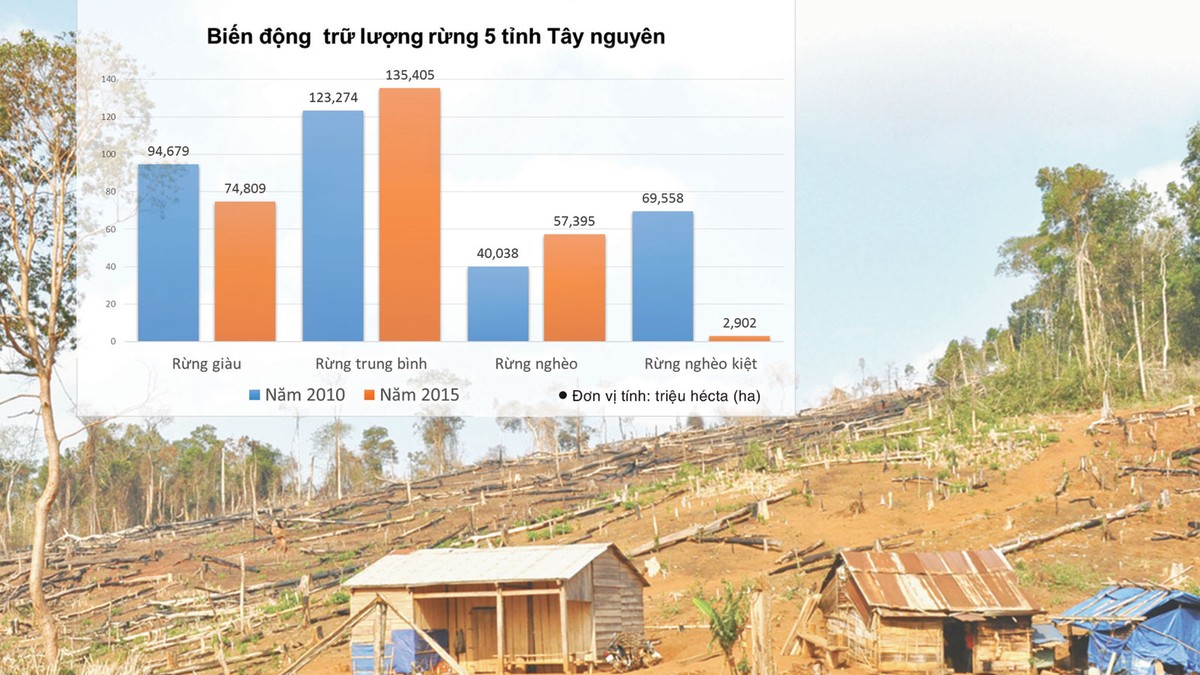
- Bài 2: Chuyển rừng giàu thành… rừng nghèo!
- Bài 3: Cán bộ đua nhau chiếm đất rừng
- Bài 4: Phải giao rừng cho ai?
***
Tây Nguyên giao rừng tràn lan
Bài 1: Rừng cộng đồng bị… “cộng đồng” phá!
Trong thời gian qua, các tỉnh Tây Nguyên đã giao nhiều diện tích rừng tự nhiên cho cộng đồng, cá nhân, nhóm hộ… để bảo vệ, quản lý và phát triển rừng. Nhưng mô hình giao rừng này đã nhanh chóng thất bại vì chủ nhân được giao rừng lại phá rừng hoặc bỏ mặc rừng bị phá.
Rừng Tây Nguyên có vai trò đặc biệt quan trọng, không những cho nội vùng mà còn chi phối rất lớn đến nguồn nước, môi trường sinh thái và phát triển kinh tế – xã hội của các tỉnh ven biển miền Trung, Đông Nam bộ và ĐBSCL. Trong những năm qua, các tỉnh Tây Nguyên đã thực hiện nhiều chính sách giao đất, giao rừng cho người dân và doanh nghiệp để bảo vệ rừng. Lợi dụng các chính sách này, nhiều cá nhân và doanh nghiệp đã ngang nhiên chặt phá, chuyển đổi rừng tràn lan để lấy đất sản xuất nông nghiệp.
Gánh nặng bệnh tật do nhiệt điện đốt than ở Đông Nam Á – Burden of Disease from Rising Coal-Fired Power Plant Emissions in Southeast Asia
Shannon N. Koplitz*†  , Daniel J. Jacob‡, Melissa P. Sulprizio‡, Lauri Myllyvirta§, and Colleen Reid∥
, Daniel J. Jacob‡, Melissa P. Sulprizio‡, Lauri Myllyvirta§, and Colleen Reid∥† Department of Earth and Planetary Sciences, Harvard University, Cambridge, Massachusetts 02138 United States
‡ John A. Paulson School of Engineering and Applied Sciences, Harvard University, Cambridge, Massachusetts 02138 United States
§ Greenpeace International, 1066 AZ Amsterdam, The Netherlands
∥ Department of Geography, University of Colorado, Boulder, Colorado 80309 United States
Environ. Sci. Technol., 2017, 51 (3), pp 1467–1476
DOI: 10.1021/acs.est.6b03731
Publication Date (Web): January 12, 2017
Copyright © 2017 American Chemical Society
*Phone: 617 496 9428; e-mail: skoplitz@fas.harvard.edu.
Abstract

Southeast Asia has a very high population density and is on a fast track to economic development, with most of the growth in electricity demand currently projected to be met by coal. From a detailed analysis of coal-fired power plants presently planned or under construction in Southeast Asia, we project in a business-as-usual scenario that emissions from coal in the region will triple to 2.6 Tg a–1 SO2 and 2.6 Tg a–1 NOx by 2030, with the largest increases occurring in Indonesia and Vietnam. Simulations with the GEOS-Chem chemical transport model show large resulting increases in surface air pollution, up to 11 μg m–3 for annual mean fine particulate matter (PM2.5) in northern Vietnam and up to 15 ppb for seasonal maximum 1 h ozone in Indonesia. We estimate 19 880 (11 400–28 400) excess deaths per year from Southeast Asian coal emissions at present, increasing to 69 660 (40 080–126 710) by 2030. 9000 of these excess deaths in 2030 are in China. As Chinese emissions from coal decline in coming decades, transboundary pollution influence from rising coal emissions in Southeast Asia may become an increasing issue.
Inspection on Đà Nẵng’s projects begins
vietnamnews Update: December, 07/2017 – 08:30
 |
| An embankement of the Đa Phước International Urban Project is built on coastal Nguyễn Tất Thành Street, Đà Nẵng City. The project will be inspected by Government agencies for possible of violations. — VNS Photo Công Thành |
ĐÀ NẴNG — The Government Inspectorate of Việt Nam (GIV) will begin inspection on the controversial Đa Phước International Urban project, along with all investment and construction projects on the protected Sơn Trà Peninsula.The inspection will consider land use and land management practices and forest and environmental protection on the peninsula, 10km from the city. Tiếp tục đọc “Inspection on Đà Nẵng’s projects begins”
Ocean plastic pollution – what role can social science play?
29 November 2017
IDS is partnering with the EU, UN, Chatham House and other organisations to host a high level side event on circular economy solutions to tackling ocean plastic pollution, during this year’s United Nations Environment Assembly in Nairobi (4-6 December). The event will showcase specific examples of collaborative action and policies that aim to reduce plastic waste, address unsustainable consumption and production patterns and redirect investment for a clean, efficient and circular economy. Ahead of the event, I want to highlight the importance of a universal development approach and transformative social science research, as solutions to the ocean plastics problem.

Ocean plastics pollution – not just an environmental issue
Plastics pollution of oceans has emerged as a major global environmental crisis. Between 4.8 and 12.7 million tonnes of plastics enter the ocean each year. It is devastating for marine ecosystems and the accumulation of microplastics in food chains pose a risk to human health. And the issue is becoming more serious. By 2050, plastics production is expected to increase to over 2000 tonnes per year, up from 311 million tonnes in 2014.
Plastics end up in the ocean as the result of chains of human activities in different parts of the world. We are all contributing to it. China, Indonesia and the Philippines have been identified as the top three sources of ocean plastics pollution by the Ocean Conservancy. While litter found on the sea floor around the UK has risen 150% in the last year and UK plastic waste drifts to the artic where is has a very damaging impact on one of the most vulnerable ecosystems in the world.
Tiếp tục đọc “Ocean plastic pollution – what role can social science play?”
Conserving Forests Could Cut Carbon Emissions As Much As Getting Rid of Every Car on Earth
By Susan Minnemeyer, Nancy Harris and Octavia Payne
 Cantonal Hojancha was once a major cattle ranching region. Most of this area was cleared for pasture only 30 years ago. Now, many of the residents have moved into the service industry, and the pasture land has slowly converted back to forest. Photo by Aaron Minnick (World Resources Institute)
New analysis from The Nature Conservancy, WRI and others estimates that stopping deforestation, restoring forests and improving forestry practices could cost-effectively remove 7 billion metric tons of carbon dioxide annually, or as much as eliminating 1.5 billion cars—more than all of the cars in the world today!
In fact, forests are key to at least six of the study’s 20 “natural climate solutions,” which could collectively reduce 11.3 billion metric tons of greenhouse gas emissions per year. That’s as much as halting global oil consumption, and would get us one-third of the way toward limiting global warming to 2 degrees C (3.6 degrees F) above pre-industrial levels — the threshold for avoiding catastrophic effects of climate change — by 2030.
Stopping Deforestation Offers the Biggest Benefit
Ministry takes action in response to EU’s warning of IUU fishing
vietnamnews
 |
| A processing line of frozen shrimp for exports. — VNA/VNS Photo Danh Lam |
Viet Nam News HÀ NỘI — The Ministry of Agriculture and Rural Development has approved a plan to implement urgent solutions in response to the European Union’s (EU’s) warning about illegal, unreported and unregulated (IUU) fishing.
Many solutions have been devised according to the EU’s recommendations. They include aligning the legal framework with regional and international regulations, implementing effectively the amended legal regulations for IUU fishing, and implementing effectively the international regulations and management measures through strict punishment. Tiếp tục đọc “Ministry takes action in response to EU’s warning of IUU fishing”
Global Tree Cover Loss Remains High. Emerging Patterns Reveal Shifting Contributors.
 Mikaela Weisse, , , , and –
WRI

Global Forest Watch released new satellite-based data showing how forests around the world changed in the year 2015. The data, produced through the analysis of roughly a million satellite images by the University of Maryland and Google, measures the death or removal of trees at least 5 meters tall within 30×30 meter areas. This can capture any number of sustainable or unsustainable activities, from the clearing of natural forests to the harvest of tree plantations, but when analyzed appropriately with other contextual data and information can serve as a proxy for deforestation (typically defined as the permanent conversion of forest land for another use). Tiếp tục đọc “Global Tree Cover Loss Remains High. Emerging Patterns Reveal Shifting Contributors.”
New forestry law looks beyond protection to development
Last update 15:51 | 26/11/2017
Ha Cong Tuan, deputy minister of Agriculture and Rural Development, speaks to the Vietnam Economic Times about his ministry’s resolve to make forests a key resource for national economic development.

How does the 2017 Law on Forestry compare to the 2004 Law on Forestry Protection and Development?
The new forestry law consists of 12 chapters with 108 articles stipulating management, protection, development and use of forests, along with processing and trade of forest products. The law will come into force on January 1st 2019. Tiếp tục đọc “New forestry law looks beyond protection to development”
Formosa exceeds emission limit after raising capacity for evaluation: Vietnam ministry
The steel business was responsible for mass fish deaths along the central coast of Vietnam in 2016
- By Tuoi Tre News November 26, 2017, 20:55 GMT+7
| A Formosa steel plant in Ha Tinh Province, Vietnam. Photo: Tuoi Tre |
Recent reports of emissions exceeding the permissible amount at Formosa steel mills in north-central Ha Tinh Province were the result of a raised capacity to evaluate the company’s emission treatment system, Vietnam’s Ministry of Natural Resources and Environment (MONRE) has said.
The ministry gave the explanation on Saturday afternoon following rumors that the Taiwanese steel business was once again bringing harm to Vietnam’s environment. Tiếp tục đọc “Formosa exceeds emission limit after raising capacity for evaluation: Vietnam ministry”
Wild animals traded via agriculture export to China
Last update 16:42 | 23/11/2017
Wild animals and their parts have been found hidden among agricultural products exported to China according to a recent report from Ministry of Finance to the government.

Police seize a large number of ivory imported to Vietnam
The illegal trading of wild animals which mostly come from Africa is carried out by air and waterways through Laos, Cambodia to Vietnam, and then by road from Vietnam to China, the report said.
“The smugglers often hide the frozen animals or animal parts including ivory, tiger bones, or rhino horn among agricultural products being exported to China through border gates or open roads between the two countries Tiếp tục đọc “Wild animals traded via agriculture export to China”
 CVD
CVD 