Dramatic Photos Show How Sand Mining Threatens a Way of Life in Southeast Asia
Conversations on Vietnam Development


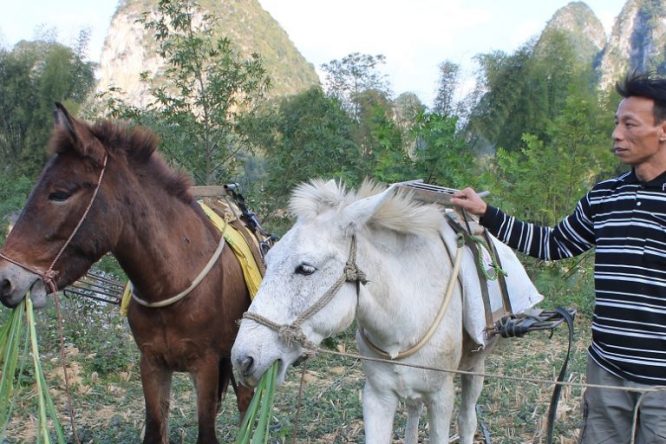
Hình ảnh banner: Một nông dân đang cho ngựa ăn cỏ voi ở tỉnh Cao Bằng, cỏ được trồng để người nông dân không cho gia súc ăn cỏ bên trong một khu rừng được bảo vệ gần đó. Ảnh của Michael Tatarski / Mongabay.
English: Environmental reporting in Vietnam often a comedy of errors
Thành phố Hồ Chí Minh, ngày 30 tháng 1 năm 2018
Tuy không phải là một điều đáng ngạc nhiên, nhưng viết báo về môi trường ở Việt Nam không phải là một việc dễ dàng. Nhà nước một đảng Việt Nam gần đây đã được xếp hạng 175 trên 180 về Chỉ số Tự do Báo chí Thế giới năm 2017 của Tờ Phóng viên Không Biên giới, nằm giữa Sudan và Trung Quốc.
Tiếp tục đọc “Điều tra tình trạng môi trường tại Việt Nam, những chuyện nực cười”

Criminals can be sentenced up to 15 years in prison
Criminals can be sentenced up to 15 years in prison and a pecuniary penalty of up to VND15 billion.
The first Criminal Code in 1985 only mentioned crimes related to forest management and protection and the illegally poaching of birds and animals. The maximum penalty stipulated in the law was three years imprisonment.
In the 1999 Criminal Code, the term ‘wildlife’ for the first time was legalized. The pecuniary penalty was raised to a maximum of VND50 million, while the crimes were subject to seven years in prison. Tiếp tục đọc “Law on wildlife crimes takes effect, but enforcement still weak”
VietNamNet Bridge – Authorities in the Central Highlands province of Gia Lai are struggling to find solutions to address deforestation and development violations, which are rampant in many localities across the province.
![]() |
| Several big trees were illegally chopped down in Gia Lai Province. – VNA/VNS Photo |
Forest rangers here came across 130 cases of deforestation and forest related violations in the first two months of this year, seizing over 148,000cu.m of timber, Duong Hoang Nguyen, head of Gia Lai Forest Protection Department’s Legal Inspection Division, told Viet Nam News Agency (VNA).
Of these, four were reportedly criminal cases, while the rest received administrative sanctions. Tiếp tục đọc “Hundreds of forest violation cases reported in Gia Lai”
Lithium Australia is the latest in a series of firms looking downstream.

An Australian lithium mine.
Lithium Australia last month became the latest in a growing list of mineral extraction firms to branch out into battery manufacturing.
The Perth, Western Australia-based lithium company announced acceptance of an offer for 99.7 percent of the Very Small Particle Company (VSPC), an Australian firm that develops and produces nanoscale metal oxides for lithium-iron-phosphate electric vehicle batteries.
Lithium Australia said VSPC, of Queensland, had spent 14 years and AUD $30 million (USD $23 million) developing “the world’s most advanced cathode production technology for lithium-ion batteries.” Tiếp tục đọc “Why Are Minerals Companies Trying to Make Batteries?”
Năm 1977, học giả Kirkpatrick Sale đã hỏi kinh tế gia người Đức E.F. Schumacher: “Dựa vào những hiểu biết sâu sắc về kinh tế, xã hội của mình, ông có thể đưa ra lời khuyên nào có tính hoàn toàn chính trị không?”. Schumacher trả lời: “Hãy trồng một cây!”.
![]() |
| Bờ kè An Nhiên trước lũ. (Ảnh: trang trại An Nhiên cung cấp) |
Những kẻ mơ mộng ấy muốn rằng ngày sẽ có thêm nhiều người mơ mộng, để trồng thêm dù chỉ một cái cây, và nhiều cây sẽ thành một khu rừng.

Ba Lan đang ở giữa mùa đông, khắp nơi cây cối đều trụi lá, trơ cành đen đúa, khẳng khiu, tưởng như đã chết khô héo, kể cả những cây thông vốn giỏi chịu lạnh cũng đổi sang màu xanh pha vàng úa hoặc xanh xám ghi. Để có chút màu xanh của cây cối, nhân dịp cuối tuần đi chợ nông dân, tôi mua ít củ hoa hyancyth (ở Việt Nam gọi là hoa tiên ông), hoa tulip và ít củ thủy tiên về trồng. Thoạt đầu, trông chúng chả khác gì mấy củ hành tây mua ngoài chợ, thế mà chỉ mấy ngày trong căn bếp ấm, được tưới nước đầy đủ, các loại hoa đã thi nhau bật tung nụ, làm rạng rỡ cả ngày đông tuyết trắng đơn sắc ngoài cửa sổ. Tiếp tục đọc “Đời luôn sẵn kẻ mộng mơ”

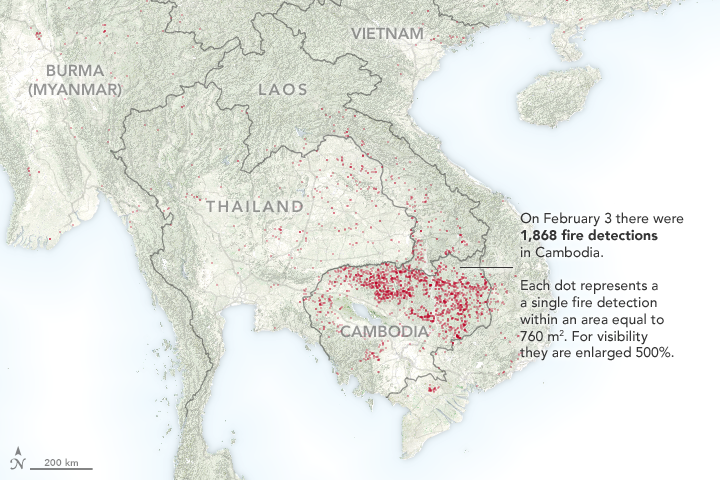
Every January through March, vast numbers of small fires spring up across the countryside in Southeast Asia. Those months usually bring cool, dry weather—perfect conditions for burning.
The Visible Infrared Imaging Radiometer Suite (VIIRS) on the Suomi NPP satellite captured data (above) showing the locations of hundreds of fires burning in Cambodia, Vietnam, Thailand, Laos, and Myanmar (Burma) on February 3, 2018. Each red dot on the map depicts one fire detection from the VIIRS 750-meter active fire data product. (Note that there is also a 375-meter active fire data product that detects more fires, but the 750-meter product is the basis for this useful mapping tool.)
On that day, there were significantly more fires in Cambodia than in neighboring countries. VIIRS detected 1,868 hot spots in Cambodia, 185 in Laos, 77 in Myanmar, 217 in Thailand, and 114 in Vietnam. The large number of fires in Cambodia were the most VIIRS has observed on a single day in 2018. The pattern is consistent with recent years: As depicted in the map below, the instrument has detected four-to-five times as many fires in northern Cambodia as it did in Vietnam and Thailand between August 2016 and February 2018. Northern Laos also had a relatively high number of fires. Tiếp tục đọc “Fire season in Southeast Asia”

Tiếp tục đọc “Quảng Ninh: Lợi ích nhờ chuyển dịch cơ cấu kinh tế từ Nâu sang Xanh”
Date:March 12, 2018 Source:University of Helsinki

Illegal wildlife trade is one of the biggest threats to biodiversity conservation and is currently expanding to social media. This is a worrisome trend, given the ease of access and popularity of social media. Efficient monitoring of illegal wildlife trade on social media is therefore crucial for conserving biodiversity.
In a new article published in the journal Conservation Biology, scientists from the University of Helsinki, Digital Geography Lab, argue that methods from artificial intelligence can be used to help monitor the illegal wildlife trade on social media. Tiếp tục đọc “Using artificial intelligence to investigate illegal wildlife trade on social media”
DW_How can you tell if mahogany is really mahogany? And can you really know whether the wood in your table wasn’t illegally felled? Germany’s wood detectives are on the case with DNA analysis.
![]() |
| Statistics from the General Statistics Office of Việt Nam (GSO) showed that the mining industry has posted a record slump since 2011, with the growth rate dropping by 7.1 per cent in 2017 and 4 per cent in 2016. — VNA/VNS Photo |
Viet Nam Newsby Võ Trí Thành*
Statistics from the General Statistics Office of Việt Nam (GSO) showed that the mining industry has posted a record slump since 2011, with the growth rate dropping by 7.1 per cent in 2017 and 4 per cent in 2016.
This could be a small disappointment amid lots of bright spots in the country’s wider socio-economic picture last year. But this could also lead to an alarming conclusion – the mining industry will be unable to return to growth, and so the growth pattern must be transformed.
The GSO attributed the slump to the plummet in crude oil and coal exploitation. This consequence is directly related to Việt Nam’s past development strategy, when the mining industry still occupied an important position. Tiếp tục đọc “Mine declines: Good news for sustainability in Vietnam”
>> Bài liên quan: Quan chức tham nhũng Việt Nam kiếm tiền từ gỗ buôn lậu ở Campuchia
Cambodia’s forests are being felled at a shocking rate, as poachers and corrupt officials profit from the black market trade in rare wood species, which is being exported to Vietnam — and beyond.
The Aoral Wildlife Sanctuary in Kampong Speu province is just a three-hour drive from Cambodia’s capital, Phnom Penh. But the scenery here couldn’t be more different than in the sprawling metropolis — even a military outpost in the reserve is peaceful and picturesque. A traditional stilt house has hammocks, chickens and ice-cold beer. Outside, a few soldiers are playing pétanque as a black pig snuffles the earth.
But behind this idyllic scene in the Cardamom Mountains, a billion-dollar black market is thriving. Tiếp tục đọc “Corruption fueling deforestation in Cambodia: poachers and corrupt officials profit from the black market trade, being exported to Vietnam — and beyond.”
TS – 04/04/2016 11:14 Nguyễn Ngọc Trân
Hiện nay và trong thời gian tới, ĐBSCL phải đương đầu với ít nhất hai thách thức toàn cầu, một thách thức khu vực và một thách thức từ chính sự khai thác đồng bằng. Toàn cầu, đó là biến đổi khí hậu, nước biển dâng, và toàn cầu hóa kinh tế, hội nhập quốc tế. Các thách thức đó không tác động riêng lẻ mà cùng nhau và liên hoàn tác động, nhân lên hậu quả của các tác hại là thách thức tổng hợp đối với sự phát triển bền vững của đồng bằng.
Đồng bằng sông Cửu Long (ĐBSCL) nằm ở ngoài cùng của châu thổ sông Mekong giáp với biển, được hình thành từ khoảng 6000 năm nay, từ trầm tích mà sông Mekong tải ra biển cộng với quá trình biển lùi. Nước và trầm tích là hai yếu tố thuộc về bản chất của đồng bằng.
Tiếp tục đọc “Đồng bằng Sông Cửu Long: Những thách thức hiện nay và ngày mai”

Photo by Tony Lam Hoang on Unsplash
A Water Window project honored at COP 23 as a Best Climate Practice.
The Buoyant Foundation Project (BFD), Development of Amphibious Homes for Marginalized and Vulnerable Populations led by architecture professor Dr. Elizabeth English of the University of Waterloo, Canada was honored as a Best Climate Practice. The honor was presented by the Initiative on Climate Change Policy and Governance (ICCG) at the 23rd Conference of Parties (COP) to the United Nations Framework Convention on Climate Change (UNFCC) in Bonn, Germany.
The BFD project was one of 12 projects that received funding from the Global Resilience Partnership Water Window Challenge (Water Window) by Zurich Insurance Group and the Z Zurich Foundation in 2017. Tiếp tục đọc “Houses that Float on Water”