Triển khai dự án Cần Giờ ‘phải giữ được rừng ngập mặn’

Bộ Tài nguyên và Môi trường lần đầu giải thích các ý kiến liên quan đến báo cáo đánh giá tác động môi trường dự án Cần Giờ.

Sáng 20/7, tại cuộc họp báo thường kỳ của Bộ Tài nguyên và Môi trường, hầu hết các câu hỏi đều liên quan đến đánh giá tác động môi trường (ĐTM) dự án khu du lịch đô thị lấn biển Cần Giờ (dự án Cần Giờ).

Ông Nguyễn Xuân Hải, Vụ trưởng thẩm định đánh giá tác động môi trường (Tổng cục Môi trường), nêu các nguyên tắc khi phê duyệt báo cáo ĐTM dự án Cần Giờ, như: “Phải giữ được rừng ngập mặn, có biện pháp phù hợp giảm thiểu tác động môi trường nhằm hạn chế tối đa tác động bất lợi đối với dòng chảy, xói lở, thoát lũ, ô nhiễm môi trường”.

Tiếp tục đọc “Triển khai dự án Cần Giờ ‘phải giữ được rừng ngập mặn’”

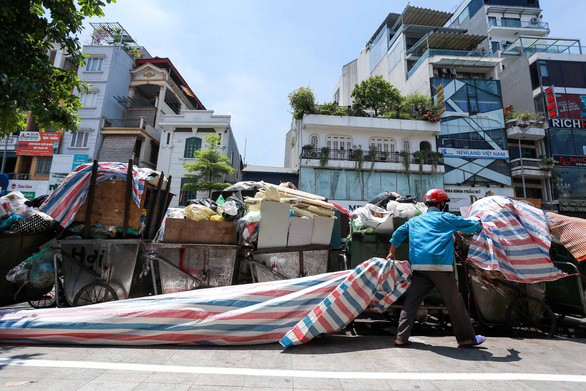
Garbage piles up in Hanoi as people block road to dump

Friday, July 17, 2020, 17:03 GMT+7 tuoitre
Garbage piles up in Hanoi as people block road to dump
Uncollected garbage piles up on a street in an urban district of Hanoi, Vietnam, July 16, 2020. Photo: Chi Tue / Tuoi Tre

Vietnam’s Environmental Challenges Risk EU Free Trade

Author: Thang Nam Do, ANUVietnam needs to address environmental challenges to fully reap the benefits from its new free trade and investment agreements with the European Union. On 8 June, Vietnam’s National Assembly ratified the EU–Vietnam Free Trade Agreement and Investment Protection Agreement, following the European Parliament’s approval in February. Ratifying the agreement clears the path for Vietnam to expand exports to the potentially lucrative EU market and to attract more investment from the economic bloc.

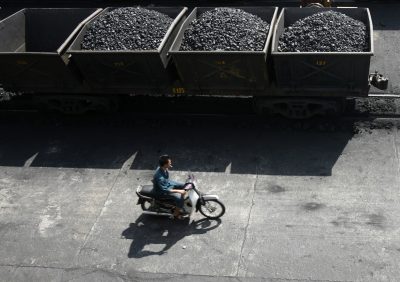
A worker rides his motorcycle near lorries transporting coal at a port of the Cua Ong Coal Preparation Company in Cam Pha town, Quang Ninh, Vietnam (Photo: Reuters/Kham).
Tiếp tục đọc “Vietnam’s Environmental Challenges Risk EU Free Trade”

NREL Research Points to Strategies for Recycling of Solar Panels

Researchers at the National Renewable Energy Laboratory (NREL) have conducted the first global assessment into the most promising approaches to end-of-life management for solar photovoltaic (PV) modules.

PV modules have a 30-year lifespan. There is currently no plan for how to manage this at end of their lifespan. The volume of modules no longer needed could total 80 million metric tons by 2050. In addition to quantity, the nature of the waste also poses challenges. PV modules are made of valuable, precious, critical, and toxic materials. There is currently no standard for how to recycle the valuable ones and mitigate the toxic ones.

Numerous articles review individual options for PV recycling but, until now, no one has done a global assessment of all PV recycling efforts to identify the most promising approaches.

“PV is a major part of the energy transition,” said Garvin Heath, a senior scientist at NREL who specializes in sustainability science. “We must be good stewards of these materials and develop a circular economy for PV modules.”
Tiếp tục đọc “NREL Research Points to Strategies for Recycling of Solar Panels”

Góp ý cho dự thảo Chiến lược bảo vệ môi trường Việt Nam đến năm 2030 tầm nhìn 2040

Viện Chiến lược, Chính sách tài nguyên và môi trường  thuộc Bộ Tài Nguyên Môi Trường, đang tổ chức các Hội thảo tham vấn địa phương góp ý cho Dự thảo Chiến lược. bảo vệ môi trường Việt Nam đến năm 2030 tầm nhìn 2040, vào ngày 03 tháng 7 năm 2020 tại Hà Nội, ngày 14 tháng 7 năm 2020 tại Thành phố Hồ Chí Minh, ngày 16 tháng 7 năm 2020 tại Đà Nẵng,

Tải dự thảo Chiến lược tại đây, trên website của Viện chiến lược

Dưới đây là một số quan sát, bình luận, và góp về bản thảo tổng kết và chiến lược chúng ta có thể cùng thảo luận thêm.

Bản dự thảo chiến lược là một công trình có sự chuẩn bị công phu, bao quát và phản ánh đúng hiện trạng các vấn đề nghiêm trọng và cấp bách của môi trường Việt Nam trong 10 năm gần đây và nhiều năm tiếp theo.

Phần 1: Thực trạng

Lời giới thiệu trang 2: “Chính phủ kiên quyết không hy sinh môi trường vì mục tiêu tăng trưởng kinh tế” ; và đoạn 1.1 trang 4 “Nhận thức về bảo vệ môi trường được nâng cao hơn một bước, Chính phủ xác định không hy sinh môi trường vì tăng trưởng kinh tế.” Tiếp tục đọc “Góp ý cho dự thảo Chiến lược bảo vệ môi trường Việt Nam đến năm 2030 tầm nhìn 2040”

Vietnam looks to new national strategy on environmental protection

A draft national strategy on environmental protection from 2021-2030 focuses on fighting sources of pollution while boosting a low-carbon emission economy.
Vietnam looks to new national strategy on environmental protection hinh anh 1

The idea is to help Vietnam realise the UN’s Sustainable Development Goals by2030.

In 2012, the first national strategy for environmental protection with a visiontowards 2030 was launched.

Deputy Minister of Natural Resources and Environment Vo Tuan Nhan said thestrategy had created positive changes to environmental protectionawareness. The Government had stuck to the principle of not sacrificingthe environment to reach its economic development goals. Tiếp tục đọc “Vietnam looks to new national strategy on environmental protection”

Water sector draws investment

Update: July, 11/2020 – 08:59 VNS

Share facebookChia sẻ bài viết lên TwitterShare google+|


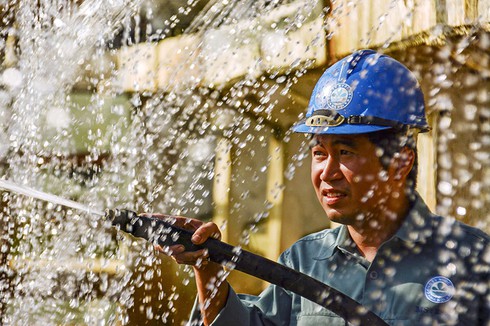
A worker of Hà Nội Water Co Ltd (Hawacom). Hawacom is among the enterprises that occupy the largest market shares in the water supply industry. Photo hawacom.vn

HÀ NỘI — The water supply and drainage sector is drawing investment thanks to its high profit margins and good growth potential.

According to the HCM City Securities Corporation (HSC), the water industry has positive prospects as rapid urbanisation and population growth have led to a higher demand for water for industrial production and clean water consumption. Tiếp tục đọc “Water sector draws investment”

Japan seeks stoppage of 100 inefficient coal plants in a decade

asia.nikkei.com

Government acts in light of pressure for switch to greener energy alternatives

Japan will urge the closure or suspension of about 100 low-efficiency coal-fired power plants by fiscal year 2030.   © Kyodo

TOKYO — The Japanese government will urge the closure or suspension of about 100 low-efficiency coal-fired power plants in the country by fiscal year 2030 in the face of international pressure for a transition to greener alternatives. Tiếp tục đọc “Japan seeks stoppage of 100 inefficient coal plants in a decade”

Air Pollution: Locked Down by COVID-19 but Not Arrested

worldbank.org

By Urvashi Narain

Even before the COVID-19 pandemic, one of the most serious global crises of our time, many countries had come to see air pollution as a major health issue. The State of Global Air/2019 report noted that air pollution was the fifth leading risk factor for mortality worldwide in 2017, with ambient air pollution contributing to around 5 million deaths globally – or one in 10 deaths. The report found that more people were dying from air pollution-related diseases than from traffic accidents or malaria.
Tiếp tục đọc “Air Pollution: Locked Down by COVID-19 but Not Arrested”

$10bn of precious metals dumped each year in electronic waste, says UN

A fast growing mountain of toxic e-waste is polluting the planet and damaging health, says new report

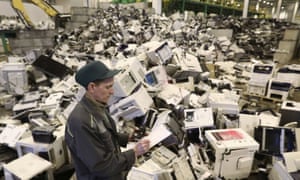
Ecotechprom electronic and electric equipment recycling plant in Moscow<br>MOSCOW, RUSSIA - FEBRUARY 21, 2020: An employee at the Ecotechprom electronic and electric equipment recycling plant of the Ecopolis Corporation, Russia’s leading enterprise investing in recycling and utilization of electronic and electric equipment; its recycling efficiency reaches 95% of the incoming volume. Sergei Karpukhin/TASS (Photo by Sergei Karpukhin\TASS via Getty Images)

A worker at an electronic and electric equipment recycling and reuse plant, belonging to Ecopolis Corporation, in Moscow. Photograph: Sergei Karpukhin/Tass

At least $10bn (£7.9bn) worth of gold, platinum and other precious metals are dumped every year in the growing mountain of electronic waste that is polluting the planet, according to a new UN report.

A record 54m tonnes of “e-waste” was generated worldwide in 2019, up 21% in five years, the UN’s Global E-waste Monitor report found. The 2019 figure is equivalent to 7.3kg for every man, woman and child on Earth, though use is concentrated in richer nations. The amount of e-waste is rising three times faster than the world’s population, and only 17% of it was recycled in 2019.

Electronic and electrical goods, from phones and computers to refrigerators and kettles, have become indispensable in modern societies and enhance lives. But they often contain toxic chemicals, and soaring production and waste damages human health and the environment, and fuels the climate crisis.

The report blames lack of regulation and the short lifespan of products that are hard or impossible to repair. Experts called the situation a “wholly preventable global scandal”.

People in northern Europe produced the most e-waste – 22.4kg per person in 2019. The amount was half as much in eastern Europe. Australians and New Zealanders disposed of 21.3kg per person, while in the US and Canada the figure was 20.9kg. Averages across Asia and Africa were much lower, at 5.6kg and 2.5kg per person respectively.E-waste contains materials including copper, iron, gold, silver and platinum, which the report gives a conservative value of $57bn. But most are dumped or burned rather than being collected for recycling. Precious metals in waste are estimated to be worth $14bn, but only $4bn-worth is recovered at the moment.
Tiếp tục đọc “$10bn of precious metals dumped each year in electronic waste, says UN”

OECMs promise a new conservation opportunity for Việt Nam

Update: July, 06/2020 – 18:14 VNS

Species of rare primates with scientific name Pygathrix nemaeus nigripes are facing extinction in Việt Nam. — Photo daidoanket.vn

HÀ NỘI — A new conservation designation of the Convention on Biological Diversity (CBD) promises more opportunities for Việt Nam to boost conservation work in the country, experts have said. Tiếp tục đọc “OECMs promise a new conservation opportunity for Việt Nam”

Wildlife trade amplifies spread of coronaviruses

telegraph.co.uk

The proportion of rats testing positive for viruses jumped substantially between the start and end of Vietnam’s supply chain

Asia’s booming wildlife trade is fuelling the spread of coronaviruses by providing the ideal opportunity for animals to infect each other and potentially humans, two studies have found.

Across Asia, wild animals including rodents, pangolins and bats are transported, often illegally, thousands of miles in crowded and chaotic conditions for use in restaurants and traditional medicines.

Experts have long thought this amplifies the transmission of coronaviruses, making the possibility of a jump to humans more likely.

In one new study, published as a preprint without peer review, researchers analysed oral swabs from more than 2,000 field rats in three provinces in southern Vietnam. They found that the animals smuggled across the Mekong River Delta, from traders to restaurants, tested positive for six different coronaviruses. More significantly, the incidence of infection increased significantly along their journey.

Roughly 20 per cent of wild rats caught by traders tested positive for at least one coronavirus, rising to 32 per cent of rodents in large markets. In restaurants, the final step in the chain, 55 per cent of rats were infected.

“The observed viral amplification along the wildlife trade supply chain for human consumption likely resulted from the mixing and close confinement of stressed live animals,” the researchers wrote.
Tiếp tục đọc “Wildlife trade amplifies spread of coronaviruses”

Laos to move on third Mekong dam project despite neighbours’ green concerns

FILE PHOTO: A local villager drive a boat where the future site of the Luang Prabang dam will be on
FILE PHOTO: A local villager drive a boat where the future site of the Luang Prabang dam will be on the Mekong River, outskirt of Luang Prabang province, Laos, February 5, 2020. REUTERS/Panu Wongcha-um/File Photo

BANGKOK: Laos is pushing ahead with a hydropower project on the Mekong River, despite reservations aired by neighbouring countries over its potential to harm fisheries and farming downstream, the Mekong River Commission (MRC) said on Wednesday (Jul 10.

The 1,400-megawatt (MW) Luang Prabang project will be Laos’s third and largest dam on the river, with construction originally set to begin this year. Tiếp tục đọc “Laos to move on third Mekong dam project despite neighbours’ green concerns”

XEM XÉT LẠI VÀ ĐÁNH GIÁ ĐỘC LẬP DỰ ÁN KHU ĐÔ THỊ DU LỊCH LẤN BIỂN CẦN GIỜ

Ký tên vào kiến nghị tại đây 

PETITION FOR THE REVIEW AND INDEPENDENT ASSESSMENT OF THE CAN GIO TOURIST CITY PROJECT IN HO CHI MINH CITY, VIETNAM

KIẾN NGHỊ XEM XÉT LẠI VÀ ĐÁNH GIÁ ĐỘC LẬP TOÀN BỘ DỰ ÁN KHU ĐÔ THỊ DU LỊCH LẤN BIỂN CẦN GIỜ – TPHCM

Kính gửi:  Thủ tướng Chính Phủ nước CHXHCN Việt Nam
Ủy ban Thường vụ Quốc Hội nước CHXHCN Việt Nam
UBND Thành phố Hồ Chí Minh

Chúng tôi kí tên dưới đây, là các cá nhân và tổ chức xã hội yêu môi trường, hoạt động trong các lĩnh vực liên quan, đồng kiến nghị Thủ tướng Chính phủ, Ủy ban Thường vụ Quốc Hội, UBND TPHCM xem xét lại và đánh giá độc lập toàn bộ dự án Khu Đô thị du lịch lấn biển Cần Giờ 2.870 ha, vì những lí do sau đây:

1. Quyết định phê duyệt Báo cáo Đánh giá tác động môi trường dự án Khu Đô thị du lịch lấn biển Cần Giờ của Bộ Tài nguyên Môi trường cho thấy các tác động của dự án lên môi trường chưa được đánh giá khách quan, toàn diện. Đặc biệt, những vấn đề quan trọng nhất đã chưa được đánh giá đầy đủ trước khi phê duyệt, như: tác động của việc thực hiện dự án đến Khu Dự trữ sinh quyển rừng ngập mặn Cần Giờ, vấn đề xói lở, bồi tụ và dòng chảy các khu vực xung quanh dự án, các biện pháp giảm thiểu thích đáng các tác động tiêu cực của dự án.

Nguy cơ Khu Đô thị lấn biển Cần Giờ tác động xấu lên rừng ngập mặn Cần Giờ sẽ kéo theo hàng loạt ảnh hưởng tiêu cực khác lên khu vực đô thị TPHCM, nơi hiện tại người dân và chính quyền vốn đang phải đối mặt với nhiều gánh nặng về ô nhiễm môi trường, ngập lụt, sụt lún, v.v. Tiếp tục đọc “XEM XÉT LẠI VÀ ĐÁNH GIÁ ĐỘC LẬP DỰ ÁN KHU ĐÔ THỊ DU LỊCH LẤN BIỂN CẦN GIỜ”