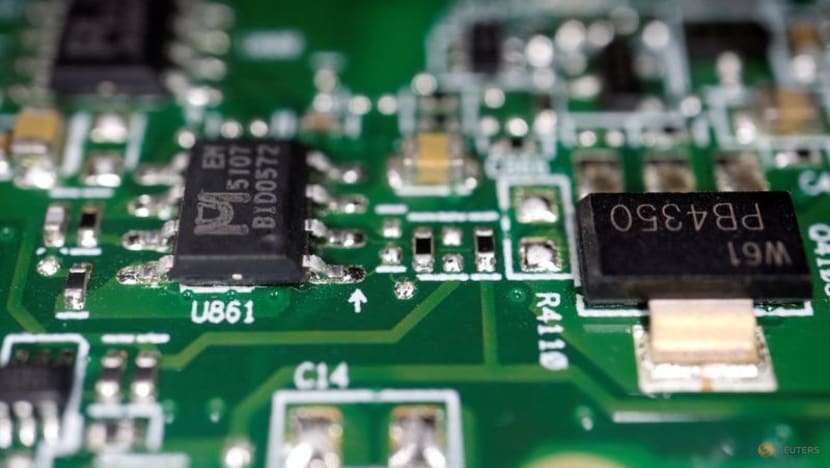
Semiconductor chips are seen on a printed circuit board in this illustration picture taken February 17, 2023. REUTERS/Florence Lo/Illustration
31 Aug 2023 01:53PM(Updated: 02 Sep 2023 12:32AM) Channelnewsasia
HANOI : A chronic shortage of engineers in Vietnam is emerging as a major challenge to the growth of its semiconductor industry and to U.S. plans of fast-tracking the Southeast Asian nation as a chips hub to hedge against China-related supply risks.
Semiconductors are expected to be a focal point when U.S. President Joe Biden visits Hanoi from Sept. 10 with the goal of formally elevating ties between the two countries. He will offer Vietnam support to boost its chips production, U.S. administration officials said.
A year and a half into a historic interest-rate upcycle, Southeast Asia’s economic prospects continue to stand out in a world faced with high inflation and soft demand.
HSBC forecasts that the six largest economies in Southeast Asia — Indonesia, Thailand, Malaysia, the Philippines, Singapore and Vietnam — will grow 4.2% this year and 4.8% next year. This pace would far outstrip the 1.1% expansion expected in the developed world in 2023 or next year’s estimated 0.7%.
This acceleration is all the more remarkable given that inflows of Chinese tourism dollars have not returned to Southeast Asia as anticipated. For example, in Singapore and Thailand — both popular destinations for Chinese holidaymakers — tourist arrivals are running at only about one-third of pre-COVID levels.
A recovery in tourism would certainly be a welcome boon for Southeast Asia. But meanwhile, trade, the transition to net zero and digital transformation are set to power the region’s economic growth for decades to come and ensure that this dynamic region remains a global growth engine.
Southeast Asia has come a long way as a manufacturing dynamo. It now accounts for 8% of global exports and since 2020, has surpassed the European Union as China’s largest trading partner.
The region is benefiting from a restructuring of global supply chains as it sits at the crossroads of two of the world’s largest free trade agreements, the Regional Comprehensive Economic Partnership (RCEP) and the Comprehensive and Progressive Agreement for Trans-Pacific Partnership.
RCEP in particular, with its tariff reductions and business-friendly rules of origin, is increasing the appeal of Southeast Asia as a manufacturing base, a fact that more companies are recognizing. According to a recent HSBC survey, Asia-Pacific companies plan to base 24.4% of their supply chains in Southeast Asia over the next one to two years, up from 21.4% as of 2020.
Ngồi vào bàn đàm phán với Mỹ về nâng cấp quan hệ, với việc nộp đơn xin gia nhập BRICS, tiếng nói của Việt Nam có trọng lượng hơn, Việt Nam có thể “mặc cả” nhiều hơn và đạt nhiều lợi ích hơn.
Mới đây, tại cuộc họp báo về Hội nghị thượng đỉnh Nhóm các nền kinh tế mới nổi BRICS sẽ diễn ra ngày 22-24/8/2023 tại Johannesburg, Nam Phi dưới sự chủ trì của nước này, Bộ trưởng Bộ Ngoại giao và Hợp tác Nam Phi Naledi Pandor tuyên bố, đơn xin gia nhập khối BRICS (bao gồm 5 nước Brazil, Nga, Ấn Độ, Trung Quốc, Nam Phi) chính thức được 23 quốc gia đệ trình và vấn đề mở rộng hiệp hội sẽ được thảo luận tại hội nghị cấp cao sắp tới của BRICS.
Trong danh sách 23 quốc gia mà bà Ngoại trưởng Nam Phi đề cập tới có Việt Nam. Thông tin này thật sự gây bất ngờ lớn đối với cả giới chuyên gia và cộng đồng mạng.
Trong cuộc phỏng vấn chuyên gia quan hệ quốc tế, Tiến sỹ Hoàng Giang, Sputnik đã xoay quanh đề tài đang nóng này.
Enormous water diversion projects spark concern across region
Water is released from the Xiaolangdi Reservoir Dam on the Yellow River in a sand-discharging operation. July 2022, Luoyang, China. (Footage via Getty Images)
Drought in China dried up parts of the Yangtze river last year – but the largest water transfer apparatus ever built still drew from it to supply Beijing’s needs.
More than a billion cubic meters flowed through the colossal South-to-North Water Diversion Project in 2022. It traveled from a reservoir in central China to millions of households in the capital 1,200 kilometers away. The journey, via underground tunnels and canals that cross the Yellow River, roughly equaled the distance between Amsterdam and Rome.
The movement highlights the scale of China’s measures to shore up water security – and the profound potential effects these have on neighboring countries.
Many of Asia’s transboundary rivers originate in the Indo-Tibetan plateau in China. They flow into 18 downstream nations such as India, Kazakhstan, Bangladesh and Vietnam, delivering water to a quarter of the world’s population.
That alone makes the world’s second most populous nation an upstream superpower with enormous influence over irrigation of much of the continent. Projects such as building dams and hydropower plants potentially fuel existing regional political tensions – and create new ones.
Hiện nay, việc hình thành và mở rộng các quỹ xã hội, từ thiện là xu thế tất yếu để giúp Chính phủ cung cấp hàng hóa công cộng và phúc lợi cho các đối tượng yếu thế, góp phần giảm chênh lệch khoảng cách giàu, nghèo. Thông qua phân tích, đánh giá một số chính sách thuế, kế toán hiện đang áp dụng đối với các quỹ xã hội, từ thiện ở Việt Nam, bài viết chỉ ra những hạn chế, khoảng trống trong các quy định này và đề xuất giải pháp nhằm hoàn thiện chính sách thuế, kế toán đối với các quỹ xã hội, từ thiện, giúp cho việc thực hiện nghĩa vụ của các quỹ này thuận tiện, minh bạch.
Ảnh minh họa. Nguồn: internet
Cơ sở pháp lý về tổ chức, hoạt động của quỹ xã hội, từ thiện ở Việt Nam
Hiện nay, các tổ chức, hoạt động của quỹ xã hội, từ thiện ở Việt Nam hoạt động dựa trên căn cứ pháp lý sau: Nghị định số 93/2019/NĐ-CP ngày 25/11/2019 của Chính phủ về tổ chức, hoạt động của quỹ xã hội, từ thiện và Nghị định số 93/2021/NĐ-CP ngày 27/10/2011 của Chính phủ về vận động, tiếp nhận, phân phối và sử dụng các nguồn đóng góp tự nguyện hỗ trợ nhân dân khắc phục khó khăn do thiên tai, hỏa hoạn, sự cố nghiêm trọng, các bệnh nhân mắc bệnh hiểm nghèo (thay thế Nghị định số 64/2008/NĐ-CP ngày 14/5/2008 của Chính phủ).
Published May 2023 in Comparative Connections · Volume 25, Issue 1 (This article is extracted from Comparative Connections: A Triannual E-Journal of Bilateral Relations in the Indo-Pacific, Vol. 25, No. 1, May 2023. Preferred citation: Yu Bin, “China-Russia Relations: War and Peace for Moscow and Beijing,” Comparative Connections, Vol. 25, No. 1, pp 161-170.)
Perhaps more than any other time in their respective histories, the trajectories of China and Russia were separated by choices in national strategy. A year into Russia’s “special military operation” in Ukraine, the war bogged down into a stalemate. Meanwhile, China embarked upon a major peace offensive aimed at Europe and beyond. It was precisely during these abnormal times that the two strategic partners deepened and broadened relations as top Chinese leaders traveled to Moscow in the first few months of the year (China’s top diplomat Wang Yi, President Xi Jinping, and newly appointed Defense Minister Li Shangfu). Meanwhile, Beijing’s peace initiative became both promising and perilous as it reached out to warring sides and elsewhere (Europe and the Middle East). It remains to be seen how this new round of “Western civil war” (Samuel Huntington’s depiction of the 1648-1991 period in his provocative “The Clash of Civilizations?” treatise) could be lessened by a non-Western power, particularly after drone attacks on the Kremlin in early May.
European power markets are in the midst of unprecedented changes, with a record-breaking surge in energy prices.This paper investigates the impact of green power resources on the level and volatility of wholesale electricity prices at a granular level, using monthly observations for a panel of 24 European countries over the period 2014–2021 and alternative estimation methods including a panel quantile regression approach. We find that renewable energy is associated with a significant reduction in wholesale electricity prices in Europe, with an average impact of 0.6 percent for each 1 percentage points increase in renewable share. We also find evidence for a nonlinear effect—that is, higher the share of renewables, the greater its effect on electricity prices. On the other hand, while quantile estimation results are mixed with regards to the impact of renewables on the volatility of electricity prices, we obtain evidence that renewable energy has a negative effect on volatility at the highest quantiles. Overall, our analysis indicates that policy reforms can help accelerate the green transition while minimizing the volatility in electricity prices.
TN – Gần 80 năm sau ngày lập nước, Lai Châu vẫn là tỉnh khó khăn, đi lại xa xôi vất vả và có mật độ dân số thấp nhất toàn quốc. Trong 7 tỉnh biên giới phía bắc, Lai Châu có chiều dài đường biên thứ 3, nhưng sự khó khăn trong quản lý, bảo vệ biên giới thì vẫn… đứng đầu cả nước.
Qua một đêm, tôi tới TP.Lai Châu (tỉnh Lai Châu), thêm nửa ngày nữa mới tới huyện lỵ Mường Tè và lên Đồn biên phòng Pa Vệ Sử (đóng ở xã Pa Vệ Sử, H.Mường Tè, Lai Châu), nghỉ qua đêm để sáng hôm sau lên mốc 42 – nóc nhà biên cương, đi lại khó khăn vất vả nhất toàn quốc.
Mốc “3 ngày 2 đêm”
Đại tá Nguyễn Văn Hưng, Chính ủy Bộ đội biên phòng (BĐBP) Lai Châu, bảo: Ở Lai Châu, có 2 cột mốc cao nhất nhì VN là mốc 79 và 42. Mốc 79 tuy cao nhất (2.880,69 m) nhưng đi lại vẫn dễ hơn so với mốc 42 (2.856,5 m); bộ đội đi tuần tra, thường là đi bộ 3 ngày 2 đêm…
Có một ‘di sản’ khác nằm trong lòng cao nguyên đá và ruộng bậc thang Hà Giang, đó là những con người không chịu khuất phục khó khăn, mạnh mẽ, bền bỉ hơn đá…
In response to reporters’ questions on the afternoon of May 25, 2023, Deputy Spokeswoman of the Vietnamese Ministry of Foreign Affairs (MOFA), Pham Thu Hang said that Chinese survey vessel Xiang Yang Hong 10 (XYH-10), Coast Guard vessels, and fishing ships had violated Vietnam’s exclusive economic zone (EEZ) established in accordance with the provisions of the United Nations Convention on the Law of the Sea 1982 (UNCLOS 1982).[1] According to Reuters, the ship XYH-10 and its escorts have appeared in Vietnam’s EEZ since May 8.[2] Data from open vessel-tracking sources such as Marine Traffic or Sea Vision also show this occurrence. Looking back from the beginning of 2023 until now, China has deployed many so-called “survey and research vessels” to operate in Vietnam’s EEZ, such as the case of the Haiyang Dizhi 4 in early March 2023, but it is noteworthy that the XYH-10 this time is approaching the coast of Vietnam and blatantly conducting activities that China calls “normal”. Against the backdrop of China’s efforts to build the image of a “responsible major power”, this move of China has obviously infringed on the UNCLOS and seriously violated Vietnam’s sovereign rights and jurisdiction in its EEZ and continental shelf established in accordance with UNCLOS.
CỘNG HÒA XÃ HỘI CHỦ NGHĨA VIỆT NAM
Độc lập – Tự do – Hạnh phúc
—————
Số: 500/QĐ-TTg
Hà Nội, ngày 15 tháng 5 năm 2023
QUYẾT ĐỊNH
PHÊ DUYỆT QUY HOẠCH PHÁT TRIỂN ĐIỆN LỰC QUỐC GIA THỜI KỲ 2021 – 2030, TẦM NHÌN ĐẾN NĂM 2050
THỦ TƯỚNG CHÍNH PHỦ
Căn cứ Luật Tổ chức Chính phủ ngày 19 tháng 6 năm 2015; Luật sửa đổi, bổ sung một số điều của Luật Tổ chức Chính phủ và Luật Tổ chức chính quyền địa phương ngày 22 tháng 11 năm 2019;
Căn cứ Luật Quy hoạch ngày 24 tháng 11 năm 2017;
Căn cứ Luật Điện lực ngày 03 tháng 12 năm 2004; Luật sửa đổi, bổ sung một số điều của Luật Điện lực ngày 20 tháng 11 năm 2012;
Căn cứ Nghị quyết 61/2022/QH15 ngày 16 tháng 6 năm 2022 của Quốc hội về tiếp tục tăng cường hiệu lực, hiệu quả thực hiện chính sách, pháp luật về quy hoạch và một số giải pháp tháo gỡ khó khăn, vướng mắc, đẩy nhanh tiến độ lập và nâng cao chất lượng quy hoạch thời kỳ 2021 – 2030;
Căn cứ Nghị quyết số 81/2023/QH15 ngày 09 tháng 01 năm 2023 của Quốc hội về Quy hoạch tổng thể quốc gia thời kỳ 2021 – 2030, tầm nhìn đến năm 2050;
Căn cứ Nghị định số 37/2019/NĐ-CP ngày 07 tháng 5 năm 2019 của Chính phủ quy định chi tiết thi hành một số điều của Luật Quy hoạch;
Căn cứ Nghị định số 137/2013/NĐ-CP ngày 21 tháng 10 năm 2013 của Chính phủ quy định chi tiết thi hành một số điều của Luật Điện lực và Luật sửa đổi, bổ sung một số điều của Luật Điện lực;
Theo đề nghị của Bộ Công Thương tại Tờ trình số 2842/TTr-BCT ngày 14 tháng 5 năm 2023 và Công văn số 2851/BCT-ĐL ngày 15 tháng 5 năm 2023; Báo cáo thẩm định số 62/BC-HĐTĐQHĐ ngày 13 tháng 5 năm 2023 của Hội đồng thẩm định Quy hoạch phát triển điện lực quốc gia thời kỳ 2021 – 2030, tầm nhìn đến năm 2050.
Philippine President Ferdinand Marcos Jr and Vietnamese Prime Minister Pham Minh Chinh are in a strategic embrace. Image: Facebook
MANILA – Philippine President Ferdinand Marcos Jr has not only revitalized defense ties with traditional Western allies but has also doubled down on strategic cooperation with like-minded regional states pushing back against China’s South China Sea assertiveness.
In particular, Vietnam has emerged as a pivotal player in the Philippines’ emerging regional strategy to constrain and roll back China’s ambitions in the hotly contested and geostrategically crucial maritime area.
Today, we — Prime Minister Anthony Albanese of Australia, Prime Minister Narendra Modi of India, Prime Minister Kishida Fumio of Japan, and President Joseph R. Biden, Jr. of the United States — met for the third in-person Quad Leaders’ Summit, hosted by Prime Minister Albanese.
Together, we reaffirm our steadfast commitment to a free and open Indo-Pacific that is inclusive and resilient. The global strategic and economic environment is changing rapidly – with direct impacts on countries in the region. We believe we should navigate this time of uncertainty and opportunity together, working closely with our Indo-Pacific partners. We believe all countries have a role in contributing to regional peace, stability, and prosperity, as well as upholding international law, including the principles of sovereignty and territorial integrity, and the rules-based international order. We seek a region where no country dominates and no country is dominated – one where all countries are free from coercion, and can exercise their agency to determine their futures. Our four countries are united by this shared vision. Tiếp tục đọc “Quad Leaders’ Joint Statement”→





 CVD
CVD 