The Microsoft Bing logo and the website’s page are shown in this photo taken in New York on Tuesday, Feb. 7, 2023. Microsoft is fusing ChatGPT-like technology into its search engine Bing, transforming an internet service that now trails far behind Google into a new way of communicating with artificial intelligence. (AP Photo/Richard Drew)
The race among tech companies to roll out generative artificial intelligence (AI) tools is raising concerns about how mistakes in technology and blind spots in regulation could hasten the spread of misinformation, elevate biases in results and increase the harvesting and use of Americans’ personal data.
So far tech giants Microsoft and Google are leading the race in releasing new AI tools to the public, but smaller companies and startups are expected to make progress in the field.
Ultimately, “[t]he [BAYC NFT] series serves as a kind of fan club on
steroids that encourages owners of the NFTs to move through an ever-growing and
exclusive list of events and opportunities.”32 And the Company presents the Bored
Ape ecosystem as a brand that is organically beloved by some of the most famous
celebrities in the world. But the truth is that the Company’s entire business model
relies on using insidious marketing and promotional activities from A-list celebrities
that are highly compensated (without disclosing such), to increase demand of the
Yuga securities by convincing potential retail investors that the price of these digital
assets would appreciate and that, as members of “the club,” these investors would be
given exclusive access to additional financial products and benefits.
Sitting across from Jimmy Fallon on “The Tonight Show,” Paris Hilton, wearing a sparkling neon green turtleneck dress and a high ponytail, looked at a picture of a glum cartoon ape and said it “reminds me of me.” The audience laughed. It did not look like her at all.
Hilton and Fallon were chatting about their NFTs – non-fungible tokens, typically digital art bought with cryptocurrency – from the Bored Ape Yacht Club. The camera zoomed in on framed printouts of the ape cartoons. “We’re both apes,” Fallon said. Hilton, with her signature vocal fry, replied, “Love it.”
“The Tonight Show” episode from January 2022 is a YouTube time capsule showing the temporary alliance between celebrity marketing and the crypto industry. Bored Ape Yacht Club was not the biggest crypto phenomenon, but it was one of the top beneficiaries of celebrity hype. That celebrity hype, in turn, helped draw new consumers to crypto — an industry rife with manipulation and fraud, and one that US regulators are now giving more scrutiny in the wake of the collapse of crypto exchange FTX. But for a time, when crypto’s prices seemed to have no limit, the money appeared too good for some to ask questions — questions like: Why are some of those apes wearing prison clothes?
Artificial Intelligence (AI) has the potential to address some of the biggest challenges in education today, innovate teaching and learning practices, and ultimately accelerate the progress towards SDG 4. However, these rapid technological developments inevitably bring multiple risks and challenges, which have so far outpaced policy debates and regulatory frameworks. This publication offers guidance for policy-makers on how best to leverage the opportunities and address the risks, presented by the growing connection between AI and education. It starts with the essentials of AI: definitions, techniques and technologies. It continues with a detailed analysis of the emerging trends and implications of AI for teaching and learning, including how we can ensure the ethical, inclusive and equitable use of AI in education, how education can prepare humans to live and work with AI, and how AI can be applied to enhance education. It finally introduces the challenges of harnessing AI to achieve SDG 4 and offers concrete actionable recommendations for policy-makers to plan policies and programmes for local contexts.
Tuyến cáp quang biển sắp bị thanh lý đang là sợi dây nguyên vẹn duy nhất kết nối Việt Nam với mạng lưới Internet toàn cầu.
Trong 5 cáp quang biển kết nối Việt Nam với thế giới, SMW-3 là sợi cáp già cỗi nhất, dự kiến được “nghỉ hưu” vào năm 2024. Nhưng nay, sợi cáp lại trở thành “con đường lành lặn” duy nhất giữ kết nối Internet qua biển cho hơn 70 triệu người dùng Việt Nam.
Đây là lần thứ hai trong 24 năm hoạt động, SMW-3 rơi vào tình cảnh này. Lần đầu năm 2007, khi một trong hai tuyến cáp của Việt Nam bị cắt trộm. Và lần này, khi 4 trên 5 tuyến cáp quang biển cùng lúc gặp sự cố. Điểm khác biệt là 16 năm trước, số người dùng Internet Việt Nam chỉ 17,7 triệu, còn nay đã tăng hơn 4 lần, đặt áp lực lớn lên sợi cáp già nua này.
Good morning. The drumbeat of layoffs in Silicon Valley is partly a result of how the pandemic upended the economy.
Amazon’s lobby in Midtown Manhattan last year.Karsten Moran for The New York Times
Future barometer
The layoff announcements dropped one after another, accelerating throughout the second half of 2022. Amazon began laying off what will be 18,000 employees. Lyft, the ride-share company, said it would dismiss 700 of its workers, or 13 percent of its staff. The technology giants Meta and Twitter announced that they were cutting thousands of employees.
Samsung’s plant in Thai Nguyen Province, northern Vietnam. Photo: Samsung
The CEO of Samsung Electronics met with Vietnamese Prime Minister Pham Minh Chinh and announced a US$850 million investment to manufacture semiconductor components in Thai Nguyen province on August 5, 2022.
The investment will make Vietnam one of only four countries – alongside South Korea, China and the United States – that produce semiconductors for the world’s largest memory chipmaker. Vietnam’s selection over more developed locations speaks volumes about the country’s rising importance in the semiconductor value chain.
DT – Các báo cáo mới nhất cho biết Việt Nam hiện có gần 70 triệu người dùng sử dụng Internet trên khắp lãnh thổ. Con số này tương đương với hơn 70,3% trên tổng dân số và cao hơn mức trung bình của thế giới (62,5%).
Đối với thế hệ trẻ hiện nay, Internet đã trở thành một phần quen thuộc, không thể thiếu trong đời sống. Không ai có thể phủ nhận được vai trò và tầm quan trọng của Internet đối với cuộc sống hiện đại ngày nay. Dù vậy, không phải ai cũng có thể biết được quá trình mà Internet “bước chân” vào Việt Nam và dần trở nên phổ biến như hiện tại.
Republish our articles for free, online or in print, under Creative Commons licence.
Not long ago, FTX was one of the world’s largest trading platforms for cryptocurrencies. Founded in 2019, the Bahamas-based crypto exchange had a meteoric rise to prominence, and was valued at more than US$30 billion earlier this year.
A few days later, rival firm Binance (the biggest crypto exchange) announced it would sell its holdings of FTT tokens, a crypto that reportedly comprises much of Alameda’s assets.
Panicked customers rushed to withdraw funds from FTX, and the company is now on the brink of collapse, with a banner message on its website announcing it is “currently unable to process withdrawals”.
Chừng nào vẫn còn khoảng trống chính sách về quyền kiểm soát dữ liệu, chừng đó các cơ quan nhà nước vẫn chưa chú trọng nghĩa vụ – trách nhiệm của mình đối với dữ liệu cá nhân của người dân.
Người dân làm các thủ tục qua cổng dịch vụ công ở TP. Hồ Chí Minh. Ảnh: Thành ủy TP. Hồ Chí Minh.
Vào năm 2020, tỉnh Đồng Tháp thông báo rằng có hiện tượng sử dụng không đúng mục đích thông tin cá nhân của người dân phản ánh kiến nghị qua tổng đài 1022 – nơi để người dân phản ánh, góp ý, kiến nghị về hiệu quả dịch vụ công, tiếp cận thông tin, chính sách của tỉnh. Điều này không chỉ ảnh hưởng đến người dân phản ánh, kiến nghị mà còn cả quá trình tương tác với người dân của tỉnh.
Trong khi Chính phủ Việt Nam nỗ lực ngăn ngừa các đơn vị tư nhân lạm dụng khai thác dữ liệu cá nhân thì dường như lại quên nhìn lại chính mình – các đơn vị nhà nước trong việc sử dụng và quản lý các dữ liệu cá nhân của người dân. Tiếp tục đọc “Bảo vệ dữ liệu cá nhân: Cơ quan nhà nước cần làm gương”→
Các quy định pháp luật hiện hành chủ yếu tập trung quản lý rất chặt các mạng xã hội trong nước. Một số quy định đã trở nên lạc hậu, bất cập, khiến cho các mạng xã hội trong nước gặp nhiều khó khăn. Các dịch vụ mạng xã hội nước ngoài chi phối đến gần 70% thị phần doanh thu quảng cáo trực tuyến.
Bộ trưởng Bộ TT-TT Nguyễn Mạnh Hùng
Báo cáo trả lời chất vấn vừa được Bộ trưởng Bộ TT-TT Nguyễn Mạnh Hùng gửi đến ĐBQH nêu nhận định, các quy định pháp luật hiện hành chủ yếu tập trung quản lý rất chặt các mạng xã hội trong nước. Một số quy định đã trở nên lạc hậu, bất cập trước sự phát triển rất nhanh của Internet và công nghệ, khiến cho các mạng xã hội trong nước gặp nhiều khó khăn trong việc thu hút người dùng, phát triển kinh doanh.
An incoming call with an unknown caller from outside of Vietnam. Photo by VnExpress/Luu QuyMinh Huy, a university student in Ho Chi Minh City, said he and his family have been terrorized by phone calls demanding repayment of loans he never took.
Someone has been calling Huy repeatedly over the past month, saying he owed money with high interest that will balloon to tens of millions of dong (VND10 million= $427.26) if it is not paid back quickly. When he denied ever using the service, the caller brought out a screenshot of an apparent contract with accurate personal information like ID card numbers, phone numbers and email addresses, even relevant information on Huy’s family members.
“This is information I’ve shared with multiple services online when I signed up for various accounts, but I have never submitted them to any credit service,” Huy said.
Illicit industry traffics thousands of victims from China through Southeast Asia
“The videos provide a window into the dark world run by transnational criminal networks able to smuggle people from China, through Vietnam and into Cambodia and Myanmar”
PHNOM PENH — The first punch lands on the left side of the young man’s face, the second on the right.
Several more follow. Knees strike his stomach. He cannot defend himself, his hands are cuffed. His attacker, face outside the frame, has his fist wrapped in cloth.
He drags his victim by the lapels into the middle of the frame, faces him to the camera and tells him to speak.
“Dad, I’m in Cambodia, I’m not inside of China,” says the young man, through tears, his voice breaking and blood streaming from his nose. “I beg you, please send money.”
The ransom video, which was sent to the victim’s parents, was one of several shown to Nikkei Asia by Li*, a person who helps rescue human trafficking victims in Cambodia.
This ransom video supplied to Nikkei shows a handcuffed man being beaten with a stick while other victims watch in horror.
Another video shows a shirtless man cuffed on the ground being beaten with a stick while two more captives, handcuffed to a nearby window grill, watch on in terror. In a third, a grounded man, a foot on his neck, writhes in pain as he is electrocuted with a Taser.
The videos provide a window into the dark world run by transnational criminal networks able to smuggle people from China, through Vietnam and into Cambodia and Myanmar.
Chinese cyber-scam operations are stealing tens of billions of dollars from victims around the world.
But few realise that thousands of those perpetrating these frauds are victims too.
Young men and women are enslaved, tortured and forced to scam in countries like Cambodia.
In an exclusive report, 101 East investigates Chinese cyber-slave syndicates operating in Cambodia and exposes the powerful and politically connected people protecting them.
Forced to Scam: Cambodia’s Cyber Slaves | 101 East Documentary
The most advanced category of mass-produced semiconductors — used in smartphones, military technology and much more — is known as 5 nm. A single company in Taiwan, known as TSMC, makes about 90 percent of them. U.S. factories make none.
The U.S.’s struggles to keep pace in semiconductor manufacturing have already had economic downsides: Many jobs in the industry pay more than $100,000 a year, and the U.S. has lost out on them. Longer term, the situation also has the potential to cause a national security crisis: If China were to invade Taiwan and cut off exports of semiconductors, the American military would be at risk of being overmatched by its main rival for global supremacy.
Hannah J. Dawson, Senior Researcher, Southern Centre for Inequality Studies, University of the Witwatersrand
Disclosure statement
The authors do not work for, consult, own shares in or receive funding from any company or organisation that would benefit from this article, and have disclosed no relevant affiliations beyond their academic appointment.
Republish our articles for free, online or in print, under Creative Commons licence.
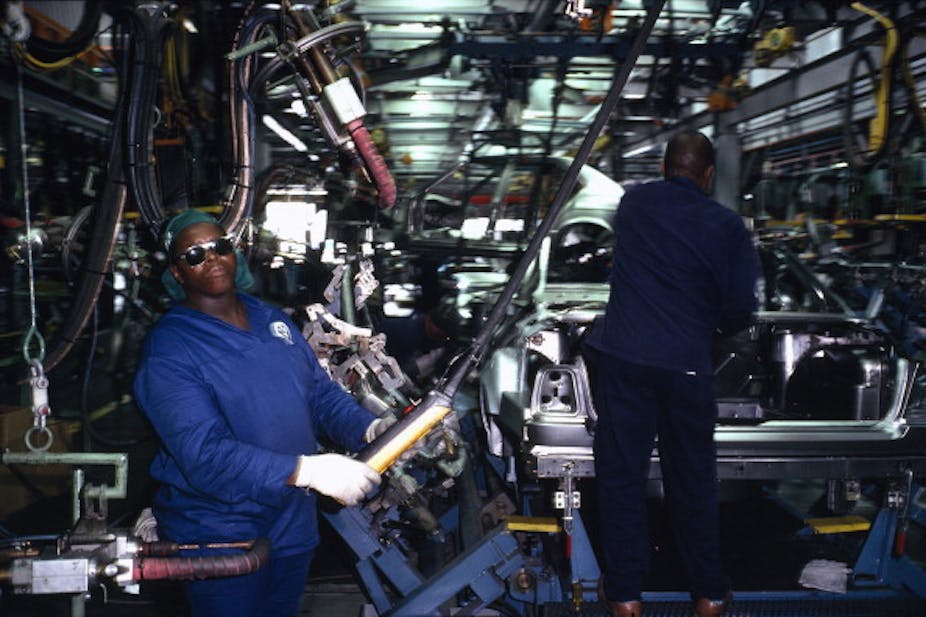
Technological innovation can indeed be beneficial for the working class. Photo by JNS/Gamma-Rapho via Getty Images
Narrative frames are fundamental to unifying ideologies. They frame what is possible and impossible, which ideas can be accepted and which must be rejected. In her book, Digital Democracy, Analogue Politics, storyteller and political analyst Nanjala Nyabola examines the framing of the Fourth Industrial Revolution narrative in this light.










 This ransom video supplied to Nikkei shows a handcuffed man being beaten with a stick while other victims watch in horror.

 CVD
CVD 