Minister of Foreign Affairs Bui Thanh Son signs the High Sea Treaty, a United Nations agreement on the conservation and sustainable use of marine biological diversity of areas beyond national jurisdiction. Photo by Thu HongVietnam on Wednesday signed the United Nations agreement on the conservation and sustainable use of marine biological diversity of areas beyond national jurisdiction, the High Sea Treaty.
The signing by Minister of Foreign Affairs Bui Thanh Son made Vietnam one of the first countries to sign the international-legally binding instrument under the 1982 United Nations Convention on the Law of the Sea (UNCLOS). It conveyed the message that Vietnam is a positive and responsible member of the international community as well as the country’s efforts to join hands with countries to deal with global issues, contributing to peace, prosperity and sustainable development.
More than 60 countries are scheduled to sign the agreement during the underway high-level week of the 78th UN General Assembly.
Pace International Law Review Volume 14 Issue 1 Spring 2002 Article 2 April 2002 Coastal State’s Jurisdiction over Foreign Vessels Anne Bardin Follow this and additional works at: https://digitalcommons.pace.edu/pilr Recommended Citation Anne Bardin, Coastal State’s Jurisdiction over Foreign Vessels, 14 Pace Int’l L. Rev. 27 (2002) DOI: https://doi.org/10.58948/2331-3536.1188 Available at: https://digitalcommons.pace.edu/pilr/vol14/iss1/2 This Article is brought to you for free and open access by the School of Law at DigitalCommons@Pace. It has been accepted for inclusion in Pace International Law Review by an authorized administrator of DigitalCommons@Pace. For more information, please contact dheller2@law.pace.edu.
We need only call to mind the first half of 2022 for an array of the extreme, energy-related global challenges we all face. Around the world, local versions of climate change effects—the temperatures, wildfires, droughts, storms, flooding—underscore how important it is for us to transition away from our overdependence on fossil fuels. And our energy sources don’t just have environmental implications but security ones as well. The Russian invasion of Ukraine is the latest rendition of the resource curse. At the heart of it all, fossil fuels are what enabled and amplified the murderous narcissism we see in Vladimir Putin and created a country with an unbalanced and unhealthy domestic economy able to profoundly destabilize energy flows and prices around the world.
The South China Sea (SCS) brings together its own assortment of these complex challenges and factors. Competing security concerns, resource needs, and nationalisms shape the motivations of the claimants. Much of the attention and conflict has centred on the oil and gas in the seabed. Estimates of SCS hydrocarbon volumes vary; only some of these resources are proven reserves that have been confirmed and measured, and are actually recoverable. But even in more generous assessments, the SCS only provides us with a small percentage of the global total of oil and gas reserves, and even less of the overall energy mix if we include non-fossil-fuel energy sources.
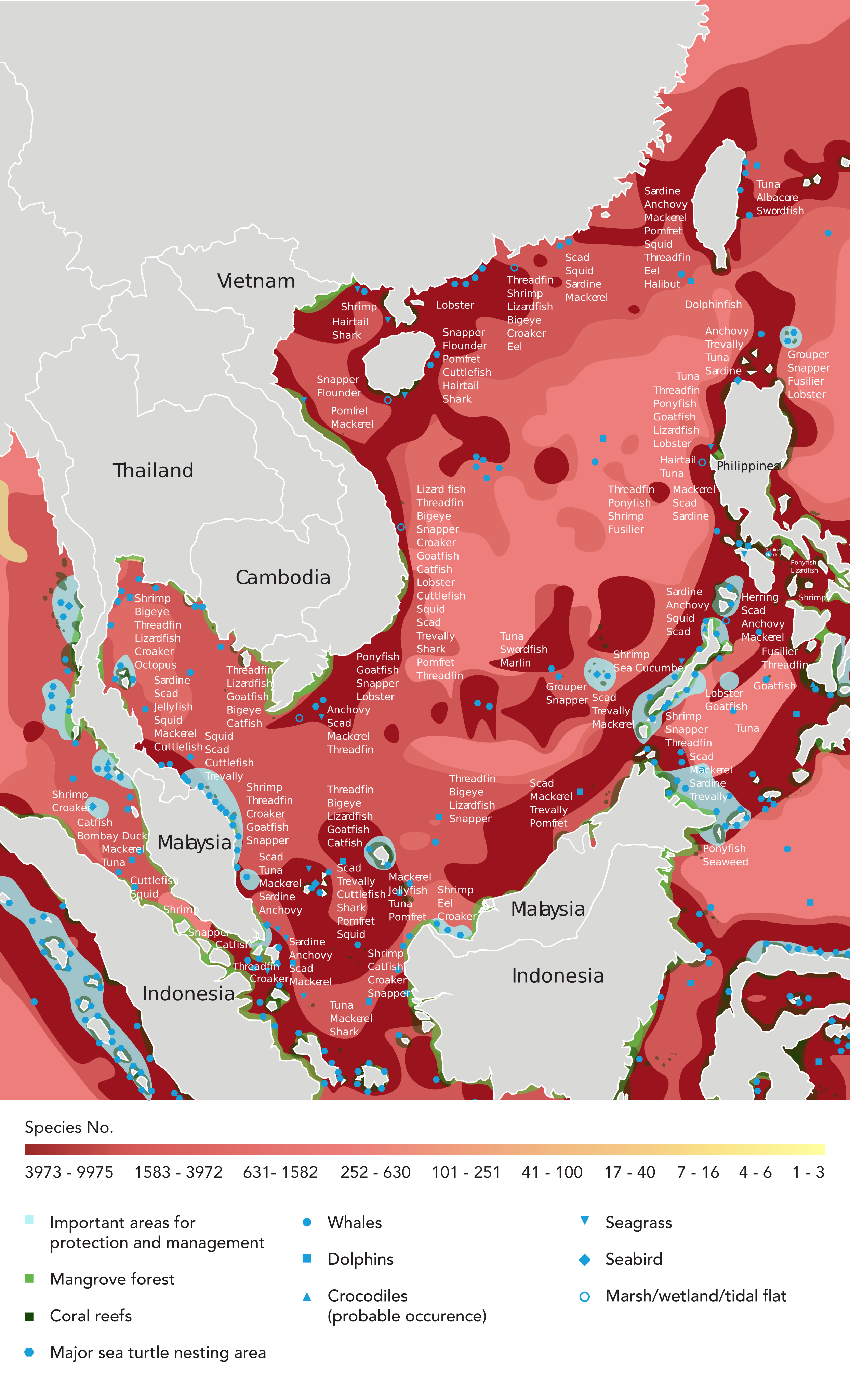
Beyond hydrocarbons, in a two-way tie with the adjacent Coral Triangle, the SCS has the highest level of marine biodiversity in the world. SCS fisheries feed and employ millions of people in the region. It’s true that conflict over these living marine resources also drives the territorial disputes in the region, and a wide variety of human activity degrades the SCS ecosystem. Yet drilling for hydrocarbons in the SCS threatens this vulnerable marine habitat even more, while also clearly contributing to geopolitical and security tensions in the region—and to climate change.
Given how destabilizing oil and gas pursuits have been for the SCS since the 1970s, we might ask ourselves whether we want to keep drilling for fossil fuels there. Do the costs and risks outweigh the benefits?
Download this 21-page report (button above) from Dr. Tabitha Grace Mallory, an inaugural John H. McArthur Research Fellow, an initiative of the Asia Pacific Foundation of Canada, and the Founder of China Ocean Institute and Affiliate Professor, Jackson School of International Studies, University of Washington.
Below, explore the rich marine biodiversity of the South China Sea, one of the most hotly-contested maritime jurisdictions on the planet, in this original map created by the author and APF Canada graphic designer Chloe Fenemore, based on historical and contemporary maps cited in the full report.
Tabitha Grace Mallory is the Founder of China Ocean Institute and Affiliate Professor, Jackson School of International Studies, University of Washington. Dr. Mallory specializes in Chinese foreign and environmental policy. She conducts research on China and global ocean governance and has published work on China’s fisheries and oceans policy.
Dr. Mallory is an inaugural John H. McArthur Research Fellow, an initiative of the Asia Pacific Foundation of Canada launched in 2021 to provide research opportunities for exceptional, mid-career scholars who are working on programs and research areas with direct relevance to Canada and Canada’s interests in Asia.
This photo taken on 20 August 2022, shows a worker sorting a fresh catch of fish at Sa Ky port on Vietnam’s offshore Ly Son island. Ly Son island, situated north-east of central Vietnam’s Quang Ngai province, is the country’s closest island to the disputed Paracel archipelago in the South China Sea region. (Photo: Nhac Nguyen / AFP)
This article is part of “UNCLOS 40th Anniversary Series – Why UNCLOS Matters” conceptualised by the Blue Security programme. The series, which commemorates the 40th anniversary of the U.N. Convention on the Law of the Sea, brings together established and emerging maritime security scholars from Southeast Asia and the broader Indo-Pacific to address the pertinence and relevance of UNCLOS. Blue Security brings together Australian and Southeast Asian experts to look at a range of maritime security issues across the region. The series was developed by Dr. Troy Lee-Brown and Dr. Bec Strating. It is published in collaboration with the team at Fulcrum.
UNCLOS’s relevance to Vietnam is significant, but the Convention must be updated if Vietnam and other signatories are to succeed in dealing with contemporary challenges in maritime affairs.





 CVD
CVD 