1 of 4 | A Japanese tourist smokes cannabis at a Dutch passion shop in Bangkok, Thailand, Tuesday, June 27, 2023. Thailand’s de facto legalization of marijuana last year has brought a wave of tourists from the region intrigued by the lure of the forbidden leaf.(AP Photo/Sakchai Lalit)
KASI, Laos — Five decades have elapsed since the signing of the Paris Peace Accords on Jan. 27, 1973 that led to the end of the Vietnam War. The long conflict devastated all of Indochina, and its aftermath continues to stymie the region’s economic development.
Early this month, specialists of the Laotian military detected unexploded ordnance (UXO) in the northern town of Kasi. The team of about 10 found one cluster bomb the size of a tennis ball and used a loudspeaker to warn residents while cordoning off nearby roads before disposing of the device.
The Independent Investigative Mechanism for Myanmar (IIMM) on Tuesday revealed compelling evidence of the country’s military and affiliate militias engaging in more frequent and audacious war crimes and crimes against humanity.
These include indiscriminate attacks on civilians from aerial bombing, mass executions of civilians and detained combatants, and large-scale and intentional burning of civilian homes and buildings, resulting in the destruction of entire villages in some cases, the Mechanism said in a news release.
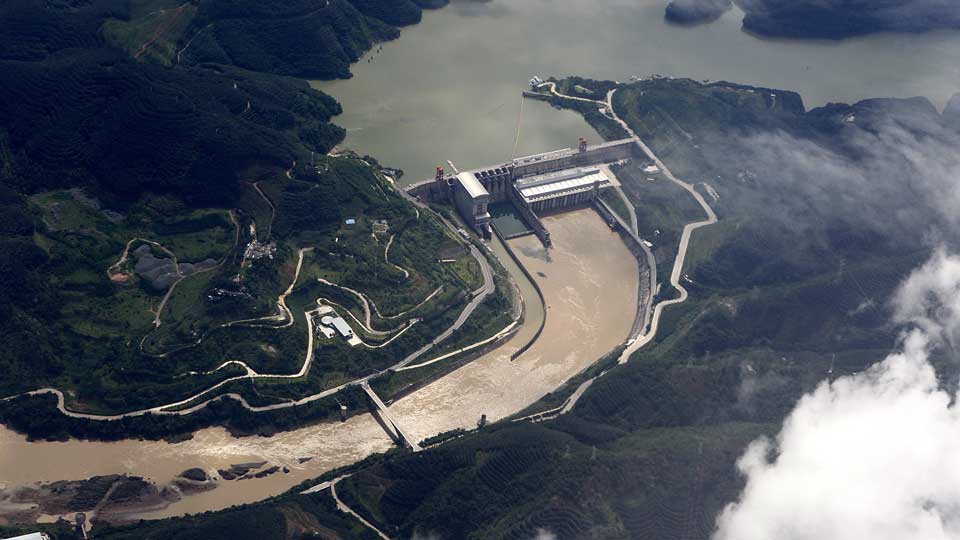
File image of the aerial view of the Jinghong Hydropower Station on the Lancang River, the Chinese part of the Mekong River, in Jinghong city, Xishuangbanna Dai Autonomous Prefecture, southwest China’s Yunnan province. Imaginechina Limited / Alamy Stock Photo
The rainy season would usually start in May, but this was late June and it was still not raining much. Niwat Roykaew, who grew up on the bank of the Mekong River in Thailand’s northern Chiang Rai province, noticed.
Born and raised in the Chiang Khong district, Roykaew, 63, was taught to observe the Mekong River to tell the season. But, in the past two decades, the river has become unpredictable like it has “pulsated out of tune”.
Niwat Roykaew is a Thai activist who campaigns for China to share data about water restrictions by its dams upstream.
“The water would get high for two days, then on the third day it would suddenly drop, even during the rainy season,” said Roykaew.
Local residents like him knew that this delay could mean another year of drought. Since at least 2019, that’s what has happened: the monsoon rain is late, and when it comes, it departs early.
The Mekong River’s water levels in the lower basin, including in Thailand, are now very unstable, being heavily affected both by climate change and hydropower dams upstream that are mostly powered by China, according to local residents, activists, and experts.
Civilians are being killed by Russian weapons just like in Ukraine, says special rapporteur Tom Andrews in call for global action
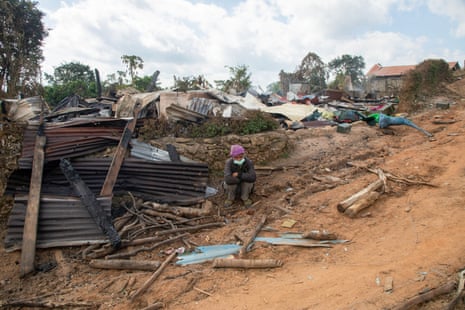
A man sits in front of a house destroyed by a Myanmar junta air strike. The UN special rapporteur for human rights there has called for an arms embargo. Photograph: SOPA Images/LightRocket/Getty Images
Rebecca Ratcliffe South-east Asia correspondentWed 15 Mar 2023 19.00 GMT
Myanmar is a “failing state” and the crisis is getting exponentially worse, a UN special rapporteur for the country has warned, urging countries to adopt the same unified resolve that followed the invasion of Ukraine.
“The same types of weapons that are killing Ukrainians are killing people in Myanmar,” Tom Andrews, special rapporteur on the situation of human rights in Myanmar, told the Guardian in an interview, citing the supply of Russian weapons to the junta since the coup two years ago. The junta relies heavily on aircraft from China and Russia, and has increasingly resorted to airstrikes to attempt to quell determined resistance forces.
The international response to Myanmar has been inadequate and some countries are continuing to enable the junta’s atrocities, Andrews said, calling for an arms embargo.
Rising fertilizer costs decimate poor Mekong farmers’ livelihoods despite their vital role in feeding millions.
BANGKOK, THAILAND ― Skyrocketing prices for fertilizers and agricultural production has pushed farmers in the Mekong region into severe debt and poverty.
Many have been forced to abandon their farms or have been unable to pay their debts and have lost their land, despite their roles in ensuring food security for millions of people.
“This is the worst year for farmers. Everything is more expensive, except rice prices, and they keep dropping,” said Prasert Tangthong, 58, a farmer with a small holding in Sing Buri province in central Thailand.
U.N. council adopts first Myanmar resolution in decades
UNITED NATIONS, Dec 21 (Reuters) – The U.N. Security Council adopted its first resolution on Myanmar in 74 years on Wednesday to demand an end to violence and urge the military junta to release all political prisoners, including ousted leader Aung San Suu Kyi.
Myanmar has been in crisis since the army took power from Suu Kyi’s elected government on Feb. 1, 2021, detaining her and other officials and responding to pro-democracy protests and dissent with lethal force.
It has long been split on how to deal with the Myanmar crisis, with China and Russia arguing against strong action. They both abstained from the vote on Wednesday, along with India. The remaining 12 members voted in favor.
“China still has concerns,” China’s U.N. Ambassador Zhang Jun told the council after the vote. “There is no quick fix to the issue … Whether or not it can be properly resolved in the end, depends fundamentally, and only, on Myanmar itself.”
He said China had wanted the Security Council to adopt a formal statement on Myanmar, not a resolution.
Russia’s U.N. Ambassador Vassily Nebenzia said Moscow did not view the situation in Myanmar as a threat to international peace and security and therefore believed it should not be dealt with by the U.N. Security Council.
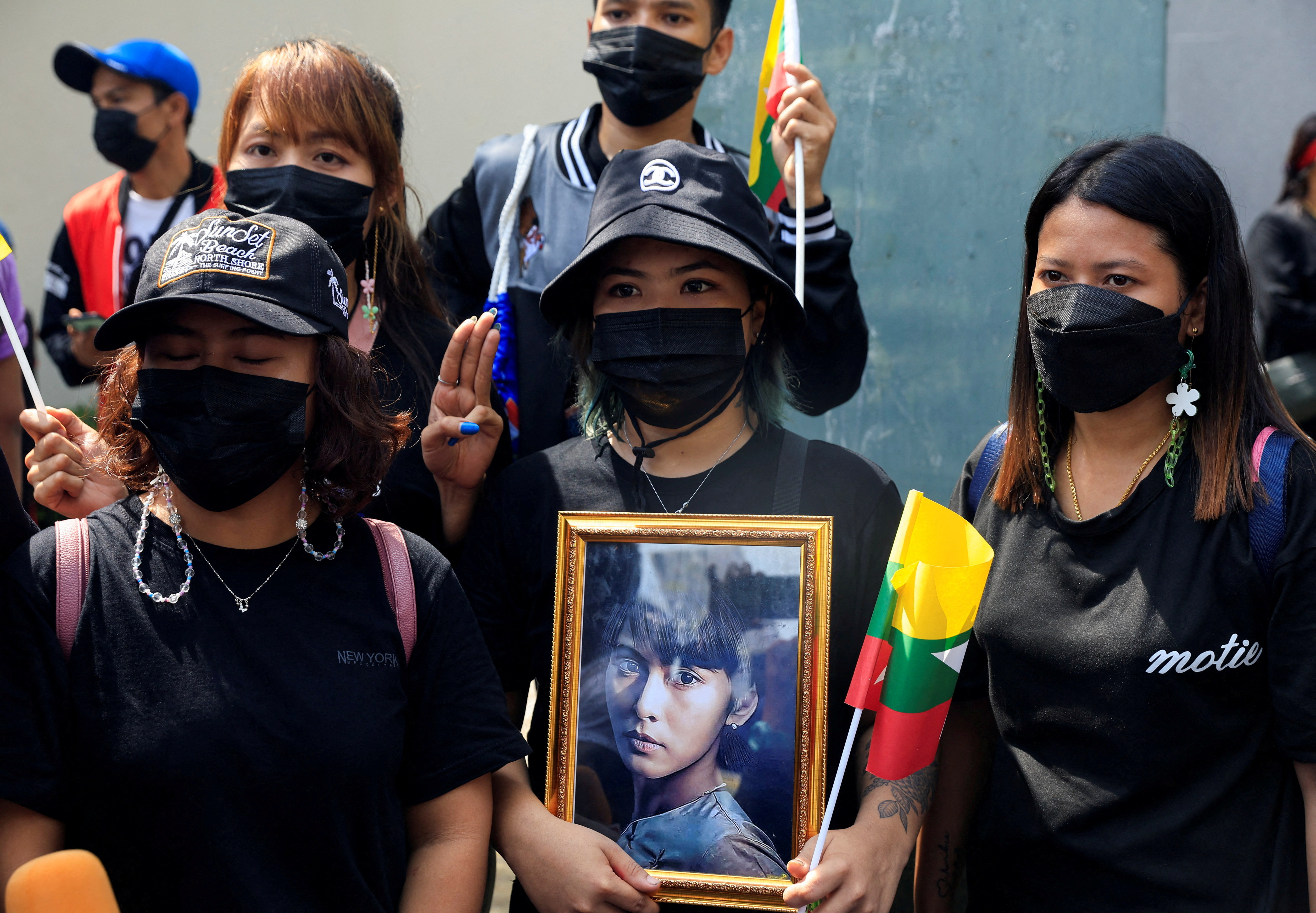
Myanmar citizens who live in Thailand, hold a portrait of former Myanmar state counsellor Aung San Suu Kyi as they protest against the execution of pro-democracy activists, at Myanmar embassy in Bangkok, Thailand July 26, 2022. REUTERS/Soe Zeya Tun
U.S. Secretary of State Antony Blinken welcomed the resolution’s adoption. “This is an important step by the Security Council to address the crisis and end the Burma military regime’s escalating repression and violence against civilians,” he said in a statement.
‘FIRST STEP’
Until now the council had only agreed formal statements on Myanmar, where the army also led a 2017 crackdown on Rohingya Muslims that was described by the United States as genocide. Myanmar denies genocide and said it was waging a legitimate campaign against insurgents who attacked police posts.
The 2022 ASEAN summit took place at the Cambodian capital Phnom Penh, this past weekend, with China as an official guest. At the event, Chinese Premier Li Keqiang announced Beijing’s approval of Chinese investment in significant infrastructure projects in the ASEAN region.
Among these is a US$1.6 billion expressway to be built from Phnom Penh to Bavet, at the Cambodian-Vietnamese border, and financial support for a rail link between Phnom Penh, Bangkok, and Vientiane, Laos, from which a high-speed rail link has already been constructed into China.
LTS. Gần 20 năm tâm huyết với các vấn đề trên dòng Mekong cũng như đồng bằng sông Cửu Long (ĐBSCL), bác sĩ Ngô Thế Vinh không chỉ là một nhà văn với hai tác phẩm Cửu Long cạn dòng, Biển Đông dậy sóng và Mekong – dòng sông nghẽn mạch, ông còn là một nhà hoạt động môi trường bền bỉ. Ông đã có những chuyến đi dọc dòng Mekong dài 4.800km, từ Tây Tạng đổ xuống Biển Đông. Người Đô Thị có cuộc phỏng vấn ông Ngô Thế Vinh về các vấn đề nóng bỏng hiện nay trên dòng Mekong và ĐBSCL.
Thưa, dù đã 17 năm trôi qua, từ những chuyến đi dọc dòng sông Mekong dài 4.800km, bức tranh sống động mà ông “phác họa” về những tác hại khủng khiếp do các con đập thủy điện gây ra cho đời sống người dân lưu vực sông Mekong đến nay vẫn nóng hổi tính thời sự. Từ những dự cảm rất sớm về những hậu quả do các đập thủy điện gây ra trên dòng Mekong và cho ĐBSCL nói riêng, ông nhận định gì về thực trạng hiện nay?
Năm 2000, khi nói “Cửu Long cạn dòng”, nhiều người xem đó là phát biểu “nghịch lý” bởi đó là năm có lụt lớn ở miền Tây. Một vị tu sĩ đang tất bật lo việc cứu trợ, mới nghe tên cuốn sách đã phát biểu: “Đang lũ lụt ngập trời với nhà trôi người chết mà lại nói “Cửu Long cạn dòng” là thế nào?” Nhưng cần hiểu rằng lũ và hạn tương ứng với mùa mưa và mùa khô là chu kỳ tự nhiên đã có hàng ngàn năm trên dòng Mekong và các vùng châu thổ, và đến nay thì mức độ càng trầm trọng và gay gắt.
Chúng ta không thể đổ lỗi hết cho “thiên tai”, mà cần can đảm gọi cho đúng tên những yếu tố “nhân tai” bởi do chính con người gây ra qua suốt quá trình phát triển không bền vững và có tính tự hủy từ nhiều thập niên qua, đã làm gãy đổ sự cân bằng của cả một hệ sinh thái vốn phức tạp nhưng cũng hết sức mong manh của dòng Mekong.
Băng qua Biển Hồ đến khu Bảo tồn sinh thái Tonle Sap (nguồn: tư liệu Ngô Thế Vinh)
Cambodian authorities have greenlit studies for a major hydropower dam on the Mekong River in Stung Treng province, despite a ban on dam building on the river that’s been in place since 2020.
Plans for the 1,400-megawatt Stung Treng dam have been around since 2007, but the project, under various would-be developers, has repeatedly been shelved over criticism of its impacts.
This time around, the project is being championed by Royal Group, a politically connected conglomerate that was also behind the hugely controversial Lower Sesan 2 dam on a tributary of the Mekong, prompting fears among local communities and experts alike.
This story was supported by the Pulitzer Center’s Rainforest Investigations Network where Gerald Flynn is a fellow.
STUNG TRENG, Cambodia — A long-dormant plan to build a mega dam on the mainstream of the Mekong River in Cambodia’s northeastern Stung Treng province appears to have been revived this year, leaving locals immediately downstream of the potential sites worried and experts confounded.
APORNRATH PHOONPHONGPHIPHAT, Nikkei staff writerAugust 24, 2022 16:12 JSTUpdated on August 24, 2022 20:08 JST
BANGKOK — Thailand’s Constitutional Court on Wednesday suspended Prime Minister Prayuth Chan-ocha from duty until it rules on a petition filed by opposition parties that the one-time army chief has served beyond the constitutionally mandated eight years.
Prayuth first awarded himself the prime minister post in 2014, after staging a military coup.
“The court has determined by a 5-4 vote to suspend Gen. Prayuth from the duties of Prime Minister from Aug. 24 onward until the court reaches a [final] verdict,” the court said in a statement.
While Prayuth remains suspended from duty, Deputy Prime Minister Prawit Wongsuwan will serve as a caretaker prime minister, said Wissanu Krea-Ngam, another deputy prime minister and the government’s legal expert. Prawit is the most senior deputy.
Challenging the regime’s legitimacy at home and abroad, Myanmar’s shadow National Unity Government (NUG) foreign minister Daw Zin Mar Aung, 45, has engaged with foreign governments and parliaments, international aid agencies and Myanmar’s many armed groups.
However, the elected lawmaker from the ousted National League for Democracy and winner of the 2012 International Women of Courage Award said international assistance is largely limited to moral support.
She exclusively tells The Irrawaddy about the importance of international support, including funding and arms, Myanmar’s friends and foes and how it receives different treatment from Ukraine.
It has been more than a year since the revolution against military rule was launched. We heard the revolution has received no assistance from foreign countries. Why is that?
It is mainly because the international community regards the crisis as a domestic issue if we compare it with the Ukraine war. It is widely believed that countries should not interfere in domestic affairs.
Yangon in February last year protests after the military coup.
11 February 2022 at 10:10 (Updated on 25 April 2022 at 14:37)
Data on agricultural, hydropower, saltwater intrusion and rainfall patterns in Vietnam Mekong Delta explains where the country’s food comes from, why it’s disappearing and what can be done about it.
The fertile Mekong Delta is a crucial region for Vietnam’s continued food and economic security but a variety of factors have wreaked havoc on how Vietnam grows food, catches fish and ultimately survives a radically changing environment. Here, reporters analyze 20 years of data on agricultural, hydropower, saltwater intrusion and rainfall patterns in Vietnam’s Mekong Delta (VMD) to explain where the country’s food comes from, why it’s disappearing and what can be done about it.
1. Disappearing waters
Vietnam’s flood plains are disappearing, and fish, rice and people along with it. The flood peak in Tan Chau and Chau Doc in 2020 is only about 60% of that in 2002. From now on, VMD will have to wait from 50 to 100 years to have a big flood season. Within 15 years, the amount of fish caught in An Giang has plummeted by two-thirds.
A general view of the future site of the Luang Prabang dam is seen on the Mekong River outskirt of Luang Prabang province, Laos, February 5, 2020. Photo by Reuters/Panu Wongcha-um
The Mekong River Commission (MRC) has unveiled the Xieng Kok water level monitoring station in Laos that’s expected to reduce downstream vulnerability to unexpected flows.
This could benefit millions who live downstream the Mekong River, an MRC Friday press release said.
Following is a joint statement on Armed Forces Day in Myanmar issued by the High Representative on behalf of the European Union and the Foreign Ministers of Albania, Australia, Bosnia and Herzegovina, Canada, Georgia, Iceland, Liechtenstein, Marshall Islands, the Federated States of Micronesia, Montenegro, New Zealand, North Macedonia, Norway, Palau, Republic of Korea, Serbia, Switzerland, Ukraine, the United Kingdom, and the United States.
Begin text:
On Armed Forces Day, we remember those killed and displaced by violence over the last year, including at least 100 people killed on this day alone one year ago.
Some countries continue to supply lethal assistance to Myanmar’s military regime, enabling its violence and repression. We urge all countries to support the people of Myanmar by immediately stopping the sale or transfer of arms, military equipment, materiel, dual-use equipment, and technical assistance to Myanmar, in line with UN General Assembly Resolution A/RES/75/287. We reiterate our call on the military to cease its violence and restore Myanmar’s path to democracy.