TTCT – Kỳ vọng một học sinh tốt nghiệp THPT có một nền tảng tiếng Anh đủ để giao tiếp với thế giới bên ngoài xem như càng xa vời, chẳng khác gì thời kỳ đề thi chỉ chú trọng ngữ pháp hay dịch.
Với học sinh lớp 12, tiếng Anh trong câu đố quá dễ, chắc chắn em nào cũng hiểu nghĩa nhưng một em giỏi tiếng Anh nhất nhưng ít khi chơi đố lắt léo cũng có thể lúng túng không biết “Tôi có thành phố nhưng không có nhà. Tôi có núi nhưng không có cây. Tôi có nước nhưng không có cá” là cái gì. Thế nên đây là câu đố mẹo chứ không phải thách đố tiếng Anh.
Hiện cả nước có trên 80 khu vực lấn biển, trong đó có khoảng trên 70 khu vực/dự án thuộc loại hình lấn biển, còn lại là các dự án đê chắn song, đường ống dẫn dầu…; có 19 tỉnh, thành phố ven biển phát triển các dự án lấn biển, với mục đích xây dựng cầu cảng, phát triển quỹ đất để xây dựng khu đô thị (KĐT), dân cư, du lịch, nghỉ dưỡng, khu công nghiệp… tiêu biểu như: Dự án đầu tư xây dựng, kinh doanh cơ sở hạ tầng khu công nghiệp – cảng biển – phi thuế quan Nam Đình Vũ (Hải Phòng), diện tích 1.329 ha; KĐT phức hợp Hạ Long Xanh tại thị xã Quảng Yên và TP. Hạ Long, với tổng diện tích đất ước tính khoảng 4.109,64 ha; KĐT du lịch Hùng Thắng (Bãi Cháy – Quảng Ninh), diện tích 224 ha; KĐT mới Hạ Long Marina (Hạ Long – Quảng Ninh), diện tích 230 ha; KĐT quốc tế Đa Phước (Đà Nẵng), diện tích 210 ha; KĐT sinh thái biển Phương Trang New Town (Đà Nẵng), diện tích 117 ha; KĐT mới Rạch Giá (Kiên Giang), diện tích 420 ha; Dự án Khu đô thị du lịch Cần Giờ, TP. Hồ Chí Minh, diện tích 2.870 ha [5].
Nearly as many U.S. adults have little or no confidence as have high confidence
WASHINGTON, D.C. — An increasing proportion of U.S. adults say they have little or no confidence in higher education. As a result, Americans are now nearly equally divided among those who have a great deal or quite a lot of confidence (36%), some confidence (32%), or little or no confidence (32%) in higher education. When Gallup first measured confidence in higher education in 2015, 57% had a great deal or quite a lot of confidence and 10% had little or none.
The latest results are based on a June 3-23 Gallup survey that gauged Americans’ confidence in various institutions. A follow-up story reporting on the remainder of institutions will be published in the coming days.
This year, Gallup and Lumina Foundation partnered to better understand the nature of confidence in higher education. The research includes the trend results reported above from Gallup’s June telephone survey as well as new results from a contemporaneous web survey of more than 2,000 Gallup Panel members.
A review of the historical trends shows that confidence has dropped among all key subgroups in the U.S. population over the past two decades, but more so among Republicans. Americans who lack confidence in higher education today say their concerns lie in colleges pushing political agendas, not teaching relevant skills, and being overly expensive.
Confidence in higher education among Republicans today is nearly a mirror image of what it was nine years ago. In 2015, 56% of Republicans had a great deal or quite a lot of confidence, and 11% had little or none. Now, 20% are confident and 50% have little or no confidence.
Republicans are not alone in having reduced confidence in higher education, as 35% of independents, down from 48% in 2015, and 56% of Democrats, down from 68%, are confident.
In the past year, all party groups have shown at least some increase in the percentage with very little or no confidence, and a decrease in the percentage saying they have some. None of the party groups shows meaningful change in high confidence over the past year.
Để đỗ trạng nguyên, nho sinh thường phải trải qua quá trình học tập vất vả, thuộc lòng nhiều sách kinh nghĩa, thông thạo làm thơ phú, ứng đối.
Theo “Đại Việt sử ký toàn thư”, nền khoa cử nước ta bắt đầu từ năm 1075, dưới thời vua Lý Nhân Tông.
Trong buổi đầu, thể lệ thi cử chưa ổn định. Về sau, theo sự phát triển của giáo dục và khoa cử, thể lệ thi cử ngày càng đi vào nền nếp, khuôn khổ, gồm 3 kỳ thi là Hương, Hội, Đình.
Nhiều vòng thi nghiêm ngặt
Thi Hương được tổ chức quy mô tỉnh hoặc liên tỉnh để chọn người vào thi Hội. Theo sách “Khâm Định Đại Nam Hội điển sự lệ”, kỳ thi Hương thời Nguyễn có ba vòng (tam trường) hoặc bốn vòng (tứ trường).
Việt Nam đang duy trì cách tiếp cận lạc hậu trong việc đào tạo lao động có kỹ năng cao.
Đội ngũ giảng viên doanh nghiệp – những người vẫn đang làm việc tại khối doanh nghiệp tham gia giảng dạy sinh viên – mới có vai trò chính trong việc hình thành kỹ năng thực tiễn cho người học. Ảnh: Fanpage TVET Viet Nam
“Để đảm bảo chất lượng sản phẩm, công ty sử dụng 100% lao động đã qua đào tạo. Những lao động đã qua đào tạo có kỹ năng về lý thuyết lẫn chuyên môn. Và cuối cùng là kỹ năng về nghề. Ba yếu tố này là rất cần thiết đối với doanh nghiệp” – Đó là phát biểu của ông Phan Quyết Long, Giám đốc Công ty TNHH Xây lắp Chế tạo và Cung cấp Thiết bị Công nghiệp Thành Long trong hội thảo trực tuyến “Xu hướng đào tạo nghề – Góc nhìn đa chiều’’ do Báo Kinh tế và Đô thị tổ chức.
Xuất phát từ chủ trương xã hội hóa các dịch vụ công cách đây gần 20 năm, việc các cơ sở giáo dục đại học đua nhau tăng học phí gần đây có thể khiến giáo dục đại học của Việt Nam phát triển không bền vững.
Khối ngành Y dược có học phí đắt nhất và tăng mạnh nhất trong những năm gần đây. Ảnh: Khoa Y dược, trường Đại học Y dược, Đại học Quốc gia Hà Nội.
Gần đây báo chí rầm rộ đưa tin mức học phí cho năm học 2024-2025 của nhiều trường đại học tăng đáng kể so với mức học phí năm học 2023-2024. Ví dụ, trường Đại học Y Dược (Đại học Quốc gia Hà Nội) tăng gấp đôi học phí so với năm học trước, lên đến 55 triệu đồng/năm. Sinh viên trường ĐH Luật TP.HCM năm học 2024-2025 phải đóng học phí cao hơn năm trước từ 4 triệu đến 16,5 triệu đồng/năm tùy chương trình. Trường ĐH FPT áp dụng mức học phí cho sinh viên nhập học mới năm 2024 với mức tăng học phí từ 1,8-2 triệu đồng/học kỳ.
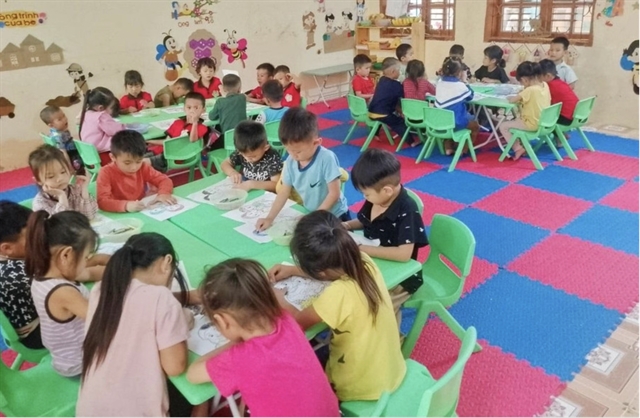
The policy of waiving tuition fees for five year olds has alleviated the financial burden on families and created opportunities for all children to attend school.
In a class of pre-school in Sơn La Province. Photo giaoducthoidai.vn
HÀ NỘI – As the new school year approaches, Lê Cẩm Vân and her husband in Thanh Hóa City of Thanh Hóa Province are anxiously preparing to pay the beginning-of-year school fees for their four children (two in primary school and two at five aged in pre-school class).
Vân said: “Both of us work freelance jobs with unstable incomes, so the start of each school year is very stressful, as we have to cover costs for fees, books, pens, and clothes for the children.
“This year, upon hearing that five-year-old pre-schoolers would be exempt from tuition fees, our whole family was overjoyed.
TTCT – Chương trình học tiếng Anh ở nhà trường phổ thông sẽ càng lạc lõng với sự phổ biến của AI tạo sinh nếu không chịu thay đổi để đáp ứng.
Cách dạy và thi tiếng Anh, từ không chuyên đến chuyên, ở Việt Nam vẫn như mấy chục năm trước, trong khi ta đã ở thời của trí tuệ nhân tạo (AI) tạo sinh, chuyện học và thực hành ngôn ngữ đã khác rất nhiều.
Inferring advantages for students with IELTS scores in the high school admission process may breed inequality, as not everyone has the means to study and take the test, the education ministry said.
Nguyen Xuan Thanh, head of the Department of Secondary Education under the Ministry of Education and Training, said there are four groups of students eligible for high school admission without taking the entrance exams in accordance with regulations from 2014: students at ethnic minority boarding schools; students of ethnic minorities; disabled students; and students with national prizes regarding culture, art, sports and science.
Certain other student groups get bonus points during the admission process, including children of war martyrs and invalids, as well as those living in areas with dire socioeconomic circumstances.
Students prepare to take a test for high school admision in HCMC, June 2023. Photo by VnExpress/Quynh Tran
Giáo dục của nước ta hiện nay vẫn bám vào cái triết lý “tạo ra con người mới xã hội chủ nghĩa”, dù chả biết cái con người ấy có đặc điểm gì, trong khi nền kinh tế đã chuyển sang mô hình thị trường, dựa trên kinh tế đa thành phần và hội nhập vào thế giới.
VNE – By Duong Tam January 25, 2024 | 10:01 am GMT+7
Students learn with a foreign teacher at Res English Language School in HCMC. Photo courtesy of Res
Students learn with a foreign teacher at Res English Language School in HCMC. Photo courtesy of Res The education ministry has requested foreigners teaching English at language centers in Vietnam to complete a training program, focusing on pedagogical skills.
Vu Minh Duc, head of the Teacher and Education Management Officials Department under the Ministry of Education and Training, said Tuesday that the program, which was introduced last month, aims to improve the quality of language teaching and learning in Vietnam.
Teachers at foreign language centers who must participate in this program include native English speakers, foreigners with an associate degree in English, or an associate degree along with a foreign language proficiency certificate of level 5 or higher according to the six-level foreign language competency framework used in Vietnam or equivalent.
Environmental activists from the Irish Wildlife Trust and Extinction Rebellion called on the Irish Government to introduce legislation in the form of a Biodiversity Act at a protest outside the National Biodiversity Conference in Dublin Castle on June 8, 2022. Credit: Niall Carson/PA Images via Getty Images
Ireland—a nation synonymous with its abundant, verdant landscapes—is considering a nationwide referendum on the rights of nature and the human right to a healthy environment.
If that happens, Ireland would become the first European country to constitutionally recognize that ecosystems, similar to humans and corporations, possess legal rights. More than two-thirds of the 27 European Union countries already recognize a universal human right to a healthy environment.
In December, a legislative committee proposed that the Irish government take a series of administrative measures to draft proposed constitutional amendments recognizing that nature has inherent rights to exist, perpetuate and be restored, and that humans have a right to a clean environment and stable climate.
To take legal effect, the proposed amendments must be approved by both houses of parliament, the Dáil Éireann (the lower house) and the Seanad (the upper house), and win a majority of the popular vote.