Roadside BBQ parties a headache in Ho Chi Minh City’s new urban area

Sunday, November 24, 2019, 17:03 GMT+7 Tuoi Tre
Roadside BBQ parties a headache in Ho Chi Minh City’s new urban area
A group of young people throw a BBQ party on the sidewalk in the Thu Thiem New Urban Area in District 2, Ho Chi Minh City. Photo: Thao Le / Tuoi Tre

Buying first home remains a pipe dream for young Vietnamese

By Dat Nguyen   November 1, 2019 | 11:10 am GMT+7

Buying first home remains a pipe dream for young Vietnamese

Apartment buildings seen in Hoang Mai District, Hanoi. Photo by VnExpress/Nhat Quang.

Surging prices and a decline in the supply of affordable apartments are making it almost impossible for young Vietnamese to buy their first home.

Pham Hoai Nam used to think that being a grown-up means having a stable job, a good salary, a beautiful girlfriend, and his own house.

Now, at age 28, he is able to check off all of those items except the last one.

“My girlfriend and I plan to get married next year, and our only major concern now is finding a place to live,” Nam, who works as an electronics salesman in Hanoi, says.

He is among many young Vietnamese in major cities who are finding that their dream of owning a home is becoming increasingly elusive as real estate prices rise faster than incomes amid a decline in affordable apartment supply.

Tiếp tục đọc “Buying first home remains a pipe dream for young Vietnamese”

Đà Lạt nhìn từ flycam: thành phố bêtông chứ đâu phải thành phố trong rừng?

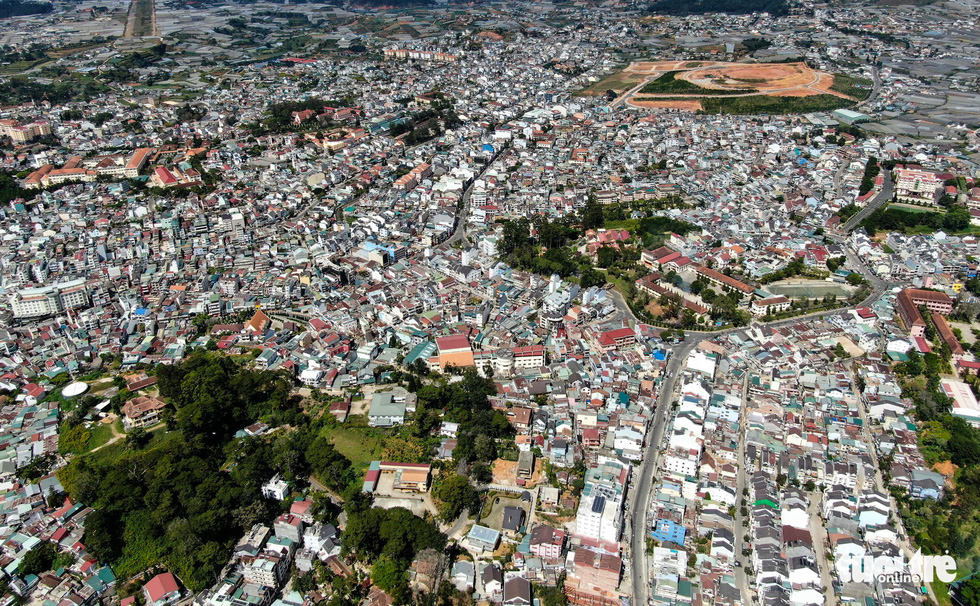
Khi dùng thiết bị bay chụp ảnh (flycam) ở độ cao hơn 300m, phóng viên Tuổi Trẻ ghi nhận rừng nội ô Đà Lạt không còn, đặc biệt trong bán kính 4km tính từ hồ Xuân Hương.

TTO 24/03/2019 10:50 GMT+7

Ngay từ khi hình thành, Đà Lạt đã được mệnh danh “thành phố trong rừng – rừng trong thành phố”. Nhưng hoạt động xây dựng thiếu kiểm soát đã khiến phong cách đô thị đặc biệt của thành phố này biến dạng, lộn xộn.

Vùng nội ô Đà Lạt ở được chụp ở độ cao khoảng 300m, có thể thấy bê tông lấn lướt, chỉ còn vài mảng xanh rải rác trong khu vục đô thị

Nếu không tính đồi Cù (sân golf do tư nhân quản lý), các rừng phòng hộ ở khu vực ngoại ô như đèo Prenn (khu vực ngoại ô), đèo Tà Nung và những khu vực cách xa trung tâm Đà Lạt (hơn 18km) như xã Xuân Trường, Trạm Hành thì có thể nói Đà Lạt đã không còn mảng xanh. Tiếp tục đọc “Đà Lạt nhìn từ flycam: thành phố bêtông chứ đâu phải thành phố trong rừng?”

Japanese investors flock to VN real estate

Last update 11:26 | 15/03/2019

Even though the Vietnamese property market is dominated by Singaporean and South Korean developers, Japanese investors are trying to climb closer to the top spot. Bich Ngoc reports.

Japanese investors flock to VN real estate, vietnam economy, business news, vn news, vietnamnet bridge, english news, Vietnam news, news Vietnam, vietnamnet news, vn news, Vietnam net news, Vietnam latest news, Vietnam breaking news

Japanese investors are increasingly attracted to the Vietnamese real estate market

For the past year, many Japanese investors have co-ordinated with Vietnamese counterparts to develop ­property projects in the country.

The largest project to come from Japanese investment so far, Sumitomo and BRG Group are expected to start construction of a $4.2 billion smart city in Hanoi this year. Tiếp tục đọc “Japanese investors flock to VN real estate”

Satellite Images Can Harm the Poorest Citizens

theatlantic

In Ho Chi Minh City, computer analysis of orbital images overlooks some urban communities. To represent them, cities will have to put boots on the ground.

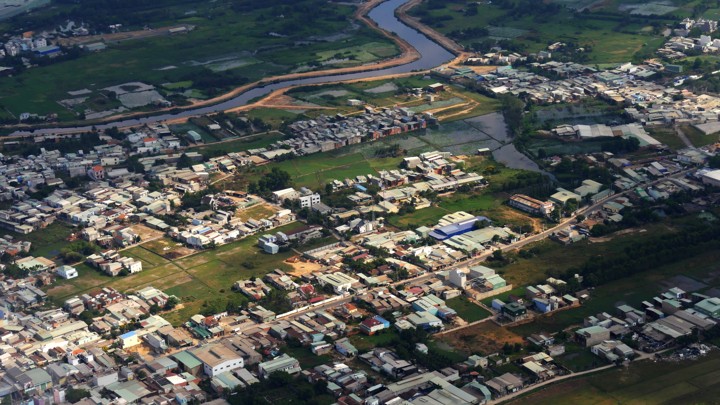
An aerial view of the outskirts of Ho Chi Minh CityAn aerial view of the outskirts of Ho Chi Minh CityRAKSYBH / SHUTTERSTOCK

Mapping a city’s buildings might seem like a simple task, one that could be easily automated by training a computer to read satellite photos. Because buildings are physically obvious facts out in the open that do not move around, they can be recorded by the satellites circling our planet. Computers can then “read” these satellite photographs, which are pixelated images like everyday photographs except that they carry more information about the light waves being reflected from various surfaces. That information can help determine the kind of building material and even plant species that appears in an image. Other patterns match up with predictable objects, like the straight lines of roads or the bends of rivers.

It turns out to be more complicated than that. When three different research groups (including my own at the University of Southern California) processed almost the same images of Ho Chi Minh City’s rapid urbanization during the 2000s, we produced different results. All three groups agreed on the location of the city center, but mine mapped the city’s periphery differently. That’s the place where most megacities in the global South exhibit their most dramatic physical growth. In particular, we identified more of the informal, self-built housing in the swampier southern area of the city.
Tiếp tục đọc “Satellite Images Can Harm the Poorest Citizens”

Đảo ngọc Phú Quốc bị băm nát: Vỡ vụn trước khi thành đặc khu

TPHơn 15 năm qua, “Hòn Ngọc biển Tây” đã thay đổi chóng mặt. Ðạt được một số thành tựu vượt bậc, song Phú Quốc đang phải trả giá cho sự phát triển “nóng” của mình. Ðó là đất đai bị “băm nát”, xã hội nảy sinh nhiều vấn đề phức tạp, trong khi chính quyền huyện đảo tỏ ra bất lực…

Giáo sư đầu ngành Thủy lợi: Dân Hà Nội phải “lội nước khi mưa” ít nhất hàng chục năm nữa!

LĐO | 

Mưa lớn đã giảm nhưng nhiều xã ngoại thành vẫn sống chung trong biển nước. Ngập lụt là câu chuyện “đến hẹn lại lên” của Hà Nội. Trao đổi với PV báo Lao Động GS.TS Trần Viết Ổn – Phó Hiệu trưởng Trường Đại học Thủy lợi nhận định, còn khá lâu nữa người dân ở đây mới hết cảnh ngập.

Toàn cảnh thôn Bùi Xá – Thị Trấn Xuân Mai – Quốc Oai – Hà Nội ngập chìm trong biển nước mênh mông. Video: Văn Thắng

Tiếp tục đọc “Giáo sư đầu ngành Thủy lợi: Dân Hà Nội phải “lội nước khi mưa” ít nhất hàng chục năm nữa!”

DEFENDING LAND AND ENVIRONMENTAL RIGHTS HAS BECOME AN INCREASINGLY DEADLY ENDEAVOR

THEY WERE KILLED by their own army. On December 3, while members of the Taboli-manubo people on the Philippine island of Mindanao were farming and doing housework, the army began shelling their neighborhood and spraying them with gunfire from all directions. Eight people were killed.

The dead included Datu Victor Danyan, a leader of protests against the expansion of a coffee plantation by an agribusiness firm, and four of his family members. Danyan had long been involved in resisting the company, Silvicultural Industries Inc., whose operation had taken over ancestral land and threatened the community’s livelihood. More were injured in the attack, and 200 were forced to evacuate the area, abandoning the fields they had sought to preserve. While the Taboli-manubo people believe the cause of the attack was their resistance to Silvicultural Industries, the Philippine army disputes this.

This was one of many attacks on land and environmental defenders in 2017 recorded by Global Witness, which defines such defenders as those who take peaceful action when land, forests, or rivers are encroached upon by industry, whether as members of the local community, or as activists, journalists, or lawyers. Tiếp tục đọc “DEFENDING LAND AND ENVIRONMENTAL RIGHTS HAS BECOME AN INCREASINGLY DEADLY ENDEAVOR”

The truth about the lie of the land

Last update 10:00 | 03/06/2018

VietNamNet Bridge – It was Mark Twain who inimitably said: “Buy land, they are not making it anymore.”

Land management, urban land management, Vietnam economy, Vietnamnet bridge, English news about Vietnam, Vietnam news, news about Vietnam, English news, Vietnamnet news, latest news on Vietnam, Vietnam
An overview of the South Saigon urban area, HCM City. Illustration. — VNA/VNS Photo

Sound advice when land is turned into a commodity that is bought and sold in a “free market,” but this is a mythical entity for many people in Vietnam, because they can only dream of owning a piece of land or a home in the nation’s urban areas.

Theoretically, though, as per the nation’s charter, all of the country’s geographical features – land, water bodies, underground minerals as well as resources deep under the sea belong to “the people,” but the State represents the people in managing them – making the State the highest authority.

It is but natural then that the State’s management of this most precious resource comes under close, critical scrutiny.

The onus, then, is on the Vietnamese State to manage this resource effectively and equitably, and despite some major steps taken in the past towards equitable distribution, its record of late has left a lot to be desired. Tiếp tục đọc “The truth about the lie of the land”

Một ngày với hành trình ‘đòi đất’ của người dân Thủ Thiêm ở Hà Nội

NN – 11/05/2018, 09:11 (GMT+7) Trong khi ở Thành phố Hồ Chí Minh, người dân Thủ Thiêm đang uất nghẹn, ngất xỉu với những cuộc tiếp xúc cử tri thì ở Hà Nội, nơi có một địa điểm vẫn được gọi là “làng Thủ Thiêm giữa Thủ đô”, hành trình đi đòi công lý vẫn đang miệt mài.

13-53-57_thu_thiem1
Bữa cơm của người dân Thủ Thiêm ở Hà Nội

Tiếp tục đọc “Một ngày với hành trình ‘đòi đất’ của người dân Thủ Thiêm ở Hà Nội”

The Greater Mekong Subregion: Rural no more

By 2030, more than 40% of the population in the Greater Mekong Subregion will be living in cities. Photo: ADB.By 2030, more than 40% of the population in the Greater Mekong Subregion will be living in cities. Photo: ADB.

greatermekong – The subregion is one of the least urbanized areas in the world, but its cities are growing and their economic impact is being felt. 

Urbanization levels in the Greater Mekong Subregion are low, ranging from 19.5% in Cambodia to 44.2% in Thailand. However, in all GMS countries, urban areas account for a much larger percentage of the gross domestic product (GDP)—at least half in most countries and about 75% in Thailand—than the share of its national populations.

Urbanization growth rates in the subregion range from 4.9% annually in Yunnan Province, People’s Republic of China (PRC) —six times the provincial population growth rate—to a low of 2.6% annually in Myanmar—1.7 times the national population growth rate. Tiếp tục đọc “The Greater Mekong Subregion: Rural no more”

What’s Up in Coal Country: Alternative-Energy Jobs

NYtimes_From the mountain hollows of Appalachia to the vast open plains of Wyoming, the coal industry long offered the promise of a six-figure income without a four-year college degree, transforming sleepy farm towns into thriving commercial centers.

But today, as King Coal is being dethroned — by cheap natural gas, declining demand for electricity, and even green energy — what’s a former miner to do?

Nowhere has that question had more urgency than in Wyoming and West Virginia, two very different states whose economies lean heavily on fuel extraction. With energy prices falling or stagnant, both have lost population and had middling economic growth in recent years. In national rankings of economic vitality, you can find them near the bottom of the pile. Tiếp tục đọc “What’s Up in Coal Country: Alternative-Energy Jobs”

Vietnam seeks solutions for problems caused by rapid urbanization

Last update 16:02 | 17/12/2017

Vietnam is facing numerous challenges caused by rapid urbanization, leaving burdens on its technical and social infrastructure and leading to many severe consequences. In this context, finding solutions for sustainable urban development is one of Vietnam’s current top priorities.

Vietnam seeks solutions for problems caused by rapid urbanization, social news, vietnamnet bridge, english news, Vietnam news, news Vietnam, vietnamnet news, Vietnam net news, Vietnam latest news, vn news, Vietnam breaking news

Vietnam is struggling with many challenges caused by its rapid urbanization, which is among the fastest in the region.

There are a total of 800 urban areas across Vietnam with a current urbanization percentage of around 37%. This figure is expected to increase by 50% by 2025. Tiếp tục đọc “Vietnam seeks solutions for problems caused by rapid urbanization”

Germany’s Transition from Coal to Renewables Offers Lessons for the World

Scientificamerican.org  
Germany's Transition from Coal to Renewables Offers Lessons for the World
Credit: Krisztian Bocsi Getty Images

From Ensia (find the original story here), from an article commissioned by Courier; reprinted with permission.

August 1, 2017—Seventy-seven-year-old Heinz Spahn—whose blue eyes are both twinkling and stern—vividly recalls his younger days. The Zollverein coal mine, where he worked in the area of Essen, Germany, was so clogged with coal dust, he remembers, that people would stir up a black cloud whenever they moved. “It was no pony farm,” he says—using the sardonic German phrase to describe the harsh conditions: The roar of machines was at a constant 110 decibels, and the men were nicknamed waschbar, or “raccoons,” for the black smudges that permanently adorned their faces. Tiếp tục đọc “Germany’s Transition from Coal to Renewables Offers Lessons for the World”

Super satellite city planned in Hanoi

Last update 17:20 | 05/12/2017

Hanoi plans to construct a super satellite city by 2030, with a total area of over 17,270ha located in two districts of Thach That and Quoc Oai and Son Tay Town.

Super satellite city planned in Hanoi, social news, vietnamnet bridge, english news, Vietnam news, news Vietnam, vietnamnet news, Vietnam net news, Vietnam latest news, vn news, Vietnam breaking news

The super satellite city on paper.— Photo tienphong.vn

The Hoa Lac super satellite city will be some 30km from Hanoi’s centre.

The plan is part of the master plan of Hoa Lac Urban Area, compiled by the municipal People’s Committee and recently submitted to the municipal People’s Council for approval. Tiếp tục đọc “Super satellite city planned in Hanoi”