Shipping data: UNCTAD releases new seaborne trade statistics

UNCTAD.org 23 April 2025

Maritime transport moves over 80% of goods traded worldwide. Country-level seaborne trade data is vital for shaping better transport, trade and investment policies.
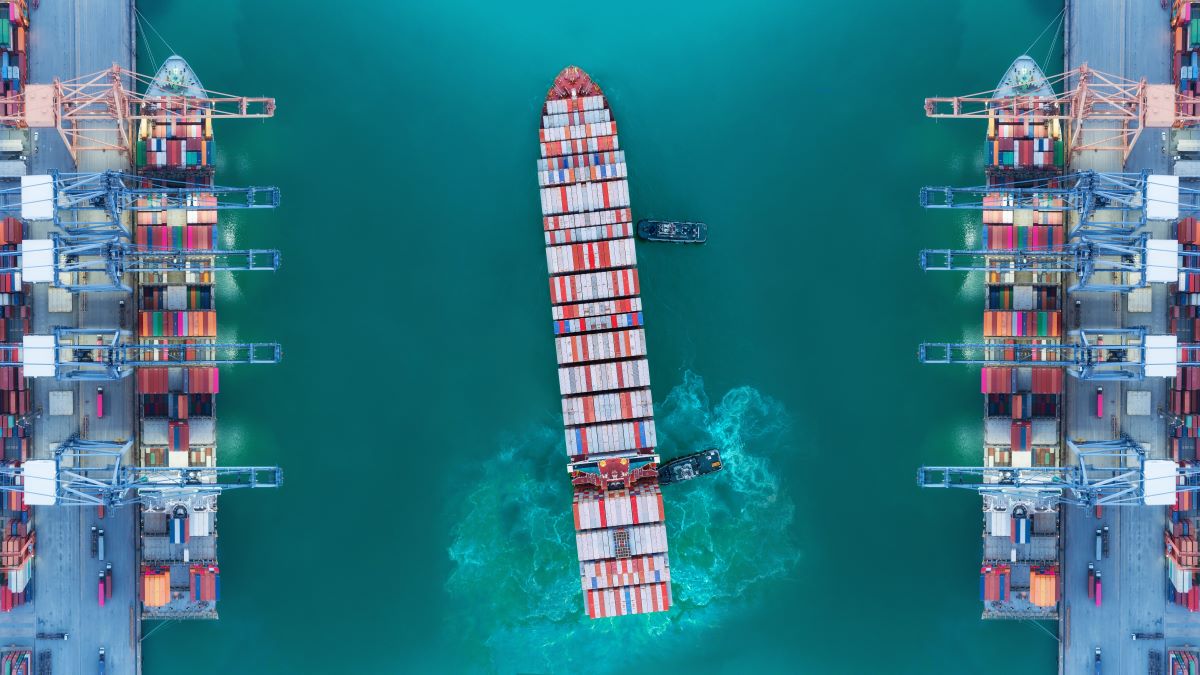
An aerial view of a container vessel leaving port
Default image copyright and description© Shutterstock/Studio conept

UN Trade and Development (UNCTAD) released on 15 April new seaborne trade dataFor the first time, the dataset includes country-level statistics.

Maritime transport is the backbone of global trade, moving over 80% of goods traded worldwide by volume. It connects global value chains, carrying raw materials and semi-processed goods to production hubs and delivering finished products to consumers. These flows are vital for industrialization, economic growth and job creation.

Seaborne trade has evolved over the decades, shaped by containerization, the rise of developing economies and shifting production and consumption patterns. Today, digitalization, geopolitics and the push for sustainability and climate resilience are redefining the sector.

A clearer picture of who ships what – and how much

Reliable, up-to-date country-level data is key to understanding trade flows and guiding better transport and trade policies and investment decisions.

Built from official trade data reported by governments to UN Comtradethe new dataset offers a more accurate and comparable view of global maritime cargo movements, helping countries to:

  • Monitor trade performance and competitiveness.
  • Assess integration into global supply chains and trade networks.
  • Inform port and transport infrastructure investment decisions.
  • Track progress on Sustainable Development Goal 9.1.2 to develop quality, reliable, sustainable and resilient infrastructure – for which maritime freight and port cargo volumes are indicators.

Data highlights developing countries’ rising share of maritime trade

Historically, developing countries served mainly as loading hubs – major exporters of raw materials but marginal importers of manufactured goods. But this has evolved since the 1970s, driven by structural changes such as the oil crises, trade liberalization, increased private sector participation in port operations, the rise of container shipping and reforms to liner shipping alliances.

The shift accelerated in the early 2000s as developing countries increased trade among themselves – including in raw materials, oil and manufactured goods. Their share of global maritime freight rose from 38% in 2000 to 54% in 2023. The surge was led by Asia, with China driving much of the growth.

Read full article here https://unctad.org/news/shipping-data-unctad-releases-new-seaborne-trade-statistics

Which countries are most exposed to the EU’s proposed carbon tariffs?

resourcetrade.earth Chris Kardish, Mattia Mäder, Mary Hellmich, and Maia Hall, 20 August 2021

The European Union (EU) is moving ahead with the world’s first border tax on the carbon content of imported goods which aims to strengthen its increasingly ambitious climate targets and policies, but is attracting criticism. How would it work and which trading partners are most vulnerable to its impacts?

Steel mill in Novokuznetsk, Russia. (Sergei Bobylev\TASS via Getty Images)

Contents

The EU is accelerating its climate ambition over the coming decade to support its 2050 long-term strategy of reaching net-zero greenhouse gas (GHG) emissions. Key aspects of this acceleration include raising its emissions reduction target from 40 per cent to at least 55 per cent below 1990 levels by 2030 and implementing a sweeping set of policy changes – especially to its flagship emissions trading system (ETS) which puts a price on pollution by requiring companies to purchase allowances for their emissions.

The costs of the allowances have skyrocketed recently and now hovers around record levels of €50 per tonne of carbon dioxide equivalent or above. This is due – at least in part – to those participating in the market expecting a tighter supply of allowances as the EU increases its climate targets. Prices are expected to continue rising over the coming decade as the EU implements its ambitious climate agenda.

Tiếp tục đọc “Which countries are most exposed to the EU’s proposed carbon tariffs?”

Advancing human rights through trade

chathamhouse.org

Why stronger human rights monitoring is needed and how to make it work

Political shifts, the impact of the COVID-19 pandemic, and the struggle for a shared vision of how to ‘build back better’, have reignited the debate about trade and human rights. 

Although many trade agreements take human rights impacts into consideration, the monitoring systems that have emerged so far are not comprehensive. Without robust human rights monitoring, trading partners have little chance of ensuring that their counterparts are meeting their commitments.

While there are considerable structural, political and resource-related challenges to conducting more systematic and effective human rights monitoring, recent experiences in this field can help policymakers design more effective monitoring mechanisms for the future.

Tiếp tục đọc “Advancing human rights through trade”

Succeeding in China’s $9.4 T E-commerce Market: Why Culture and Context Matters

asiapacfic.ca

China’s cross-border e-commerce has been growing in recent years in terms of both volume and value. With increasingly sophisticated customers who have rapidly evolving expectations, Asia’s largest economy is expected to become the world’s largest e-commerce market by 2020, with e-commerce transactions expected to reach almost 50 trillion yuan, or approximately C$9.4 trillion.

This report is intended for Canadian firms contemplating expansion into e-commerce in China. In addition to providing an overview and statistics, as well as primary data insights into key challenges and considerations, the report also offers two case studies to provide further insights into this explosive sector in China.

Read our infographic summary of the report below, or click the download button to read the full text.
Tiếp tục đọc “Succeeding in China’s $9.4 T E-commerce Market: Why Culture and Context Matters”

Vietnam files complaint with WTO over US solar tariffs

pv-magazine.com

The Vietnamese authorities have submitted a complaint to the World Trade Organization (WTO) to request formal consultations with Washington over its recently announced 30% tariff on crystalline silicon PV imports.

Vietnam’s capital market increasingly attractive

Last update 17:12 | 27/10/2017

With its steady economic growth, political stability, a youthful population, and equitisation of State-owned enterprises, Viet Nam’s securities market is attractive to investors, the Gateway to Vietnam Conference heard in HCM City on October 25.

Vietnam’s capital market increasingly attractive, vietnam economy, business news, vn news, vietnamnet bridge, english news, Vietnam news, news Vietnam, vietnamnet news, vn news, Vietnam net news, Vietnam latest news, Vietnam breaking news

Deputy Prime Minister Truong Hoa Binh speaks at Gateway to Vietnam 2017, which is being held in HCM City from October 25-27, with the participation of 25 Vietnamese leading companies together with nearly 200 domestic and foreign investment funds.

Deputy Prime Minister Truong Hoa Binh said the country’s population of nearly 100 million, of whom 60 per cent are under 35, is a source of cheap and skilled labour. Tiếp tục đọc “Vietnam’s capital market increasingly attractive”

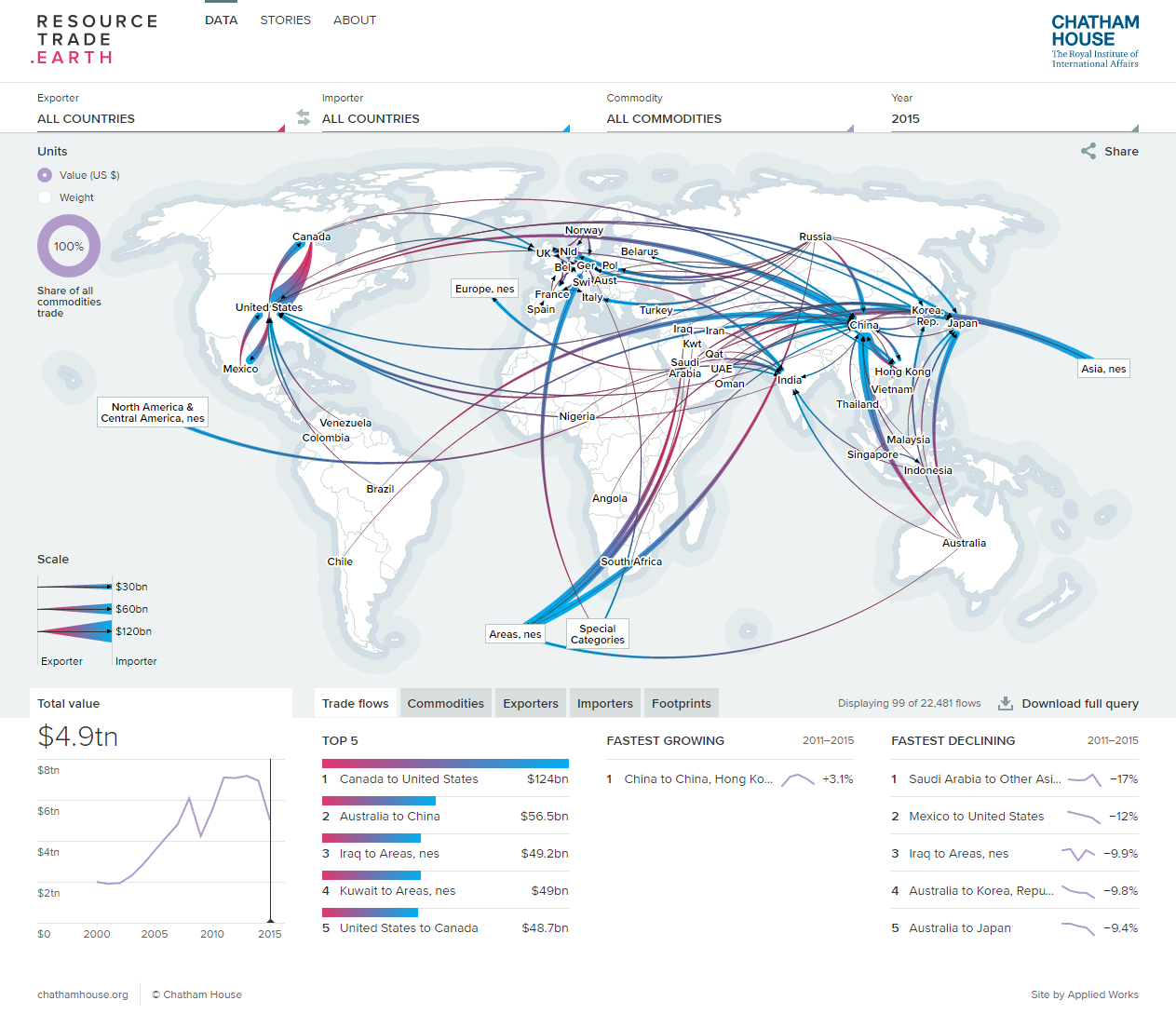
Exploring Interdependencies in Global Resource Trade

resourcetrade.earth features powerful interactive visualisations that provide easy access to an extensive and authoritative database of international trade in natural resources, developed from United Nations data. The Chatham House Resource Trade database reorganizes UN Comtrade data into a natural resource hierarchy, covering trade in over 1,350 different types of natural resources and resource products, including agricultural, fishery and forestry products, fossil fuels, metals and other minerals, and pearls and gemstones. The site allows users to easily interrogate resource trade flows between more than 200 countries and territories since the year 2000, by monetary value and by weight, at varying degrees of granularity and aggregation.The political economy of natural resources is increasingly shaped by large, structural shifts in the changing natural environment, in the deepening interrelationship between resource systems and actors, and in the rebalancing of global income and power. We consider these dynamics in the stories section of the site, which provides detailed explorations of different facets of resource trade and the economic, political, and environmental implications of resource interdependencies. Featuring expert analysis and insights from Chatham House and others, this section will continue to expand with new content over time. We launch with an overarching look at the scale and significance of resource trade, and Professor Tim Benton considers the state of agricultural trade, food security, and the potential impacts of an outbreak of protectionism affecting the key food commodities.


For the first time, resourcetrade.earth opens up complex patterns of resource trade for examination by non-experts as well as policy-makers, civil society groups, business analysts, and everyone with an interest in resource trade dynamics and their environmental impacts.

Tự do lựa chọn


Chào các bạn,

Sự phát triển của các hệ thống quản lý kinh tế chính trị đều nhằm mục đích, nói đến tận cùng, là tự do lựa chọn cho mỗi người.

Khi nghèo thì ta chỉ có 5, 7 món ăn để chọn lựa cả năm. Khi giàu thì có cả trăm món để lựa chọn.

Trang phục, xe cộ, trường học… cũng thế. Đó là chưa nói đến lựa chọn nhà cửa, nơi giải trí, nơi nghỉ hè… Tiếp tục đọc “Tự do lựa chọn”

“Một vành đai, Một con đường:” Có gì trong đó cho ta?

English: “One Belt, One Road:” What’s in It For Us?

Ý kiến tại hội thảo của Viện nghiên cứu biển Trung Quốc

Cầu cao tốc Beipanjiang tại tỉnh Quý Châu, Trung Quốc (Ảnh: Glabb / trên trang Wikimedia Commons)

Alexander Đại đế là người được cho là đã tuyên bố: “người lo hậu cần là những kẻ không hề hài hước…họ hiểu rằng nếu chiến dịch của ta thất bại, chúng là những kẻ đầu tiên ta xử tử.” Alexander Đại đế là một trong những chiến lược gia đầu tiên hiểu được tầm quan trọng của việc kết nối và cũng là người đầu tiên chỉ ra rằng chẳng có gì đáng cười về điều này. Tốc độ và độ tin cậy của việc vận chuyển và các dạng liên lạc khác có ý nghĩa rất lớn đối với hiệu quả kinh tế cũng như đối với chiến tranh. Tiếp tục đọc ““Một vành đai, Một con đường:” Có gì trong đó cho ta?”