All the Metals We Mined in One Visualization

 visualcapitalist.com November 15, 2023 By Bruno Venditti
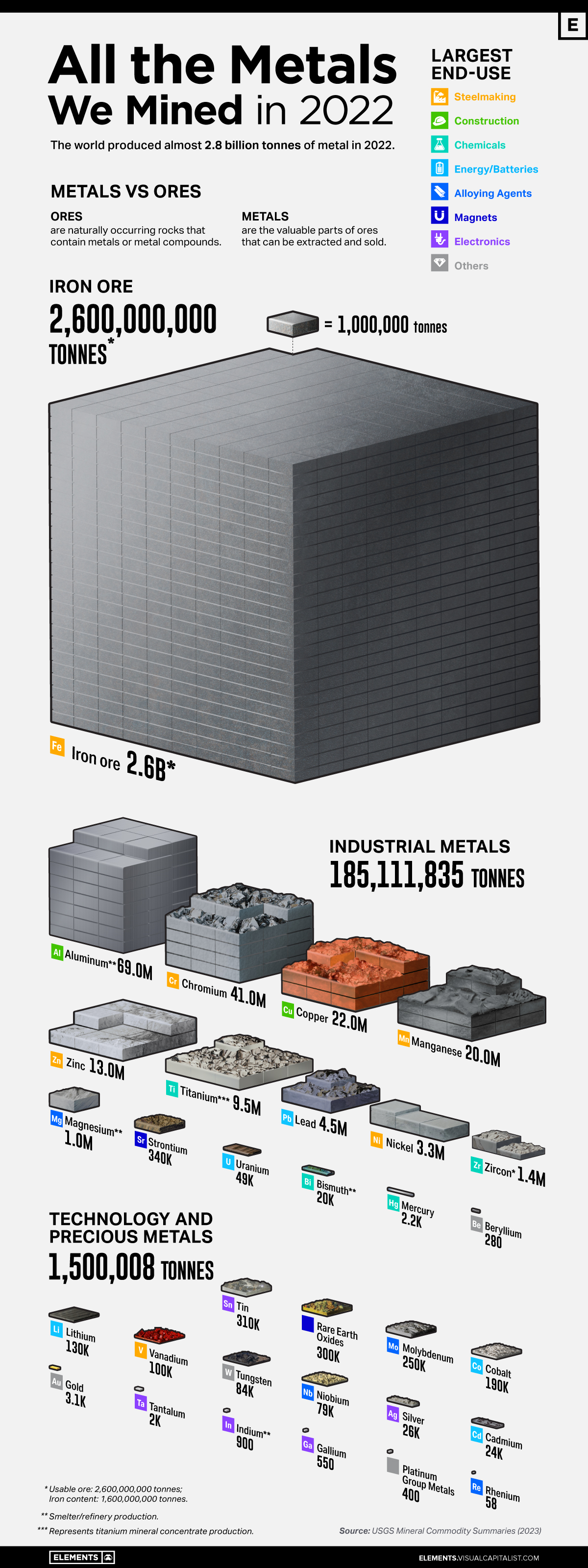
All the metals we mined

Metals are a big part of our daily lives, found in every building we enter and all devices we use.

Today, major industries that directly consume processed mineral materials contribute 14% of the United States economy.

The above infographic visualizes all 2.8 billion tonnes of metals mined in 2022 and highlights each metal’s largest end-use using data from the United States Geological Survey (USGS).

Iron Ore Dominance

Iron ore dominates the metals mining landscape, comprising 93% of the total mined. In 2022, 2.6 billion tonnes of iron ore were mined, containing about 1.6 billion tonnes of iron.

Metal/OreQuantity Mined in 2022 (tonnes)% of Total
Iron ore2,600,000,00093.3%
Industrial metals185,111,8356.6%
Technology and Precious Metals1,500,0080.05%
Total2,786,611,843100%

Percentages may not add up to 100 due to rounding.

Iron ores are found in various geologic environments, such as igneous, metamorphic, or sedimentary rocks, and can contain over 70% iron, with many falling in the 50-60% range.

Combined with other materials like coke and limestone, iron ore is primarily used in steel production. Today, almost all (98%) iron ore is dedicated to steelmaking.

The ore is typically mined in about 50 countries, but Australia, Brazil, China, and India are responsible for 75% of the production.

Because of its essential role in infrastructure development, iron ore is one of the most crucial materials underpinning urbanization and economic growth.

Industrial Metals

Industrial metals occupy the second position on our list, constituting 6.6% of all metals mined in 2022. These metals, including copper, aluminum, lead, and zinc, are employed in construction and industrial applications.

Tiếp tục đọc “All the Metals We Mined in One Visualization”

Despite reforms, mining for EV metals in Congo exacts steep cost on workers

washingtonpost.com
After revelations of child labor and treacherous conditions in many cobalt mines, automakers and mineral companies said they would adhere to international safety standards

The Shabara artisanal mine, where cobalt and copper are dug out by hand, near the Congolese boomtown of Kolwezi.

By Katharine Houreld and  Arlette Bashizi

Aug. 4 at 5:00 p.m.

Correspondent Katharine Houreld and photographer Arlette Bashizi traveled together across southeastern Congo, visiting industrial and artisanal mines in the country’s three largest cobalt mining towns. Houreld is The Washington Post’s East Africa bureau chief, based in Nairobi, with responsibilities stretching from the Horn of Africa to the continent’s southern tip. Bashizi is a Congolese photographer, based in Goma, focusing on issues related to health, environment and culture.

FUNGURUME, Democratic Republic of Congo — Alain Kasongo, burly and goateed, worked for four years driving the heavy trucks that hauled away tons of cobalt ore from a gaping hole at one of the biggest mines in Congo. The vibrations from the equipment and the jolts of driving over rough ground during his 12-hour shifts could be bone-rattling, he said. Finally, the pain in his spine grew so unbearable that he needed surgery.

His older brother, Patchou Kasongo Mutuka, worked the same job at the same mine. He suffered the same injury and required the same surgery — as did 13 other drivers of excavators and trucks at the mine who were interviewed. They lifted their shirts to reveal surgical scars and spread out carefully folded medical records confirming their accounts. They in turn named seven more colleagues who had suffered the same fate, all within a two-year period.

“It hurt so badly when I went home, I would lie awake at night,” said Alain Kasongo, 43, displaying bumps and ridges on his body from what he said were three operations.

Tiếp tục đọc “Despite reforms, mining for EV metals in Congo exacts steep cost on workers”

Where is gallium in our bauxite? Gali – kim loại trọng yếu – đang nằm ở đâu trong quặng Boxit của Việt Nam?

Bài tiếng Việt theo sau bài tiếng Anh

Where is gallium in our bauxite?

Given the strategic role of gallium in the world’s economy and security, and the availability of gallium in bauxite, why there has been absolutely neither discussion on nor mentioning of gallium through all these years of heated discussions about bauxite in Việt Nam?

Gallium is listed as a critical mineral by many advanced economies and may very well exist in Vietnam’s bauxite mines.

Minerals that have important uses and no viable substitutes, yet face potential disruption in supply, are defined as critical to a nation’s economic and national security.”[1]  Oftentimes, the terms “critical mineral” and “strategic mineral” are used interchangeably – if a mineral is deemed critical, it is usually essential for a national strategy, be it an economic or a defense strategy.


Gallium, appearance: silvery blue
Tiếp tục đọc “Where is gallium in our bauxite? Gali – kim loại trọng yếu – đang nằm ở đâu trong quặng Boxit của Việt Nam?”

Khủng hoảng kim loại đất hiếm: ngành năng lượng sạch đừng lo lắng

Rare-earth stock prices from 2007 to 2017

“Nguyên tố Đất hiếm” là 17 nguyên tố hóa học với tên gọi lạ lùng và đặc điểm không bình thường. Số nguyên tử của chúng là từ 57-71, 21 và 39. Hai phân nhóm nhỏ hơn, một nhóm là hiếm hơn và vì thế có giá trị hơn nhóm còn lại, có đặc điểm hóa học tương tự, vì vậy chúng thường được tìm thấy và khai thác cùng nhau.

Mặc dù tên gọi là hiếm, đất hiếm không phải là chất hiếm về mặt địa lý nhưng được phân tán rộng khắp lớp vỏ trái đất. Tuy nhiên, đất hiếm được khai thác ở một vài nơi và bởi một vài công ty bởi vì chúng thường không xuất hiện tập trung một chỗ với lượng lớn. Hơn nữa khai thác mỏ ngày càng nhiều chi phí và rủi ro, thị trường đất hiếm trên thế giới không lớn (vài tỷ đô la một năm), dễ bay hơi, phức tạp và bị chi phối bởi Trung Quốc, nơi mà không phải tất cả các mỏ và xuất khẩu khoáng sản đều hợp pháp và minh bạch. Một chuyên gia kết luận rằng khoảng một nửa số đất hiếm được sản xuất trên toàn cầu năm 2015 không nằm trong thống kê chính thức.
Tiếp tục đọc “Khủng hoảng kim loại đất hiếm: ngành năng lượng sạch đừng lo lắng”

What Happened to the Rare-Earths Crisis?

technologyreview_Four years ago, manufacturers fretted that trade controls in China would lead to a shortage of materials used in making an array of technology products. But demand fell more than expected.

February 25, 2015

      Four years ago, some manufacturers worried that they would run up against a shortage of rare-earth elements, which are used to make wind turbines, certain light bulbs, computers, and many other high-tech products. Rare earths actually aren’t rare, but they are found in low concentrations, attached to minerals from which they must be separated. And most of the facilities designed to mine and separate rare earths are based in China, which limited exports of these materials in 2009 and 2010 (see

“The Rare-Earth Crisis”

    ). A 2010 U.S. Department of Energy

report

    •  envisioned a possible “critical shortage” of five rare earth elements, especially dysprosium—crucial to the permanent magnets used in wind turbines and motors in hybrid or electric cars—between 2012 and 2014. But such worries seemingly dissipated without much fanfare. Why?
A chunk of dysprosium.

Falling prices Tiếp tục đọc “What Happened to the Rare-Earths Crisis?”

Critical Minerals of the United States

US Geological Survey, US Department of Interior

 Critical Minerals of the United States
It would be no exaggeration to say that without minerals, no aspect of our daily lives would be possible.

From the high-tech devices we use to access the information superhighway to the cars and trucks we use to drive the freeways, from the urban jungle to rural farms, every aspect of our lives relies on minerals. Thus, access to sufficient supplies of these minerals is a crucial part of keeping our economy and our security running.

In this new volume, entitled Critical Minerals of the United States, USGS geologists provide the latest and greatest on the geology and resources of 23 mineral commodities deemed critical to the economy and security of the United States. This work is meant to provide decision-makers, researchers, and economists with the tools they need to make informed choices about the mineral mix that fuels our society.

Image shows a chart of the elements used in computer chips over time
The number of elements used in computer chip technology  has changed: 12 in the 1980s, 16 in the 1990s, and more than 60 by the 2000s. (Public domain.)

Tiếp tục đọc “Critical Minerals of the United States”