Amid evolving dynamics in Asia’s supply chain and labor markets, extensive discussions have unfolded regarding the notable shift of manufacturing operations to Southeast Asian countries. While much of this discourse has traditionally centered around foreign companies relocating from China in pursuit of cost-effective alternatives, a compelling aspect often overlooked is the surge in such endeavors by Chinese corporations themselves.
Driven in part by rising domestic wages and operational costs, Chinese companies have increasingly directed their investments towards the manufacturing sector in ASEAN countries. What was once a less pronounced trend has rapidly transformed, reflecting a strategic recalibration of Chinese business interests and a major shift in where the majority of global manufacturing takes place.
The significance of Chinese investment in ASEAN’s manufacturing landscape is underscored by the fact that China holds the position of ASEAN’s largest trade partner, and is fast becoming one of the most important sources of investment in the region.
China’s alleged abuse of the world’s oceans was examined in recent studies into its vast fishing fleet, which is accused of destroying maritime ecosystems far from its shores and perpetuating the industry’s forced labor practices.
China-flagged ships on the high seas were involved in “theft on a grand scale, unrestricted warfare on natural resources,” said a report by the SeaLight project, which says it uses “commercially available technology to shed light on the maritime ‘gray zone.'”
Illegal, unregulated and unreported (IUU) fishing by Chinese vessels was happening throughout the Asia-Pacific, including within other countries’ exclusive economic zones (EEZ), according to SeaLight, which is under Stanford’s Gordian Knot Center for National Security Innovation.
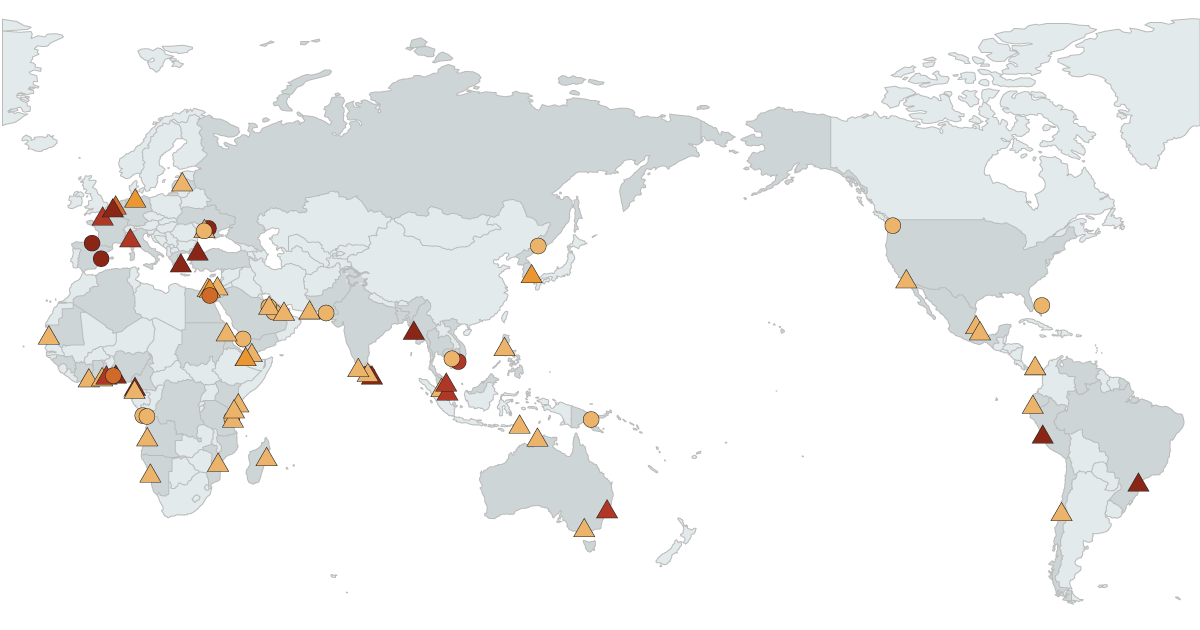
This interactive map tracks China’s growing maritime influence through investments in strategic overseas ports. Users can plot the location of each port and view satellite images alongside detailed information on the share of Chinese ownership, the total amount of Chinese investment, and the port’s suitability for use by the Chinese military.
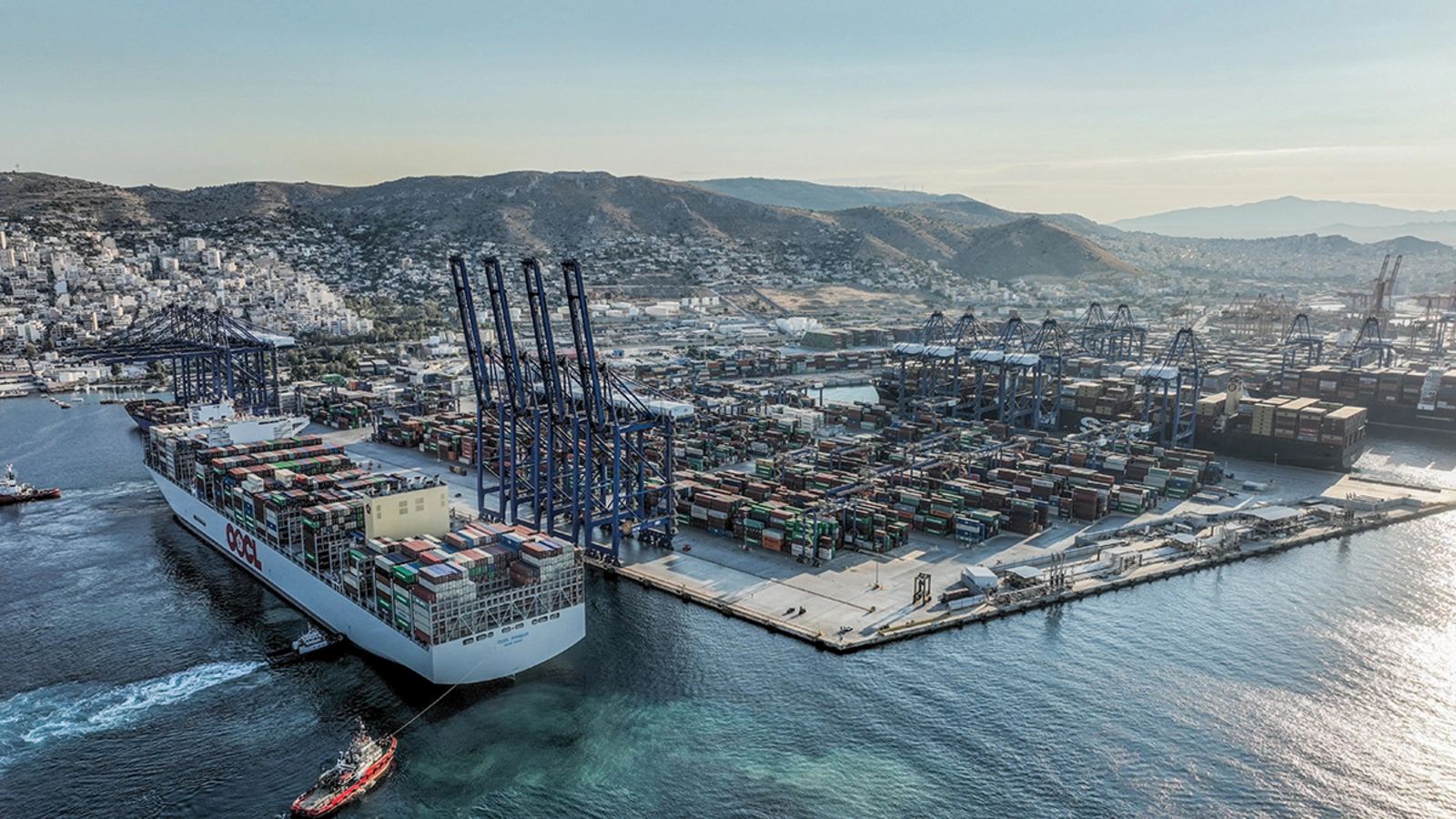
The new container ship, OOCL Piraeus, docks at the Port of Piraeus in Greece in 2023. Xinhua via Getty Images
The China Overseas Ports interactive visualizes degrees of China’s overseas port ownership by types of investment across regions and time. It also evaluates the dual-use (commercial and military) potential of ports owned, constructed, or operated by Chinese entities. The database supporting this interactive includes 101 port projects of which Chinese entities have acquired varied equity ownership or operational stakes. China operates or has ownership in at least one port in every continent except Antarctica. Of the 101 projects, 92 are active, whereas the remaining 9 port projects have become inactive due to cancellation or suspension by the end of September 2023. Reasons for cancellation or suspension include environmental concerns, souring of political relations, financial problems, and security issues raised domestically and internationally. Suspended projects, such as China’s construction of the Khalifa Port in the United Arab Emirates, could resume construction.
92 Port projects total (port projects outside China with Chinese investment)
13 Port projects with majority Chinese ownership
10 Port projects with majority Chinese ownership where there is physical potential for naval use
Excludes cancelled port projectsChineseownership0–12.5%12.5–25%25–37.5%37.5–50%Over 50%The share of the port project that is owned by the Chinese government or Chinese companiesPhysicalpotential for naval useWhether the port project is located at a port that includes berths with enough depth for a naval vesselYesNoData is as of September 2023.
Laos borrowed billions from President Xi Jinping’s administration to finance railways, highways and hydroelectric dams, which has ballooned public debt to over 100% of GDP.
Combined with a currency crisis and soaring inflation, Laos is on the brink of economic collapse.
Without a clear-cut debt reduction deal with China, Laos’ financial hardships are unlikely to ease, analysts warn. But it remains to be seen if Beijing will agree to long-term concessions.
A pedestrians at a bus station in Vientiane, Laos, on Saturday, June 24, 2023.
China is bad. At least, that’s what even a glance of U.S. reporting on China tells us. It’s a way of reporting that follows a long history of constructing the Chinese — in news, popular culture and the halls of DC — as a threat. In the first episode of Backspace, a new media critique series from AJ+, Sana Saeed explores what China and the Chinese have looked like in the American imagination, how that impacts and is impacted by U.S. immigration and foreign policies, and ways we can retell that story.
A decade ago, China launched the Belt and Road Initiative (BRI), an ambitious effort to finance infrastructure around the world. Since then, Chinese investments made through the BRI have become an integral part of the global infrastructure landscape — particularly in developing countries — with estimates of $1 trillion or more invested across 152 countries.
Unfortunately, the first 10 years of the BRI were dominated by fossil fuel investment, with $52 billion invested in coal power alone according to the China Overseas Finance Inventory.
But the next decade could look very different: At the 2021 UN General Assembly, China announced it would cease building new coal plants abroad and instead step up investment in renewable energy, a commitment reiterated by President Xi Jinping at the latest BRI summit in October 2023.
US-China: Is A New NATO Emerging In Asia? | When Titans Clash 2 – Part 1/3 | CNA Documentary
CNA Insider – 29-4-2022
As the Ukraine crisis unfolds, China accuses the US of creating an Indo-Pacific version of NATO, and warns of a “Ukraine style tragedy” for Asia. On the other hand, countries like Japan, Philippines, India, Australia and South Korea, seek closer ties to the US as concerns emerge over China’s actions. Could Asia witness a war in the years ahead? Tiếp tục đọc “When titans clash 2 (3 parts)”→
Teachers in Hong Kong are leaving in record numbers. About 6,550 resigned or retired in the last academic year, almost twice the average prior to 2021. One possible reason? The National Security Law. Changes to the curriculum and limits on what can be discussed have left liberal-minded educators feeling stifled. Teachers are also worried that they risk censure should class discussions run afoul of the law. At the same time, thousands of students have also dropped out of Hong Kong schools, as the emigration wave continues. Some classrooms now sit empty. How will Hong Kong schools emerge from this shake up, and what will they look like after?
00:00 Introduction 01:35 Hong Kong teachers are quitting in record numbers 05:06 The National Security Law and how it affected education 14:47 Teachers under pressure 19:42 Recent changes to school curriculum 24:01 Heightened scrutiny in classrooms 27:04 The emigration wave and falling student enrolment 38:15 More mainland students entering Hong Kong 42:49 Future of Hong Kong’s education sector
China’s People’s Liberation Army celebrates its centenary in 2027, what are its goals for this date? The PLA is already the largest army in the world with over 2 million soldiers. It also has the biggest number of warships. But China’s defense budget is still climbing amidst increasing geopolitical tensions. How exactly is the PLA “preparing for Dangerous Storms” as tasked by President Xi?
Amidst rising tensions in the South China Sea and the Taiwan Strait, the American military is set to expand its presence in the Philippines. The Marcos administration wants to increase the number of US forces in the country, by allowing Americans access to four additional military bases including Palawan and Cagayan, through the Enhanced Defense Cooperation Agreement (EDCA). This move reverses the cooling US-Filipino ties under President Duterte. But the long, storied history between the two countries could complicate the return of US troops. At the same time, Chinese investments in the archipelago are in jeopardy, as Beijing protests the move. What is behind this troop buildup in the Philippines, and could this raise the temperature in the region, as China reacts to the growing American might at its doorstep?
As the two superpowers compete for dominance in the Pacific, Dena Takruri asks Filipinos how they feel being caught in the middle. Who is the bigger threat to the Philippines: the U.S. or China?
China’s Belt And Road: Future Opportunities For Singapore? | Singapore & The BRI | Full Episode
CNA Insider -20-10-2023
2023 marks the 10th anniversary of China’s Belt and Road Initiative. As the BRI continues to evolve, opportunities for Singapore remain in the areas of infrastructure expertise and legal services and are emerging in green innovations, green financing sectors. In the next decade, how can Singapore continue to tap on its strengths as a global trading, innovation, financial and legal hub to forge its own paths in the BRI?
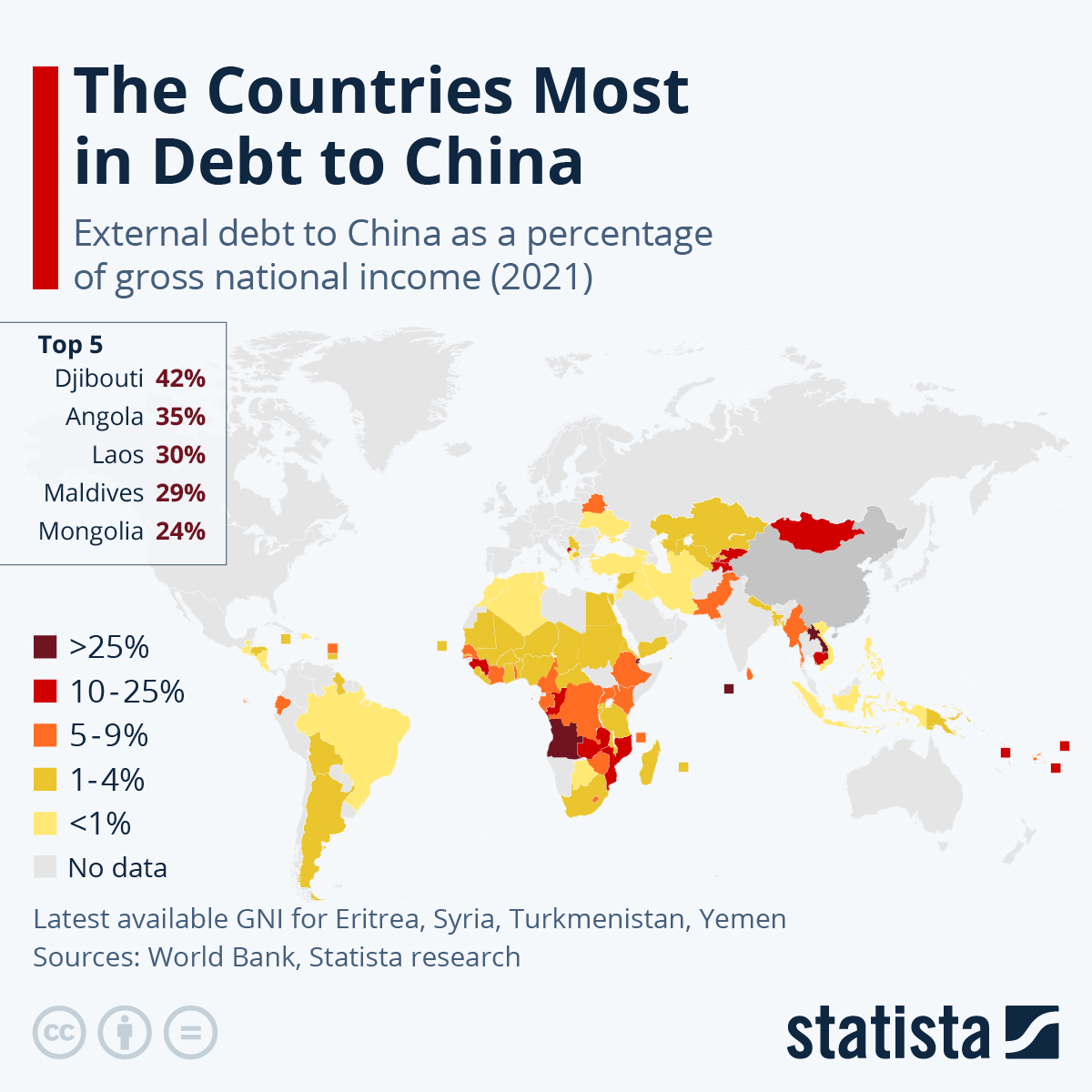
DESCRIPTION This chart shows global debt levels cause by direct loans from China (as percentage of GDP) in 2021.
According to World Bank data analyzed by Statista, countries heavily in debt to China are mostly located in Africa, but can also be found in Central Asia, Southeast Asia and the Pacific. As the new preferred lender to low-income countries, China held 37 percent of these nations’ debt in 2020. Just 24 percent of the countries’ bilateral debt comes from the rest of the world that year.
The “New Silk Road” project, which finances the construction of port, rail and land infrastructure across the globe, has created much debt to China for participating countries. At the end of 2021, of the 98 countries for whom data was available, Pakistan ($27.4 billion of external debt to China), Angola (22.0 billion), Ethiopia (7.4 billion), Kenya (7.4 billion) and Sri Lanka (7.2 billion) held the biggest debts to China. The countries with the biggest debt burdens in relative terms were Djibouti and Angola, followed by the Maldives and Laos, which opened a debt-laden railway line to China last year. The President of the World Bank, David Malpass, has called the level of debt many countries once again hold “unsustainable”.
Chinese loans have higher interest rates than those from international institutions like the International Monetary Fund or The World Bank or bilateral loans from Paris Club countries, and also have shorter repayment windows. Their setup is closer to commercial loans concerning their conditions of repayment, confidentiality as well as their objectives of funding specific infrastructure projects instead of pursuing development goals in general.
The Covid-19 pandemic has complicated the already difficult repayment of Chinese loans even more. According to the Financial Times, the country had to renegotiate loans worth $52 billion in 2020 and 2021 – more than three times the amount that met this fate in the two previous years. One such case was Sri Lanka – also among China’s biggest debtors – which in 2022 was the first Asian country in two decades to default on its debt.
It is the 10th year of the Belt and Road Initiative (BRI). From Central and Southeast Asia to the Middle East and Africa, how has China’s mega infrastructure project changed the world? In this retrospective on the 10th anniversary of the BRI, Insight looks at the developments in Asia and Africa that have sprung from China’s marquee project. From growing trade links to environmental impacts to political influence, the BRI has undeniably changed the region. But with growing economic headwinds and a flagging Chinese economy, will Beijing continue to invest in the BRI? What will the next decade bring?



 CVD
CVD 