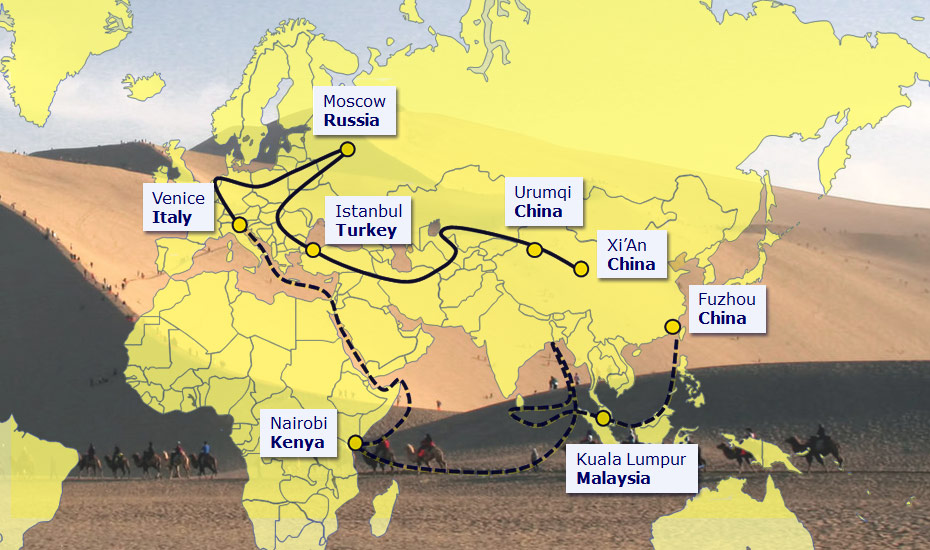
“One Belt, One Road” and RMB internationalization serve global interest: Report

xinhuanet
English.news.cn   2015-10-09 08:51:21

 NEW YORK, Oct. 8 (Xinhua) — The “One Belt One Road” initiative and internationalization of Renminbi (RMB), the Chinese currency, are two strategies that serve both China’s national and global interests, according to a report released here Thursday.

The RMB international Report 2015, done by the International Monetary Institute (IMI) of Renmin University of China, said China has been promoting the two important strategies as an emerging country and the world will be benefiting from implementation of the two strategies. Tiếp tục đọc ““One Belt, One Road” and RMB internationalization serve global interest: Report”

A brilliant plan One Belt, One Road

Thirty years of unprecedented growth

In just 30 years, China has developed from a poor inward-looking agricultural country to a global manufacturing powerhouse. Its model of investing and producing at home and exporting to developed markets has elevated it to the world’s second-largest economy after the USA.

Now faced with a slowing economy at home, China’s leadership is looking for new channels to sustain its appetite for growth at a time when developing neighbours are experiencing rapidly rising demand.

A new economic paradigm emerges

At the heart of One Belt, One Road lies the creation of an economic land belt that includes countries on the original Silk Road through Central Asia, West Asia, the Middle East and Europe, as well as a maritime road that links China’s port facilities with the African coast, pushing up through the Suez Canal into the Mediterranean. Tiếp tục đọc “A brilliant plan One Belt, One Road”

Chợt hiểu Tổ quốc đến xót xa… Về bài thơ “Gửi quần đảo Trường Sa” của Đỗ Nam Cao

GỬI QUẦN ĐẢO TRƯỜNG SA

Trường Sa ư với ngày thường xa thật
Đảo ở đâu tôi có hỏi đâu mà
Điều khốn nạn là chỉ khi máu đổ
Đảo mới gần mới thật đảo của ta

Các anh cắm ngọn cờ Tổ quốc gió cuồn cuộn
Sóng lừng ngầu bọt bãi san hô
Kẻ muốn nhổ ngọn cờ khỏi ngực
Thì nhận đây dòng máu nóng hực ra

Chính lúc bấy giờ tôi mới hiểu Trường Sa
Hiểu đến xót xa
Tổ quốc là vỏ con ốc biển
Anh nâng niu cất gửi tặng quà Tiếp tục đọc “Chợt hiểu Tổ quốc đến xót xa… Về bài thơ “Gửi quần đảo Trường Sa” của Đỗ Nam Cao”

Trung Quốc bán lợn biến đổi gen, loài người sẽ trả giá!

(Khoa học) – Các nhà khoa học Trung Quốc ở Viện Gen Bắc Kinh (BGI) vừa tiết lộ họ đã lai tạo thành công giống lợn chuyển gen hay lợn chỉnh sửa gen.

Theo trang tin Zmescience của Rumani, các nhà khoa học Trung Quốc ở Viện Gen Bắc Kinh (BGI) vừa tiết lộ họ đã lai tạo thành công giống lợn chuyển gen hay lợn chỉnh sửa gen, có kích thước chỉ bằng hoặc lớn hơn con chó cỡ trung bình, và sẽ được đưa ra thương phẩm cho mục đích làm cảnh.

Trung Quóc ban lon bien doi gen, loai nguoi se tra gia!
Lợn chuyển gen của BGI vừa được đưa ra giới thiệu tại Hội nghị thượng đỉnh Công nghệ sinh học Quốc tế Thâm Quyến hôm 23/9.

Tiếp tục đọc “Trung Quốc bán lợn biến đổi gen, loài người sẽ trả giá!”

ASEAN can survive great-power rivalry in Asia

4 October 2015
Author: Amitav Acharya, American University
Eastasiaforum – Pundits and policymakers increasingly see changing great-power politics in Asia as a challenge to ASEAN. China’s growing military assertiveness in the South China Sea, the US ‘rebalancing’ strategy, Japan’s moves to reinterpret its constitution, and India’s growing military presence and assertive diplomacy all press upon ASEAN’s choices in the region.A satellite image, issued by the Center for Strategic and International Studies (CSIS) think tank, showing an airstrip under construction at Fiery Cross Reef in the Spratly Islands. (Photo: AFP)Some argue that ASEAN is both toothless and clueless in responding to these changes. Seen as ‘talk shops’, ASEAN’s regional institutions — the ASEAN Regional Forum (ARF), ASEAN+3, ASEAN+6 and the East Asian Summit (EAS) — might have been sufficient when great-power relations were less volatile right after the Cold War, but they have outlived their usefulness. ‘ASEAN centrality’, and even its very survival, is being written off. Tiếp tục đọc “ASEAN can survive great-power rivalry in Asia”

Tàu Trung Quốc xâm phạm sâu vùng biển Việt Nam, cách Đà Nẵng chỉ 34 hải lý!

INSáng 1/10, tại buổi tiếp xúc cử tri TP Đà Nẵng nhằm chuẩn bị cho kỳ họp thứ 10, Quốc hội khóa XIII, Phó Chủ tịch Quốc hội Huỳnh Ngọc Sơn đã thông tin nhiều diễn biến mới về tình hình Biển Đông.

Theo đó, Trung Quốc tập trung triển khai xây dựng các công trình trên các đảo chiếm đóng tại Trường Sa, như tiếp tục hoàn thiện đường băng sân bay tại bãi Đá chữ thập, xây dựng sân bay trực thăng tại một số đảo khác. Thi công xây nhà kiên cố từ 3 – 6 tầng, hoàn thiện đèn luông và đèn hải đăng, lắp đặt điện gió lại nhỏ, bố trí 2 ra đa hàng hải.

Phó Chủ tịch Quốc hội Huỳnh Ngọc Sơn phát biểu tại buổi tiếp xúc cử tri TP Đà Nẵng sáng 1/0 (Ảnh: HC)

Tiếp tục đọc “Tàu Trung Quốc xâm phạm sâu vùng biển Việt Nam, cách Đà Nẵng chỉ 34 hải lý!”

Nhân dân Trung Quốc và Chủ nghĩa bá quyền Đại Hán

Mai An Nguyễn Anh Tuấn

Giữa lúc những người lãnh đạo ở Trung Nam Hải đang “vừa ăn cướp vừa la làng”, vu cáo trắng trợn Việt Nam, xuyên tạc việc hạ đặt giàn khoan Hải Dương 981 trái phép trong vùng đặc quyền kinh tế và thềm lục địa Việt Nam thì trên không ít báo chí, diễn đàn mạng như Sohu, Sina, weibo, Bưu điện Hoa Nam buổi sáng, Tân Hoa xã, v.v. của Trung Quốc, nhiều người dân bình thường và trí thức của đất nước này đã lên tiếng vạch rõ: “Đường lưỡi bò” là không thể chấp nhận, đã nghiêm khắc chỉ trích hành vi đối đầu ngạo mạn với các nước láng giềng ở Biển Đông của Trung Quốc, đồng thời đề nghị những người lãnh đạo TQ cần tôn trọng sự thật lịch sử cùng luật pháp quốc tế. ( như: GS Lý Lệnh Hoa- Trung tâm Thông tin Cục Hải dương quốc gia Trung Quốc, biên tập viên Chu Phương- Tân Hoa Xã,  GS Hà Quang Hộ- Đại học Nhân dân Trung Quốc, GS Thượng Hội Bằng- Học viện Quan hệ Quốc tế Bắc Kinh, GS Trương Kỳ Phàm- Học viện Pháp luật Đại học Bắc Kinh, nhà báo Lý Tiểu Tinh…)

baby_cheongsam_becomes_fashionable_children_chothing_4.jpg (672×372)

Tiếp tục đọc “Nhân dân Trung Quốc và Chủ nghĩa bá quyền Đại Hán”

Chinese hackers tracked to China Military

FP Sit-Rep Spet 24, 2015

By Paul McLeary with Adam Rawnsley

You’ve got a friend in me. On the eve of Chinese President Xi Jinping’s visit to Washington, two security firms claim to have uncovered proof that a Chinese military unit involved in cyber espionage has teamed up with a grassroots hacker collective in southern China. Together, the two have managed to break into sensitive computer networks in countries competing with China for control over the South China Sea.

But the best part of the story is how the researchers made the connection. Turns out, it was partly a simple case of laziness with a username that allowed cybersecurity firms ThreatConnect and Defense Group Inc. to link the army and the Naikon hacker group. The trail led to a man named Ge Xing, a member of People’s Liberation Army Unit 78020 who apparently used the username greensky27 all over the Web, including for work, creating a virtual map for researchers to trace the hacks.

The dominoes fall. What’s one more disturbing cyber story? FP’s Elias Groll writes that the hack of the Office of Personnel Management first revealed in June was much bigger than originally reported. The OPM said Wednesday that suspected Chinese hackers made off with 5.6 million sets of fingerprints, a much higher number than the 1.1 million that had previously been estimated. While there isn’t much that anyone can do with fingerprints just yet, an OPM spokesman offered the chilling assessment that this “could change over time as technology evolves.”


Hoàn cảnh lịch sử dẫn đến tranh chấp chủ quyền của Việt Nam tại quần đảo Hoàng Sa và Trường Sa – Nguyên nhân và giải pháp

Hàn Nguyên Nguyễn Nhã

17 tháng 7, 2009

SH – Sự thực lịch sử về chủ quyền và những hoàn cảnh lịch sử dẫn đến sự tranh chấp cùng nguyên nhân xâm phạm chủ quyền của Việt Nam đã quá rõ ràng, nên giải pháp phải là “cái gì của César phải trả lại cho César”. Bất kỳ chính quyền nào cũng như bất cứ người Việt Nam nào, dù khác chính kiến, đều coi trọng việc lấy lại Hoàng Sa về với Việt Nam và bảo toàn toàn vẹn Trường Sa. Lịch sử đã chứng minh dù có hàng ngàn năm bị lệ thuộc rồi cũng có ngày với sự kiên cường, bất khuất, cuộc đấu tranh sẽ thành công. – Hàn Nguyên Nguyễn Nhã

A- HOÀN CẢNH LỊCH SỬ DẪN ĐẾN VIỆC CHÍNH QUYỀN TỈNH QUẢNG ĐÔNG (TRUNG HOA) KHẢO SÁT TRÁI PHÉP QUẦN ĐẢO HOÀNG SA VÀO NĂM 1909 VÀ TIẾP TỤC XÂM PHẠM CHỦ QUYỀN CỦA VIỆT NAM Ở HOÀNG SA CHO ĐẾN NĂM 1930

Việt Nam bị Pháp xâm lược năm 1858, mất hết chủ quyền tự chủ ngoại giao theo Hiệp ước cuối cùng ký với Pháp năm 1884, nên đã không bảo vệ được chủ quyền của mình tại Hoàng Sa khi bị các nước khác xâm phạm. Tiếp tục đọc “Hoàn cảnh lịch sử dẫn đến tranh chấp chủ quyền của Việt Nam tại quần đảo Hoàng Sa và Trường Sa – Nguyên nhân và giải pháp”

Kitô giáo: Lịch sử truyền đạo

TĐH: Đây là một bài học lịch sử và văn hóa rất hữu ích và hiện nay vẫn là vấn đề rất lớn trên thế giới. Các bạn, nhất là các bạn Kitô giáo, nên bỏ một chút thời giờ đọc kỹ, để chúng ta còn biết lo cho đất nước chúng ta, cũng như những mâu thuẫn tôn giáo và chính trị tại nhiều nơi trên thế giới. Bài này đọc nghe có vẻ một chiều, Điều này có thể hiểu được, vì nói đến các tội lỗi gây ra do việc truyền đạo Kitô giáo, người viết thường rất căm phẫn. Tuy vậy, bức tranh tổng quát kể lại ở đây có thể nói là khá chính xác.

Ngày nay, việc truyền đạo Kitô giáo, với hỗ trợ tài chính và chính trị từ các nước Âu Mỹ, đe dọa sự tồn vong văn hóa và ổn định chính trị của nhiều dân tộc yếu kém trên thế giới. Các nhà truyền đạo Kitô giáo nên rất nhạy cảm về các tổn hại xã hội họ đã và đang gây ra.

Tinh thần Giêsu là hòa bình, hy sinh, thương khó, và tình yêu vô điều kiện, Người Kitô giáo, trong việc truyền đạo, thường đi ngược lại những điều Chúa Giêsu dạy. Rất tiếc!

Không có cách truyền đạo nào tốt bằng sống với tinh thần chúa Giêsu.

Bản dịch Việt: Minh Kiến

Nguyên bản tiếng Anh: PARTIAL HISTORY OF CHRISTIAN MISSIONARY ATROCITIES

Nguồn Việt: Thời Sự Phật Pháp
Lời mở đầu: Tiếp tục đọc “Kitô giáo: Lịch sử truyền đạo”

CSIS: Pacific Forum – China’s Preferred World Order: What Does China Want?

Pacific Forum CSIS
Honolulu, Hawaii
3 Tel: (808) 521-6745
Fax: (808) 599 – 8690
Email: PacificForum@pacforum.org
PacNet Number 62
Sept 21,2015

by Yun Sun

Yun Sun (ysun@stimson.org) is a senior associate at the
Stimson Center and a
non-resident fellow at the Brookings
Institution.
The analysis is based on field research in China
this summer


New Contingency Planning Memorandum: A China-Vietnam Military Clash

Council on Foreign Relations

by Joshua Kurlantzick

September 23, 2015

china_vietnam_HY SY 981 Chinese oil rig Haiyang Shi You 981 is seen surrounded by ships of China Coast Guard in the South China Sea, about 210 km (130 miles) off shore of Vietnam on May 14, 2014. (Nguyen Minh/Reuters)

Share

The risk of a military confrontation between China and Vietnam is rising. Although the two countries have enjoyed close party-to-party ties for decades, since 2011 they have both asserted conflicting claims to the South China Sea. Beijing claims 90 percent of the sea as its exclusive economic zone. China has repeatedly moved oil rigs into disputed areas, dredged and occupied parts of the disputed Paracel Islands, and constructed at least one and potentially multiple airstrips, possibly for military use, in the Spratly Islands. Vietnam has also tried to use oil explorations to claim disputed areas of the sea and reportedly has rammed Chinese vessels in disputed waters. Vietnam has cultivated close military ties to the United States, to other Southeast Asian nations like the Philippines, and to regional powers such as India, all to the consternation of China.

In addition, Vietnam and China increasingly compete for influence in mainland Southeast Asia, where Vietnam had dominated between the 1970s and late 2000s. China has become the largest aid donor and investor in many mainland Southeast Asian nations, as well as an important military partner to Myanmar, Cambodia, Thailand, and Laos. Rising nationalism in both Vietnam and China fuels this race for regional influence and makes it harder for leaders in each country to back down from any confrontation, whatever the initial genesis.
These growing sources of friction could lead to a serious military confrontation between the two countries in the next twelve to eighteen months, with potentially significant consequences for the United States. Accordingly, the United States should seek to defuse tensions and help avert a serious crisis.

For more on the chances of a China-Vietnam military clash, and how the United States could help prevent one, see my new Contingency Planning Memorandum.

U.S. Gears Up to Challenge Beijing’s ‘Great Wall of Sand’

 FP

Washington has quietly avoided sending U.S. ships near China’s artificial islands. The Obama administration is now mulling a more muscular approach.

U.S. Gears Up to Challenge Beijing’s ‘Great Wall of Sand’

Almost 20 years ago, when China used missile tests to intimidate Taiwan ahead of key elections there, the United States responded by dispatching not one but two aircraft carrier strike groups to the area. The unabashed U.S. show of force set off howls of protest in Beijing, which deemed it a “hostile act,” yet America was able to respond with impunity to brazen Chinese behavior and act to buttress its allies in the region. Tiếp tục đọc “U.S. Gears Up to Challenge Beijing’s ‘Great Wall of Sand’”

Danh sách các đảo do Trung Quốc chiếm đóng trái phép ở quần đảo Trường Sa

Thứ tư, 29/05/2013, 18:47 (GMT+7)

 (Biển Đảo) – Ban biên tập gửi đến Quý độc giả loạt bài viết Danh sách thực thể bị chiếm đóng ở quần đảo Trường Sa, liệt kê danh sách các thực thể địa lí theo sự chiếm đóng của từng quốc gia, xếp đồng thời theo thứ tự bảng chữ cái và theo bản chất địa lí. Vì danh sách này chỉ dựa theo các nguồn có thể kiểm chứng được nên trong thực tế, có thể các quốc gia chiếm đóng hoặc khống chế nhiều hơn hoặc ít hơn. Brunei là quốc gia duy nhất chưa chiếm thực thể địa lí nào.

Chú thích viết tắt:

A: tiếng Anh; F: tiếng Filipino;
H: tiếng Hoa; M: tiếng Mã Lai.

TRUNG QUỐC KIỂM SOÁT

(Tổng cộng: 7 thực thể địa lí; tất cả đều là rạn san hô).

1. Đá Châu Viên

Đá Châu Viên Tiếp tục đọc “Danh sách các đảo do Trung Quốc chiếm đóng trái phép ở quần đảo Trường Sa”

Pentagon probes Chinese intercept of US spy plane

The Hill