Marcos takes office

FP – June 30, 2020

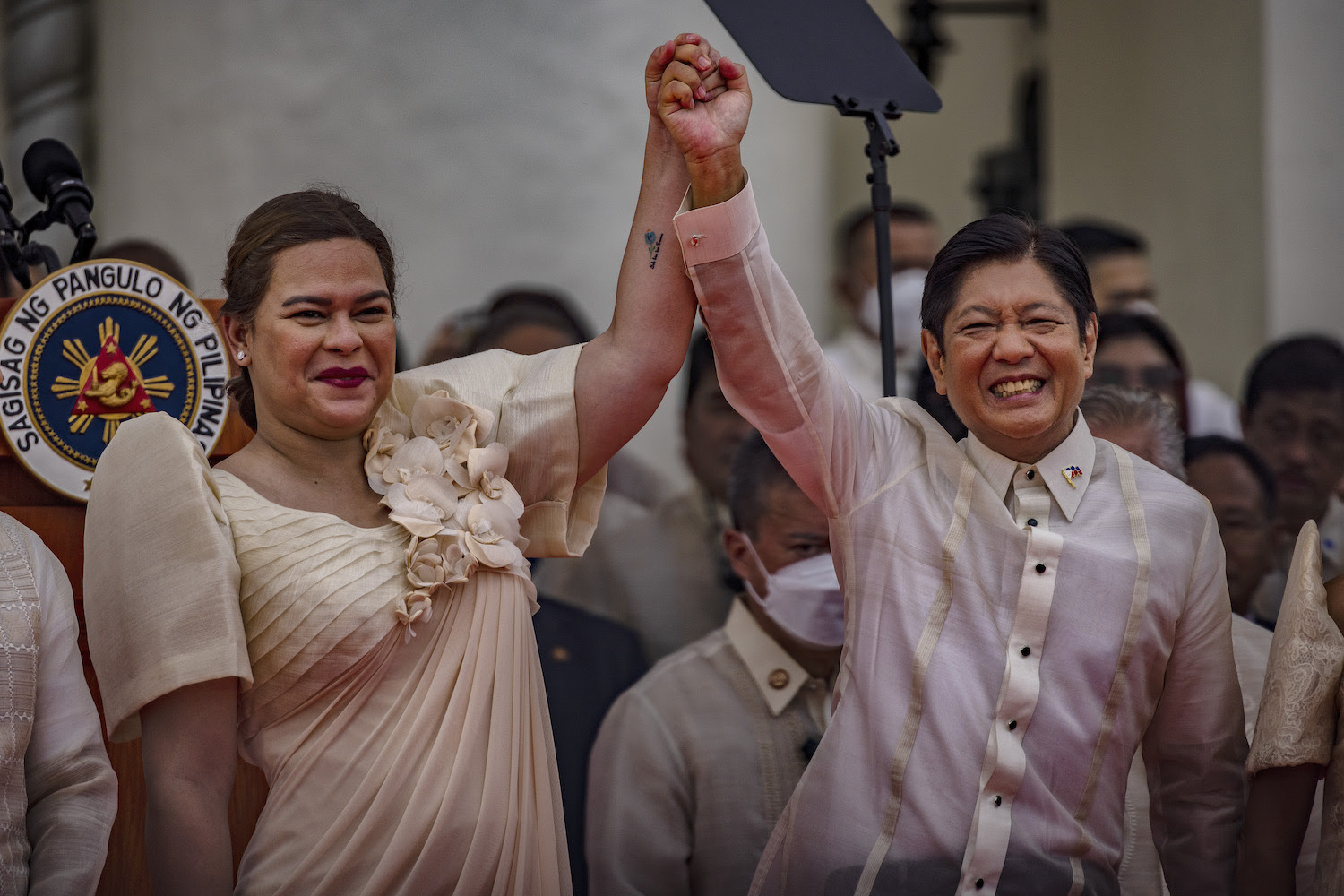
Ferdinand Marcos Jr. is now the president of the Philippines, 36 years after he fled the country along with his dictator father. Marcos took the oath of office today at a muted ceremony in Manila, urging citizens to look ahead to the future, as his mother, Imelda, looked on.

Marcos, known in the Philippines by his nickname Bongbong, has risen to the country’s highest office after a social media-driven campaign helped to rehabilitate his family’s image, transforming memories of the bloody days of martial law, when thousands were tortured and killed, to a nostalgic golden era.

Tiếp tục đọc “Marcos takes office”

Greenland: Đảo băng nóng bỏng

CHIÊU VĂN 26/3/2021 8:00 GMT+7

TTCT – Hồi năm 2019, khi tổng thống Mỹ lúc đó là Donald Trump hỏi mua hòn đảo khổng lồ ở Bắc Cực Greenland từ Đan Mạch, ông đã bị chê là vô duyên và lố bịch. Nhưng giờ, khi cuộc bầu cử sớm sắp diễn ra ở đấy – chính quyền Greenland sụp đổ vì tranh cãi liên quan tới tài nguyên đất hiếm – xem chừng ông Trump đã nhìn xa trông rộng.

Cuộc bầu cử ở Greenland, với tổng dân số chỉ hơn 56.000 người, dự kiến diễn ra vào ngày 6-4, và chỉ hơn một tháng sau sẽ là cột mốc trọng đại khác – 300 năm ngày vùng đất này trở thành lãnh thổ của Đan Mạch. Đầu cua tai nheo cũng là từ đó: ở đây có một phe đang đòi độc lập.

Hình ảnh này không có thuộc tính văn bản thay thế; tên tập tin là 2a5f6f07.jpg

Dân Greenland biểu tình phản đối một dự án khai khoáng. Ảnh: ejatlas.org

Tiếp tục đọc “Greenland: Đảo băng nóng bỏng”

Trung Quốc không thể cản trở hàng hải quốc tế xuyên qua Eo biển Đài Loan

. .

China cannot hinder international navigation through Taiwan Strait

(Published on Pacific Forum on June 22, 2022)
Trung Quốc không thể cản trở hàng hải quốc tế xuyên qua Eo biển Đài Loan

(Đăng trên Pacific Forum ngày 22/6/2022)
By Tran Đinh Hoanh 
Tran Đinh Hoanh is an international litigator and writer in Washington DC.
Tác giả: Trần Đình Hoành
Trần Đình Hoành
là luật sư tranh tụng quốc tế và tác giả viết sách tại Washington DC.

Tiếp tục đọc “Trung Quốc không thể cản trở hàng hải quốc tế xuyên qua Eo biển Đài Loan”

The World Responsible for Myanmar Becoming Failed State: National Unity Government foreign minister Minister of Myanmar

National Unity Government foreign minister Daw Zin Mar Aung. / The Irrawaddy

By THE IRRAWADDY 1 April 2022

Challenging the regime’s legitimacy at home and abroad, Myanmar’s shadow National Unity Government (NUG) foreign minister Daw Zin Mar Aung, 45, has engaged with foreign governments and parliaments, international aid agencies and Myanmar’s many armed groups.

However, the elected lawmaker from the ousted National League for Democracy and winner of the 2012 International Women of Courage Award said international assistance is largely limited to moral support.

She exclusively tells The Irrawaddy about the importance of international support, including funding and arms, Myanmar’s friends and foes and how it receives different treatment from Ukraine.

It has been more than a year since the revolution against military rule was launched. We heard the revolution has received no assistance from foreign countries. Why is that?

It is mainly because the international community regards the crisis as a domestic issue if we compare it with the Ukraine war. It is widely believed that countries should not interfere in domestic affairs.

Yangon in February last year protests after the military coup.

Tiếp tục đọc “The World Responsible for Myanmar Becoming Failed State: National Unity Government foreign minister Minister of Myanmar”

A looming threat

NYT Russia’s invasion of Ukraine has civilians in Taiwan taking China’s aggression more seriously.

Civilians participating in a battle simulation during a combat medic training workshop near Taipei in May. Since the war in Ukraine began, a growing number of Taiwanese have been making their own preparations for war.
Civilians participating in a battle simulation during a combat medic training workshop near Taipei in May. Since the war in Ukraine began, a growing number of Taiwanese have been making their own preparations for war.Credit…Lam Yik Fei for The New York Times
Ian Prasad Philbrick

By Ian Prasad Philbrick

June 19, 2022, 7:26 a.m. ET

Taiwan has spent more than seven decades under the threat of an invasion: China sees the island as a breakaway part of its territory. In the months since Russia invaded Ukraine, Taiwanese citizens have come to view a Chinese incursion as a more serious possibility than ever. My colleague Amy Qin, who’s based in Taipei, Taiwan’s capital, recently reported on how the island is preparing. I called her to learn more.

Tiếp tục đọc “A looming threat”

Security and Economic Challenges for Taiwan in Cross-Strait Relations

Home » Security and Economic Challenges for Taiwan in Cross-Strait Relations

Taiwan

Security and Economic Challenges for Taiwan in Cross-Strait Relations

Chien-pin Li is Professor of Political Science and Dean of the College of Humanities and Social Sciences at Sam Houston State University. Before his current position, he taught at Kennesaw State University for 26 years, and was a founding member of the China Research Center. He received his Ph.D. in Political Science from the University of Iowa and was an Associate Research Fellow at Academia Sinica (Taipei, Taiwan), a Senior Fellow at the Atlantic Council of the United States (Washington, D.C.) and a Research Fellow at the Pacific Cultural Foundation (Taipei, Taiwan). His teaching and research interests focus on East Asian political economy, including trade disputes, trade negotiations, and regional integration. He is the author of Rising East Asia: The Quest for Governance, Prosperity, and Security (2020) and has published articles in Asian Survey, Pacific Review, Issues & Studies, International Studies Quarterly, and other journals. 

More articles by the Author »

Print Friendly, PDF & Email

The security and economic landscape in the Indo-Pacific is increasingly difficult to navigate. While trade agreements such as the Comprehensive and Progressive Agreement for Trans-Pacific Partnership, the successor to the Trans-Pacific Partnership or TPP, and the Regional Comprehensive Economic Partnership signal an interest to cooperate in a region full of economic vibrancy, competition and rivalry between great powers cast significant uncertainty over the peace and stability in the region. The paradoxical trends in economic and security affairs are particularly evident in cross-Strait relations between Taiwan and China.

Tiếp tục đọc “Security and Economic Challenges for Taiwan in Cross-Strait Relations”

China’s Threat of Force in the Taiwan Strait

By Raul “Pete” PedrozoTuesday, September 29, 2020, 9:16 AM lawfareblog

A view of Taiwan’s Kaohsiung Harbor, which faces the Taiwan Strait. (Flick/Formosa Wandering, https://flic.kr/p/9aCnHR; CC BY-NC 2.0, https://creativecommons.org/licenses/by-nc/2.0/)

Raul "Pete" Pedrozo

Captain Raul (Pete) Pedrozo, U.S. Navy (Ret.), is the Howard S. Levie Chair on the Law of Armed Conflict and Professor of International Law in the Stockton Center for International Law at the U.S. Naval War College. He was a Peer Reviewer for the International Committee of the Red Cross Commentary of 2017 on the Convention (II) for the Amelioration of the Condition of Wounded, Sick and Shipwrecked Members Of the Armed Forces at Sea (1949) and is currently one of two U.S. representative to the International Group of Experts for the San Remo Manual on the Law Applicable to Armed Conflicts at Sea, produced by the International Institute of Humanitarian Law. Prior to his retirement from the Navy he served as the senior legal advisor to Commander, U.S. Pacific Command and was a Special Assistant to the Under Secretary of Defense for Policy, Office of the Secretary of Defense. Pedrozo is co-author of the forthcoming, “Emerging Technology and the Law of the Sea” (Oxford University Press).

________

On Sept. 18 and 19, People’s Liberation Army combat aircraft on 40 occasions intentionally crossed the median line in the Taiwan Strait that separates mainland China from the island of Taiwan. Taiwan President Tsai Ing-wen immediately condemned the provocation as a “threat of force.”

The center line in the Taiwan Strait (also known as the median line, middle line or Davis Line, named after Brig. Gen. Benjamin Davis, commander of Task Force 13 in Taipei and famed commander of the World War II Tuskegee Airmen) has its origins in the 1954 U.S.-Taiwan Mutual Defense Treaty. The treaty was one link in the chain of U.S. collective defense arrangements in the Western Pacific—which included agreements with the Republic of the Philippines, Australia, New Zealand, Japan and the Republic of Korea—designed to resist further communist subversive activities directed against their territorial integrity and political stability. Pursuant to Article V of the Mutual Defense Treaty, an armed attack in the treaty area, which included Taiwan and the Pescadores (or Penghu) Islands, directed against the territory of either party would be considered a danger “to its own peace and safety” and each party “would act to meet the common danger in accordance with its constitutional processes.” An addendum to the treaty established a buffer zone into which U.S. aircraft were not allowed to enter.

Tiếp tục đọc “China’s Threat of Force in the Taiwan Strait”

Censors silence popular influencer around Tiananmen Square Massacre anniversary

foreignpolicy

June 4, the anniversary of the 1989 Tiananmen Square massacre—in which People’s Liberation Army (PLA) forces killed hundreds and perhaps thousands of protesters as well as crushing demonstrations across the country—is a fraught moment in China. In Hong Kong, the public once freely memorialized the massacre. This year, authorities again used the national security law passed in 2020 to block gatherings; six people were arrested.

In mainland China, the anniversary claimed an unexpected victim: e-commerce influencer Li Jiaqi, widely known as the “Lipstick Brother” or “Lipstick King.” During a livestream on June 3, Li was presented with a cake that resembled a tank. Censors promptly pulled the show offline, and it hasn’t returned, with Li’s team citing “technical difficulties.” Early June is a prime time for online shopping ahead of June 18, China’s second-biggest day for online sales. But Li’s name now returns blank results on search platforms, even on e-commerce sites.

Tiếp tục đọc “Censors silence popular influencer around Tiananmen Square Massacre anniversary”

PODCAST – Asia Stream: The Philippine Election — Dynasty and Disinformation

nikkeiNearly 50 years after Ferdinand Marcos Sr. declared brutal martial law, the Philippines is poised to elect his son. Has history been forgotten?

Nikkei staff writersMay 7, 2022 03:26 JST

NEW YORK — Welcome to Nikkei Asia’s podcast: Asia Stream.

Every week, Asia Stream tracks and analyzes the Indo-Pacific with a mix of expert interviews and original reporting by our correspondents from across the globe.

New episodes are recorded biweekly and available on Apple PodcastsSpotify and all other major platforms, and on our YouTube channel.

This week, we focus on one of Asia’s most dynamic but flawed democracies: the Philippines. With the election just days away, we get under the hood of the electoral system and investigate the powerful role that dynasties play in the country, with a special focus on Ferdinand Marcos Jr., the front-runner on the cusp of taking power. We then take into account that other essential, if dangerous, tenet of modern Philippine democracy: disinformation, and how it is being used to gain support among the country’s most vulnerable populations.

Tiếp tục đọc “PODCAST – Asia Stream: The Philippine Election — Dynasty and Disinformation”

Smart Asian women are the new targets of CCP global online repression

3 Jun 2022|Albert Zhang and Danielle Cave Strategist special repor

The Chinese Communist Party has a problem with women of Asian descent who have public platforms, opinions and expertise on China.

In an effort to counter the views and work of these women, the CCP has been busy pivoting its growing information operation capabilities to target women, with a focus on journalists working at major Western media outlets.

Right now, and often going back weeks or months, some of the world’s leading China journalists and human rights activists are on the receiving end of an ongoing, coordinated and large-scale online information campaign. These women are high-profile journalists at media outlets including the New YorkerThe Economist, the New York TimesThe GuardianQuartz and others. The most malicious and sophisticated aspects of this information campaign are focused on women of Asian descent.

Tiếp tục đọc “Smart Asian women are the new targets of CCP global online repression”

Southeast Asians sticking with China on Taiwan: survey

asiatimesDemocracy Perception Index survey shows most Southeast Asians would not support cutting economic ties with China if it invades Taiwan

By DAVID HUTTJUNE 1, 2022Print

Military helicopters carrying large Taiwan flags do a flyby rehearsal on October 5, 2021, ahead of National Day celebrations amid escalating tensions between Taipei and Beijing. Photo: AFP / Ceng Shou Yi / NurPhoto

A recent Democracy Perception Index survey of worldwide public opinion found that a majority of Southeast Asians would not support their governments cutting economic ties with China if Beijing launched an invasion of Taiwan. 

The same report found that only Singaporeans, from the six Southeast Asian countries surveyed, favored cutting economic ties with Russia because of its invasion of Ukraine in February. Indonesians and Vietnamese were two of the three nationalities who believed most strongly that ties with Russia should be maintained.  

The Democracy Perception Index 2022 survey, published this month by Latana and the Alliance of Democracies Foundation, asked respondents: “If China started a military invasion of Taiwan, do you think your country should cut economic ties with China?” 

Tiếp tục đọc “Southeast Asians sticking with China on Taiwan: survey”

The Xinjiang Police Files Should Prompt Action Against Uyghur Genocide

Olivia Enos , Contributor

I write about international human rights and national security.Follow

May 31, 2022,10:54am EDT Forbe

Listen to article 4 minutes

20180523125453301_653121197205
Photo of Hawagul Tewekkul, a 46-year-old Uyghur preliminarily sentenced to time in a political … [+] VICTIMS OF COMMUNISM MEMORIAL FOUNDATION’S XINJIANG POLICE FILES

Looking through the photos of the 2,884 inmates in the Xinjiang Police Files is not for the faint of heart. You scroll – as you would on Instagram – past face after face of a people unjustly detained by the Chinese government for no other reason than that they are Uyghur.

The first thing I noticed in the photos were their eyes. Some look bewildered, others determined, others tear-filled, others entirely blank.

Tiếp tục đọc “The Xinjiang Police Files Should Prompt Action Against Uyghur Genocide”

Understanding The China-Russia Trade, Investment & Economic Relationship In The Context Of The Ukraine Conflict

silkroadbriefing.com

 May 10, 2022Posted bySilk Road Briefing

Surging Trade As Bilateral Relations Grow Closer

China and Russia have grown increasingly close in recent years, including as trading partners, in a relationship that brings both opportunities and risks as Russia reels from tough new sanctions led by the West in response to its invasion of Ukraine. Total trade between China and Russia jumped 35.9% in 2021 last year to a record US$147.9 billion, according to Chinese customs data, with Russia serving as a major source of oil, gas, coal and agriculture commodities, and running a trade surplus with China.

Since sanctions were imposed in 2014 after Russia annexed Ukraine’s Crimea, bilateral trade has expanded by more than 50% and China has become Russia’s biggest export destination The two were aiming to boost total trade to US$200 billion by 2024, but according to a new target unveiled last month during Russian President Vladimir Putin’s visit to Beijing for the Winter Olympics, the two sides want bilateral trade to grow to US$250 billion.

Tiếp tục đọc “Understanding The China-Russia Trade, Investment & Economic Relationship In The Context Of The Ukraine Conflict”

Indonesia’s finance minister says palm oil export ban will hurt other countries, but necessary

By David Lawder and Andrea Shalal

A palm oil plantation is pictured next to a burnt forest near Banjarmasin in South Kalimantan province, Indonesia
People shop for cooking oil made from oil palms at a supermarket in Jakart

People shop for cooking oil made from oil palms at a supermarket in Jakarta, Indonesia, March 27, 2022. REUTERS/Willy Kurniawan

reuter.com

WASHINGTON, April 22 (Reuters) – Indonesia’s new palm oil export ban will hurt other countries but is necessary to try to bring down the soaring domestic price of cooking oil driven up by Russia’s war in Ukraine, Indonesia’s finance minister told Reuters on Friday.

Sri Mulyani Indrawati said that with demand exceeding supplies, the ban announced earlier on Friday is “among the harshest moves” the government could take after previous measures failed to stabilize domestic prices. read more

“We know that this is not going to be the best result,” for global supplies, she said in an interview on the sidelines of the International Monetary Fund and World Bank spring meetings. “If we are not going to export, that’s definitely going to hit the other countries.”

China and India are among big importers of palm oil from Indonesia, the world’s largest producer accounting for more than half the world’s supply. Palm oil is used in products from cooking oils to processed foods, cosmetics and biofuels.

Indrawati said previous measures requiring producers to reserve stocks for domestic use did not result in “the level of prices that we want. It’s still too expensive for the ordinary household to buy those cooking oils.”

Tiếp tục đọc “Indonesia’s finance minister says palm oil export ban will hurt other countries, but necessary”

China is expanding in the Pacific while the West is distracted

Officers with the Royal Solomon Islands Police Force undergo training by members of the China Police Liaison Team in this undated photo released March 29 by the RSIPF. (AFP/Royal Solomon Islands Police Force) (Handout/AFP/Getty Images)

washingtonpost – 15-4-22 – By Josh Rogin

Over the past few weeks, the world has been understandably transfixed by Russian President Vladimir Putin’s horrific invasion of Ukraine. Meanwhile, though, his close ally Chinese President Xi Jinping has been quietly taking advantage of the West’s distraction by expanding China’s sphere of influence in the South Pacific. If Washington doesn’t wake up to this threat, China’s efforts to dominate the region will gain dangerous and perhaps irreversible momentum.

Tiếp tục đọc “China is expanding in the Pacific while the West is distracted”