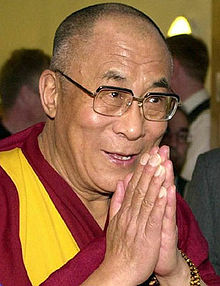
Dalai Lama says successor will be born in ‘free world’ outside of China

Aljazeera.com

Tibetan spiritual leader says in a new book that his people’s aspiration for freedom cannot be indefinitely delayed.

The Dalai Lama offers blessings to his followers at his Himalayan residence in the northern hill town of Dharamshala, India, on December 20, 2024 [Priyanshu Singh/Reuters]

Published On 11 Mar 202511 Mar 2025

The Dalai Lama has said that his successor will be born in the “free world” outside of China.

In a new book released on Tuesday, the 89-year-old spiritual leader of Tibetan Buddhism says that he will be reincarnated outside of Tibet, which is an autonomous region of China.

“Since the purpose of a reincarnation is to carry on the work of the predecessor, the new Dalai Lama will be born in the free world so that the traditional mission of the Dalai Lama – that is, to be the voice for universal compassion, the spiritual leader of Tibetan Buddhism, and the symbol of Tibet embodying the aspirations of the Tibetan people – will continue,” the Dalai Lama, who fled Tibet for India in 1959, writes in Voice for the Voiceless.

China considers Tibet, which has alternated between independence and Chinese control over the centuries, as an integral part of the country and views movements advocating greater autonomy or independence as threats to its national sovereignty.

Beijing has labelled the current Dalai Lama, who was identified as the reincarnation of his predecessor at two years old, a “separatist” and insisted on the right to appoint his successor after his death.

The Dalai Lama, who stepped down as the political leader of the Tibetan government-in-exile in 2011 to focus on his spiritual role, has denied advocating Tibetan independence and argued for a “Middle Way” approach, which would grant the mainly Buddhist territory greater autonomy.

In his book, the Dalai Lama writes that he has received numerous petitions from people in and outside Tibet asking him to ensure that his lineage continues, and says that Tibetan people’s aspirations for freedom cannot be denied indefinitely.

“One clear lesson we know from history is this: If you keep people permanently unhappy, you cannot have a stable society,” he writes.

Source: Al Jazeera and news agencies

Home away from home: The untold story of Canada’s ‘Little Tibet’

Al Jazeera English – 27 thg 10, 2022

Tucked away within Toronto’s inner city is a small enclave known as “Little Tibet”.

Located in the Parkdale neighbourhood, the restaurants here are famous for delicious Tibetan dumplings known as momos.

Parkdale is also home to one of the largest concentrations of Tibetans outside Asia, stemming from the 1970s when Tibetan refugees flocked to Canada. The community has thrived here, establishing Little Tibet’s reputation as a food mecca and setting up a cultural centre.

But today, rapid gentrification and Toronto’s sky-high rents threaten the area’s unique social fabric. Amid China’s increasing global influence, the Tibetan community is striving to hold on to its past and maintain its traditions in an adopted land.

Explore Little Tibet and meet an immigrant community working to preserve its identity in this episode of A Sense of Community, a four-part series about unique neighbourhoods around the world and the challenges they face.

US Congress stings China with new Tibet law on the next Dalai Lama

The Hindustan Times

The Central Tibetan Administration welcomed the Tibetan Policy and Support Act passed by the US Congress, calling it a historic move and a clear message to China

WORLD Updated: Dec 22, 2020, 15:20 IST The Hindustan Times

Shishir Gupta

Shishir Gupta
Hindustan Times, New Delhi

The US Congress has passed a law that reaffirms the right of Tibetans to select the successor to His Holiness Dalai Lama.
The US Congress has passed a law that reaffirms the right of Tibetans to select the successor to His Holiness Dalai Lama.(Sonu Mehta/HT PHOTO)

The US Congress has passed a bill that reaffirms the right of Tibetans to choose a successor to their spiritual leader, the Dalai Lama. The law has been described by Dharamshala, the seat of the Tibetan government-in-exile, as a historic move and a clear message to China.

The Tibetan Policy and Support Act of 2020 (TPSA), which was passed by the US Senate, calls for the establishment of a US consulate in Tibet’s main city of Lhasa and underlines the absolute right of Tibetans to choose a successor to the Dalai Lama.

Tiếp tục đọc “US Congress stings China with new Tibet law on the next Dalai Lama”

Rise of domestic social media in Tibet against China

ANI
03 Dec 2020, 18:55 GMT+10

Taipei [Taiwan], December 3 (ANI): Despite the attempts by the authoritarian Chinese Communist Party (CCP) to curb freedom of expression, right to information, association and religion in Tibet, there has been a rise in domestic social media giving platform to voices challenging the government-sponsored news.

Tiếp tục đọc “Rise of domestic social media in Tibet against China”

China says US should stop meddling after exiled Tibetan leader visits State Department

Lobsang Sangay, PM of the Tibetan government-in-exile, poses for a picture after an interview with

20 Oct 2020 09:43PM CNA

Lobsang Sangay, the president of the Tibetan Central Administration (CTA), met the new US special coordinator on Tibet last week. Sangay said it was the first time that the head of the CTA had been received at the State Department.Advertisement

“China will take all necessary measures to protect its interests,” foreign ministry spokesman Zhao Lijian said during a daily news conference in Beijing on Tuesday (Oct 20).

China’s irritation with the United States over Tibet comes at a time when relations between the two world powers are at their lowest point in decades over a range of issues, including trade, Taiwan, human rights, the South China Sea and COVID-19.

Describing Sangay as an anti-China separatist, Zhao said the United States should cease any official contact with him.

The meeting “sent a seriously wrong signal to Tibetan independence forces”, he said.Advertisement

“The US should immediately stop using the Tibet issue to interfere in China’s internal affairs.”

READ: US’ Pompeo to visit Sri Lanka and Maldives as China threat looms

China seized control over Tibet in 1950 in what it describes as a “peaceful liberation”. International human rights groups and exiles routinely condemn what they call China’s oppressive rule in Tibetan areas.

Since its formation in 1959, the Tibetan government-in-exile has been based in Dharamshala in northern India. China’s relations with India became fraught in recent months following a bloody clash between troops stationed on the disputed Himalayan border.
Source: Reuters/jt

US appoints Tibet coordinator amid tensions with China

OCt. 14, 2020 Al Jareeza

Senior US human rights official named as special coordinator for Tibetan issues amid increasingly tense relations between Washington and Beijing.

Human rights activists say Beijing suppresses local culture, the Buddhist religion and minorities in Tibet [File: He Penglei/CNS via Reuters]

14 Oct 2020

The United States has appointed a senior human rights official as special coordinator for Tibetan issues, amid increasingly tense relations between Washington and Beijing.

US Secretary of State Mike Pompeo announced on Wednesday that Robert Destro, assistant secretary of state for democracy, human rights and labor, would assume the additional post, which has been vacant since the start of President Donald Trump’s term in 2017.

Tiếp tục đọc “US appoints Tibet coordinator amid tensions with China”

Tầm quan trọng của giáo dục

Tác giả: Đạt Lai Lạt Ma
Dịch giả: Phạm Thu Hương

Trích từ bài phát biểu của Đức Đạt Lai Lạt Ma ở Dharamsala [Ấn Độ] với một nhóm lớn những con dân Tây Tạng của Ngài vào ngày 27 tháng Ba năm 2006. Đức Đạt Lai Lạt Ma đã cảnh báo nguy cơ trầm trọng nhất đối với sự sống còn của bản sắc Tây Tạng đồng thời nhấn mạnh công cuộc giáo dục hiện đại là không thể thiếu để duy trì văn hóa Phật giáo Tây Tạng cũng như duy trì tính dân tộc trong những hoàn cảnh khó khăn nhất của lịch sử Tây Tạng.

Tôi luôn luôn nói rằng, quần chúng nhân dân Tây Tạng ở Tây Tạng mới là chủ nhân thật của vận mệnh Tây Tạng, và khoảng một trăm năm mươi ngàn người Tây Tạng lưu vong ở đây [Dharamsala, Ấn Độ] [1] chỉ đại diện cho nhân dân để hoàn thành sự thật của chính nghĩaTây Tạng, để hành động như những người phát ngôn tự do và như những người đại diện tượng trưng của nhân dân.

Cho đến nay, quần chúng nhân dân ở Tây Tạng vẫn còn ở trong trạng thái đau khổ vì hậu quả bị tước đoạt tự do của họ. Mặc dù vậy, ngay cả khi đối diện với những hiểm nguy đến với cuộc sống của họ, trong mọi phương diện họ vẫn kiên định giữ vững sứ mệnh cao cả về sắc tộc của họ và niềm tin chung vào viễn cảnh tương lai của người Tây Tạng, vẫn giữ vững trong tâm trí các quyền lợi của họ với tư cách là một dân tộc.

Tiếp tục đọc “Tầm quan trọng của giáo dục”