VE – Ảnh hưởng kinh tế lớn của Trung Quốc tại Lào đặt ra câu hỏi về và tác động đến vấn đề Biển Đông, khi Lào là chủ tịch ASEAN năm nay.

Tiếp tục đọc “Dấu chân Trung Quốc tại Lào gây nghi ngại về vấn đề Biển Đông”
Conversations on Vietnam Development

VE – Ảnh hưởng kinh tế lớn của Trung Quốc tại Lào đặt ra câu hỏi về và tác động đến vấn đề Biển Đông, khi Lào là chủ tịch ASEAN năm nay.
Tiếp tục đọc “Dấu chân Trung Quốc tại Lào gây nghi ngại về vấn đề Biển Đông”

On Tuesday, Chinese President Xi Jinping visited a mosque in China’s western Ningxia province. The leader of the officially atheist Chinese Communist Party (CCP) praised the local Muslim community’s rich cultural contribution and efforts alleviating poverty. “Religions in our country, the endemic ones and those from abroad, have become deeply embedded in the Chinese civilization, whose history covers more than 5,000 years,” Xi said in Ningxia’s capital Yinchuan, reports the state-backed China Daily newspaper. Tiếp tục đọc “Uighur Extremists Joining ISIS Poses a Security and Economic Headache for China’s Xi Jinping”

lowyinterpreter – Thailand has a long tradition of balancing its relations with major powers and, since the 2014 coup, it has been shifting towards China. However, with the two countries now involved in a complicated collaboration on high speed rail, the Thai public has started to question whether China is truly its best ally. Indeed, once one looks beyond perceptions and emotions and examines the detail of the Thailand-China relations, the best friend status is puzzling.

Thailand and China drew closer back in the late 1970s when Bangkok needed Beijing’s military and strategic support to cope with an expansionist Vietnam. The friendship strengthened when China withdrew its support of the communist movement in Thailand, removing red threats from within and outside of the country. Cordial relations strengthened further in the last decade. Then, when other friends — like the US, UK, Australia and Japan — condemned the 2014 coup, China stated that Thailand should resolve its domestic conflicts peacefully. This reaction was welcomed by many Thais who supported the overthrow of the Shinawatra government, even by unconstitutional means.
Tiếp tục đọc “The curious case of Thai-Chinese relations: Best friends forever?”

China’s recent global infrastructure development initiatives serve to place it at the center of Asian regional and worldwide economic activity, while also meeting a critical need in the developing world. In marked contrast, the United States lacks a strategic approach to supporting global infrastructure investment. While the U.S. government does have the instruments in place to increase support for infrastructure investment, there is little coordination among relevant agencies, including the Overseas Private Investment Corporation, the Trade and Development Agency, and the Export-Import Bank. This report examines how the United States has approached infrastructure development in the past and how it is approaching it today with an eye toward practical recommendations to improve the United States’ ability to support infrastructure investment.

President Xi Jinping’s “Belt and Road” Initiative highlights the influences shaping the genesis of the “One Belt, One Road” initiative, examines the balance China is seeking to strike between geostrategic ambitions and practical economic aims, and explores the mechanisms the Xi administration is establishing to manage its implementation. The report concludes by assessing potential pitfalls and making the call for an innovative U.S. approach to global infrastructure development.
Thứ hai, 19 Tháng 10 2015 10:41 dinh tuan anh
NCBĐ – Trong thời kỳ các ông Giang Trạch Dân và Hồ Cẩm Đào nắm quyền, Trung Quốc đã thiết lập và nuôi dưỡng văn hóa vinh danh quyền lãnh đạo tập thể. Tuy nhiên, Tập Cận Bình là mẫu lãnh đạo khác biệt. Ngay cả người dân Trung Quốc cũng bất ngờ với thực tế này.

Hỏi: Có thể định nghĩa ý tưởng của ông Tập Cận Bình về “Giấc mơ Trung Hoa” như thế nào trên khía cạnh đối ngoại?
Trả lời: Chính sách ngoại giao trước đây của Bắc Kinh dựa trên cơ sở Trung Quốc còn là nước đang phát triển. Tuy nhiên, dưới sự lãnh đạo của ông Tập Cận Bình, Trung Quốc đã thay đổi từ nhận thức với tư cách là một cường quốc và bắt đầu nói với thế giới về “Giấc mơ Trung Hoa”. Nội dung của “Giấc mơ Trung Hoa” là Trung Quốc sẽ tìm cách trở thành một quốc gia đủ tự tin để khẳng định với bất kỳ đối tác nào về những lợi ích cốt lõi, lãnh thổ, chủ quyền và sự phát triển, cũng như về các vấn đề toàn cầu trên cơ sở bình đẳng. Tiếp tục đọc “Ông Tập Cận Bình có ảnh hưởng về đối ngoại lớn hơn so với những người tiền nhiệm”
Thứ tư, 09 Tháng 9 2015 14:15
NCQT – Do dự án Cảng Hòn Khoai của Việt Nam và Kênh Kra của Thái Lan đều gắn với Biển Đông – và những căng thẳng giữa Mỹ và Trung Quốc cũng đang diễn ra ở đây- vì vậy chúng cần phải được đánh giá trong một bối cảnh rộng hơn về thiết lập trật tự khu vực mà hai cường quốc lớn nhất này đang dẫn dắt.
 Tiếp tục đọc “Dự án Kênh Kra của Thái Lan- Mối quan tâm của Việt Nam ?”
 The white star marks the location of the Kra Isthmus. The red star is Singapore, at the entrance to the Strait of Malacca.(Map/China Times)
China and Thailand recently agreed in Guangzhou on a canal project through the Kra Isthmus, the narrowest part of the Malay peninsula in southern Thailand, which means the project, in the pipeline for years, may start construction soon, according to the website of Hong Kong-based Oriental Daily. Tiếp tục đọc “Thailand, China to team up on long-proposed Kra Isthmus canal”
xinhuanet
English.news.cn 2015-10-09 08:51:21
The RMB international Report 2015, done by the International Monetary Institute (IMI) of Renmin University of China, said China has been promoting the two important strategies as an emerging country and the world will be benefiting from implementation of the two strategies. Tiếp tục đọc ““One Belt, One Road” and RMB internationalization serve global interest: Report”

In just 30 years, China has developed from a poor inward-looking agricultural country to a global manufacturing powerhouse. Its model of investing and producing at home and exporting to developed markets has elevated it to the world’s second-largest economy after the USA.
Now faced with a slowing economy at home, China’s leadership is looking for new channels to sustain its appetite for growth at a time when developing neighbours are experiencing rapidly rising demand.
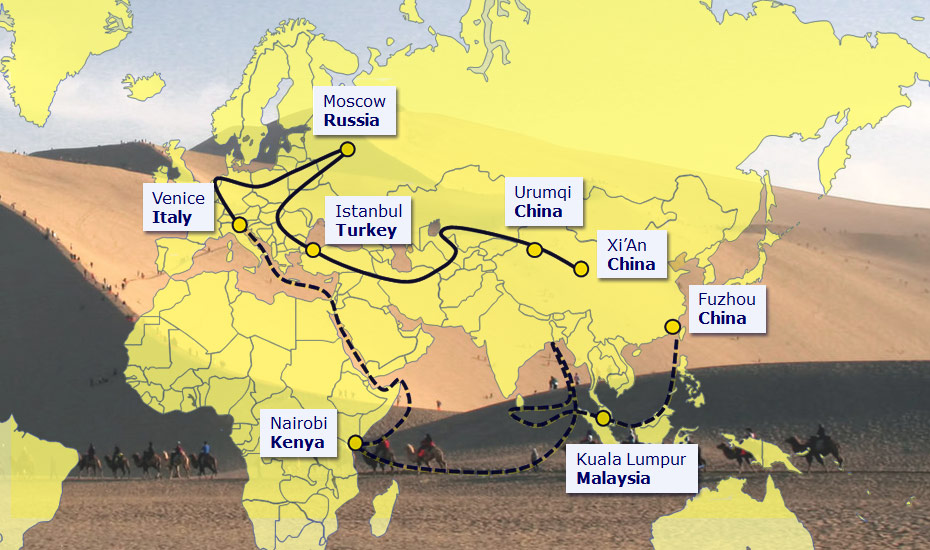
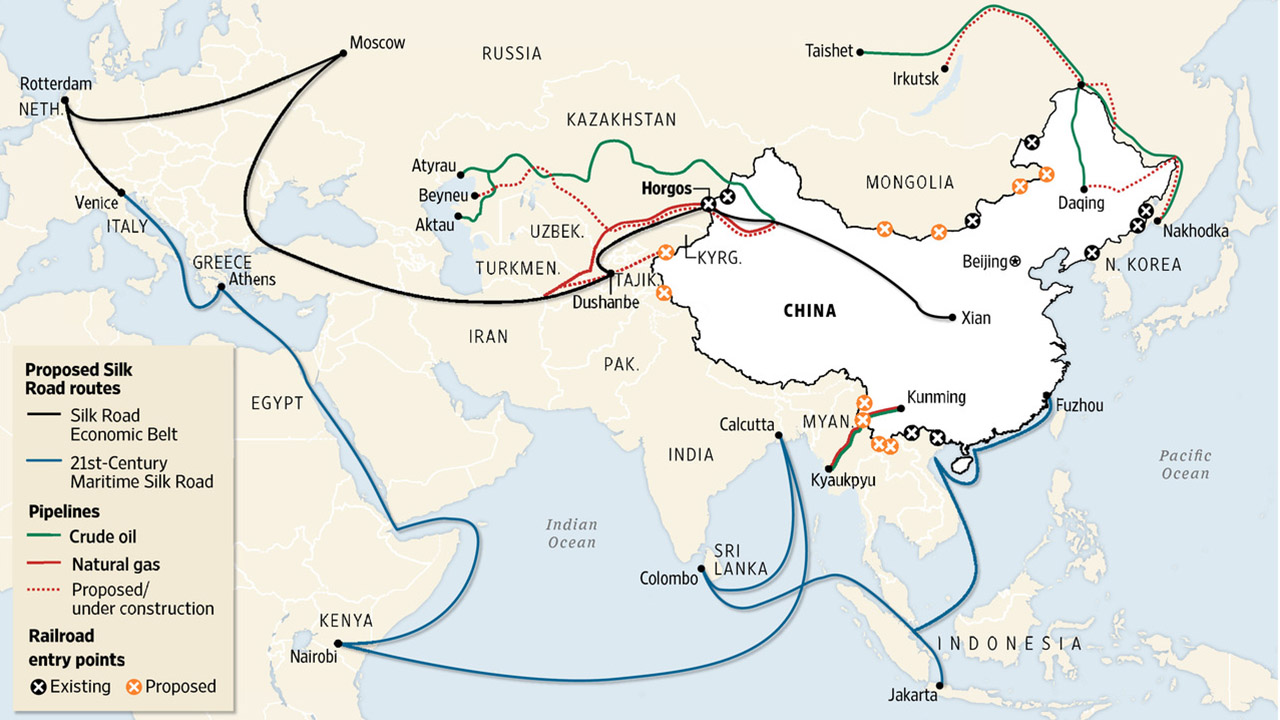
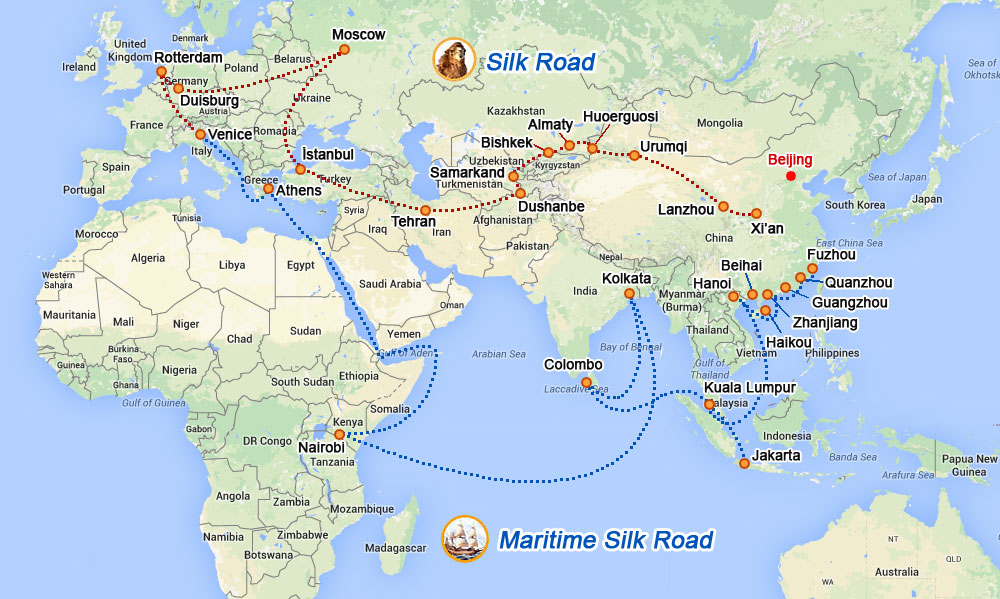
At the heart of One Belt, One Road lies the creation of an economic land belt that includes countries on the original Silk Road through Central Asia, West Asia, the Middle East and Europe, as well as a maritime road that links China’s port facilities with the African coast, pushing up through the Suez Canal into the Mediterranean. Tiếp tục đọc “A brilliant plan One Belt, One Road”
by Yun Sun

Nguồn: Lê Hồng Hiệp, “The Vietnam-US-China Triangle: New Dynamics and Implications,” ISEAS Perspective, No 45/2015, 25/08/2015.
Biên dịch: Nguyễn Huy Hoàng
Dẫn nhập
Chuyến thăm Washington gần đây của Tổng Bí thư Đảng Cộng sản Việt Nam (ĐCSVN) Nguyễn Phú Trọng được cả hai bên ca ngợi như một dấu mốc “lịch sử” trong quan hệ song phương (The White House, 2015). Tuy nhiên, để có một đánh giá sâu sắc hơn về ý nghĩa của chuyến thăm, chúng ta cần đặt nó vào bối cảnh khu vực rộng lớn hơn, trong đó có xét đến những biến đổi gần đây trong tam giác quan hệ Việt-Mỹ-Trung.
Bài viết này phân tích những động lực mới trong tam giác Việt-Mỹ-Trung và ý nghĩa của chúng. Thông qua cách tiếp cận ba cấp độ phân tích và từ góc nhìn của Việt Nam, bài viết xem xét ba yếu tố quan trọng nhất ở các cấp độ hệ thống quốc tế (systemic), quốc gia (national), và trong nước (subnational) đang định hình mối quan hệ ba bên. Những yếu tố này bao gồm sự cạnh tranh chiến lược ngày càng tăng giữa Mỹ và Trung Quốc, lòng tin chiến lược giữa Việt Nam và hai cường quốc, và các diễn biến chính trị và kinh tế trong nước của Việt Nam. Tiếp tục đọc “Động lực mới trong tam giác chiến lược Việt – Mỹ – Trung”

Trung Quốc đầu tư sâu và rộng hệ thống giao thông tại 5 quốc gia GMS. Ảnh: EFR

 CVD
CVD 