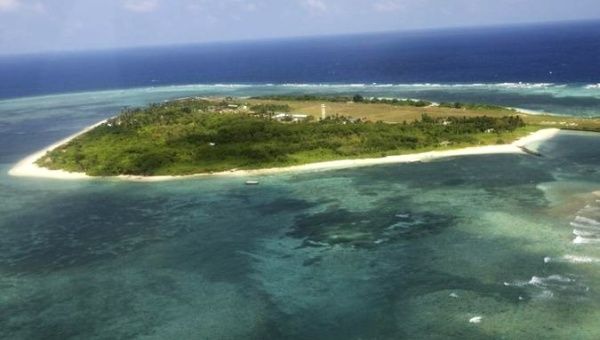
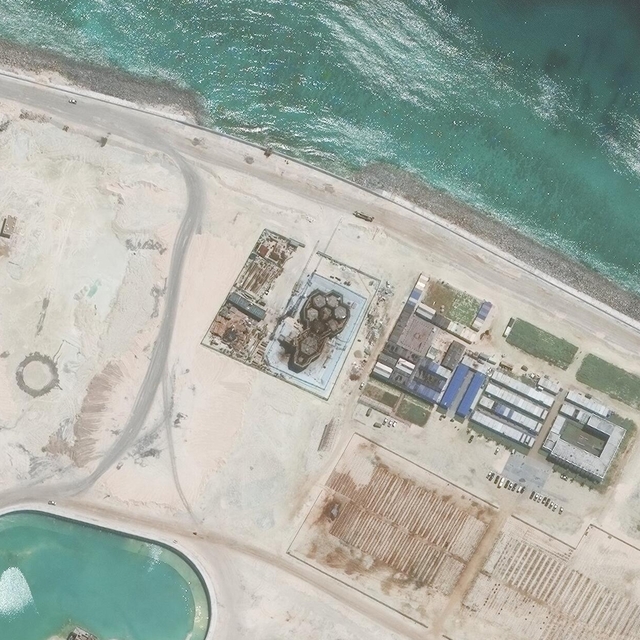
Vietnam continues modest expansions to its outposts in the Spratly Islands, most recently on Ladd Reef. Satellite imagery from March and June shows that Hanoi has dredged a new channel, which did not exist in older photos, and is expanding one of its two facilities (the other is a small lighthouse to the west) at the feature.
Gần đây, trên website của tổ chức Sáng kiến minh bạch hàng hải châu Á có đăng những ảnh vệ tinh cho thấy Việt Nam tập hợp 80 tàu ở vùng biển phía đông nam.
TTCT – Tình hình Biển Đông đang thay đổi chóng vánh và dồn dập, kèm theo những “bình luận” trích từ nhiều nguồn dễ gây ngộ nhận tương quan “nhân quả”. Các sự kiện trên Biển Đông liên quan gì tới cuộc tập trận RIMPAC và những động thái mới của Mỹ? Các dữ kiện sẽ cho phép nhận chân tình hình.
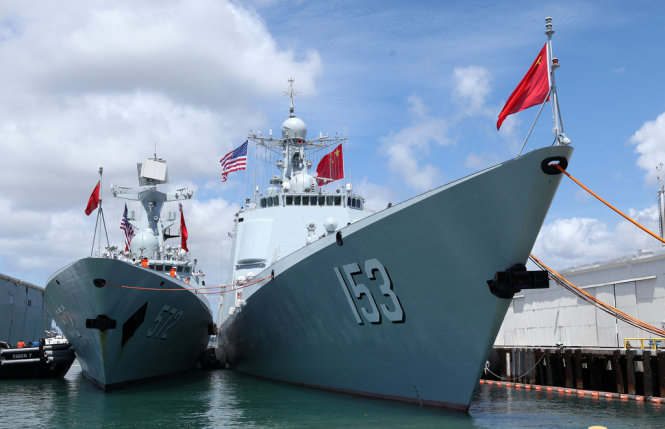
Tàu chiến Trung Quốc tham gia cuộc tập trận RIMPAC 2016. Ảnh: Asia News
“Chúng tôi có bằng chứng mạnh mẽ rằng Trung Quốc đã triển khai các tên lửa đối hạm, đối không, cùng các thiết bị nhiễu sóng tại các thực thể tranh chấp ở khu vực Trường Sa của Biển Đông. Việc Trung Quốc vừa cho hạ cánh máy bay ném bom trên đảo Phú Lâm cũng đã làm căng thẳng nổi lên” – người phát ngôn Bộ Quốc phòng Mỹ loan báo hôm 23-5. Tiếp tục đọc “Từ biển Đông đến RIMPAC”→
The secretary allayed fears and addressed criticism by stressing that the Philippines has not lost a single inch of territory to China during the Duterte administration.
The government of Filipino President Rodrigo Duterte has fired off a stern warning to China regarding the natural resources in the South China Sea region.
The Philippines foreign ministry vows that the country will not shy away from going to war over the disputed region. The official, on Monday, stated that there are several “red lines” or actions – if crossed or taken – would be deemed unacceptable resulting in an aggressive response from Manila. Tiếp tục đọc “Philippines: We Will go to War Over South China Sea Violations”→
TTCT – Vụ một nhóm du khách Trung Quốc nhập cảnh vào Cam Ranh với áo thun in hình “lưỡi bò” trên lưng chỉ là một trong vô vàn âm mưu thôn tính lớn nhỏ.
Máy bay vận tải quân sự Thiểm Tây Y-8 của Trung Quốc trên đá Subi, ảnh công bố ngày 28-4. Ảnh: AMTI
Hôm thứ hai 14-5, Hãng thời trang GAP đã xin lỗi Bắc Kinh vì bán ra những áo thun in bản đồ Trung Quốc mà không thể hiện trên đó Đài Loan, Nam Tây Tạng và biển Nam Hải (cách Trung Quốc gọi Biển Đông). Hãng GAP cam kết trong một thông báo trên Hoàn Cầu Thời Báo rằng họ “tôn trọng chủ quyền và sự vẹn toàn lãnh thổ của Trung Quốc”.
Báo mạng chuyên về kinh tế – tài chính Business Insider của Mỹ, phát hành bằng 8 thứ tiếng Anh, Ba Lan, Đức, Hà Lan, Nhật, Pháp, Hoa, Ý, còn “lập công” khi cho biết “đến tối thứ hai, Business Insider vẫn tìm thấy áo thun gây tranh cãi của Hãng GAP được bán” ngoài thị trường. Vụ việc đó, cùng vụ mặc áo thun in hình “lưỡi bò” ở Việt Nam, thật điển hình cho “cuộc chơi” cùng “luật chơi” ở Biển Đông lúc này. Tiếp tục đọc “Biển Đông: Cuộc chơi và luật chơi của ai?”→
The US network CNBC reports, citing sources close to US intelligence, the Chinese army installed anti-ship and air-to-air defenses on outposts also claimed by Vietnam and the Philippines over the last 30 days
DISPUTED. This 2016 file photo shows a portion of the disputed Mischief Reef in the South China Sea where there are Chinese facilities.
BEIJING, China – Beijing Thursday, May 3, reasserted its right to build “defense” facilities in the disputed South China Sea, but declined to confirm reports it had installed new missiles on artificial islands it has built in the region.
The Chinese army installed anti-ship and air-to-air defenses on outposts also claimed by Vietnam and the Philippines over the last 30 days, US network CNBC reported Wednesday, citing sources close to US intelligence. Tiếp tục đọc “Beijing ‘installs missiles’ on South China Sea islands”→
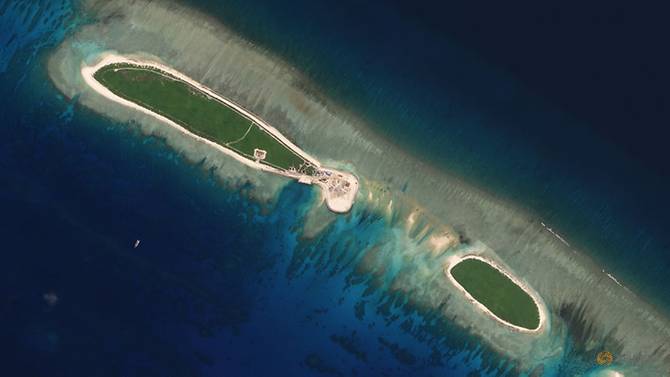
channelnewsasiaSatellite photo shows Chinese-controlled North Island, part of the Paracel Islands group in the South China Sea, on Sep 29, 2017. (Photo: Planet Labs/Handout via Reuters)
WASHINGTON: While attention in Asia has been distracted by the North Korean nuclear crisis in the past year, China has continued to install high-frequency radar and other facilities that can be used for military purposes on its man-made islands in the South China Sea, a US think tank said on Thursday (Dec 14).
Chinese activity has involved work on facilities covering 29 hectares of the Spratly and Paracel islands, territory contested with several other Asian nations, according to the Asia Maritime Transparency Initiative of Washington’s Center for Strategic and International Studies. The report cited satellite images. Tiếp tục đọc “While focus is on North Korea, China continues South China Sea buildup: Think tank”→
White Paper on the Hoang Sa (Paracel) and Truong Sa (Spratly) Islands
Republic of Vietnam
Ministry of Foreign Affairs
Saigon, 1975
CHAPTER I
Foreword
The Vietnamese archipelagoes of Hoang Sa (Paracel) and Truong Sa (Spratly) are both situated in the South China Sea off the Republic of Vietnam’s shore. Their very modest size by no means lesser the importance given them by the Vietnamese: to Vietnamese hearts, these remote insular territories are as dear as could be any other part of the fatherland. The Hoang Sa Islands to the North were occupied by force of arms by the People’s Republic of China on January 20, 1974, following a brazen act of invasion which left the world extremely indignant. As for the Truong Sa Islands 500 km to the South, two other foreign powers are illegally stationing troops on four of the main islands in the archipelago. Tiếp tục đọc “White Pape of the Republic of Vietnam on the Hoang sa (Paracel) and Truong Sa (Spratly) Islands – (1975)”→
Vox_Since 2014, China has been building islands in the middle of the South China Sea. What were once underwater reefs are now sandy islands complete with airfields, roads, buildings, and missile systems. In less than two years, China has turned seven reefs into seven military bases in the South China Sea, one of the most contentious bodies of water in the world.
href=””>United Nations Law of the Seas, which says a country’s territory extends 200 miles off its shores, an area called the exclusive economic zone, or EEZ. Any trade or resources that fall in a country’s EEZ belong to that country; they’re its sovereign territory. Any area that is not in an EEZ is considered international waters and subject to UN maritime law, meaning it’s shared by everyone. Every country in the region, which includes Malaysia, the Philippines, Brunei, and Vietnam, bases its claim to the South China Sea on the UN’s EEZ laws — except China.
China argues it has a historical claim to the South China Sea, dating back to naval expeditions in the 15th century. After World War II, the Japanese Empire lost control of the South China Sea, and China took advantage of the moment to reclaim it. On maps, it started drawing a dashed line that encompassed most of the South China Sea. This line became its official claim and is known today as the Nine-Dash Line, because it always has nine dashes. In 1973, when the UN law established EEZs, China reaffirmed its Nine-Dash Line, refusing to clarify the line’s boundaries and rejecting other countries’ claims.
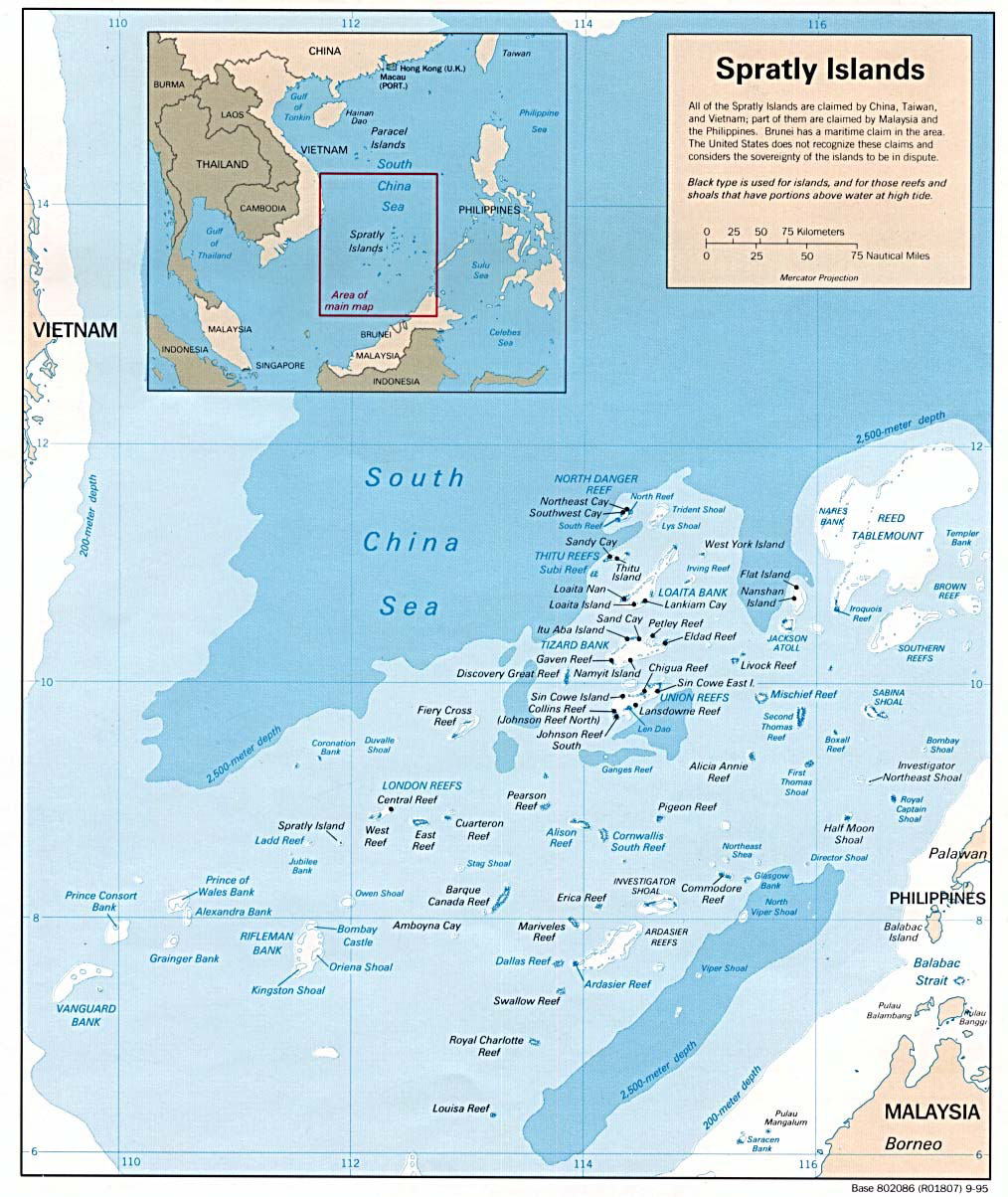
Since then, tensions have built around who rightfully owns the South China Sea. The dispute has centered on the Spratly Islands, an archipelago at the heart of the South China Sea. Currently, China, Malaysia, the Philippines, and Vietnam claim some part of the Spratly Island chain. They’ve asserted their claims by putting small buildings, ports, and even some people on what are essentially rocks in the middle of the ocean.
But the Spratlys are very important, because whichever country can successfully claim themcan extend its EEZ to include them, thus gaining miles of precious sovereign territory. This is why China began building up islands in 2014. By turning these rocks into military bases, the Chinese are now able to support hundreds of ships, bolstering their presence in the region. They are using fishing boats, surveillance ships, and navy destroyers to set up blockades around other countries’ islands and defend their own. This is all done very cautiously and in small steps in order to avoid sparking a wider conflict.
Since China began building islands, the disputes have not become violent.But tensions are building in the region. As China deploys more of its military to the Spratlys, other countries are getting nervous and building up their own islands. It’s a complex situation that will continue to gain international attention, for better or for worse.
First posted on UNCLOSforum.wordpress.com on April 24, 2015
Chào các bạn,
Đây là bản tiếng việt nguyên thủy “Bạch thư về các quần đảo Hoàng Sa và Trường Sa” mà chính phủ Việt Nam Cộng Hòa (nam Việt Nam) công bố năm 1975, sau khi Trung quốc cưỡng chiếm Hoàng Sa.
First posted on UNCLOSforum.wordpress.com on April 24, 2015
PREFACE
BTO – Viet Nam has more than 3,000 coastal islands and two offshore archipelagoes, namely Hoang Sa archipelago and Truong Sa archipelago. The closest point of Hoang Sa archipelago is 120 nautical miles from the east of Quang Ngai. Meanwhile, the closest point of Truong Sa archipelago is about 250 nautical miles to the east of Cam Ranh Bay, Nha Trang city, Khanh Hoa province.
These two archipelagoes are the inseparable part of Viet Nam’s territory. The State of Viet Nam has already exercised the sovereignty over the two archipelagoes for hundred of years. The sovereignty of Viet Nam over Hoang Sa and Truong Sa archipelagoes is in full accordance with international law and supported by numerous legal and historical evidences.
With a view to helping the readers have a better understanding of the process of establishing and exercising Viet Nam’s sovereignty over these two archipelagoes, the National Political Publishing House publishes “Viet Nam’s Sovereignty over Hoang Sa and Truong Sa Archipelagoes.”Tiếp tục đọc “Viet Nam’s Sovereignty Over Hoang Sa And Truong Sa Archipelagoes”→
First posted on UNCLOSforum.wordpress.com on April 24, 2015
Vietnam’s Position on the Sovereignty over the Paracels & the Spratlys: Its Maritime Claim
Hong Thao Nguyen
Vietnam National University – Hanoi
May 4, 2012
Journal of East Asia International Law, V JEAIL (1) 2012 Abstract:
The South China Sea has long been regarded as a major source of tension and instability in Pacific Asia. To clarify the position of claimants is a research task for creating the confidence building measures and promoting efforts to manage the possible conflicts in the region. The purpose of this article is to address the Vietnamese position on the sovereignty disputes over the Paracels and Spratlys, and maritime zones in the South China Sea. The Vietnamese position will be examined from three aspects: (1) the sovereignty of the Paracels and the Spratlys; (2) the maritime zones around these islands; and (3) the settlement of disputes in the South China Sea.
Number of Pages in PDF File: 48
Keywords: Dispute Management, Maritime Zones, Paracels, Sovereignty, South China Sea, Spratlys



 CVD
CVD 