There are tankers that exploit gaps in international law by fraudulently registering under flags of convenience or assuming false identities to avoid enforcement. Indeed, approximately 100+ false-flagged tankers now operate with limited scrutiny in critical regions like the Indian Ocean and South China Sea, bringing new impetus to the questions for coastal states: do they have the legal right to act, and should they exercise that right?
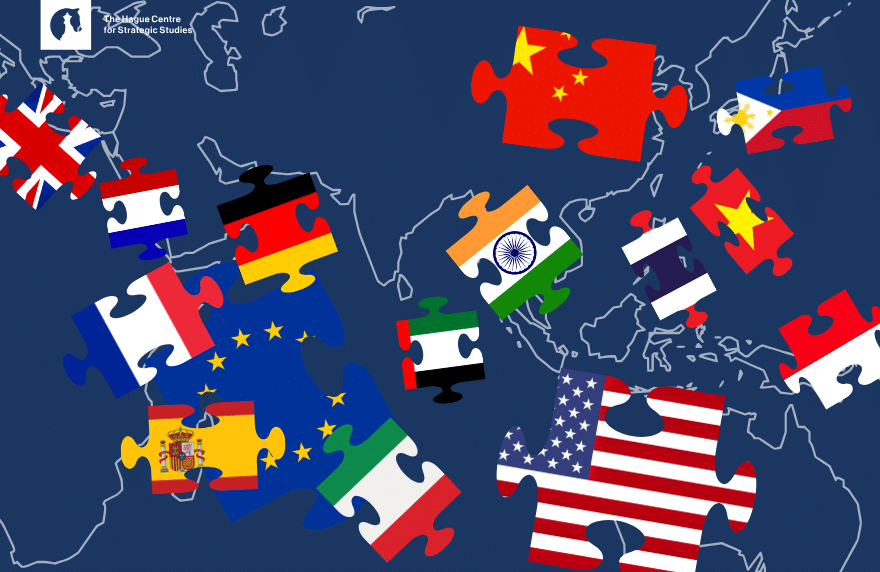
How should Europe strengthen its engagement with the Indo-Pacific? While the continent is highly dependent on trade from the region, it has limited capabilities to protect its interests in the face of growing Sino-American competition. This new HCSS report by Paul van Hooft, Benedetta Girardi and Alisa Hoenig examines how European states can engage in the Indo-Pacific by deepening cooperation with regional powers.
The Indo-Pacific comprises many actors, which are positioned along key chokepoints and share geopolitical and geoeconomic interests in protecting crucial sea lines of communication with Europe. This report does two things to establish pathways for deeper European engagement with Indo-Pacific states:
Based on relevance for maritime security and political affinity with European countries, it assesses the suitability of regional states as partners. Besides the usual suspects Australia, Japan and South Korea, it identifies an “inbetweener” group of countries, with whom cooperation can be fruitful but is not guaranteed, and states with whom engagement is unlikely to yield beneficial results.
It then zooms in on the “inbetweeners” to determine pathways for deepening ties. By comparing bilateral relations between different European and Indo-Pacific states along security, trade and investment, and capacity-building and infrastructure, the authors identify relative strengths and weaknesses of European states. Finally, they also contrast Europe’s involvement with that of China and the United States.
Based on the analysis, the report recommends to strengthen European collaboration with more ambivalent Indo-Pacific states, with a focus on trade and investment and capacity-building in the short- to medium-term.
The research for and production of this report has been conducted within the PROGRESS research framework agreement. Responsibility for the contents and for the opinions expressed, rests solely with the authors and does not constitute, nor should be construed as, an endorsement by the Netherlands Ministries of Foreign Affairs and Defence.
Released today, the annual Piracy and Armed Robbery Report of the ICC International Maritime Bureau (IMB) raises concern over the first successful Somali based hijacking since 2017.
The IMB annual report recorded 120 incidents of maritime piracy and armed robbery against ships in 2023 compared to 115 in 2022. It reveals that 105 vessels were boarded, nine attempted attacks, four vessels hijacked and two fired upon.
Where the number of 2023 reported incidents has slightly increased compared to 2022, the IMB urges caution for crew safety as the number of crew taken hostage and kidnapped increased from 41 to 73 and from two to 14 in 2022 and 2023 respectively. A further 10 crew were threatened, four injured and one assaulted in 2023.
Alarming first successful hijacking off Somalia since 2017
On 14 December 2023, the report recorded the first successful hijacking of a vessel off the coast of Somalia since 2017.
Much of the focus on the South China Sea over the past decade has centered around the nationalistic territorial disputes between China and four Southeast Asian claimants and a geopolitical tussle between China and the United States over freedom of navigation in the contested waters. What is going on beneath the surface of the sea – overfishing, destruction of coral reefs, climate change, plastics pollution, ocean acidification – is equally threatening and may have a longer-term impact on the survivability of the sea with its rich fishing beds, potential gas and oil reserves, and bustling sea lanes.
Kurt Campbell, the U.S. National Security Council Indo-Pacific coordinator speaks at the United States Institute of Peace on Nov. 19. (Screenshot)KEN MORIYASU, Nikkei Asia chief desk editorNovember 20, 2021 03:20 JST
NEW YORK — U.S. President Joe Biden’s administration views India and Vietnam as key countries to strengthen relations with, his Indo-Pacific point man said Friday.
India will be a key fulcrum player on the global stage in the 21st century, and successive American administrations have been united in that assessment, said Kurt Campbell, the National Security Council’s coordinator for the Indo-Pacific, at an event hosted by the Washington-based United States Institute of Peace.
“I’m very bullish about the future with India. I think we all recognize that the critical, crucial member in the Quad is India,” Campbell said, referring to the Quadrilateral Security Dialogue among the U.S., Japan, India and Australia.
In August 2018, the HMS Albion sailed through the Paracel Islands to assert freedom of navigation and challenge China’s claim to straight baselines around the island group. The United Kingdom’s challenge was the first operation by a non-U.S. vessel in the South China Sea that was analogous to the United States’ now well-publicized freedom of navigation operations (FONOPs). Three months later, the USS Chancellorsville undertook an identical challenge to Beijing’s baselines around the Paracels. Similar operations had been undertaken by the USS Decatur in October 2016 and the USS Chafee in October 2017. Tiếp tục đọc “Reading Between the Lines: The Next Spratly Legal Dispute”→
On February 4, Philippine defense secretary Delfin Lorenzana announced that construction of a new beaching ramp at Thitu Island would be completed in early 2019. Thitu is the largest of the nine features occupied by the Philippines in the Spratlys Islands and is home to about 100 civilians along with a small military garrison. The ramp, which was originally scheduled for completion in 2018, will facilitate the delivery of construction equipment and materials to the island for further planned upgrades, especially to its crumbling runway. AMTI previously tracked the start of repair work on the runway in May 2018, but that appears to have been halted while the beaching ramp is completed. Tiếp tục đọc “Under Pressure: Philippine Construction Provokes a Paramilitary Response”→
Vietnam continues modest expansions to its outposts in the Spratly Islands, most recently on Ladd Reef. Satellite imagery from March and June shows that Hanoi has dredged a new channel, which did not exist in older photos, and is expanding one of its two facilities (the other is a small lighthouse to the west) at the feature.
Vox_Since 2014, China has been building islands in the middle of the South China Sea. What were once underwater reefs are now sandy islands complete with airfields, roads, buildings, and missile systems. In less than two years, China has turned seven reefs into seven military bases in the South China Sea, one of the most contentious bodies of water in the world.
href=””>United Nations Law of the Seas, which says a country’s territory extends 200 miles off its shores, an area called the exclusive economic zone, or EEZ. Any trade or resources that fall in a country’s EEZ belong to that country; they’re its sovereign territory. Any area that is not in an EEZ is considered international waters and subject to UN maritime law, meaning it’s shared by everyone. Every country in the region, which includes Malaysia, the Philippines, Brunei, and Vietnam, bases its claim to the South China Sea on the UN’s EEZ laws — except China.
China argues it has a historical claim to the South China Sea, dating back to naval expeditions in the 15th century. After World War II, the Japanese Empire lost control of the South China Sea, and China took advantage of the moment to reclaim it. On maps, it started drawing a dashed line that encompassed most of the South China Sea. This line became its official claim and is known today as the Nine-Dash Line, because it always has nine dashes. In 1973, when the UN law established EEZs, China reaffirmed its Nine-Dash Line, refusing to clarify the line’s boundaries and rejecting other countries’ claims.
Since then, tensions have built around who rightfully owns the South China Sea. The dispute has centered on the Spratly Islands, an archipelago at the heart of the South China Sea. Currently, China, Malaysia, the Philippines, and Vietnam claim some part of the Spratly Island chain. They’ve asserted their claims by putting small buildings, ports, and even some people on what are essentially rocks in the middle of the ocean.
But the Spratlys are very important, because whichever country can successfully claim themcan extend its EEZ to include them, thus gaining miles of precious sovereign territory. This is why China began building up islands in 2014. By turning these rocks into military bases, the Chinese are now able to support hundreds of ships, bolstering their presence in the region. They are using fishing boats, surveillance ships, and navy destroyers to set up blockades around other countries’ islands and defend their own. This is all done very cautiously and in small steps in order to avoid sparking a wider conflict.
Since China began building islands, the disputes have not become violent.But tensions are building in the region. As China deploys more of its military to the Spratlys, other countries are getting nervous and building up their own islands. It’s a complex situation that will continue to gain international attention, for better or for worse.
chathamhouse – Despite its dramatic rejection of the South China Sea arbitration case initiated by the Philippines, China is gearing up to play a much larger role in the evolution of the international legal system.
A vendor in Beijing stands behind a map including an insert depicting the ‘nine-dash line’ in the South China Sea. Photo by Getty Images.
It is tempting to read China’s refusal in this case to acknowledge the jurisdiction of the arbitral tribunal in The Hague as the defiance of an arrogant superpower that views itself as above international law. No doubt many in Manila, Washington and elsewhere are purveying this view. But there is more here than meets the eye.
Vietnam’s Island Building:
Double Standard or Drop in the Bucket?China has sought to deflect criticism of its island building in the South China Sea by accusing other claimants, especially Vietnam, of doing the same. AMTI has examined each of the islets and reefs Vietnam occupies in the Spratly Islands and found evidence of reclamation at 10 of them. The images below suggest Vietnam has created just over 120 acres of new land in the South China Sea, mostly at Spratly Island, Southwest Cay, Sin Cowe Island, and West Reef. The majority of this work has occurred in the last two years. Tiếp tục đọc “CSIS – AMTI Brief – May 13, 2016”→
Secretary of Defense Ashton Carter’s trip to the Philippines on April 13-15 was an affirmation of U.S. support for its treaty ally amid the simmering South China Sea maritime disputes. The timing of his visit—at the end of the annual Balikatan U.S.-Philippine joint exercises and just weeks before an expected decision by the Permanent Court of Arbitration in The Hague in the Philippines’ arbitration case against China’s nine-dash- line claim—was a clear message to Beijing and Manila that Philippine maritime security is a priority for the United States. Tiếp tục đọc “CSIS – Southeast Asia from Scott Circle – April 28 2016”→
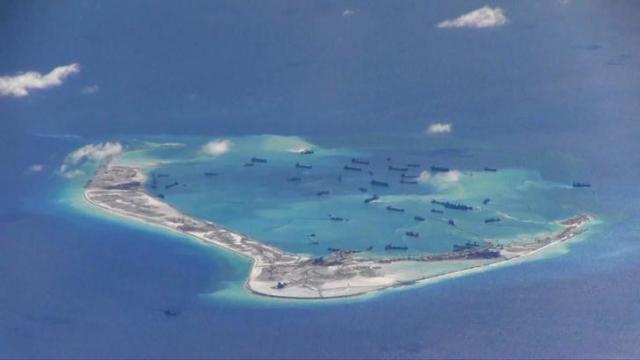
Chinese dredging vessels are purportedly seen in the waters around Mischief Reef in the disputed Spratly Islands in the South China Sea in this still image from video taken by a P-8A Poseidon surveillance aircraft provided by the United States Navy May 21, 2015. REUTERS/U.S. Navy/Handout via Reuters
WASHINGTON (Reuters) – The United States has seen Chinese activity around a reef China seized from the Philippines nearly four years ago that could be a precursor to more land reclamation in the disputed South China Sea, the U.S. Navy chief said on Thursday. Tiếp tục đọc “Exclusive: U.S. sees new Chinese activity around South China Sea shoal”→
China’s airstrip construction at Fiery Cross, Mischief, and Subi reefs, and more recently developments in the Paracel Islands, have dominated the South China Sea discussion. But capabilities being developed at its smaller Spratly Island outposts—Gaven, Hughes, Johnson South, and especially Cuarteron reefs—will prove equally important to Beijing’s long-term strategy. Tiếp tục đọc “CSIS: AMTI Brief – February 22, 2016”→
The Center for Strategic and International Studies last month completed an independent review of the defense portion of the Obama administration’s rebalance to the Asia Pacific. This review, which includes an evaluation of the rebalance’s implementation and resourcing as well as recommendations for its improvement, was mandated by the U.S. Congress under the 2015 National Defense Authorization Act. Tiếp tục đọc “CSIS: AMTI Brief – Evaluating the Asia-Pacific Rebalance – Feb 4, 2016”→







 CVD
CVD 