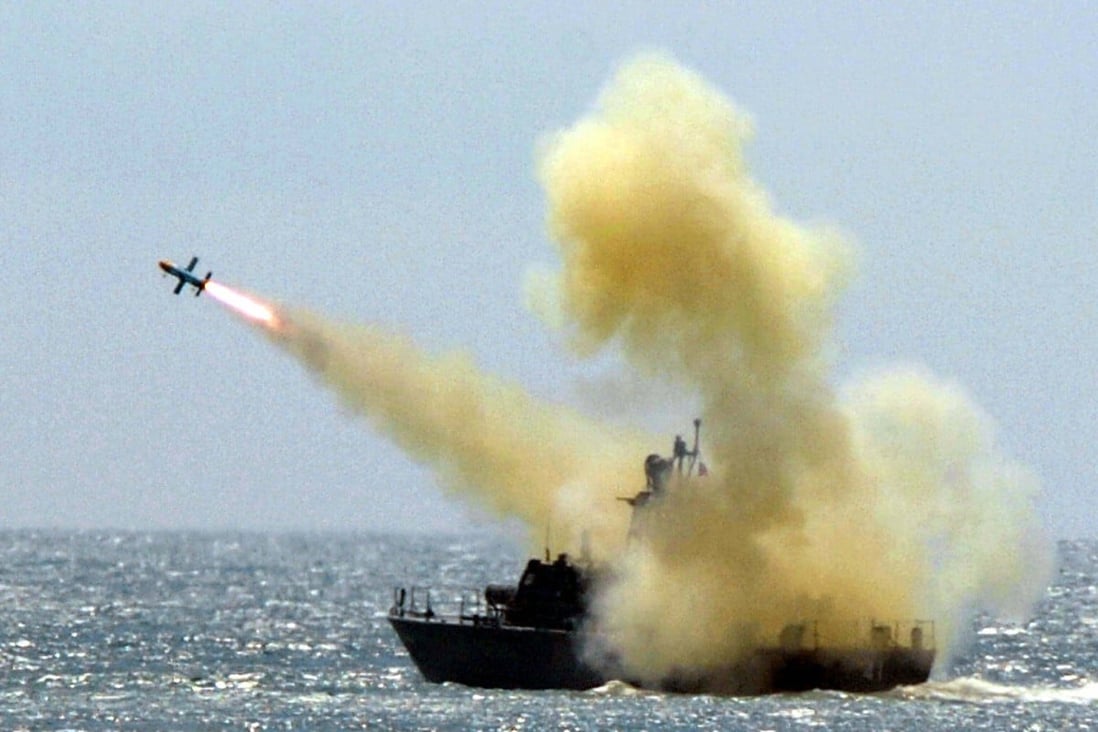
A Taiwanese patrol boat fires a ship-to-ship missile during a military drill in 2006. Vietnam slammed Taiwan’s recent live-fire exercises near Taiping Island as “illegal”. Photo: AFP
Vietnam was quick to voice its displeasure this month at Taiwanese military drills near a South China Sea island that both claim, but analysts say the incident speaks more to Taipei’s anxiety for its outlying islands’ continued security than the state of its relations with Hanoi.
Over the past year, the Asia Maritime Transparency Initiative and the Center for Advanced Defense Studies conducted a study of China’s maritime militia using remote sensing data and open-source Chinese language research. The resulting report, Pulling Back the Curtain on China’s Maritime Militia, features the most comprehensive study to-date of the structure, subsidies, and ownership networks of China’s maritime militia in the South China Sea, as well as a methodology for identifying Chinese maritime militia vessels and a list of over 120 militia vessels thus identified.
Since completing the construction of its artificial island outposts in the Spratly Islands in 2016, China has shifted its focus toward asserting control over peacetime activity across the South China Sea. A key component of this shift has been the expansion of China’s maritime militia—a force of vessels ostensibly engaged in commercial fishing but which in fact operate alongside Chinese law enforcement and military to achieve Chinese political objectives in disputed waters.
Điều gì đẩy các ngư dân đến nỗi tuyệt vọng đằng sau cánh cửa nhà giam của những nước láng giềng? Và tại sao dù biết kết cục cay đắng đó, nhiều người dân vẫn liên tiếp dấn tàu vào khu vực đánh bắt cá trái phép? Và lí do gì khiến nỗ lực gỡ thẻ vàng của Việt Nam vẫn chưa thể thành công?
Đánh bắt thủy hải sản trên vùng biển đảo Phú Quốc. Ảnh: Thuyền trưởng Nguyễn Văn Thành.
Trong căn buồng giam ở Tanjung Pinang, Indonesia, ngư phủ Việt Nam tên Nguyễn Văn Tư, 64 tuổi, một mình vật lộn với những cơn đau nhức ở cẳng chân. Mùa hè hai năm trước, tàu cá ông làm việc bị bắt quả tang đang thả lưới trái phép trong vùng biển Indonesia. Theo luật pháp nước này, những ngư dân làm thuê sẽ không bị phạt tù. Tuy nhiên, Tư đã không đủ tiền mua vé máy bay về nước sau phiên tòa nên bị giữ lại suốt 20 tháng qua.
Hàng trăm ngư dân Việt Nam giống Tư đang đợi chờ ngày về từ các nhà giam kham khổ của Indonesia nhưng có lẽ tình cảnh của Tư bi đát hơn cả. Ông bị tách ra khỏi đồng hương và bị giam riêng biệt do bị nghi mắc bệnh phong.
Thực trạng ngư dân Việt Nam xâm phạm vùng biển nước khác phổ biến đến mức, năm 2017, Việt Nam đã bị Ủy ban châu Âu (EC) rút thẻ vàng cảnh cáo hoạt động khai thác thủy sản. Theo số liệu thống kê của lực lượng Cảnh sát biển Việt Nam, hàng ngàn ngư dân trên hơn 1.000 tàu cá bị lực lượng chức năng các nước bắt giữ trong ba năm 2017-2020.
Lượng tàu cá Việt Nam tăng gần gấp bốn lần trong 20 năm qua. Tàu cá từ biển miền Trung và vùng Đồng bằng sông Cửu Long chiếm lần lượt 50% và 25% tàu cá toàn bộ đất nước. Biểu đồ: Thibi.co
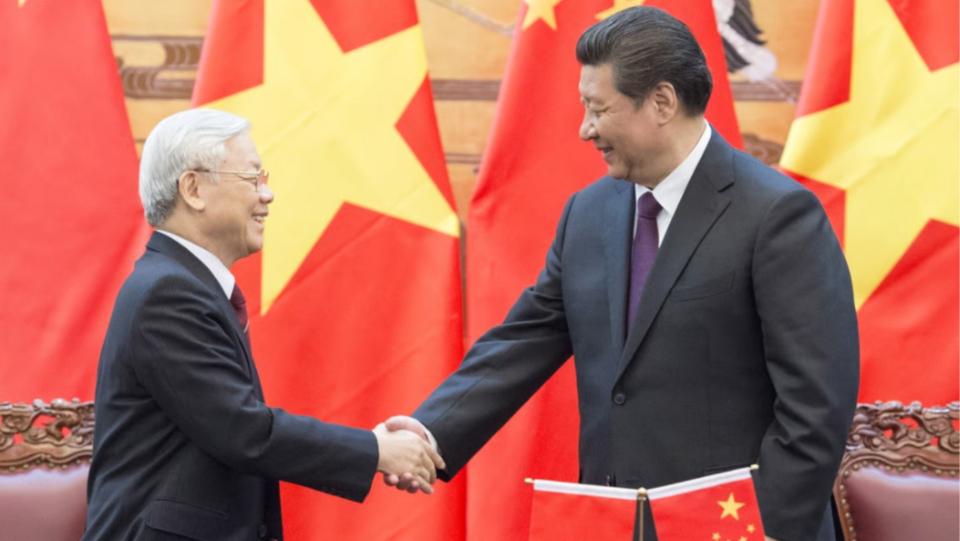
Communist Party of Vietnam leader Nguyen Phu Trong, left, meets with China’s Communist Party leader Xi Jinping in Beijing in 2015. | Xinhua
HANOI—The Socialist Republic of Vietnam will not be coerced into joining the United States-led effort aimed at isolating China and provoking conflict as part of its Cold War 2.0 foreign policy.
That’s a major message expected to come out of the upcoming visit to China by Nguyen Phu Trong, General Secretary of the Communist Party of Vietnam. Trong will travel to China to pay an official visit to the newly re-elected Communist Party of China leader Xi Jinping. Trong will be one of the first world leaders to visit China since the closing the 20th National Congress of the Communist Party of China, earlier this month.
Four years ago, I traveled around America, visiting historical archives. I was looking for documents that might reveal the hidden history of climate change – and in particular, when the major coal, oil and gas companies became aware of the problem, and what they knew about it.
I pored over boxes of papers, thousands of pages. I began to recognize typewriter fonts from the 1960s and ‘70s and marveled at the legibility of past penmanship, and got used to squinting when it wasn’t so clear.
What those papers revealed is now changing our understanding of how climate change became a crisis. The industry’s own words, as my research found, show companies knew about the risk long before most of the rest of the world.
Surprising discoveries
At an old gunpowder factory in Delaware – now a museum and archive – I found a transcript of a petroleum conference from 1959 called the “Energy and Man” symposium, held at Columbia University in New York. As I flipped through, I saw a speech from a famous scientist, Edward Teller (who helped invent the hydrogen bomb), warning the industry executives and others assembled of global warming.
We need only call to mind the first half of 2022 for an array of the extreme, energy-related global challenges we all face. Around the world, local versions of climate change effects—the temperatures, wildfires, droughts, storms, flooding—underscore how important it is for us to transition away from our overdependence on fossil fuels. And our energy sources don’t just have environmental implications but security ones as well. The Russian invasion of Ukraine is the latest rendition of the resource curse. At the heart of it all, fossil fuels are what enabled and amplified the murderous narcissism we see in Vladimir Putin and created a country with an unbalanced and unhealthy domestic economy able to profoundly destabilize energy flows and prices around the world.
The South China Sea (SCS) brings together its own assortment of these complex challenges and factors. Competing security concerns, resource needs, and nationalisms shape the motivations of the claimants. Much of the attention and conflict has centred on the oil and gas in the seabed. Estimates of SCS hydrocarbon volumes vary; only some of these resources are proven reserves that have been confirmed and measured, and are actually recoverable. But even in more generous assessments, the SCS only provides us with a small percentage of the global total of oil and gas reserves, and even less of the overall energy mix if we include non-fossil-fuel energy sources.
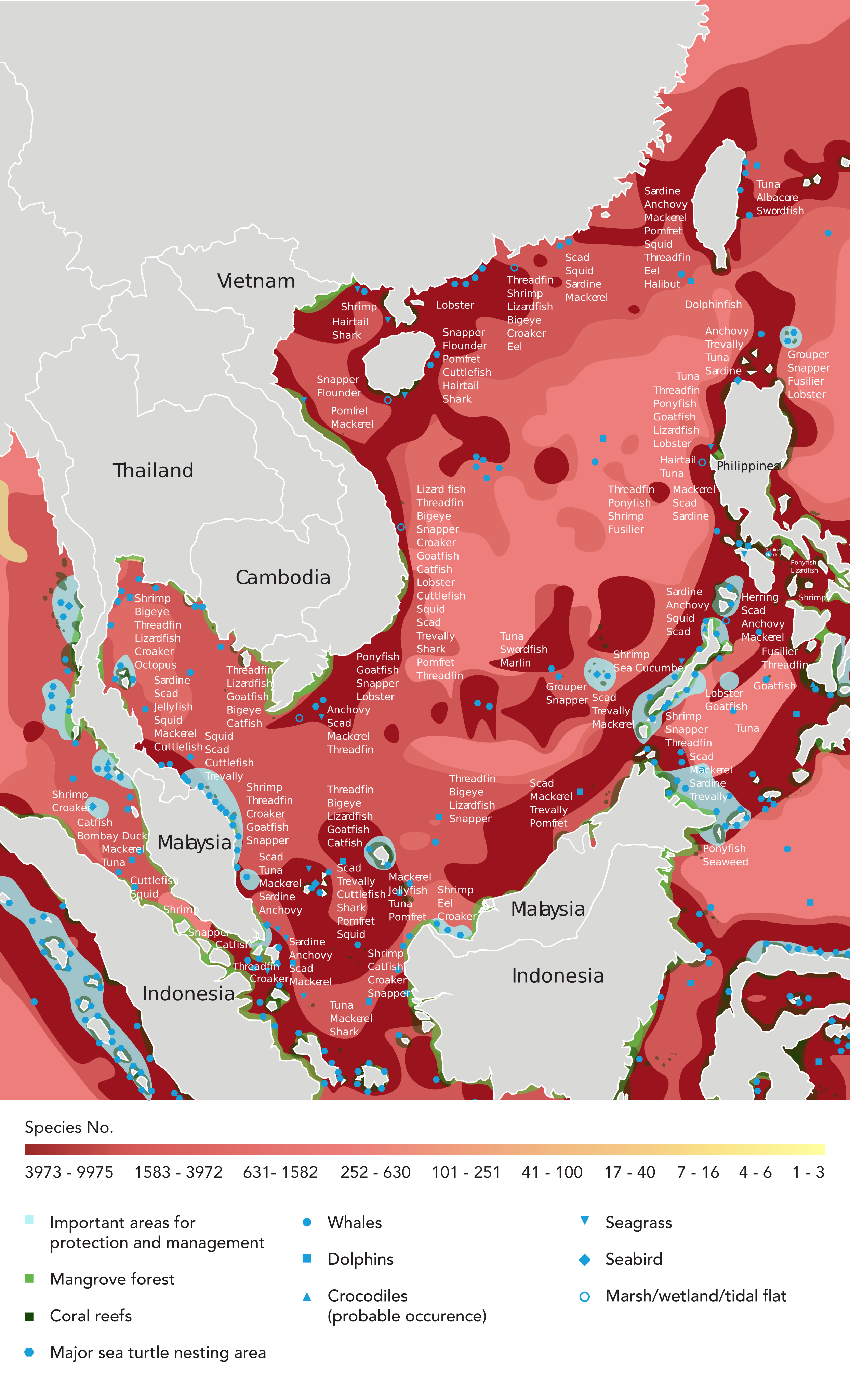
Beyond hydrocarbons, in a two-way tie with the adjacent Coral Triangle, the SCS has the highest level of marine biodiversity in the world. SCS fisheries feed and employ millions of people in the region. It’s true that conflict over these living marine resources also drives the territorial disputes in the region, and a wide variety of human activity degrades the SCS ecosystem. Yet drilling for hydrocarbons in the SCS threatens this vulnerable marine habitat even more, while also clearly contributing to geopolitical and security tensions in the region—and to climate change.
Given how destabilizing oil and gas pursuits have been for the SCS since the 1970s, we might ask ourselves whether we want to keep drilling for fossil fuels there. Do the costs and risks outweigh the benefits?
Download this 21-page report (button above) from Dr. Tabitha Grace Mallory, an inaugural John H. McArthur Research Fellow, an initiative of the Asia Pacific Foundation of Canada, and the Founder of China Ocean Institute and Affiliate Professor, Jackson School of International Studies, University of Washington.
Below, explore the rich marine biodiversity of the South China Sea, one of the most hotly-contested maritime jurisdictions on the planet, in this original map created by the author and APF Canada graphic designer Chloe Fenemore, based on historical and contemporary maps cited in the full report.
Tabitha Grace Mallory is the Founder of China Ocean Institute and Affiliate Professor, Jackson School of International Studies, University of Washington. Dr. Mallory specializes in Chinese foreign and environmental policy. She conducts research on China and global ocean governance and has published work on China’s fisheries and oceans policy.
Dr. Mallory is an inaugural John H. McArthur Research Fellow, an initiative of the Asia Pacific Foundation of Canada launched in 2021 to provide research opportunities for exceptional, mid-career scholars who are working on programs and research areas with direct relevance to Canada and Canada’s interests in Asia.
This photo taken on 20 August 2022, shows a worker sorting a fresh catch of fish at Sa Ky port on Vietnam’s offshore Ly Son island. Ly Son island, situated north-east of central Vietnam’s Quang Ngai province, is the country’s closest island to the disputed Paracel archipelago in the South China Sea region. (Photo: Nhac Nguyen / AFP)
This article is part of “UNCLOS 40th Anniversary Series – Why UNCLOS Matters” conceptualised by the Blue Security programme. The series, which commemorates the 40th anniversary of the U.N. Convention on the Law of the Sea, brings together established and emerging maritime security scholars from Southeast Asia and the broader Indo-Pacific to address the pertinence and relevance of UNCLOS. Blue Security brings together Australian and Southeast Asian experts to look at a range of maritime security issues across the region. The series was developed by Dr. Troy Lee-Brown and Dr. Bec Strating. It is published in collaboration with the team at Fulcrum.
UNCLOS’s relevance to Vietnam is significant, but the Convention must be updated if Vietnam and other signatories are to succeed in dealing with contemporary challenges in maritime affairs.
TTCT – Muốn trung lập thật sự phải ở vị thế của kẻ mạnh. Indonesia là ví dụ điển hình ở khu vực Đông Nam Á.
Cho tới nay, có thể nói là ông Jokowi đã lèo lái thành công con thuyền Indonesia trong một thế giới đầy bất trắc. Ảnh: Nikkei Asia Review
Tờ Kompass của Indonesia hôm 12-8 đăng tin: “Binh sĩ Indonesia và Hoa Kỳ diễn tập bắn đạn thật khi căng thẳng Trung Quốc lên cao”. Còn hôm 1-8, Hãng tin News 18 (Ấn Độ) chạy tít: “Tập Cận Bình gặp Widodo của Indonesia: Trung Quốc cần đồng minh giữa cuộc chiến Ukraine và cuộc khủng hoảng Đài Loan”. Vậy thì Indonesia đang đứng về phe nào trong cuộc cạnh tranh toàn cầu mới?
Việc hàng ngàn binh sĩ Indonesia, Mỹ và các đồng minh khác diễn tập bắn đạn thật vào hôm 12-8 được tư lệnh Bộ tư lệnh Ấn Độ Dương – Thái Bình Dương của Mỹ, đô đốc John Aquilino, gọi là nỗ lực của Washington nhằm ngăn chặn một cuộc xung đột khu vực sau “các hành động gây bất ổn” của Trung Quốc xung quanh Đài Loan.
Kèm theo bản tin là tấm hình chụp ông Aquilino và Tổng tư lệnh Lực lượng vũ trang Indonesia Andika Perkasa thị sát cuộc tập trận mang tên Siêu lá chắn Garuda 2022, diễn ra ở Baturaja, nam Sumatra.
Explained: the history of China’s territorial disputes
South China Morning Post – 29-8-2020
China shares over 22,000 kilometres (13,670 miles) of border with 14 countries, but Beijing has disputes with many of its neighbours over where some of these international lines are drawn. The various territorial claims, citing history, politics and geography, have resulted in clashes and occasionally, outright military confrontations. Land borders aside, China also says its territory includes nearly all of the South China Sea, despite competing claims to parts of those waters made by many Southeast Asian countries. As tensions rise between China and the United States, Beijing has adopted a more aggressive attitude, pledging to defend China’s “sovereignty and territorial integrity.”
Will Pacific tensions define a new global struggle? | Project Force
Al Jazeera English – 18-4-2022
Tensions are rising in the South China Sea with Beijing accusing the US of breaking a promise by staging military drills. Will the battle over the Pacific region define the struggle for global dominance? Watch Project Force with @ Alex Gatopoulos.
How hard would it be for China to invade Taiwan? | Project Force
Al Jazeera English – 4-4-2022
When Russian forces went into Ukraine, concern grew in Taiwan that an attack by China could be next. But how difficult would it be for China to invade Taiwan? @Alex Gatopoulos takes a look, in Project Force.
What’s the fallout from Nancy Pelosi’s visit to Taiwan? | Inside Story
Al Jazeera English – 4-8-2022
U.S. House Speaker Nancy Pelosi has ended her controversial tour of Taiwan.
Despite warnings from China, the most senior American politician to visit in 25 years pledged an ‘iron-clad’ commitment to the self-ruled Island’s democracy.
Beijing is responding with live-fire military drills and import bans.
So how will Taipei and Washington deal with the consequences?
Presenter: Kim Vinnell
Guests:
Vincent Chao – Former Director of the Political Division, Taipei Economic and Cultural Representative Office in the United States.
June Teufel Dreyer – Professor of Political Science, University of Miami.
Henry Huiyao Wang- Founder and President, Center for China and Globalization.
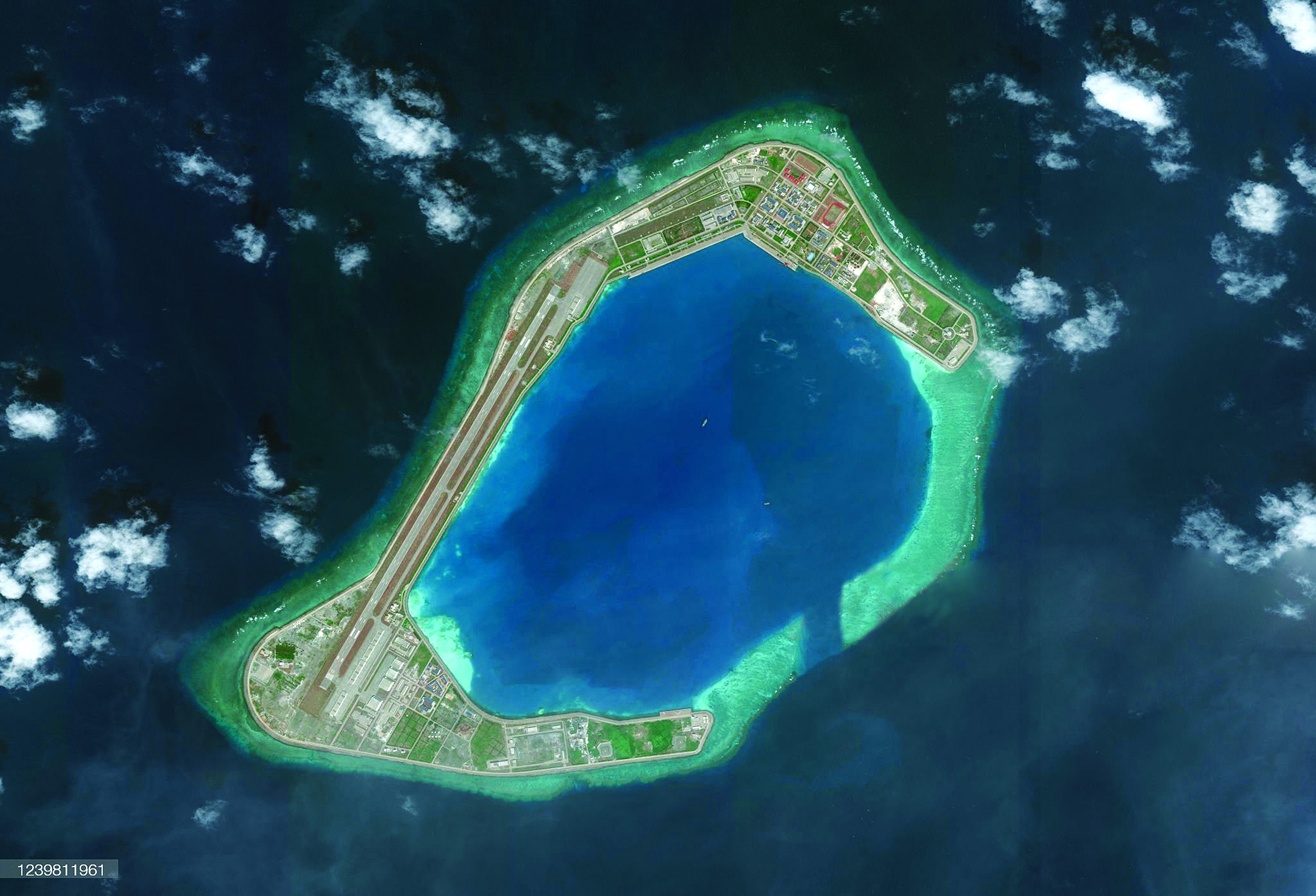
TTCT – Các nhân viên cứu hộ, phi đội máy bay và tàu tìm kiếm cứu nạn mà Trung Quốc triển khai thường trú ở 3 thực thể nhân tạo tại Trường Sa không nằm ngoài nỗ lực củng cố các yêu sách vô lý của họ trên Biển Đông.
Đá Subi thuộc quần đảo Trường Sa của Việt Nam nhưng bị Trung Quốc chiếm đóng và cải tạo trái phép thành đảo nhân tạo. Ảnh vệ tinh của Công ty Maxar chụp tháng 3-2022
Tuần cuối tháng 7, ngay trước mùa bão trên Biển Đông, truyền thông Trung Quốc loan tin một phi đội bay mới cùng các nhân viên điều hành và kiểm soát hàng hải sẽ đồn trú trên đá Chữ Thập, Subi và Vành Khăn nhằm cải thiện khả năng ứng cứu kịp thời các sự cố nhân đạo và thiên tai.
Sự hiện diện của họ ở 3 thực thể nhân tạo lớn nhất thuộc quần đảo Trường Sa của Việt Nam, theo lời Trung Quốc, là minh chứng cho thấy trách nhiệm của nước này với quốc tế. Thế nhưng đó chỉ là một mặt của câu chuyện cung ứng nhân đạo.







 CVD
CVD 