South China Sea – Occupation and Island Building

CHINA  – MALAYSIAPHILIPPINES  –  TAIWAN – VIETNAM

Indonesia rejects China’s claims over South China Sea

JANUARY 1, 2020 / 7:02 AM / UPDATED 16 HOURS AGO Reuters

JAKARTA (Reuters) – Indonesia said on Wednesday it rejected China’s claims over a disputed part of the South China Sea as “having no legal basis”, after two days earlier protesting to Beijing over the presence of a Chinese coastguard vessel in its territorial waters.

FILE PHOTO: Indonesia’s Deputy Minister for Maritime Affairs Arif Havas Oegroseno points at the location of North Natuna Sea on a new map of Indonesia during talks with reporters in Jakarta, Indonesia, July 14, 2017. REUTERS/Beawiharta/File Photo

The boat trespassed into Indonesia’s exclusive economic zone off the coast of the northern islands of Natuna, leading Indonesians officials to issue a “strong protest” and summon the Chinese ambassador in Jakarta.

Speaking in Beijing on Tuesday, Chinese Foreign Ministry spokesman Geng Shuang had said China had sovereignty over the Spratly Islands and their waters and that both China and Indonesia have “normal” fishing activities there. Tiếp tục đọc “Indonesia rejects China’s claims over South China Sea”

ASEAN Outlook to solve South China Sea dispute?

This year marks one of the most important years for ASEAN’s geopolitical landscape. During the plenary session of the 34th ASEAN Summit in June, all member states agreed to adopt the ASEAN Outlook on the Indo-Pacific. The brief five-page document emphasised the ASEAN led mechanism in dealing with strategic issues in the Indo-Pacific region. It could not be denied that one of the most important ongoing issues in the region is still the South China Sea dispute, so will the Outlook help to solve the ongoing dispute? Tiếp tục đọc “ASEAN Outlook to solve South China Sea dispute?”

ASEAN Outlook on the Indo-Pacific

ASEAN

The AsiaPacific and Indian Ocean regions are amongst the most dynamic in the world as well as centers of economic growth for decadesAs a result, these regions continue to experience geopolitical and geostrategic shiftsThese shifts present opportunities as well as challengesOn the one hand, the economic growth of the region opens up possibilities of cooperation to alleviate poverty and elevate living standards of millions of peopleOn the other hand, the rise of material powers, i.eeconomic and military, requires avoiding the deepening of mistrust, miscalculation, and patterns of behavior based on a zerosum game.

Download the full statement here.

‘We are losing control’: China’s ‘dangerous’ South China Sea plan almost complete

It’s a mission that has existed in the shadows, seizing control little-by-little – and now China’s ultimate plan is almost complete.

Jamie Seidel
news.com.au JANUARY 2, 20209:56AM

Vietnam fights China’s ‘nine-dash line’ amid old enmities

Vietnam is pushing back on Chinese claims over the South China Sea targeting Beijing’s controversial nine-dash line.

AL JAZEERA NEWS by 18 Dec 2019
China's nine-dash line is at the heart of the country's claim to the South China Sea but has been rejected by an international tribunal [File: Andy Wong/AP Photo]
China’s nine-dash line is at the heart of the country’s claim to the South China Sea but has been rejected by an international tribunal [File: Andy Wong/AP Photo]
Ho Chi Minh City, Vietnam – It came as no surprise to Vietnamese student Doan Thanh Hai that China’s infamous nine-dash line has been causing trouble in his country.

China has long used the geographical demarcation to claim an historical connection to much of the resource-rich South China Sea, including large areas that are claimed also by Vietnam, the Philippines, Malaysia, Brunei and Taiwan. Tiếp tục đọc “Vietnam fights China’s ‘nine-dash line’ amid old enmities”

Vietnam hopes for Chinese restraint in South China Sea in 2020

DECEMBER 17, 2019 / 12:42 PM

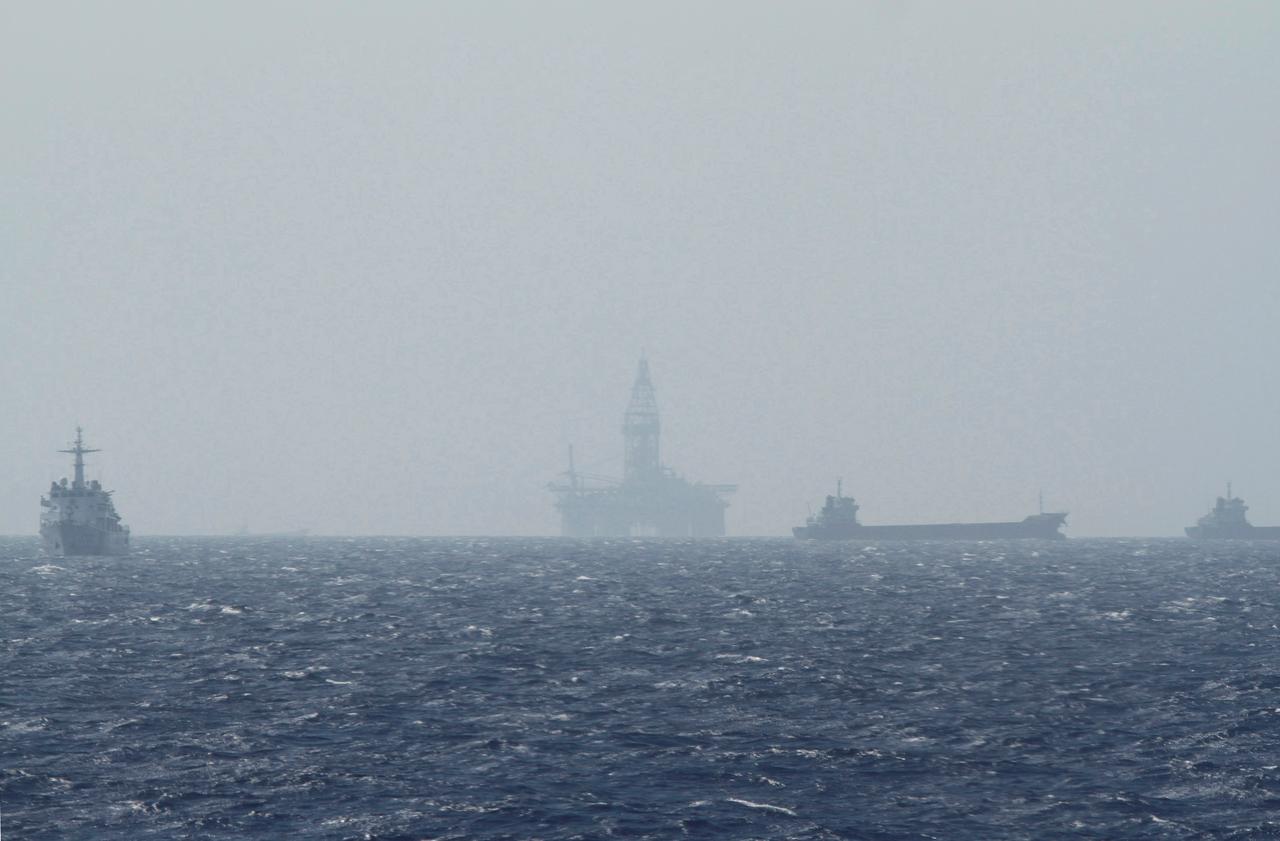
FILE PHOTO: An oil rig (C) which China calls Haiyang Shiyou 981, and Vietnam refers to as Hai Duong 981, is seen in the South China Sea, off the shore of Vietnam in this May 14, 2014 file photo. REUTERS/Minh Nguyen/File Photo

SINGAPORE (Reuters) – Vietnam said it hoped China would show restraint in the South China Sea next year after a Chinese oil survey vessel and its escorts spent months within Vietnam’s exclusive economic zone in what Hanoi called a blatant violation of its sovereignty.

Vietnam, the region’s most forceful challenger of China’s extensive maritime claims to the busy waterway, will take on the rotating chairmanship of the Association of Southeast Asian Nations (ASEAN) in 2020. Tiếp tục đọc “Vietnam hopes for Chinese restraint in South China Sea in 2020”

Update: China Risks Flare-up over Malaysian, Vietnamese Gas Resources


December 13, 2019  |  AMTI Brief

Update: China Risks Flare-up over Malaysian, Vietnamese Gas Resources

The Chinese survey vessel Haiyang Dizhi 8 along with its coast guard and paramilitary escorts left Vietnam’s exclusive economic zone on October 23, ending a standoff with Vietnamese ships that began more than four months earlier. The de-escalation seems to have been in response to the departure a day earlier of the drilling rig Hakuryu 5 from Vietnam’s oil and gas Block 06-01, which is operated by Russia’s Rosneft.

The standoff began on June 16 when a China Coast Guard (CCG) ship started harassing the Hakuryu 5 and the offshore supply vessels servicing it. Automatic Identification System (AIS) data shows that several CCG ships were deployed in succession to keep up the harassment over the course of the standoff, including the 35111, 45111, 4203, 3308, 5303, and 2305. As ships were relieved, they often traveled to the Chinese outpost on Fiery Cross Reef to resupply before either joining the escort mission around the Haiyang Dizhi 8 or heading back to China.

Exactly how many Chinese and Vietnamese vessels were involved in these two related operations over the course of the standoff is unclear. Those broadcasting AIS—mostly the CCG—almost certainly account for just a small percentage of the total number. Some Vietnamese law enforcement vessels had broadcast AIS during the early weeks of the standoff in July, but soon ceased doing so. In October, Vietnamese Major General Nguyen Minh Hoang announced that 50 Vietnamese and 40 Chinese vessels were involved, while others reported as many as 80 Chinese participants.

Only a few opposing ships seem to have been regularly deployed around the Hakuryu 5 throughout the standoff, suggesting that most of these reported vessels were busing escorting the Haiyang Dizhi 8 or, in the case of the Vietnamese, trying to block its operations. A satellite image from late August captured a Vietnam Fisheries Resource Surveillance vessel positioned between the Hakuryu 5, which was being serviced by an offshore supply vessel (identified via AIS as the Crest Argus 5), and CCG ship 5303. The 56-meter Vietnamese vessel is effectively unarmed and less than half the size of the 138-meter 5303, one of China’s advanced Type 818 Zhaoduan-class cutters which sports a 76-mm cannon.

The Hakuryu 5 broadcast AIS only sporadically during the standoff. Its signal was last seen in Block 06-01 on October 17 and then again in port at Vung Tau, Vietnam, on October 26. This lends credence to social media reports that it had left Block 06-01 on October 22 after completing its drilling work. AIS data shows that the last CCG vessel assigned to the area, the 31302 (since renamed the 2305) left the same day heading north. It joined up with the Haiyang Dizhi 8 and its escorts a day later and together the group returned to Hainan.

As for the Haiyang Dizhi 8, it moved north after the first few weeks of the standoff, extending its survey over a much wider area for the next three months. In hindsight, it is clear that the survey area closely matched a group of oil and gas exploration blocks that the China National Offshore Oil Corporation unsuccessfully offered up for foreign bidding in 2012.

Over the course of the standoff, the Haiyang Dizhi 8 and its CCG escorts made multiple resupply trips to Fiery Cross Reef. While ultimately unsuccessful in persuading Vietnam to halt Rosneft’s drilling work in block 06-01, China’s operations demonstrated that its Spratly outposts now allow it to conduct extended pressure campaigns, increasing the costs and risks for its neighbors to operate within the nine dash line.

###

The Center for Strategic and International Studies (CSIS) is a bipartisan, nonprofit organization founded in 1962 and headquartered in Washington, D.C. It seeks to advance global security and prosperity by providing strategic insights and policy solutions to decisionmakers.