Ireland Could Become the Next Nation to Recognize the Rights of Nature and a Human Right to a Clean Environment

The move to enshrine those rights is part of a flurry of developments advancing the rights of nature movement this year.

insideclimatenews.org By Katie Surma January 1, 2024

Environmental activists from the Irish Wildlife Trust and Extinction Rebellion called on the Irish Government to introduce legislation in the form of a Biodiversity Act at a protest outside the National Biodiversity Conference in Dublin Castle on June 8, 2022. Credit: Niall Carson/PA Images via Getty Images

Ireland—a nation synonymous with its abundant, verdant landscapes—is considering a nationwide referendum on the rights of nature and the human right to a healthy environment.  

If that happens, Ireland would become the first European country to constitutionally recognize that ecosystems, similar to humans and corporations, possess legal rights. More than two-thirds of the 27 European Union countries already recognize a universal human right to a healthy environment.

In December, a legislative committee proposed that the Irish government take a series of administrative measures to draft proposed constitutional amendments recognizing that nature has inherent rights to exist, perpetuate and be restored, and that humans have a right to a clean environment and stable climate. 

To take legal effect, the proposed amendments must be approved by both houses of parliament, the Dáil Éireann (the lower house) and the Seanad (the upper house), and win a majority of the popular vote.

Tiếp tục đọc “Ireland Could Become the Next Nation to Recognize the Rights of Nature and a Human Right to a Clean Environment”

Vietnam’s forests have been cleared to supply the world’s timber industry (2 parts)

pulitzercenter.org – APRIL 4, 2023

Vietnam’s Forests Have Been Cleared To Supply the World’s Timber Industry

author image

In Central Vietnam’s factory, wood chips are accumulated in the rear of a three-wheel vehicle used to transport acacia wood to the processing machine. Image by Thanh Nguyen.

Vietnam is ranked the fifth-largest country in the world, second in Asia, and the largest in Southeast Asia in furniture exports. Vietnamese furniture has been directly exported to 120 countries and territories.

However, behind this impressive figure is that series of natural forests that have been cut down and quickly. These forest land areas have been occupied for growing short-term timber trees.

Deforestation makes natural disasters in Vietnam more severe, local people suffer the most from the consequences.

An investigation will be published on Mekong Eye.

Tiếp tục đọc “Vietnam’s forests have been cleared to supply the world’s timber industry (2 parts)”

The Unexpected Twist in Vietnam’s Renewable Energy Saga

fulcrumm.sg PUBLISHED 4 JAN 2024 LE HONG HIEP

Punishment awaits the senior officials who allowed Vietnam’s renewable energy quest to go off the rails, despite its apparent initial success. This policy crisis has the potential to affect other economic sectors if no clear end is in sight.

In late 2023, the Inspection Commission of the Central Committee of the Communist Party of Vietnam (CPV) found that Tran Tuan Anh, head of CPV’s Central Economic Commission, and Trinh Dinh Dung, former deputy prime minister, were among the senior government officials responsible for “shortcomings in the advisory and policy-making processes for the development of solar and wind power projects, as well as in the implementation of the amended Power Development Plan VII” (PDP7). The Commission therefore recommended disciplinary actions be taken against Anh, Dung and some other senior officials involved.

Anh served as the minister of industry and trade while Dung was deputy prime minister overseeing economic affairs, including the energy sector, from 2016 to 2021. During their tenure, Vietnam experienced a remarkable surge in renewable energy, with numerous solar and wind power projects completed in just three years. According to Vietnam Electricity (EVN), the state-owned utility company, this led to a significant increase in Vietnam’s renewable energy output, rising from a mere 997 GWh in 2018 to an impressive 37,865 GWh in 2022. Vietnam therefore emerged as Southeast Asia’s renewable energy leader, accounting for 69 per cent of the region’s solar and wind power generation by 2022.

Such successes, however, did not come without problems. Last April, an inspection by the Government Inspectorate revealed numerous violations in the licensing and certification of renewable energy projects. For example, the amended PDP7 outlined a goal of installing 850MW of solar power by 2020, increasing to 4,000MW by 2025. Similarly, the plan projected 800MW of wind power by 2020, with a target of 2,000MW by 2025. However, as of May 2023, the total installed capacity of wind, solar, and rooftop solar projects in Vietnam had already reached a staggering 21,839MW, greatly surpassing targets set in PDP7.

This sudden surge in renewable energy has caused a strain on the national power grid, particularly in the central region where most renewable energy projects are located. Moreover, during the same period, there was a lack of new traditional power plants constructed, which are necessary to provide a stable baseload for renewable energy sources that are more weather-dependent and thus less reliable. This has created significant safety concerns for the national power system. Consequently, EVN had to curtail the amount of power it purchased from renewable sources, resulting in substantial financial losses for project owners.

A main driver behind Vietnam’s rapid growth in renewable energy has been the implementation of high feed-in tariffs (FITs) for certified projects that began commercial operation before specific deadlines. For instance, solar farms that became operational by 30 June 2019 were eligible for a FIT of 9.35 US cents/kWh, while onshore and offshore wind farms that began commercial operation by 1 November 2021 received FITs of 8.5 US cents/kWh and 9.8 US cents/kWh, respectively. Meanwhile, the FIT for rooftop solar projects operated before 31 December 2020 is 8.38 US cents/kWh. These FITs are locked in for 20 years.

This sudden surge in renewable energy has caused a strain on the national power grid, particularly in the central region where most renewable energy projects are located.

These attractive FITs sparked fierce competition among local investors to build solar and wind projects but most of them had no track record in the energy sector. They mainly leveraged connections, often involving under-the-table payments, to secure project licenses, then relied heavily on bank financing or corporate bonds to fund project development. Due to the pandemic and cut-throat competition for equipment and contractors, 62 wind projects failed to start operation before the FIT deadlines. Unable to sell their output to EVN, these projects faced severe financial difficulties. Even projects that qualified for the FITs faced mounting issues. Aside from the curtailment imposed by EVN, the Government Inspectorate found violations in the certification of many projects, putting them at risk of disqualification from the FITs. Foreign investors acquiring projects from local investors may face potential losses if similar violations are found.

The situation also negatively impacts the state and the broader economy. Most FIT rates are higher than average electricity retail prices, meaning that the state and end-users are essentially subsidising renewable energy projects. These high FITs have contributed to EVN’s mounting accumulative losses over the past two years, reaching VND55 trillion (US$2.3 billion) by September 2023. The government therefore has had no choice but to allow EVN to raise electricity retail prices, putting upward pressure on inflation and undermining Vietnam’s competitiveness.

In light of these grave consequences, the government has been trying to contain the damage. For example, EVN stopped buying power from rooftop solar projects completed after 31 December 2020, leaving thousands of investors in limbo. Authorities have also conducted thorough inspections into most renewable energy projects. Projects found to have committed serious violations, such as lacking construction permits or failing to secure proper land usage purpose conversion and commercial operation certification, may have their power purchase agreements with EVN terminated.

Last month, EVN even proposed lowering the FITs for 38 projects but quickly withdrew the proposal after just one day. This sudden reversal may reflect the government’s struggle in finding a satisfactory solution. Being lenient will perpetuate losses for the state budget but a heavy-handed approach could cause extensive financial losses for investors, potentially affecting the banking system, given investors’ heavy reliance on bank financing. This could also negatively impact investors’ confidence in Vietnam’s investment climate and raise doubts about the country’s commitment to energy transition.

At present, there seems to be no straightforward solution. It is not clear yet how Vietnam will effectively address and learn from this situation for future policy decisions. However, it is inevitable that those responsible for this predicament will soon face serious consequences for what could potentially become one of the most significant policy mishaps in Vietnam’s recent history.

2024/2

Le Hong Hiep is a Senior Fellow and Coordinator of the Vietnam Studies Programme at ISEAS – Yusof Ishak Institute.

Is 2024 going to be the first full year to breach 1.5C of warming?

With 2023 the warmest year on record, 2024 could see the unwelcome milestone of 1.5C of warming reached for a full year

A plane flies through the sky as the sun sets over a city
The global outlook suggests 2024 will end with average global temperatures between 1.34C and 1.58C above preindustrial levels. Photograph: Matt York/AP

Kate Ravilious @katerav TheGuardian

Thu 4 Jan 2024 06.00 GMT

The year 2023 has been confirmed as the warmest in recorded history, with average global temperatures topping 1.5C of heating above preindustrial levels for more than one third of the year. It continues the rapid warming trend, with the 10 warmest years in human history all having occurred since 2010.

So what could 2024 hold? Forecasts suggest the year ahead is likely to be another record breaker, with a strong possibility that this could be the first full year to go beyond 1.5C of warming.

Tiếp tục đọc “Is 2024 going to be the first full year to breach 1.5C of warming?”

Rừng ngập mặn: Trước sự mất mát và xé lẻ


Tia sáng – 122023 THANH NHÀN

Báu vật của những vùng đất ngập nước, của những mênh mông giao hòa giữa biển và đất liền, đang ngày một bị mất mát hoặc suy thoái. Các cánh rừng ngập mặn, giờ đây, phải vật lộn để tồn tại, trước những tác động của cả con người lẫn tự nhiên.

Một vạt rừng ngập mặn bị sóng đánh ở Thái Bình. Ảnh: Thanh Nhàn

Tiếp tục đọc “Rừng ngập mặn: Trước sự mất mát và xé lẻ”

COP28: Ai đang gây ô nhiễm

SÁNG ÁNH 23/12/2023 13:59 GMT+7

TTCT Hội nghị thượng đỉnh COP28 về biến đổi khí hậu kết thúc tại UAE với kết quả lừng khừng…

Các họp hành kiểu này thường kết thúc như vậy. Rất nhiều quyền lợi mâu thuẫn chưa giải quyết được nên mới phải họp hành và họp hành không giải quyết được nên mới phải dung hòa, ta nâng ly uống rồi về nhà, hẹn gặp lại sau.

Mỹ là nước thải ra rác thải nhựa nhiều nhất thế giới, theo cả hai thông số tổng số rác và số rác bình quân trên đầu người. Ảnh: Getty Images

Các quyền lợi mâu thuẫn này là giữa thế giới phát triển và đang phát triển, tức là mâu thuẫn nam bắc; giữa các nước sản xuất và có tài nguyên dầu khí với các nước tiêu thụ; giữa công nghệ cũ dựa trên dầu khí, than đá, và công nghệ mới dựa trên năng lượng nắng, gió, thủy triều… 

Các mâu thuẫn về quyền lợi chẳng khi nào đơn giản. Ở mức thế giới, quốc gia, ở mức công nghệ, nó bao giờ cũng đi kèm thượng tầng văn hóa, chính trị và ý thức hệ để bảo vệ, tuyên dương, phát triển hay duy trì quyền lợi.

Tiếp tục đọc “COP28: Ai đang gây ô nhiễm”

In memoriam: Saleemul Huq (1952-2023) – “For three decades, Huq was arguably the foremost champion of poorest countries in UN climate negotiations”

This short film pays tribute to professor Saleemul Huq, an environmental and climate change giant who died on 28 October 2023.

Professor Saleemul Huq OBE (1952-2023)

Following the passing of Professor Saleemul Huq, senior fellow of IIED. This book of remembrance is open to all who wish to share their memories of Saleem.

Article, 29 October 2023

Head and shoulders photo of Saleemul Huq.

Professor Saleemul Huq was an environmental and climate change giant and senior fellow and dear friend of IIED and many IIED colleagues past and present.

Director of the International Centre for Climate Change and Development (ICCCAD) and a senior associate of IIED, he was awarded an OBE by the Queen in the 2022 New Year’s Honours List for his services to combating international climate change.

The honour was awarded in recognition of his work to build climate expertise in Bangladesh, the UK and across the world. 

Saleem was an expert on the links between climate change and sustainable development, particularly from the perspective of vulnerable developing countries. A constant voice for climate action and justice for the global South, he was the lead author of chapters in the third, fourth and fifth assessment reports of the Intergovernmental Panel on Climate Change. Huq’s work with the IPCC spanned 1997 to 2014 and he contributed to reports that led to the panel being awarded the Nobel Peace Prize in 2007.

A professor at the Independent University, Bangladesh, and an advisor to the Least Developed Countries (LDC) Group of the UNFCCC, Huq published hundreds of scientific as well as popular articles and was named by Nature in 2022 as one of its top 10 scientists

He set up the climate change research group at IIED in 2000 and was its initial director – continuing as a senior fellow until 2021 – and worked across the institute to ensure climate was at the heart of all that IIED did. 

IIED executive director Tom Mitchell said: “I would like to offer my deepest sympathy and condolences to Saleem’s family and loved ones on behalf of IIED. There was no one quite like Saleem and I will remember his unique combination of warmth, generosity of spirit, academic prowess and enormous standing in climate science. 

Tiếp tục đọc “In memoriam: Saleemul Huq (1952-2023) – “For three decades, Huq was arguably the foremost champion of poorest countries in UN climate negotiations””

Three major gaps in climate-adaptation finance for developing countries

preventionweb.net

Source(s): Stockholm Environment Institute

In the new Adaptation Finance Gap Update, part of the UN Environment Programme(UNEP) Adaptation Gap Report 2023, we examine recent trends in adaptation funding.

Specifically, we focus on the flow of public adaptation funds from the governments of developed countries to developing countries, since the implementation of the Paris Agreement.

In this article, we identify three major gaps in adaptation finance and explain why these gaps have emerged even as nations commit to scaling up these funds.

Financial shortfall

Adaptation costs for developing countries are estimatedat between $215bn and $387bn annually this decade, according to the latest Adaptation Finance Gap Update report.

Spending from the public funds of developed nations, while not the only source of adaptation finance, remains a crucial source, especially for low-income countries.

As it stands, people in the least developed countries(LDCs) and small-island states are often more exposedto climate hazards and more likelyto be killed by climate-related disasters. This is despite the fact that these nations bear very little responsibilityfor causing climate change.

Tiếp tục đọc “Three major gaps in climate-adaptation finance for developing countries”

Asia’s climate goals at risk over Cop28’s modest transition from fossil fuels: ‘we have one foot in the grave’

scmp.com

  • Critics say the deal is still severely lacking when it comes to addressing the climate concerns of developing nations
  • Asia faces multiple obstacles to its clean energy transition, with countries such as China, India and Indonesia failing to provide clear timelines for ending coal usage

The United Nations Climate Change Conference in Dubai ended on Wednesday with a message signalling the eventual end to the fossil fuel era, but its lack of a clear timeline could leave parts of developing Asia increasingly vulnerable to climate shocks, experts said.

The conference, also known as Cop28, adopted within minutes of its presentation the proposed text for a final climate deal that acknowledges for the first time the need for “transitioning away from fossil fuels” and “accelerating action in this critical decade” to achieve net-zero carbon emissions by 2050.

The text also includes agreements to triple the deployment of renewable energy and double the rate of efficiency gains by the end of the decade.

Cop28 climate summit adopts world-first ‘transition’ from fossil fuels13 Dec 2023

Tiếp tục đọc “Asia’s climate goals at risk over Cop28’s modest transition from fossil fuels: ‘we have one foot in the grave’”

COP28 DELIVERS HISTORIC CONSENSUS IN DUBAI TO ACCELERATE CLIMATE ACTION

COP28.com

  • “The world needed to find a new way. By following our North Star, we have found that path,” said COP28 President, Dr. Sultan Al Jaber during his closing speech, “We have worked very hard to secure a better future for our people and our planet. We should be proud of our historic achievement.”
  • COP28 has concluded with a final consensus that lays out an ambitious response to the Global Stocktake and puts forward a plan to close the gaps to 2030. It calls on Parties to transition away from fossil fuels to reach net zero, encourages them to submit economy-wide Nationally Determined Contributions (NDCs), includes a new specific target to triple renewables and double energy efficiency by 2030, and builds momentum behind a new architecture for climate finance.
  • The COP28 Presidency took bold and decisive steps to deliver beyond the negotiated text through its ‘Action Agenda,’ which spans the four pillars of the Paris Agreement: fast tracking a just and orderly energy transition; fixing climate finance to make it more available, affordable, and accessible; focusing on people, nature, lives and livelihoods; and fostering full inclusivity in climate action.
  • COP28 has mobilized over $85 billion in funding for climate action, secured a historic agreement on Loss and Damage, advanced the Global Goal on Adaptation (GGA) and overseen breakthrough agreements on the energy transition.
  • This has been the most inclusive COP to-date, ensuring all voices could participate in the process.

Dubai, December 13, 2023

Tiếp tục đọc “COP28 DELIVERS HISTORIC CONSENSUS IN DUBAI TO ACCELERATE CLIMATE ACTION”

Người vắng mặt ở COP28

TỊNH ANH – 12/12/2023 09:51 GMT+7

TTCT Tham dự không sót kỳ COP (hội nghị khí hậu của Liên Hiệp Quốc) nào, nhưng đến đúng lúc mọi thứ có vẻ dần thành hình thì lại vắng mặt, vì đã từ giã cõi đời đúng một tháng trước. Đó là chuyện của nhà khoa học người Bangladesh Saleemul Huq.

Saleemul Huq phát biểu tại một sự kiện ở Bangladesh năm 2022. Ảnh: IIED

Tiếp tục đọc “Người vắng mặt ở COP28”

Climate change impacts on seaports: A growing threat to sustainable trade and development

UNCTAD.org

04 June 2021 Written by Regina Asariotis, Article No. 75 [UNCTAD Transport and Trade Facilitation Newsletter N°90 – Second Quarter 2021]

© Jan Hoffmann

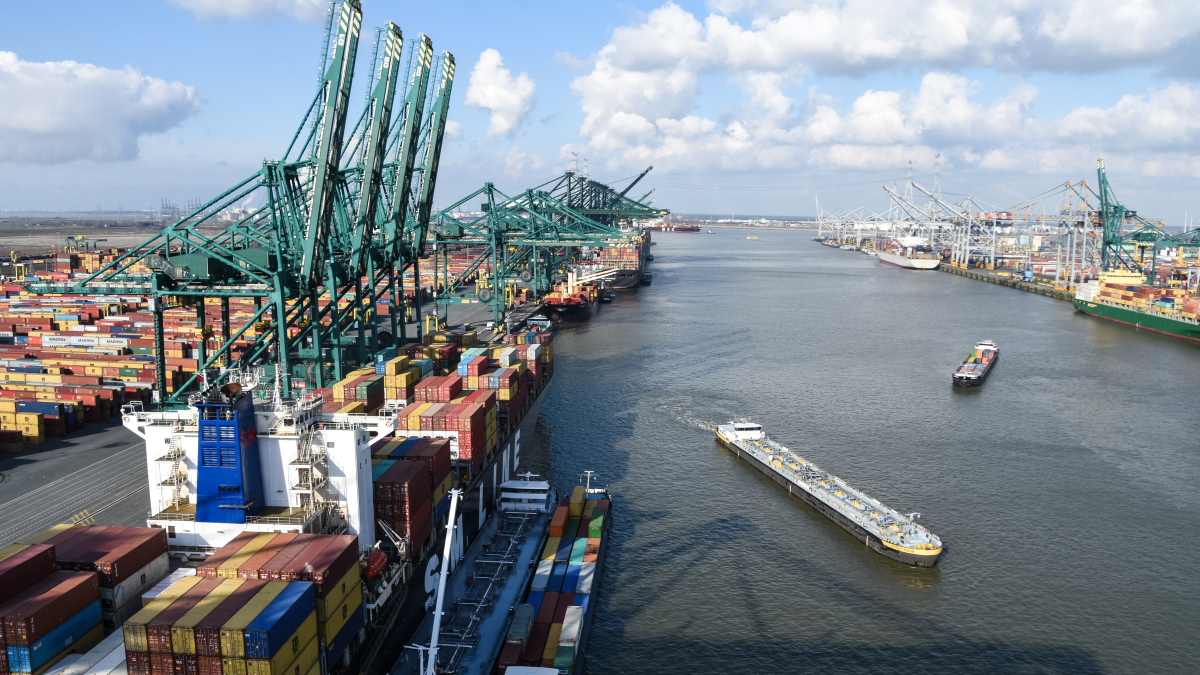
Seaports are essential for global trade-led development, and for the ‘Blue Economy’. They provide access to global markets and supply-chains for all countries, and are integral to maritime transport, as well as fisheries, offshore energy development, and many economic activities in coastal zones. With over 80 % of world trade volume carried by sea – from port to port -, they are crucial infrastructure nodes that  underpin global supply chains and are key to future trade and development prospects, particularly of developing States which currently account for around  60 % of goods loaded and unloaded globally. At the same time, ports are particularly exposed to various natural hazards, due to their locations along open coasts or in low-lying estuaries and deltas; their setting makes them susceptible to impacts of climatic hazards such as rising sea levels, storm surges, waves and winds,  riverine and pluvial flooding, as well as  tectonic events (e.g. tsunamis).  

Tiếp tục đọc “Climate change impacts on seaports: A growing threat to sustainable trade and development”

Một số vấn đề ứng phó với biến đổi khí hậu trong quy hoạch các đô thị ven biển Việt Nam

moc.gov.vn

Việt Nam là một trong số những quốc gia chịu ảnh hưởng nặng nề nhất của biến đổi khí hậu (BĐKH) trên thế giới. Trong những năm gần đây, biến đổi khí hậu đã gây ra nhiều hiện tượng như lũ lụt, sạt lở đất, gió bão, nước biển dâng, xâm nhập mặn…với tần suất ngày càng cao, mức độ tàn phá ngày càng nặng nề hơn đối với môi trường, đời sống kinh tế – xã hội Việt Nam.

Với bờ biển dài (trên 3.200km) và diện tích đồng bằng ven biển rộng lớn (135.946km2), Việt Nam đã xây dựng được hơn 405 đô thị ven biển. Đó là các thành phố cảng, trung tâm kinh tế biển, các đô thị du lịch và thương mại, dịch vụ – đóng vai trò quan trọng trong sự phát triển kinh tế của Việt Nam. Biến đổi khí hậu tạo ra những thiệt hại về kinh tế – xã hội ở các đô thị ven biển nhiều hơn bất cứ nơi nào khác vì vậy quy hoạch đô thị khu vực này cần phải có giải pháp kịp thời về cấu trúc đô thị, sử dụng đất, tổ chức không gian môi trường, cơ sở hạ tầng, cảnh quan, … để đô thị phát triển bền vững và chống chịu, tự phục hồi trước những diễn biến bất thường của BĐKH. Bài viết giới thiệu những ảnh hưởng của BĐKH đối với hệ thống đô thị ven biển Việt Nam và một số giải pháp quy hoạch đô thị nhằm giảm nhẹ và thích ứng với các tác động của BĐKH.

1. Giới thiệu

Việt Nam có bờ biển dài, đồng bằng ven biển rộng là cái nôi để phát triển hệ thống đô thị ven biển đa dạng, phong phú trở thành những trung tâm kinh tế, du lịch và dịch vụ quan trọng, đóng góp to lớn cho sự phát triển kinh tế của Việt Nam. Là một trong số những quốc gia được đánh giá là bị ảnh hưởng nghiêm trọng nhất trên thế giới, Biến đổi khí hậu có ảnh hưởng sâu rộng đến mọi lĩnh vực của đời sống, kinh tế – xã hội và môi trường Việt Nam. Đặc biệt các đô thị ven biển Việt Nam hiện nay đang phải đối mặt với các thách thức lớn của BĐKH như hiện tượng nước biển dâng, xâm nhập mặn, lũ lụt, và thiên tai… làm giảm quỹ đất xây dựng, phá hoại hệ thống hạ tầng xã hội và hạ tầng kỹ thuật, suy giảm nguồn nước, xáo trộn và ảnh hưởng đến chất lượng cuộc sống, sinh kế của người dân đô thị. Trước những yêu cầu thực tế, Quy hoạch đô thị cần có những thay đổi về cách tiếp cận để góp phần giảm thiểu các tác động bất lợi của BĐKH, giúp các đô thị ven biển Việt Nam chuyển hóa, thích ứng và chống chịu được BĐKH.

Tiếp tục đọc “Một số vấn đề ứng phó với biến đổi khí hậu trong quy hoạch các đô thị ven biển Việt Nam”

COP28 Ends With Deal on Transition Away From Fossil Fuels

bloomberg.com By Jennifer A DlouhyJess Shankleman, and Laura Millan Updated on 

  • First time fossil fuels have made it to a global climate deal
  • Steps needed to turn agreement into tangible actions: Al Jaber
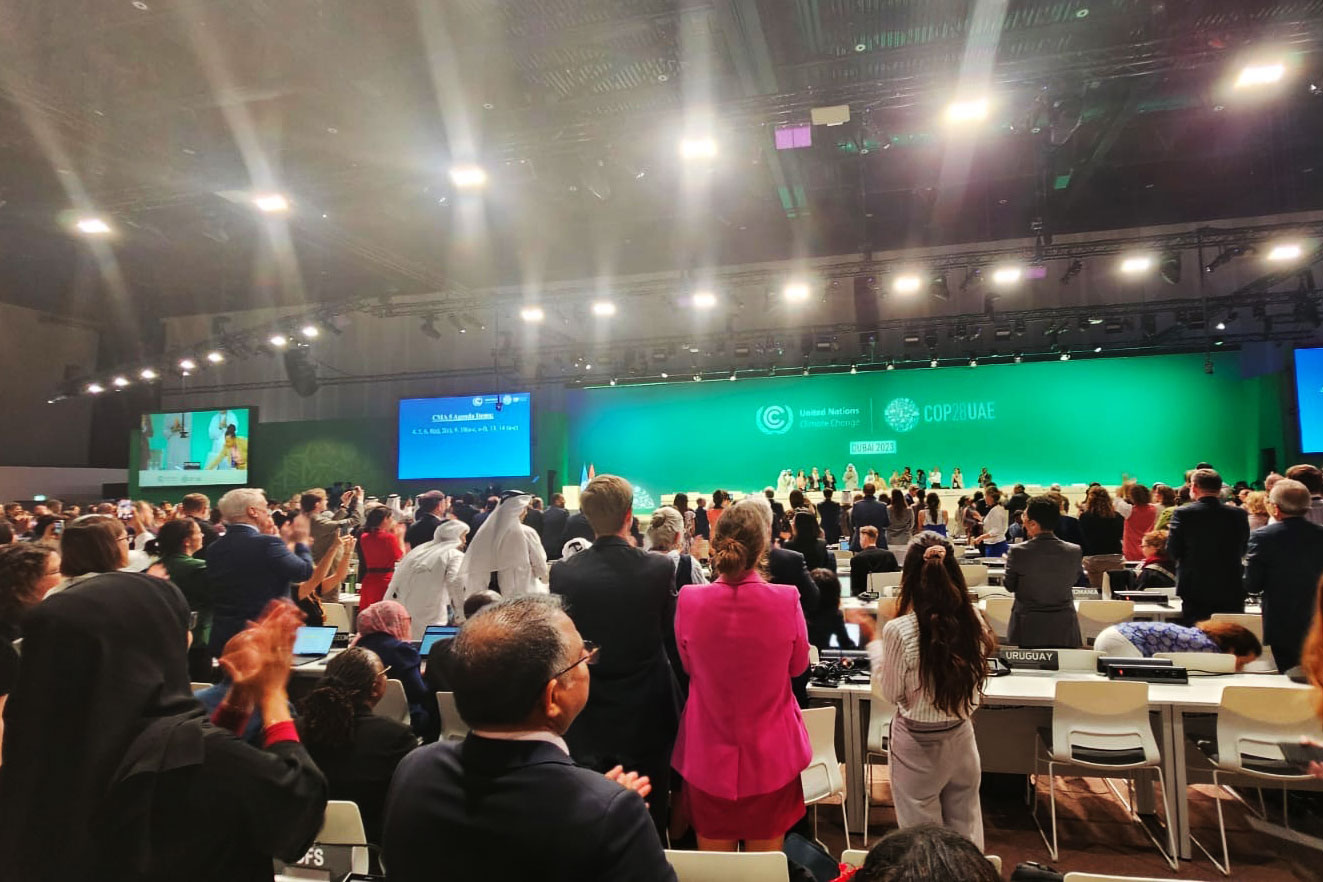
Standing ovation after COP28 President Sultan Al Jaber brokered an agreement to a commitment to transition away from fossil fuels.
Standing ovation after COP28 President Sultan Al Jaber brokered an agreement to a commitment to transition away from fossil fuels.Photographer: Nayla Razzouk/Bloomberg

The COP28 climate talks in Dubai ended in a deal that saw a commitment to transition away from all fossil fuels for the first time.

The president of this year’s UN-sponsored summit, the UAE’s Sultan Al Jaber, brokered an agreement that was strong enough for the US and European Union on the need to dramatically curb fossil fuel use while keeping Saudi Arabia and other oil producers on board.

The agreement calls for countries to quickly shift energy systems away from fossil fuels in a just and orderly fashion, qualifications that helped convince the skeptics. Under the deal, countries also are called to contribute to a global transition effort — rather than being outright compelled to make that shift on their own.

Tiếp tục đọc “COP28 Ends With Deal on Transition Away From Fossil Fuels”

Only half of young people able to identify correct definition of climate change – UNICEF, Gallup

Unicef.org

Findings highlight urgent need to protect and invest in children, including in climate education, in decisions at COP28

06 December 2023

a child stands by a pool of flood water and plastic pollution.

 UNICEF/UNI390327/Wilander

NEW YORK/DUBAI, 7 December 2023 – Most children and young people say they have heard of climate change but only half understand what it is, according to a new UNICEF-Gallup poll, as world leaders gather at this year’s COP28.

Tiếp tục đọc “Only half of young people able to identify correct definition of climate change – UNICEF, Gallup”