5 reasons to be worried about health security in Asia

Published on Thursday, 17 December 2015

Pharmacy at a health clinic in Poipet, Cambodia.

blogs.adb.org – If you live in Asia and the Pacific, do you ever wonder how high your risk is of contracting antimicrobial-resistant bacteria or emerging infectious diseases such as a new strain of avian influenza? Unfortunately, I have to tell you that the risk here is higher that in any other region in the world.

1. South and Southeast Asia are epicenters for antimicrobial resistance.

South and Southeast Asia are home to the highest number of major bacterial pathogens for which there is antimicrobial resistance. Most developing countries in the region do not monitor or reinforce standards in antibiotic use and prescription, and the limited available data paints a picture of widespread non-compliance with antibiotic treatment regimen. Self-medication with antibiotics available over-the-counter is common throughout Asia, and an estimated 50% of patients fail to follow the recommended antibiotics course of treatment, mainly because it’s expensive. Traces of antimicrobials used in the animal husbandry sector find their way into the food chain; so most of the meat that was not grown organically was likely treated with antibiotics. Even fish is often bathed in antibiotic solution in many commercial fisheries. And of course the water you drink might also be contaminated due to lack of adequate water treatment plants. Constant exposure to antibiotics increases the risk of developing antimicrobial resistance.

2. Asia is a hotspot for emerging infectious diseases.

Asia as where new emerging infectious diseases are most likely to originate, particularly zoonosis (diseases transmitted from animals), vector-borne diseases and drug-resistant pathogens. This is evident in the increasing frequency of these events over the last decade and is correlated directly with socio-economic, environmental and ecological factors. Numerous outbreaks of emerging infectious diseases have had a huge impact in Asia. SARS rapidly decimated tourism to the region in 2003, costing the industry $18 billion or approximately $2 million per person infected. The H5N1 virus had a profound effect on the poultry industry: in 2003-2004 Viet Nam culled 45 million birds and lost $118 million, while a Thai ban on poultry reduced the country’s income from poultry exports by 93%, from $598 million in 2003 to $44 million in 2004.

3. Health risks are increasing in Asia.

Asia is one of the most globalized, mobile regions in the world, and trade facilitates the rapid spread of diseases that otherwise may have been contained by geographical boundaries. Climate change and the associated rise in temperature and flooding lead to more vector-borne diseases such as chikungunya, malaria and dengue. Pollution and natural disasters are also significant risk factors for respiratory tract infections and water-borne diseases.

4. Fragmented supply chains impact the efficiency of drugs and vaccines.

Too much medicine that needs cold storage but is exposed to heat and humid environments can lead to an overestimation of actual effective vaccination coverage and decreased efficacy of medicines – both contributing to increasing risk of disease outbreaks. You might have seen this affect in your own children, who have been vaccinated in Asia but still developed certain diseases they were supposed to be protected against because the vaccine probably wasn’t effective anymore.

5. Unregulated health service providers.

Chronic under-investment in public health systems has resulted in private sector provision of health services, which are often unregulated (threatening quality) and not required to report routinely to health management information systems. A consequence of this data gap is that critical information on incidence of infectious diseases or drug resistance identified in the private sector takes much longer to reach public health sector officials.

The above risks can only be addressed with strengthened health systems and increased accountability, both of which arise from collaboration between countries and development partners to invest in public health services. To combat health threats and to avoid significant economic losses, we must step up health financing and redouble their efforts in cross-sector, cross-border and regional coordination on health policies and practices.

Investing in health systems today will yield not only direct health and economic benefits tomorrow, but will also help protect populations from emerging health threats both within and beyond the region. Donors outside of the region must continue to support health system strengthening in Asia, as weak health systems in any country can pose threats to their own public health and economic security.

Health is having the same disease as your neighbor – so make sure your neighbor has no diseases.

CSIS Energy Publication | Assessing the Final Clean Power Plan: Emissions Outcomes

FROM THE CSIS ENERGY AND NATIONAL SECURITY PROGRAM

Assessing the Final Clean Power Plan:
Emissions Outcomes

The U.S. Environmental Protection Agency’s (EPA) Clean Power Plan (CPP) is the most significant greenhouse gas (GHG) policy ever undertaken in the United States, and is expected to achieve significant emission reductions by the time it is fully implemented in 2030. However, calculating the ultimate emissions-abatement potential is more difficult than simply adding up the state reduction targets. While the EPA has set a floor on cumulative emissions from existing fossil-fuel-fired power plants, it has not set a ceiling, and projecting the actual emissions outcome on a national level is not straightforward due to the flexibility states have in implementation.

Our analysis deepens the understanding of the potential emissions outcomes of the CPP and what factors could influence that outcome. We start by explaining the primary factor that has the potential to undermine EPA’s emissions floor—leakage—and how EPA is attempting to address this issue. We then turn to a quantitative analysis of two potential pathways for state implementation plans (SIPs) under optimal implementation conditions. Bearing in mind that optimal implementation is unlikely, we also explore key drivers and decisions that could result in emissions that are higher or lower than our initial projections.

To read the full report, click here

By: John Larsen, Director, Rhodium Group, and Non-Resident Senior Associate, Energy and National Security Program, CSIS; Sarah Ladislaw, Director and Senior Fellow, Energy and National Security Program, CSIS; Michelle Melton, Associate Fellow, Energy and National Security Program, CSIS; and Whitney Herndon, Research Analyst, Rhodium Group

RECENT PUBLICATIONS

Adjusting to Low Prices:
Prospects for Fossil Fuel Subsidy Reform

By: Sarah Ladislaw, Director and Senior Fellow, Energy and National Security Program, CSIS and Zachary Cuyler, Research Associate, Energy and National Security Program, CSIS

Is India the Next China? An Energy-Related Comparison

By: Jane Nakano, Senior Fellow, Energy and National Security Program, CSIS and Michelle Melton, Associate Fellow, Energy and National Security Program, CSIS

Renewed Solar Subsidies – A Missed Opportunity

By: Francis O’Sullivan, Director of Research and Analysis, MIT Energy Initiative; Senior Associate, Energy and National Security Program, CSIS

Reinvigorating agricultural productivity in the Lower Mekong

November 27, 2015 1:00 pm JST
Aladdin D. Rillo and Mercedita A. Sombilla

asia.nikkei.com – The green revolution has done wonders for Asia. Yields for most crops, particularly the region’s main staple of rice, have doubled over recent decades. In the Lower Mekong Delta, considered to be Asia’s rice bowl, the new technologies and crop strains that the green revolution brought were a big success.

Cambodian farmers load vegetables onto a cart for transport to market, at a farm in Kandal Province, south of Phnom Penh, on Oct. 16, which was World Food Day. © AP

Rice production in the Lower Mekong countries of Cambodia, Laos, Myanmar and Vietnam soared 68% between 1980 and 1995. During the same period, average yields more than doubled from their levels in the 1960s to about 3.5 tons per hectare. Total land area planted with rice also increased by around 25% to 16.3 million hectares between 1996 and 2005.

      By the end of 2013, however, the gains seemed to have leveled off. Between 2006 and 2013, average yield growth slowed to 22% across all of the Lower Mekong countries except Cambodia, as growth in rice production slid to 36%.

The slower trends in yield and production growth were not unique to the Lower Mekong. They also applied to the rest of Asia for various reasons. Chief among them is that green revolution technologies, particularly new rice seed varieties, had become exhausted. Poor land and water quality were also culprits in the drop-off, along with inadequate farm management practices and the rapid conversion of farmland to non-agricultural use. Eroding profit margins due to a decline in the price of rice on global markets exacted a heavy toll as well.

Low productivity

There is reason for alarm at the change. Agriculture still provides 10% of Asia’s value-added output and is an important source of employment as about 45% of jobs in Asia are in rural areas. With declining yields and production, this means that productivity, the value of output per worker, will decline further. Tiếp tục đọc “Reinvigorating agricultural productivity in the Lower Mekong”

The Power of Smallholder Land Rights to Combat Climate Change

CSIS

Photo courtesy of Groman123 from https://www.flickr.com/photos/pkirtz/21038826799/
Dec 16, 2015

Last weekend the world rejoiced over the historic, long-awaited climate-change agreement reached at the Paris Climate Conference (COP21). While the cooperation of 190 countries around a singular issue, especially one as pressing as climate change, should be applauded, the COP21 pact is missing something major: the role of agriculture.

This year is on target to be the hottest in recorded history. Just in the past few months, we have watched El Nino, which is likely to be one of the strongest on record, create unpredictable and chaotic weather patterns, taking a tremendous toll on harvests and pushing millions into extreme poverty and emergency levels of food insecurity. Ethiopia is experiencing its worst drought in decades, with predictions of at least 15 million people requiring emergency food assistance by early 2016. As climate change continues to threaten global stability, it pressures the international community to enact creative solutions. One solution that hasn’t received enough attention is increasing land rights for smallholder farmers, particularly for women in the developing world. Tiếp tục đọc “The Power of Smallholder Land Rights to Combat Climate Change”

Setting the Post-Paris Climate Agenda

Photo courtesy of Kim Seng from https://www.flickr.com/photos/captainkimo/6702244011/
Dec 1, 2015

CSIS – UN climate negotiations are sort of like the holiday season. In the lead up there is always huge amounts of anticipation, lots of planning and logistics, and the promise of something new, merry, and important. The event itself is chaotic with lots of complicated family dynamics and the ever-present threat of someone storming off in a huff. The day after often brings plenty of leftovers to be dealt with, presents to be stored, regifted, or returned, and a sense that it is time to move on to all the things that had been put off while dealing with the big preparations.

There is no denying that for the climate community the last twelve months have been one big crescendo to Paris, a carefully orchestrated set of activities and announcements designed to drive momentum and activity toward the big moment. By any stretch this has been a tremendously successful crescendo. The country pledges that have been rolling in since this past spring total over 180 in number and cover approximately 95 percent of global emissions. By the UN’s own estimates, these pledges, if pursued in earnest, could keep the world in the ballpark of limiting temperature rise to 2.7 degrees Celsius above pre-industrial levels. Over 400 cities, 1,000 plus companies, and countless members of civil society pledged separate and additional actions. The Pope and several other groups of religious leaders weighed in on the moral imperative to tackle climate change and the United States denied the Keystone XL pipeline project – a major North American symbol of the environmentalist struggle to catalyze action on climate change. Unlike five years ago in Copenhagen , there is a lot on the table this time even before the talks get underway. Tiếp tục đọc “Setting the Post-Paris Climate Agenda”

Germany Could Make $2 Billion By Exporting Electricity

November 10th, 2015 by

cleantecnica – The Fraunhofer Institute has found that Germany made about €1.7 billion, or $1.93 billion, in 2014 by selling surplus electricity. In 2015, that amount could reach €2 billion or $2.2 billion. Germany may also achieve a record export surplus of 40 TWh of electricity in 2015. “Over the past years, Germany was able to secure higher prices for its electricity exports than it paid for electricity imports,” explained Fraunhofer professor, Bruno Burger.

germancliffsRenewables added 118 TWh of energy production capacity in Germany from the period beginning in 2010 through 2014. What are some of Germany’s other exports? According to one source, Germany exported about $2.6 billion in pharmaceuticals to Japan in 2014. In 2007, cheese exports were about €2.7 billion. Tiếp tục đọc “Germany Could Make $2 Billion By Exporting Electricity”

Powering the Internet with renewable energy

December 3, 2015

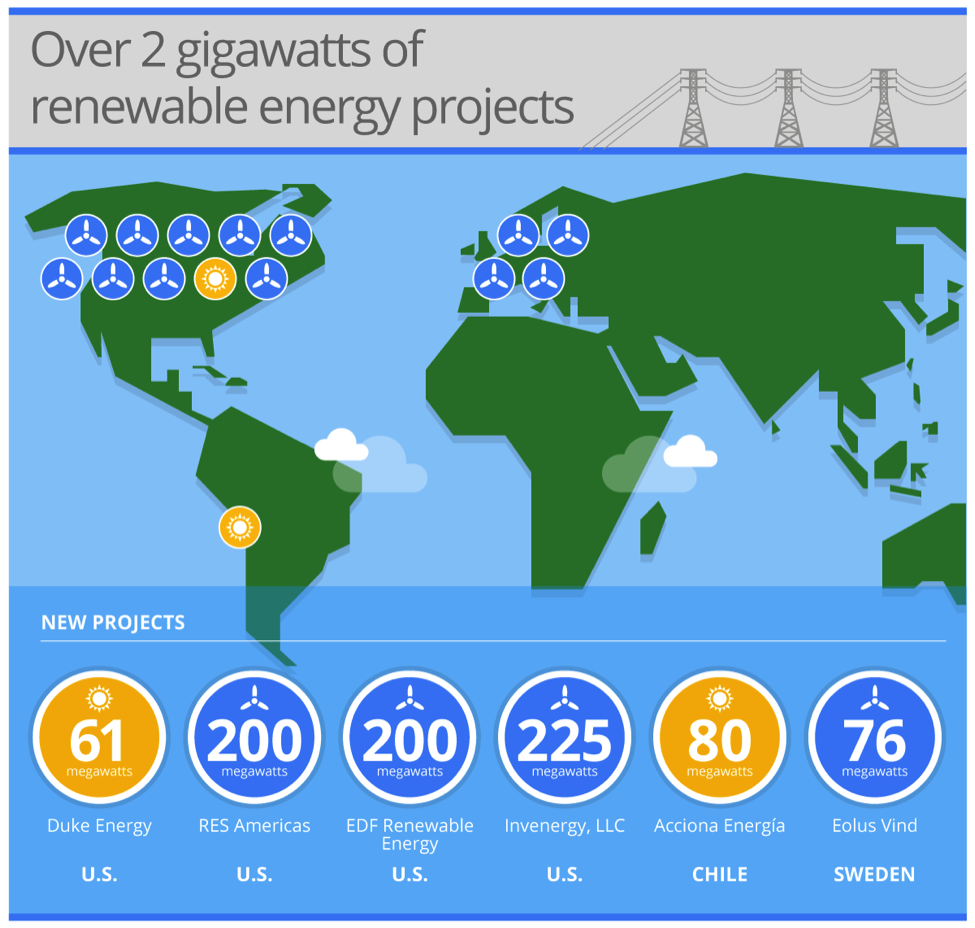
Googleblog – Today we’re announcing the largest, and most diverse, purchase of renewable energy ever made by a non-utility company. Google has already committed to purchase more renewable energy than any other company. Now, through a series of new wind and solar projects around the world, we’re one step closer to our commitment to triple our purchases of renewable energy by 2025 and our goal of powering 100% of our operations with clean energy. 842 MW of renewable energy around the world Today’s agreements will add an additional 842 megawatts of renewable energy capacity to power our data centers. Across three countries, we’re nearly doubling the amount of renewable energy we’ve purchased to date. We’re now up to 2 gigawatts—the equivalent to taking nearly 1 million cars off the road. These additional 842 megawatts represent a range of locations and technologies, from a wind farm in Sweden to a solar plant in Chile.

These long-term contracts range from 10-20 years and provide projects with the financial certainty and scale necessary to build these wind and solar facilities—thus bringing new renewable energy onto the grid in these regions. For our part, these contracts not only help minimize the environmental impact of our services—they also make good business sense by ensuring good prices. Our commitment to a sustainable energy future Since we opened our very first owned data center in 2006, we’ve been working to promote renewable and sustainable energy use in several ways:

  • First, we’re building the world’s most efficient computer infrastructure by designing our data centers to use as little energy as possible.

Tiếp tục đọc “Powering the Internet with renewable energy”

Đóng góp ý kiến cho Quy hoạch điện VII hiệu chỉnh (Việt Nam)

25/11/2015 | 13:40

Xem và tải báo cáo tại đây: Bản tiếng ViệtBản tiếng Anh

GreenID – “Không cần đầu tư xây dựng mới khoảng 30.000 tới 40.000 MW nhiệt điện than mà có thể dùng nguồn đầu tư này vào việc thực hiện sử dụng hiệu quả năng lượng và phát triển nguồn năng lượng tái tạo trong khi vẫn đáp ứng được nhu cầu”. Đây là một trong những thông tin quan trọng được đề cập trong báo cáo “Phân tích Quy hoạch điện VII và một số khuyến nghị đối với Quy hoạch điện VII hiệu chỉnh – hướng tới phát triển năng lượng bền vững tại Việt Nam” do Trung tâm Phát triển Sáng tạo Xanh (GreenID) thực hiện với sự tham gia và tư vấn của các chuyên gia năng lượng trong nước và quốc tế.

Sau hơn 4 năm thực hiện Quyết định Phê duyệt Quy hoạch phát triển điện lực Quốc gia giai đoạn 2011-2020 có xét đến năm 2030 số 1208/QĐ-TTg ngày 21/7/2011 của Thủ tướng Chính phủ, ngành điện đạt được một số thành tựu đáng ghi nhận, từ chỗ phải tiết giảm điện trong các năm 2010-2011 do thiếu điện đến nay ngành điện không những đã cung cấp được đủ điện cho sản xuất và sinh hoạt của nhân dân mà còn có dự phòng. Tuy nhiên, Quy hoạch điện VII cũng đã bộc lộ một số vấn đề mang tính vĩ mô và ảnh hưởng tới tính khả thi như dự báo nhu cầu điện năng quá lớn khiến nhu cầu vốn đầu tư quá nhiều mà nền kinh tế không chịu nổi; huy động nhà máy nhiệt điện chạy than quá cao, nhu cầu than cung cấp cho điện quá lớn, có thể dẫn tới không đủ nguồn cung cấp kể cả nhập khẩu, không đảm bảo môi trường và phát triển bền vững; chưa chú trọng đúng mức tới nguồn năng lượng tái tạo. Tiếp tục đọc “Đóng góp ý kiến cho Quy hoạch điện VII hiệu chỉnh (Việt Nam)”

Carbon capture analyst: ‘Coal should stay in the ground’

Date:December 2, 2015

Source:University of Michigan

Summary:Serious flaws have been found in a decade’s worth of studies about the best way to reduce greenhouse gas emissions and stabilize the climate, report experts in a new article.

Serious flaws have been found in a decade’s worth of studies about the best way to reduce greenhouse gas emissions and stabilize the climate.

sciencedaily – The findings, from the University of Michigan, are released as world leaders at COP21 attempt to negotiate the globe’s first internationally binding climate agreement.

The U-M researchers have found that most economic analysis of carbon capture and storage, or CCS, technology for coal-fired power plants severely underestimates the technique’s costs and overestimates its energy efficiency. CCS involves sucking carbon out of coal-fired power plants’ flue gases, compressing it and then injecting it deep underground.

The new analysis puts the cost of reducing carbon emissions with CCS-equipped coal plants higher than any previous study — and most importantly, higher than wind and comparable to solar power. It’s the first study to confront the so-called ‘energy loop’ inherent in the CCS process. Tiếp tục đọc “Carbon capture analyst: ‘Coal should stay in the ground’”

El Nino và La Nina

PCLB – El Nino và La Nina  (gọi tắt là ENSO: Nino Southern Oscillation (El Nino – Dao động Nam) dùng để chỉ hai hiện tượng El Nino và La Nina ).

I. Khái niệm

1. El Nino

“El Nino” (theo tiếng Tây Ban Nha có nghĩa là đứa con của Chúa hay còn gọi là bé Hài Đồng nam) là từ được dùng để chỉ hiện tượng nóng lên dị thường của lớp nước biển bề mặt ở khu vực xích đạo trung tâm và Đông Thái Bình Dương, kéo dài 8 – 12 tháng, hoặc lâu hơn, thường xuất hiện 3 – 4 năm 1 lần, song cũng có khi dày hơn hoặc thưa hơn. Tiếp tục đọc “El Nino và La Nina”

New Platform Reveals How Much Carbon Is Locked in Tropical Forests – and How Much Was Lost

WRI – Between 2001 and 2013, greenhouse gas emissions from deforestation across the world’s tropical forests were, on average, larger than Russia’s economy-wide emissions in 2012. That’s 2,270 million metric tons (Mt) of carbon dioxide every year.

Emissions from tropical deforestation have significant implications for implementation of the new national climate plans (INDCs), as well as international initiatives like the New York Declaration on Forests, whose signatories aim to cut global deforestation in half by 2020. Tiếp tục đọc “New Platform Reveals How Much Carbon Is Locked in Tropical Forests – and How Much Was Lost”

Việt Nam và những cam kết ở COP-21

30/11/2015 09:18 GMT+7

TTCTHội nghị thượng đỉnh Liên Hiệp Quốc về biến đổi khí hậu (COP-21) diễn ra từ ngày 30-11 đến 11-12 tại Paris đặt mục tiêu đi đến một hiệp định quốc tế về khí hậu có hiệu lực từ năm 2020, nhằm giới hạn nhiệt độ trung bình toàn cầu tăng không quá 20C vào cuối thế kỷ 21.

Biến đổi khí hậu gây hạn hán ở Ninh Thuận -Thuận Thắng

Để chuẩn bị cho việc xây dựng dự thảo hiệp định quốc tế về khí hậu này, các quốc gia được yêu cầu trình nộp báo cáo “Đóng góp dự kiến do quốc gia tự quyết định” (INDC) cho Ban thư ký Công ước khung của Liên Hiệp Quốc về biến đổi khí hậu (UNFCCC), trong đó thể hiện cam kết pháp lý trong việc cắt giảm phát thải khí nhà kính và thích ứng với biến đổi khí hậu giai đoạn sau năm 2020.

Việt Nam cần tham vọng hơn

Báo cáo INDC của Việt Nam đưa ra các đóng góp dự kiến trong hai hợp phần chính là cắt giảm phát thải khí nhà kính và thích ứng với biến đổi khí hậu. Các đóng góp dự kiến trong hợp phần cắt giảm phát thải khí nhà kính tập trung vào lĩnh vực năng lượng, nông nghiệp, sử dụng đất, thay đổi sử dụng đất và lâm nghiệp, quản lý chất thải. Tiếp tục đọc “Việt Nam và những cam kết ở COP-21”

International Climate Negotiations Glossary

CSIS – This glossary provides an overview of terms used by negotiators and others when discussing international climate negotiations. While several excellent climate glossaries exist—including from the U.S. Environmental Protection Agency and the United Nations Framework Convention on Climate Change (UNFCCC)—that provide technical definitions of terms, this glossary also provides the political and economic context for understanding the developments leading up to the Conference of Parties 21 (COP 21) in Paris in December 2015. At COP 21, Parties to the UNFCCC will be negotiating an international agreement that provides the framework for greenhouse gas emission reduction beyond the year 2020.

A | B | C | D | E | F | G | H | I | J | K | L | M | N | O | P | Q | R | S | T | U | V | W | X | Y | Z Tiếp tục đọc “International Climate Negotiations Glossary”

Why the Paris climate deal must put the poorest, lowest emitting and most vulnerable people first

The poorest half of the global population are responsible for only around 10% of global emissions yet live overwhelmingly in the countries most vulnerable to climatechange – while the richest 10% of people in the world are responsible for around 50% of global emissions

Oxfam – Climate change is inextricably linked to economic inequality: it is a crisis that is driven by the greenhouse gas emissions of the ‘haves’ that hits the ‘have-nots’ the hardest. While COP21 in Paris will see a deal negotiated between governments on the basis of the total emissions produced in their territories, the real winners and losers will be their citizens. The true test of the deal will be whether it delivers something for the poorest people who are both the least responsible for and the most vulnerable to climate change, wherever they live.

In this briefing Oxfam presents new data analysis that demonstrates the extent of global carbon inequality by estimating and comparing the lifestyle consumption emissions of rich and poor citizens in different countries.

See also the technical briefing on the methodology and data sets. DOWNLOAD here