Tsunami Risk in Vietnam – Hazard level: Medium 

Think Hazard.org Global Facility for Disaster Reduction and Recovery (GFDRR)

In the area you have selected (Vietnam) tsunami hazard is classified as medium according to the information that is currently available. This means that there is more than a 10% chance of a potentially-damaging tsunami occurring in the next 50 years. Based on this information, the impact of tsunami should be considered in different phases of the project for any activities located near the coast. Project planning decisions, project design, and construction methods should take into account the level tsunami hazard. Further detailed information should be obtained to adequately account for the level of hazard.

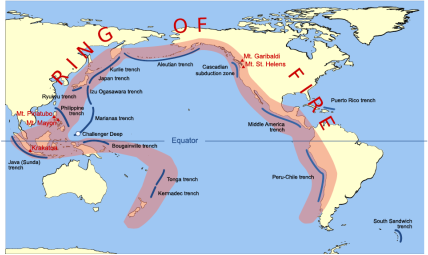
Pacific "Ring of Fire" (enlarged graphic). Source: Adapted from U.S. Geological Survey
Pacific “Ring of Fire” (enlarged graphic). Source: Adapted from U.S. Geological SurveyDownload Image

Climate change impact: The areas at risk of tsunami will increase as global mean sea level rises. According to the IPCC (2013), global mean sea level rise depends on a variety of factors, and estimates for 2100 range from ~20 cm to nearly 1 m. However, regional changes in sea level are difficult to predict. Projects in low-lying coastal areas such as deltas, or in island states should be designed to be robust to projected increases in global sea level.

Tiếp tục đọc “Tsunami Risk in Vietnam – Hazard level: Medium “

Vì sao chậm giải cứu hàng nghìn người kẹt ở rốn lũ Đăk Lăk?

VNE – Thứ ba, 25/11/2025, 06:00 (GMT+7)

Cả đêm vật lộn với lũ, chị Nguyễn Thị Phương, 35 tuổi, thôn Mỹ Điền, xã Hòa Thịnh, một tay ôm đứa nhỏ, tay còn lại luồn qua mái ngói, kéo đứa lớn để không chìm trong nước.

“Có lúc tôi nghĩ chỉ giữ được đứa nhỏ”, người mẹ hai con nhớ lại đêm kinh hoàng từ tối 19/11 đến rạng sáng hôm sau. Chồng đi làm xa, ba mẹ con chị Phương sống trong căn nhà cấp 4 nằm dọc sông. Trước đó, chị nhận thông báo về mưa, lũ qua nhóm Zalo của khu dân cư. Chiều 19/11, điện mất, mạng Internet và sóng điện thoại chập chờn, khiến chị gần như không theo kịp các tin nhắn mới.

Cùng thời điểm, khu vực mưa rất lớn, thủy điện Sông Ba Hạ cách Hòa Thịnh gần 60 km xả lũ kỷ lục 16.100 m3/s. Lượng nước trong một giây đủ làm đầy khoảng 80 căn nhà rộng hơn 50 m2, cao tầm 4 m như của chị Phương. Tuy nhiên, chị không hình dung được mức độ nguy hiểm, chỉ kê đồ dễ hư lên cao hơn đầu gối và chuẩn bị thức ăn cho 1-2 ngày.

Chiều cùng ngày, nước bò vào phòng khách, ngập lút đồ đạc. Nghĩ nước sẽ rút như mọi năm, chị chưa quá lo. Nhưng càng về đêm, nước càng dâng nhanh. Gần nửa đêm, nước ngập qua bộ ghế phòng khách, chị vội bế hai con lên dầm nhà – phần khung sắt dưới mái ngói. Song đây vẫn chưa phải đỉnh lũ, dòng nước tiếp tục dâng, nhấn chìm cả phần khung.

Chị Nguyễn Thị Phương trong căn nhà nơi ba mẹ con mắc kẹt từ tối 19/11 khi nước dâng cao. Ảnh: Đình Văn
Chị Nguyễn Thị Phương trong căn nhà nơi ba mẹ con kẹt từ tối 19/11 khi nước dâng cao. Ảnh: Thanh Tùng
Tiếp tục đọc “Vì sao chậm giải cứu hàng nghìn người kẹt ở rốn lũ Đăk Lăk?”

Lỗ hổng từ vụ lật tàu Vịnh Xanh

vnexpress.net

Tàu Vịnh Xanh được thiết kế cao hơn quy chuẩn, nhưng không có thiết bị phát tín hiệu cấp cứu tự động, cơ quan giám sát không sớm phát hiện khi tàu bị ngắt GPS.

Tàu Vịnh Xanh 58 chở 46 hành khách và 3 thuyền viên rời bến cảng Bãi Cháy, tỉnh Quảng Ninh lúc 12h55 ngày 19/7, đến 13h30 khi gần hang Đầu Gỗ thì bị giông gió xô lật úp, tất cả người trên tàu rơi xuống biển. Đến 14h05, tàu mất kết nối GPS. Vị trí tàu lật cách bến Tuần Châu hơn một km, cách đất liền ba km.

Tại cuộc họp chiều 20/7, đại tá Hoàng Văn Thuyết, Chính ủy Bộ Chỉ huy quân sự tỉnh Quảng Ninh, cho biết 15h30 đơn vị tiếp nhận tin báo tai nạn đầu tiên, tức sau hai tiếng xảy ra sự cố và sau 10 phút đã triển khai tàu cứu hộ tới hiện trường. Lý do cứu hộ cứu nạn chậm, theo đại tá Thuyết là sau khi tàu lật, trời xuất hiện mưa đá, giông gió tiếp tục đến khoảng 15h nên thông tin tai nạn được báo chậm.

Tiếp tục đọc “Lỗ hổng từ vụ lật tàu Vịnh Xanh”

Number of internally displaced people tops 80 million for first time

“Internal displacement refers to the forced movement of people within the country they live in.” 

Internal-displacement.org

     –  83.4 million people were living in internal displacement at the end of 2024, more than twice as many as only six years ago (2018).

     –  90 per cent had fled conflict and violence. In Sudan, conflict led to 11.6 million internally displaced people (IDPs), the most ever for one country. Nearly the entire population of the Gaza Strip remained displaced at the end of the year.

     –  Disasters triggered nearly twice as many movements in 2024 as the annual average over the past decade. The 11 million disaster displacements in the United States were the most ever recorded for a single country. 

GENEVA, Switzerland – The number of internally displaced people (IDPs) reached 83.4 million at the end of 2024, the highest figure ever recorded, according to the Global Report on Internal Displacement 2025 published today by the Internal Displacement Monitoring Centre (IDMC). This is equivalent to the population of Germany, and more than double the number from just six years ago.  

“Internal displacement is where conflict, poverty and climate collide, hitting the most vulnerable the hardest,” said Alexandra Bilak, IDMC director“These latest numbers prove that internal displacement is not just a humanitarian crisis; it’s a clear development and political challenge that requires far more attention than it currently receives.”

Tiếp tục đọc “Number of internally displaced people tops 80 million for first time”

Sổ tay – Hệ thống cảnh báo sớm hiểm họa tự nhiên tại Việt Nam

Cuốn “Sổ tay hệ thống cảnh báo sớm hiểm họa tự nhiên tại Việt Nam” nhằm cung cấp một cách khoa học và hệ thống thông tin về các loại hình hiểm họa tự nhiên (bao gồm: hiểm họa khí tượng – thủy văn và hiểm họa địa vật lý), đồng thời đề cập việc quản lý rủi ro thảm họa tiếp cận thông qua “Hệ thống cảnh báo sớm đa thiên tai tại Việt Nam”, qua đó góp phần nâng cao hiểu biết và nhận thức của đội ngũ cán bộ Hội, các cấp chính quyền, các tổ chức cộng đồng và nhân dân về thiên tai, thảm họa 

Tải báo cáo tại đây: http://www.dmc.gov.vn/chi-tiet-tai-lieu/so-tay—he-thong-canh-bao-som-hiem-hoa-tu-nhien-tai-viet-nam-doc628.html?lang=vi-VN

Fukushima wastewater issue will further divide a nation, split families, and cause ‘atomic divorce’

thebulletin.org By Maxime Polleri | October 17, 2023

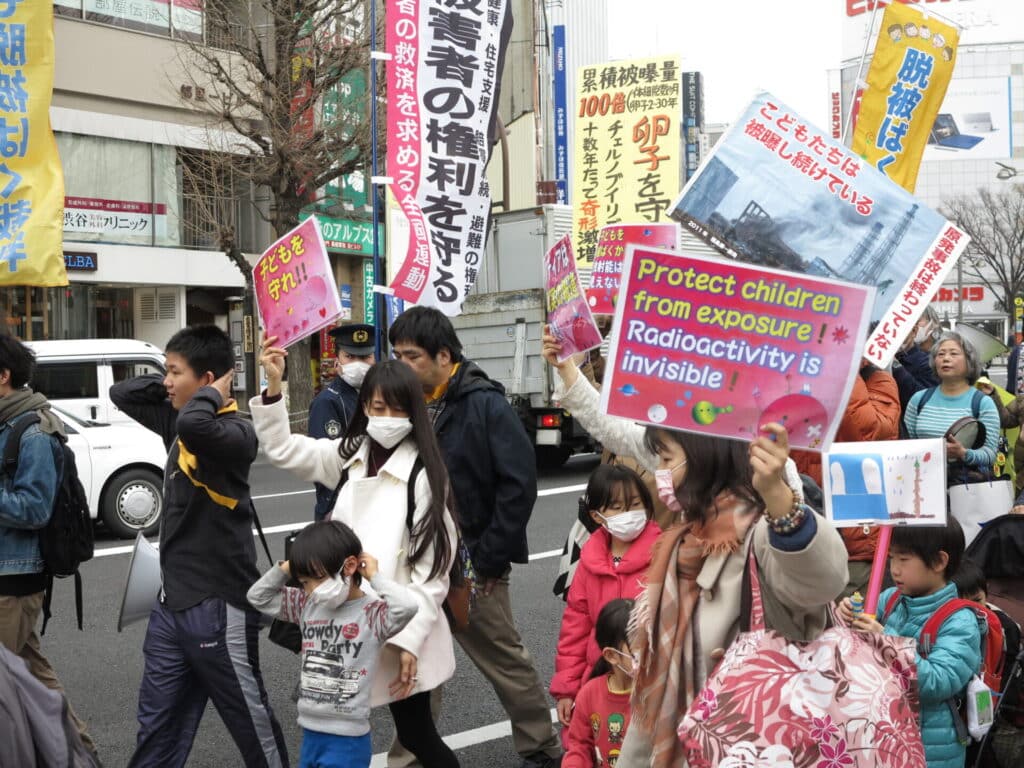
 Mothers march in Tokyo against radiation exposure risks five years after the Fukushima nuclear disaster on March 5, 2016. (Photo by Maxime Polleri)Share
In a bid to dispel seafood worries around the release of Fukushima nuclear wastewater into the ocean, Japan’s Prime Minister Fumio Kishida ate an array of sashimi late in August; the raw fish ranged from flounder to sea bass caught in the Fukushima area. It is “safe and delicious,” he joyfully declared during a public relations effort to revitalize the fishing industry, which has been affected by a Chinese seafood ban and consumer anxieties over the wastewater release.

Many applauded Kishida’s comment, which echoes the same government narrative around post-Fukushima food safety, as well as his firm support for the release of tritium-contaminated water—a discharge process that the International Atomic Energy Agency stated complies with operational safety limits for radiation.

But as someone who studied the aftermath of the Fukushima nuclear disaster for more than a decade, I believe that this decision will irreversibly erode public trust and create irreparable long-lasting tensions. During my years of research in Japan as an anthropologist, I witnessed first-hand how state policies around Fukushima’s economic recovery are fragmenting communities, which constitutes an enduring catastrophe of its own.

Tiếp tục đọc “Fukushima wastewater issue will further divide a nation, split families, and cause ‘atomic divorce’”

Drought drives Vietnam’s Mekong Delta to declare state of emergency

scmp.com

  • A total of 33,000 hectares of rice fields have been damaged and nearly 70,000 households are suffering from a lack of water
  • Reasons for the drought and salinity intrusion include a lack of rain, growing water consumption and increased water storage in dams
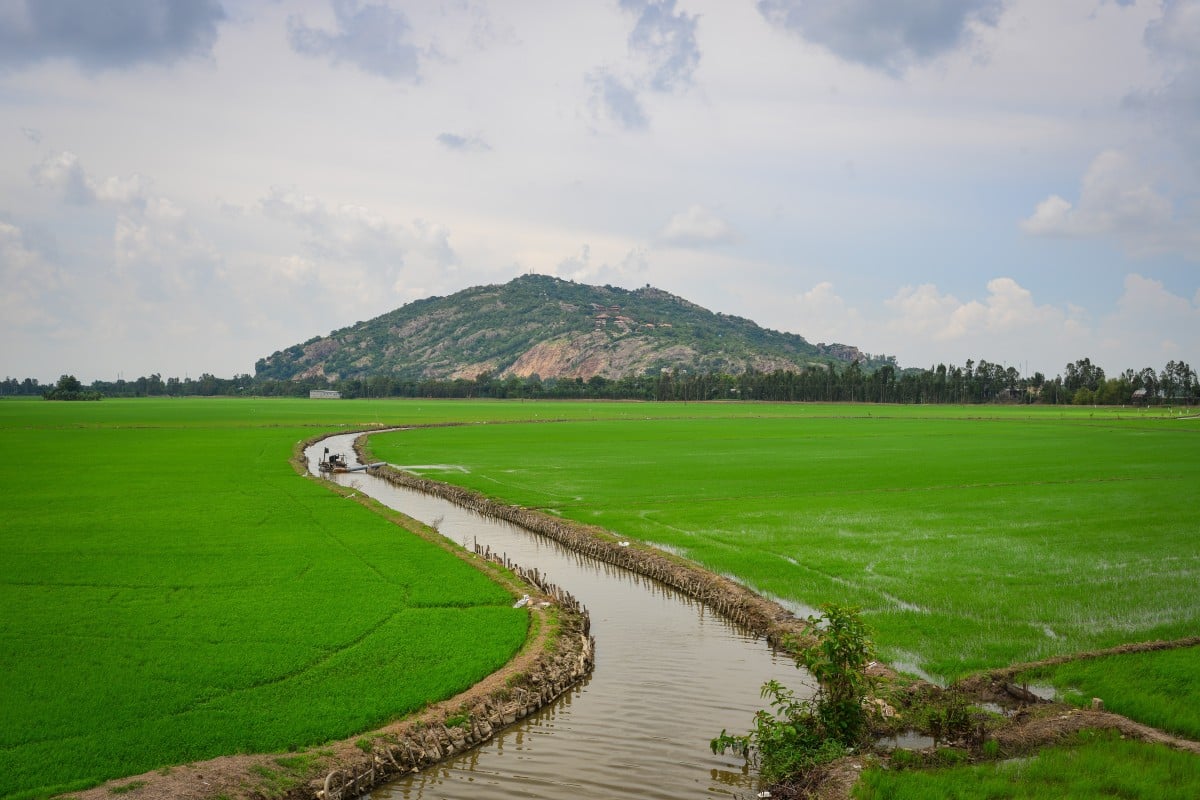
Rice fields in the Mekong Delta of Southern Vietnam. Photo: Shutterstock
Vietnam

’s prolonged drought, coupled with an extensive build-up of salinity, have driven five provinces in the country’s rice bowl to declare a state of emergency.

“This year’s drought and salinity have been way more devastating than what we saw four years ago,” said Nguyen Thien Phap, head of the water resources department in Tien Giang, one of the provinces that announced the emergency in the Mekong Delta.

Tiếp tục đọc “Drought drives Vietnam’s Mekong Delta to declare state of emergency”

UN Launches Multibillion-Dollar Appeal for World’s Most Vulnerable

VOV

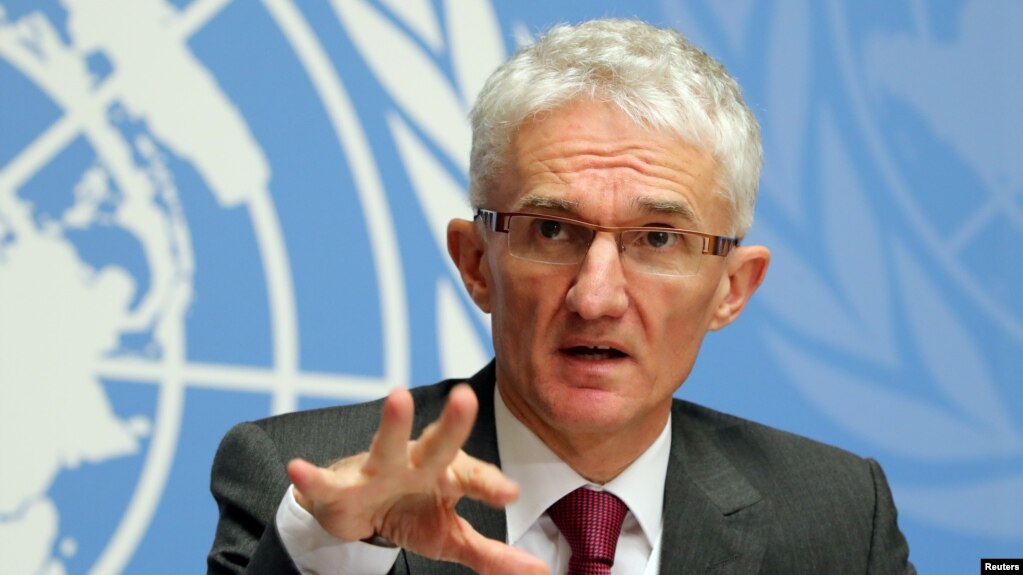
U. N. Undersecretary-General for Humanitarian Affairs and Emergency Relief Coordinator (OCHA) Mark Lowcock attends a news conference for the launch of the “Global Humanitarian Overview 2019” at the United Nations in Geneva, Switzerland, Dec. 4, 2018.

The United Nations is launching a $21.9 billion humanitarian appeal for 2019 to help nearly 94 million people in 42 countries survive conflict, hunger, homelessness, deprivation, and the impact of climate change. Tiếp tục đọc “UN Launches Multibillion-Dollar Appeal for World’s Most Vulnerable”

Typhoon Mangkhut: Philippines braces for one of the strongest in its history

theguardian

Five million could be hit by super storm as gusts of up to 255km/h are expected

Philippines is braced for one of the strongest typhoons in its history, as authorities evacuate families in their thousands, close schools and put rescuers and troops on full alert in the country’s north.

Five million people are expected to be affected by Typhoon Mangkhut, which experts have categorised as a super typhoon with powerful winds and gusts equivalent to a category-5 Atlantic hurricane.

By Friday morning, almost 10,000 people across three regions had been evacuated and 22 domestic flights cancelled. By the evening, strong winds had already downed trees in Tuguegarao, a city in the main northern island of Luzon, where almost all businesses had been shuttered and police were patrolling otherwise quiet streets. Tiếp tục đọc “Typhoon Mangkhut: Philippines braces for one of the strongest in its history”

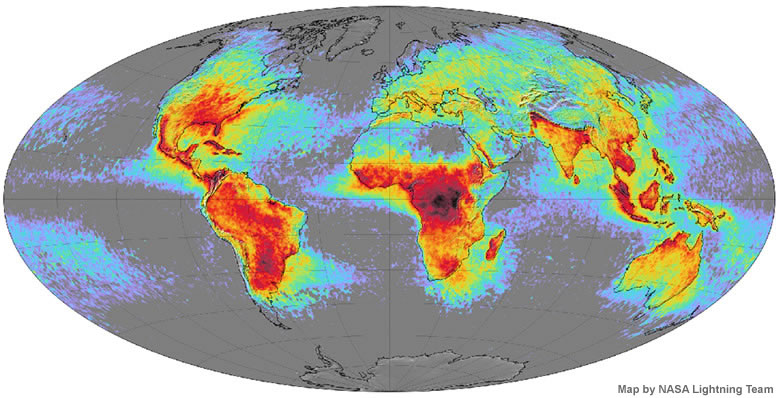
World Lightning Map: Lightning is not uniformly distributed across the Earth.

geology.com

Article by: , Ph.D., RPG

world lightning map

lightning flash scale

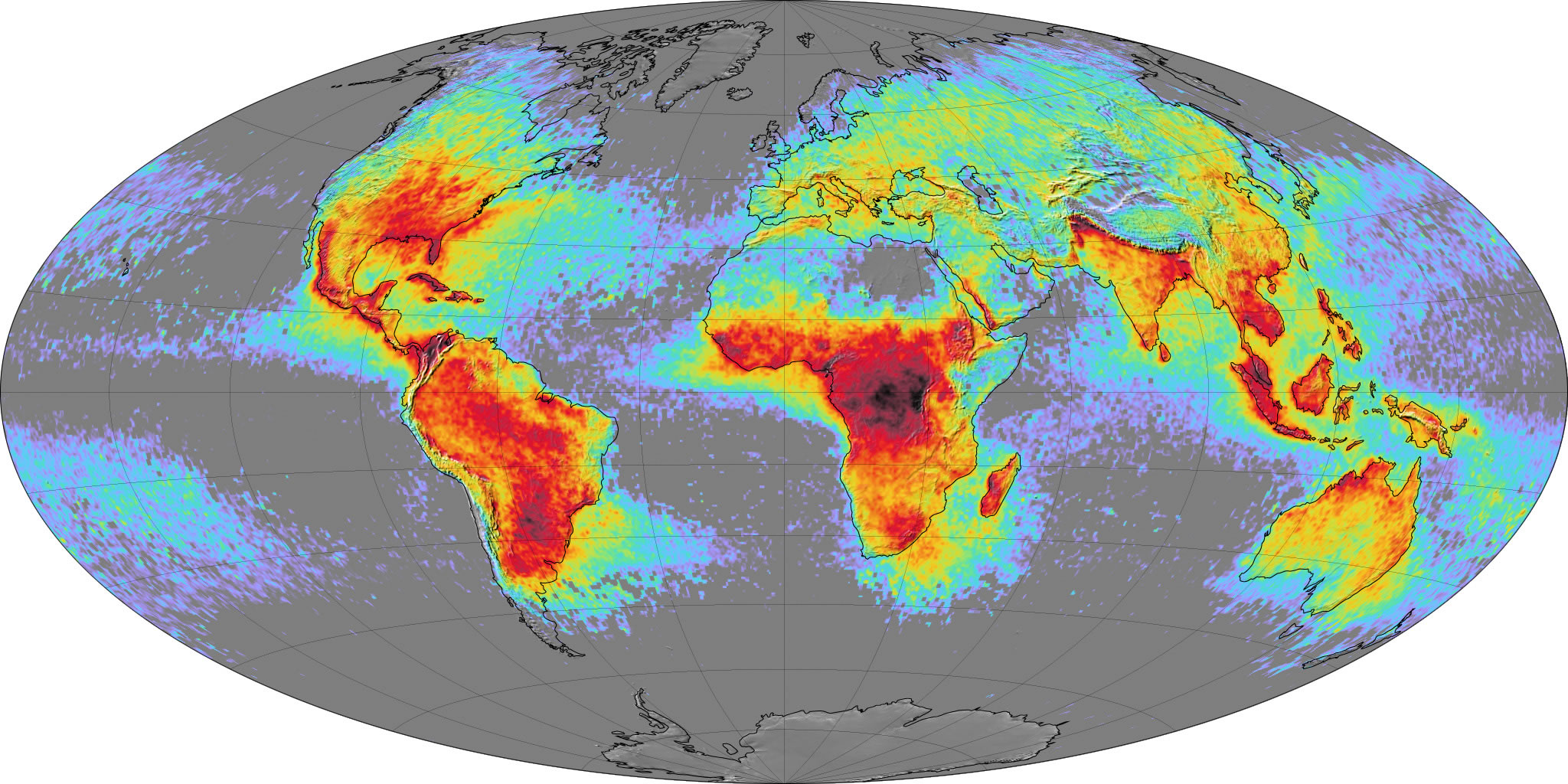
World Lightning Map: The map above shows the average yearly counts of lightning flashes per square kilometer based on data collected by NASA’s Lightning Imaging Sensor on the Tropical Rainfall Measuring Mission satellite between 1995 and 2002. Places where less than one flash occurred (on average) each year are gray or light purple. The places with the largest number of lightning strikes are deep red, grading to black. Enlarge.

What is Lightning?

Lightning is a sudden high-voltage discharge of electricity that occurs within a cloud, between clouds, or between a cloud and the ground. Globally, there are about 40 to 50 flashes of lightning every second, or nearly 1.4 billion flashes per year. These electrical discharges are powerful and deadly.
Tiếp tục đọc “World Lightning Map: Lightning is not uniformly distributed across the Earth.”

Thunderstorm activity and research on lightning position in Vietnam

.

Vietnam is situated in the centre of the Asian thunderstorm region – one of three thunderstorm centres in the world. This article gives an overview of thunderstorm activity in Vietnam and results from the research on lightning position over the past year in Institute of Geophysics under the Vietnam Academy of Science and Technology.

Research on thunderstorms aims to observe and study thunderstorm activity over space and time, as well as exploring how and why lightning formulates. Research on lightning position aims to define the density of lightning (number of lightning flash/km2 /year), and also measure other lightning parameters such as the intensity and the slope of the lightning bolt. Lightning density is an important specific quantity for thunderstorm activity in each region. It requires complicated steps to determine a lightning bolts density. This value is different according to region, depending on characteristics in climate terrain and other weather conditions.

Tiếp tục đọc “Thunderstorm activity and research on lightning position in Vietnam”

Laos Dam Collapses, and Hundreds Are Missing

NYTIMES

HONG KONG — Hundreds of people were missing on Tuesday after a billion-dollar hydropower dam that was under construction in Laos collapsed, killing several people and displacing more than 6,600 others, a state news agency said.

KPL, the official Lao news agency, reported that the Xe-Pian Xe-Namnoy hydropower dam collapsed at 8 p.m. on Monday, releasing five billion cubic meters of water and sweeping away homes in the southern province of Attapeu, which lies along the country’s border with Vietnam and Cambodia. The agency did not give an exact death toll.

Prime Minister Thongloun Sisoulith of Laos later suspended a planned government meeting and led members of his cabinet to monitor rescue and relief efforts around the collapsed dam, the agency reported on Tuesday.

Laos is a landlocked authoritarian state and one of the poorest countries in Asia.

Flooding in Attapeu Province, Laos, after the Xe-Pian Xe-Namnoy dam collapse.CreditVideo by idsala ອິດສະຫຼະ

The 410-megawatt dam was being built by the Xe-Pian Xe-Namnoy Power Company, a joint venture between a state-owned Laotian company and several other companies, the KPL agency said. Construction on the dam began in 2013, five years after the completion of a feasibility study, KPL reported.

The dam was expected to begin operating by 2019 and to generate approximately 1,879 gigawatt hours of electricity per year, the Xe-Pian Xe-Namnoy Power Company says on its website. Ninety percent of the electricity would be sold to neighboring Thailand, and the other 10 percent within Laos, the company says.

Tiếp tục đọc “Laos Dam Collapses, and Hundreds Are Missing”

Tính sơ tán gần 1 triệu dân, ứng phó bão số 16 cấp thảm họa

– Lần đần tiên, các tỉnh Nam Bộ phải sơ tán, di dời gần 1 triệu dân để tránh bão số 16 – có thể là cơn bão mạnh nhất từ trước tới nay đổ bộ vào khu vực này.

Tại cuộc họp trực tuyến ứng phó với bão Tembin (đêm nay vào biển Đông thành bão số 16) sáng nay, cơ quan khí tượng nhận định, đây là cơn bão rất phức tạp, là cơn bão muộn mạnh nhất từ trước tới nay và nếu giữ cấp 10-11 hoặc đạt cấp 12 khi đổ bộ thì sẽ là cơn bão mạnh nhất vào Nam Bộ.

Ông Trần Quang Hoài, Tổng cục trưởng Tổng cục Phòng chống thiên tai đánh giá, khu vực bão đổ bộ là nơi rất ít bão, kinh nghiệm ứng phó hạn chế, một số cấp chính quyền còn chủ quan nên cần kiên quyết để không xảy ra kịch bản thiệt hại như bão số 12 (Damrey) vừa qua. Tiếp tục đọc “Tính sơ tán gần 1 triệu dân, ứng phó bão số 16 cấp thảm họa”

Typhoon Tembin turns deadly in the Philippines; Vietnam faces threats around Christmas

By Kristina Pydynowski, AccuWeather senior meteorologist
December 24, 2017, 6:29:56 AM EST

accuweather_Typhoon Tembin will threaten more lives and property as it targets southern Vietnam around Christmas Day.

Tembin, which is being called Vinta in the Philippines, is being blamed for the deaths of at least 90 people as it crossed Mindanao with heavy rain and strong winds late this week.

Landslides that wiped out entire villages are being blamed for a majority of the deaths.

Tembin track 12 24 17

Floodwaters washed away homes, made some roads impassable and forced hundreds to evacuate.

RELATED: 
Interactive Philippines weather satellite
Vietnam weather center
15 photos recall the magnitude, devastation of natural disasters around the world in 2017
Tiếp tục đọc “Typhoon Tembin turns deadly in the Philippines; Vietnam faces threats around Christmas”

Vietnam Typhoon Damrey, International Red Cross response – Bão Damrey, con số và ứng phó của Chữ thập đỏ Quốc tế

From International Federation of Red Cross and Red Crescent Societies – IFRC

Hiệp hôi Chữ Thập Đỏ và Trăng lưỡi liềm đỏ quốc tế tại Việt Nam,

Thiệt hại

4,3 triệu người bị ảnh hưởng bởi bão

381, 000 nghìn người cần hỗ trợ

120,000 nghìn ngôi nhà bị hỏng và gần 15,000 nghìn nhà bị phá huỷ

Cứu trợ từ Chữ Thập Đỏ

600 bộ, dựng lều và  gia cố nơi ở

1,200 nhà bạt che mưa di động

600 lít nước lọc

272,000 viên lọc nước uống

51,000 Francs Thuỵ Sĩ

Hỗ trợ về người dọn dẹp, xây dựng, khắc phục hậu quả sau bão