In the early 2010s, the coal industry attracted a large wave of investment, banking on surging coal imports from China and India.
When this growth didn’t materialise, coal oversupply and depressed prices sent major companies bankrupt with significant value destruction for shareholders.
The LNG industry risks repeating the coal industry’s mistakes, as investment levels outstrip future demand, with potentially more severe consequences for the capital-intensive industry.
Peddling a ‘supercycle’ for coal in the 2010s
In the early 2010s, the coal industry was on the rise. Global trade had tripled between 1990 and 2011, with the 2000s experiencing “the largest growth in coal demand in history – greater than the previous four decades combined”. This growth was expected to accelerate after China and India entered the global coal import market (Figure 1). Between 2011 and 2012, global coal imports increased by 13% and coal prices doubled (Figure 2).
Tiasang – COP30 đã thay đổi cách đánh giá và phân bổ tài chính cho thích ứng với biến đổi khí hậu. Từ nay, dòng tài trợ chỉ đến quốc gia nào chứng minh được rủi ro, đo được hiệu quả sử dụng tiền tài trợ và quản trị minh bạch. Vốn rất cần nguồn tài trợ quốc tế để chống chịu và phục hồi, Việt Nam sẽ phải điều chỉnh cách tiếp cận nguồn tài chính quốc tế như thế nào?
Thousands of people march in the sidelines of the COP30 UN Climate Change Conference in Belém, Brazil on Nov. 15, 2025.Pablo Porciuncula—AFP via Getty Image
by Brian Mukhaya Brian Mukhaya is the Africa Program Manager at Clean Air Task Force.
Ten years after the landmark Paris Agreement, the world is still trying to solve two crises as if they were separate: climate change and economic development. That’s a dangerous illusion. Climate progress cannot succeed if billions of people remain in poverty, without electricity, stable food systems, or the means to build better lives. And development, if it ignores climate risk, is little more than a short-term fix that will collapse under the weight of future disasters.
I saw this tension firsthand at COP30 in Belém, Brazil, the annual UN climate summit. The energy there was unmistakable—a mixture of urgency and frustration. Delegates from across Africa reminded the world that promises made in Paris have not been kept. Wealthy nations pledged to support developing countries as they cut emissions and adapted to rising temperatures. Yet, a decade later, those commitments remain largely unfulfilled.
At COP29 in Baku last year, developed countries agreed to mobilize at least $300 billion annually by 2035 for developing countries’ climate action, part of a broader aspirational target of $1.3 trillion per year. While this represents a tripling of the previous $100 billion goal, representatives from developing countries remain skeptical. More fundamentally, the $300 billion commitment falls far short of actual needs. The Independent High-Level Expert Group on Climate Finance estimates that developing countries (excluding China) need approximately $2.7 trillion annually by 2030 to meet climate and nature-related goals. The gap between promise and reality remains vast—and widening
But money is only part of the problem. Even when funding arrives, it often misses the mark. A new analysis by the Clean Air Task Force looked at 52 African countries’ climate and development plans. It found that the two rarely intersect. Climate strategies focus on emissions and energy transitions, while national development plans emphasize job creation and economic growth—but without embedding climate targets. The result is a patchwork of policies that fail to deliver either lasting prosperity or real emissions cuts.
As Bill Gates noted in a recent memo, global climate policy increasingly risks sidelining development altogether. Today, more than 600 million Africans lack access to electricity, while 900 million do not have clean cooking technologies—conditions that undermine productivity, constrain public services, and contribute to preventable deaths.
Crucially, this should not be understood as an either/or dilemma. Wealthy nations already recognize that decarbonization must go hand in hand with economic growth to be politically viable at home. The same is true globally. Emerging and developing economies cannot be expected to choose between climate progress and economic progress. Insisting on a tradeoff between the two as a trade-off is both unrealistic and unjust.
When climate and development are treated as separate silos, everyone loses. Fragmented planning leads to inefficient allocation of scarce resources, missed opportunities for infrastructure investments with broad benefits, and policies that fail to produce either meaningful emissions reductions or durable socio-economic progress. Importantly, this is not a challenge restricted to Africa but a blind spot in international climate governance. Even wealthy countries are discovering that climate action divorced from economic realities is politically unsustainable. When climate action appears to threaten economic growth, job creation, or living standards, political support erodes quickly.
As negotiations in Belém draw to a close, one truth should be clear: climate and development are not competing agendas—they are the same story. Sustainable development is the foundation of lasting climate progress. And climate resilience is the only path to enduring prosperity. Any strategy that treats them separately is doomed to fail.
Development without climate action is a short-term fix. And climate action without development is an empty promise.
This ARSET training covers general approaches to apply satellite remote sensing data when studying or forecasting climate-sensitive infectious diseases.
Description
Climate-sensitive vector-borne diseases such as malaria impact millions of people each year, causing more than 700,000 deaths annually, according to the World Health Organization (WHO). Satellite remote sensing data can provide valuable insights for monitoring conditions which support disease vectors. In this training, participants will learn the basic principles of how satellite remote sensing data can be applied to track climate-sensitive vector-borne disease outbreaks and provide early warnings for potential outbreaks. Participants will learn about general approaches to apply satellite remote sensing data when studying or forecasting climate-sensitive infectious diseases. These will be illustrated with a case study example in the forecasting of malaria. Participants will also become familiar with some of the common, freely available NASA remote sensing datasets used in these applications, as well as where and how to access them and how to decide which datasets are fit for their purpose.
Part 1: How Remote Sensing Can be Used to Study Climate-Sensitive Infectious Diseases
Identify environmental variables and conditions that can be observed from space which are relevant to climate-sensitive infectious disease outbreaks.
Identify how satellite observations can improve the assessment and forecasting of climate-sensitive infectious disease outbreaks.
List the steps of a conceptual framework for incorporating remote sensing data into the study of climate-sensitive infectious diseases.
Recognize several remote sensing datasets commonly used to study and forecast climate sensitive infectious diseases, along with their key attributes such as resolution, coverage, latency, and uncertainty.
Select appropriate remote sensing datasets for studying climate-sensitive infectious diseases based on the disease characteristics, region of interest, and relevant environmental parameters.
Examine common benefits and challenges of using remote sensing data for studying climate-sensitive infectious diseases.
Part 2: Case Study in the Use of Remote Sensing to Study Climate-Sensitive Infectious Diseases
Identify environmental variables and conditions relevant to malaria that can be observed from space.
Recognize why the remote sensing datasets used in this case study were chosen, based on their key attributes.
Recognize the steps taken for accessing and preparing remote sensing data for use in this case study.
Identify the steps used by the EPIDEMIA system for integrating remote sensing data.
Examine the benefits and challenges of using remote sensing data for tracking and forecasting malaria in Ethiopia, and how these were addressed through the case study.
Examine the primary outcomes of the case study and ways its approach might be expanded in the future.
Aproject of the Center for Climate and Security (CCS). Please read important information on this project’s scope, methodology, limitations, and citation guidelines below.
This map is based on a dataset regularly updated by CCS staff, based on publicly available information, tracking the date, location, actors, and circumstances of military deployments to climate-related hazards.
Researchers, journalists, academics, government officials, or members of the public are encouraged to contribute to this effort by entering information and sourcing on such incidents here, which CCS uses to supplement its own tracking in updating this map.
The dataset starts in June 2022 and was last updated 30 September, 2025.
Scope and Definitions
This project tracks the deployment of military and paramilitary personnel and equipment in response to natural hazards exacerbated by climate change, worldwide.
This includes all hazard types that climate change is known to make more likely or intense–such as heatwaves, flooding, drought, extreme precipitation, and storms and hurricanes—even if a scientific study has not yet quantified the role of climate change in a particular incident. Natural disasters largely unrelated to climate change, such as earthquakes or volcanoes, are excluded. Entries include direct deployment of military forces, the use of other armed paramilitaries, and the lending of military personnel or equipment to civil authorities, but does not include purely civilian disaster response.
Similarly, military deployments in response to challenges indirectly contributed to by climate change (such as migration or civil unrest) are not included, nor are deployments related to energy security or the energy transition.
Limitations
Users should be aware of limitations in this project, especially in comprehensiveness and precision. Because of the project’s scope, data access issues, and English-language focus, this page probably misses some incidents that fit the project’s criteria, especially in locations under-covered in English-language media and/or with opaque militaries. CCS logs incidents based on approximate start date and displays incidents by month, and logs incidents by the most precise location feasible based on available information and the geographic scope of the hazard. Finally, this project does not distinguish military deployments or hazards by magnitude – users should click through to underlying sources to learn more about the size of a given incident.
Citation
This data may be freely cited by academics, researchers, or journalists, crediting The Center for Climate and Security.
Childcare, red tape and separation from parents stand in the way of school for children of millions of Mekong Delta migrants
HO CHI MINH CITY, VIET NAM – In a 12-square-meter rented apartment lined with pink Hello Kitty wallpaper, Thúy Hằng, 37, continually ponders whether to bring her six-year-old daughter from the rural Mekong Delta to the city.
Hằng works at an Adidas supplier factory and her husband at a wood processing factory. The couple left their two daughters with the grandparents in Đồng Tháp province, when the girls were only infants.
Source: Mapbox
For years, Hằng has dreamed of reuniting with her children. She decorated the room, inquired about schools and had the funds ready, but could not figure out childcare. The couple work until 7-8pm, and public schools close at 4:30pm.
In the past decade, more thanone million people have left the Mekong Delta for industrial zones in Ho Chi Minh City – as the region faces mounting environmental stress.
Once considered Viet Nam’s rice bowl, the delta now grapples with sediment loss, saltwater intrusion and soil erosion – the results of upstream dams, rampant sand mining and climate change.
Columbia Climate School identifies 65 ‘Red Zone’ nations across four separate climate scenarios.
43 nations in Sub-Saharan Africa, eight in Latin America and the Caribbean, six in Asia-Pacific, six in the Middle East, and two in Europe are most at-risk.
With support from The Rockefeller Foundation, the “Climate Finance Vulnerability Index” aims to help close the gap between risk assessments and funding allocations.
People swim in the lagoon in Funafuti, Tuvalu, on November 28, 2019. Mario Tama/Getty ImagesSydney, AustraliaCNN —
More than a third of the population of Tuvalu has applied to move to Australia, under a landmark visa scheme designed to help people escape rising sea levels.
The island nation – roughly halfway between Hawaii and Australia – is home to about 10,000 people, according to the latest government statistics, living across a clutch of tiny islets and atolls in the South Pacific.
On June 16, Australia opened a roughly one-month application window for what it says is a one-of-a-kind visa offering necessitated by climate change. Under the new scheme, Australia will accept 280 visa winners from a random ballot between July and January 2026. The Tuvaluans will get permanent residency on arrival in Australia, with the right to work and access public healthcare and education.
More than 4,000 people have applied under the scheme, according to official figures seen by CNN.
“The opening of the Falepili Mobility Pathway delivers on our shared vision for mobility with dignity, by providing Tuvaluans the opportunity to live, study and work in Australia as climate impacts worsen,” Australian Foreign Minister Penny Wong said in a statement.
CNN has reached out to the Tuvalu government.
According to Tuvalu’s Prime Minister Feleti Teo, more than half of Tuvalu will be regularly inundated by tidal surges by 2050. By 2100, 90% of his nation will be regularly under water, he says.
Fongafale, the nation’s capital, is the largest and most populated islet in Tuvalu’s main atoll, Funafuti. It has a runway-like strip of land just 65 feet (20 meters) wide in some places.
“You can put yourself in my situation, as the prime minister of Tuvalu, contemplating development, contemplating services for the basic needs of our people, and at the same time being presented with a very confronting and disturbing forecast,” Teo told the United Nations Oceans Conference this month in Nice, France.
The world is warming despite natural fluctuations from the El Niño cycle.
In 2024, the world was around 1.5°C warmer than it was in pre-industrial times.1 You can see this in the chart below, which shows average warming relative to average temperatures from 1861 to 1890.2
Temperatures, as defined by “climate”, are based on temperatures over longer periods of time — typically 20-to-30-year averages — rather than single-year data points. But even when based on longer-term averages, the world has still warmed by around 1.3°C.3
But you’ll also notice, in the chart, that temperatures haven’t increased linearly. There are spikes and dips along the long-run trend.
Many of these short-term fluctuations are caused by “ENSO” — the El Niño-Southern Oscillation — a natural climate cycle caused by changes in wind patterns and sea surface temperatures in the Pacific Ocean.
While it’s caused by patterns in the Pacific Ocean and most strongly affects countries in the tropics, it also impacts global temperatures and climate.
There are two key phases of this cycle: the La Niña phase, which tends to cause cooler global temperatures, and the El Niño phase, which brings hotter conditions. The world cycles between El Niño and La Niña phases every two to seven years.4 There are also “neutral” periods between these phases where the world is not in either extreme.
The zig-zag trend of global temperatures becomes understandable when you are taking the phases of the ENSO cycles into account. In the chart below, we see the data on global temperatures5, but the line is now colored by the ENSO phase at that time.6
The El Niño (warm phase) is shown in orange and red, and the La Niña (cold phase) is shown in blue.
You can see that temperatures often reach a short-term peak during warm El Niño years before falling back slightly as the world moves into La Niña years, shown in blue.
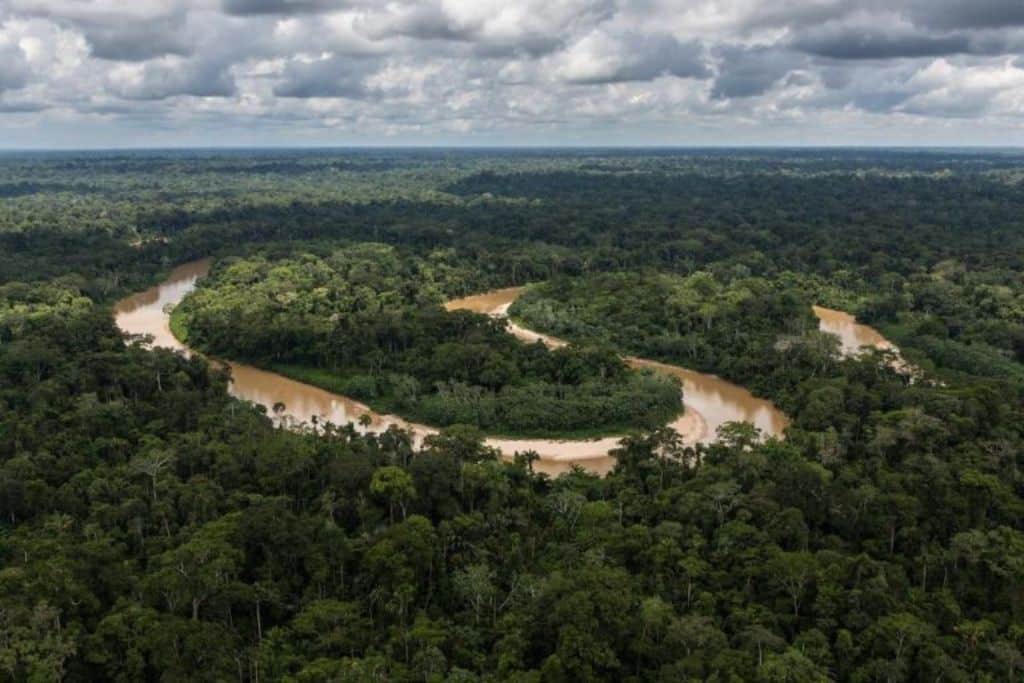
The months-long drought – a 1 in 100 years event – has dried up large parts of the Amazon River, with water levels at their lowest in more than a century.
—
Climate change is the main driver behind the exceptional drought that has been affecting the Amazon River since mid-2023, with the return of El Niño further exacerbating the situation, new research suggests.
A group of scientists from the World Weather Attribution (WWA) group used published peer-reviewed methods to assess the role of climate change and El Niño in influencing the drought, which is affecting an estimated 30 million people that rely on the river for transport, food, and power. They found that climate change-driven high temperatures were the main driver of the historic drought – a 1 in 100 year event on the Standardized Precipitation Index (SPI). On the other hand, the El Niño – a phenomenon that warms the Pacific Ocean and historically a driver of drought – had a “much smaller influence.”
Environmental activists from the Irish Wildlife Trust and Extinction Rebellion called on the Irish Government to introduce legislation in the form of a Biodiversity Act at a protest outside the National Biodiversity Conference in Dublin Castle on June 8, 2022. Credit: Niall Carson/PA Images via Getty Images
Ireland—a nation synonymous with its abundant, verdant landscapes—is considering a nationwide referendum on the rights of nature and the human right to a healthy environment.
If that happens, Ireland would become the first European country to constitutionally recognize that ecosystems, similar to humans and corporations, possess legal rights. More than two-thirds of the 27 European Union countries already recognize a universal human right to a healthy environment.
In December, a legislative committee proposed that the Irish government take a series of administrative measures to draft proposed constitutional amendments recognizing that nature has inherent rights to exist, perpetuate and be restored, and that humans have a right to a clean environment and stable climate.
To take legal effect, the proposed amendments must be approved by both houses of parliament, the Dáil Éireann (the lower house) and the Seanad (the upper house), and win a majority of the popular vote.
TTCT – Tham dự không sót kỳ COP (hội nghị khí hậu của Liên Hiệp Quốc) nào, nhưng đến đúng lúc mọi thứ có vẻ dần thành hình thì lại vắng mặt, vì đã từ giã cõi đời đúng một tháng trước. Đó là chuyện của nhà khoa học người Bangladesh Saleemul Huq.
Saleemul Huq phát biểu tại một sự kiện ở Bangladesh năm 2022. Ảnh: IIED
By Editor On Dec 11, 2023 Last updated Dec 11, 2023
By Vishani Ragobeer in Dubai
Fossils fuels- the main contributor to the climate crisis- were always going to be the hot topic at this year’s global climate talks in Dubai, COP28, with sweltering temperatures making 2023 the hottest year on record. But as the end of the conference draws nearer with a new draft agreement released, fiery debates have taken over the conference.
On Monday night (Dubai time), a new text for the Global Stocktake (GST) was released after negotiators from Guyana and other countries spent days hammering out how best to satisfy everyone.
The GST is a global inventory of sorts that shows how climate goals are unfolding. And the draft text said countries (called Parties) were called upon to take several actions that would reduce greenhouse gas emissions.
Those emissions include carbon dioxide, a harmful gas produced when fossil fuels like oil and diesel are burnt. When that gas is produced, it goes into the atmosphere and leads to global warming.
And countries were told that they could take actions ranging from tripling renewable energy use (that is, using more environmentally-friendly energy sources like solar energy or hydropower) to reduce both the production and use of fossil fuels in a “just orderly and equitable” manner.
DUBAI, United Arab Emirates (AP) — As United Nations climate talks enter their second week, negotiators who are largely focused on how to curb climate change have another thing on their plates: how to adapt to the warming that’s already here.
Discussions for what’s known as the Global Goal on Adaptation — a commitment made in the 2015 Paris Agreement to ramp up the world’s capacity to cope with climate-fueled extreme weather — are being overshadowed by negotiations on how the world is going to slash the use of fossil fuels, causing frustration among some climate campaigners in the most vulnerable countries.
Officials and activists from climate-vulnerable nations are pushing for more money to help them deal with scorching temperatures, punishing droughts and deluges and strengthening storms made worse by global warming. Major fossil fuel-emitting countries need to pay vulnerable, developing countries being battered by these events, experts and officials say, to help them avoid catastrophic humanitarian and economic losses.
In this free resource, explore seven ways countries are responding to a changing environment, from cap and trade policies to clean energy standards.
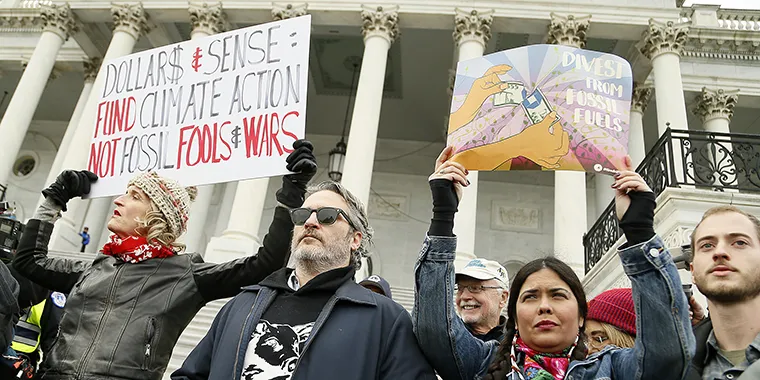
Actor Joaquin Phoenix (center) stands with protestors waiting to be arrested on the steps of the U.S. Capitol Building during a climate change protest and rally on Capitol Hill on January 10, 2020 in Washington, D.C.
Have you ever brought a reusable tote bag to the grocery store? Or refilled a water bottle rather than buying a disposable one? Do you separate your recycling from your trash?
If you answered yes to any of those questions, you’re not alone. In the United States, more than half of all adults claim to have taken some action to protect the environment. But will individual actions be enough to address the massive, transnational challenge of climate change? Unfortunately, no.




 CVD
CVD 