Enforced disappearances, torture, extrajudicial killings: The human rights abuses allegedly committed by former Prime Minister Sheikh Hasina’s regime have left scores of Bangladeshis scarred and traumatised.
After a student-led movement overthrew the government in 2024, the full extent of the suffering is finally coming to light as an interim government, led by 84-year-old Nobel Peace Prize winner Muhammad Yunus, tries to rebuild a shattered nation.
From repairing the demoralised police force to seeking justice for victims and presiding over unstable relations with India, it’s a daunting task. How will Bangladesh rise from the rubble of a dictator’s rule? 101 East investigates.
Sau khi phong trào biểu tình của sinh viên lật đổ Thủ tướng Sheikh Hasina, Bangladesh đang đứng trước một ngã ba lịch sử. Nhưng, đất nước đông dân thứ 8 trên thế giới vẫn lúng túng, chưa biết lối đi nào an toàn.
Từ chuyện những sinh viên trở thành bộ trưởng
3 tháng trước, Nahid Islam còn bận rộn với các bài đăng trực tuyến về cuộc chiến ở Gaza và những cuộc thảo luận trong câu lạc bộ sách tại Đại học Dhaka. Hiện tại, sinh viên xã hội học 26 tuổi – người đã giúp lãnh đạo các cuộc biểu tình lật đổ cựu Thủ tướng Sheikh Hasina – là Bộ trưởng Công nghệ và Viễn thông của Bangladesh và đưa ra các quyết định ảnh hưởng đến 170 triệu người.
At least six students have been killed and over a hundred injured in protests calling for an end to civil service job quotas in Bangladesh. The violence in the capital Dhaka on July 16, 2024, was the latest flare-up in a deepening conflict over the issue. Hundreds of university students demonstrated against the local government job allocation system, which currently favours children of pro-government groups who back Prime Minister Sheikh Hasina. Thousands have taken part in protests in several cities since July 7.
Mosquito-borne disease once largely limited to Dhaka spreads countrywide as higher rainfall and heat lead to fivefold rise in cases in a year, with children the hardest hit
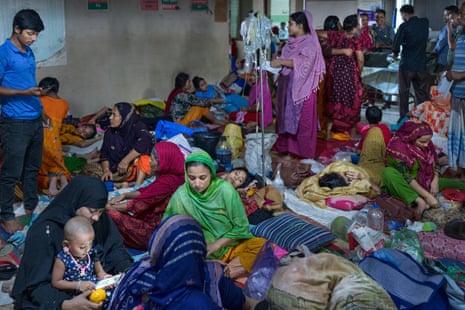
Corridors in Dhaka Medical College hospital crowded with dengue patients amid a shortage of beds. Bangladesh’s worst outbreak of dengue on record comes after unusually heavy rain, torrid temperatures and high humidity led to an explosion in the mosquito population
All photographs by Fabeha Monir for WHO
In a small, dimly lit control room at the Directorate General of Health Services (DGHS) in Dhaka, data on Bangladesh’s dengue outbreak flashes across multiple computer screens. Government analysts here have been busy collecting and monitoring the impact of the disease across the country since cases were first reported last April.
In 2023, the total reported cases of dengue numbered 321,179, with 1,705 deaths recorded, a massive jump from the year before, when 62,000 people were known to have had the virus, and 281 died. It was the highest number of annual deaths caused by the mosquito-transmitted disease ever recorded in Bangladesh.
We can’t afford to admit her to hospital so I’ve been doing whatever I can to protect her at home
Masuma Begum
The deaths last year included at least 113 children. According to Save the Children, the majority of these deaths were of children under the age of 10, with 38 deaths among those under five.
“Children make up around 30% of all dengue cases in Bangladesh and are particularly vulnerable to the virus because of underdeveloped immune systems,” says Dr Shamim Jahan, Bangladesh director of Save the Children. “Those under five are particularly at risk from developing severe symptoms, such as dehydration and shock.”
Over the past few months, the surge in cases has pushed Bangladesh’s health system to the limit, with hospital corridors overflowing with patients as wards run out of beds.
TTCT – Tham dự không sót kỳ COP (hội nghị khí hậu của Liên Hiệp Quốc) nào, nhưng đến đúng lúc mọi thứ có vẻ dần thành hình thì lại vắng mặt, vì đã từ giã cõi đời đúng một tháng trước. Đó là chuyện của nhà khoa học người Bangladesh Saleemul Huq.
Saleemul Huq phát biểu tại một sự kiện ở Bangladesh năm 2022. Ảnh: IIED
(PLO)- Đã có khoảng 50% doanh nghiệp dệt may Việt Nam rời khỏi cuộc chơi do không xanh hóa chuỗi sản xuất và cung ứng.
Đơn hàng ngành dệt may Việt Nam sụt giảm rất mạnh trong thời gian gần đây. Ảnh: TÚ UYÊN
Số liệu thống kê từ Hiệp hội Dệt may Việt Nam (VITAS) cho thấy tổng kim ngạch xuất khẩu hàng dệt may trong ba tháng đầu năm nay chỉ đạt hơn 8,7 tỉ USD, giảm gần 19% so với cùng kỳ năm ngoái. Hiện ngành dệt may Việt Nam đang đối mặt với nhiều khó khăn khi lượng đơn hàng sụt giảm 30%-60% so với cùng kỳ.
Điều đáng chú ý là trong khi xuất khẩu dệt may Việt Nam sụt giảm mạnh khiến hàng loạt công ty lao đao thì dệt may một số nước vẫn “sống khỏe”.
A rare look inside Bangladesh’s island camp for Rohingya refugees | 101 East Documentary
Al Jazeera English – 6-10-2022
Bangladesh is home to the world’s largest refugee camp, hosting more than a million Rohingya refugees who fled a brutal crackdown by Myanmar’s military in 2017.
Fifty years after it gained its independence, Bangladesh’s commitment to secularism remains shaky.
thediplomat – By Shafi Md Mostofa – December 06, 2021
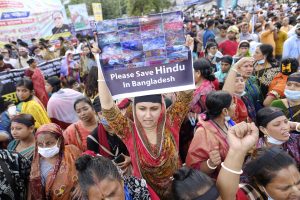
Hundreds of Hindus protesting against attacks on temples and the killing of two Hindu devotees shout slogans in Dhaka, Bangladesh, Monday, October 18, 2021.Credit: AP Photo/Mahmud Hossain Opu
In a couple of weeks, Bangladesh will celebrate the golden jubilee of its victory in the liberation war against Pakistan. Fifty years have passed since it became independent, and secular nationalist forces gained the upper hand over religious ones in the war. However, Bangladesh has not been able to secure its secularism.
Concerns are growing among United Nations agencies and humanitarian groups over an agreement between the Bangladesh and Myanmar governments to repatriate several hundred thousand Rohingya refugees within two years.
About 270,000 Rohingyas fleeing violence in Myanmar have sought refuge in Bangladesh in the past two weeks, a spokeswoman for the UN High Commissioner for Refugees says. Photo: Anisur Rahman
Reuters, Cox’s Bazar
Amid a dramatic increase in the number of refugees fleeing violence in Myanmar’s Northern Rakhine state, UNHCR today called for urgent action to address the root causes of the recent surge in violence, so that people are no longer compelled to flee and can eventually return home in safety and dignity.
The Rohingya are often described as “the world’s most persecuted minority”.
They are an ethnic Muslim group who have lived for centuries in the majority Buddhist Myanmar. Currently, there are about 1.1 million Rohingya Muslims who live in the Southeast Asian country.
The Rohingya speak Rohingya or Ruaingga, a dialect that is distinct to others spoken in Rakhine State and throughout Myanmar. They are not considered one of the country’s 135 official ethnic groups and have been denied citizenship in Myanmar since 1982, which has effectively rendered them stateless. Tiếp tục đọc “Who are the Rohingya Muslims?”→
An estimated 5 percent of deaths in Bangladesh are attributable to drinking water with high levels of arsenic, researchers sayBy Thin Lei Win
BANGKOK, Aug 28 (Thomson Reuters Foundation) – Almost a quarter of a century after public health experts discovered mass public poisoning in Bangladesh caused by water contaminated with arsenic, the government is planning a new push to end the scourge, while researchers are designing an app to find safe sites for new wells.
About 20 million Bangladeshis, or one in eight, have been drinking water with arsenic levels higher than the government’s limit of 50 microgrammes (μg) per litre, said Kazi Matin Uddin Ahmed, geology department chair at the University of Dhaka. Tiếp tục đọc “Can technology help Bangladesh end mass arsenic poisoning?”→
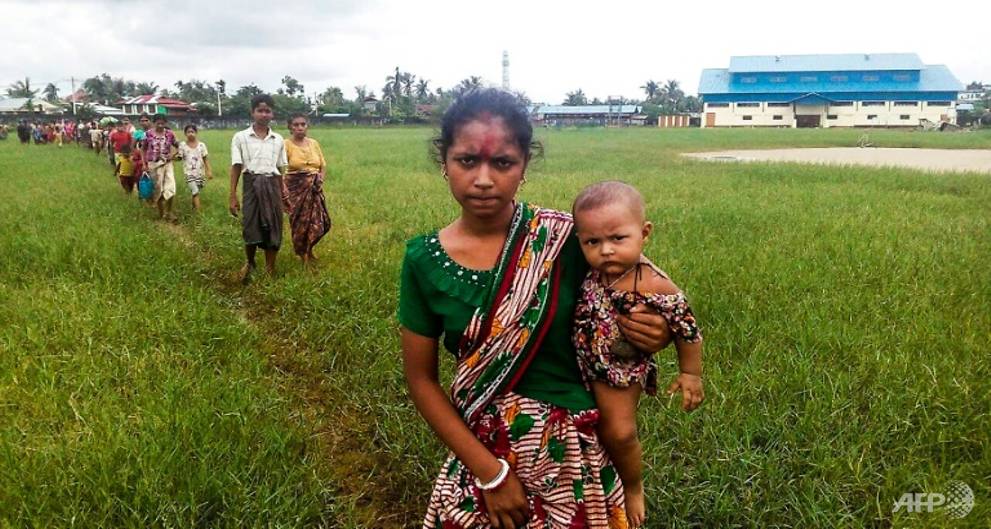
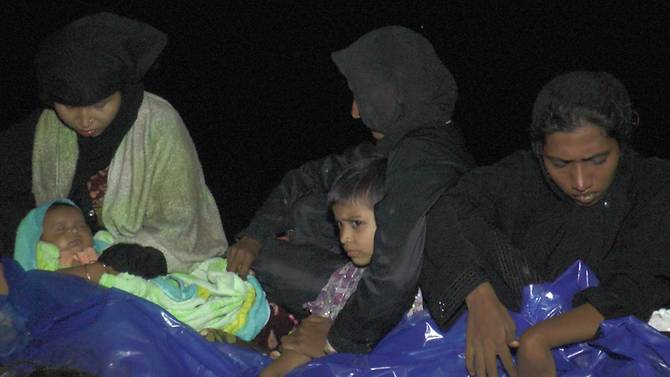
A woman holds a child in her arms as she arrives at Yathae Taung township in Rakhine state after fleeing violence in their home village. (Photo: AFP/Wai Moe)
27 Aug 2017 06:53PM
COX’S BAZAR, Bangladesh: Bangladesh has detained and forcibly returned 90 Rohingya migrants to Myanmar, police said Sunday (Aug 27), just hours after Myanmar troops on the other side of the border had opened fire on people fleeing the country.
Police intercepted a group of 70 Rohingya late Saturday after they crossed the “zero line” border zone, where Myanmar soldiers earlier fired mortars and machine guns at villagers making the dangerous dash from the northern state of Rakhine into Bangladesh. Tiếp tục đọc “Bangladesh sends back 90 Rohingya despite violence”→
Displaced Rohingya people from Myanmar’s northern Rakhine state are gathered at the border town of Ukhiya after Bangladeshi border guards stopped them from entering Bangladesh on Aug 26. efugees towards Bangladesh. (Photo: AFP/STR)
26 Aug 2017 05:05PM (Updated: 26 Aug 2017 06:39PM)
COX’S BAZAR, Bangladesh/YANGON: About 1,000 Rohingya Muslims fleeing escalating violence in Myanmar had been halted at the border with Bangladesh, Bangladeshi security officials said on Saturday, as fresh fighting erupted in Myanmar’s northwestern Rakhine state. Tiếp tục đọc “Rohingya flee for Bangladesh as fresh violence erupts in Myanmar”→
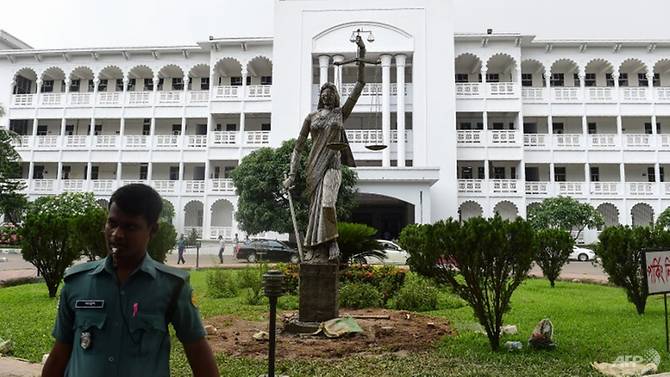
A statue denounced by religious hardliners as “un-Islamic” is pictured on the grounds of the Supreme Court in Dhaka after it was reinstalled on May 28, 2017. (Photo: AFP)
28 May 2017 07:45PM (Updated: 28 May 2017 08:06PM)
DHAKA: Bangladesh on Sunday (May 28) reinstalled a controversial statue deemed un-Islamic by religious hardliners on the grounds of the Supreme Court, just days after its removal had sparked angry protests by secular groups. Tiếp tục đọc “Bangladesh reinstalls controversial statue after outcry”→





 CVD
CVD 