Australia’s Strategic Priorities and Challenges with Southeast Asia

lowyinstitute.org By Susannah Patton 6 November 2025

On this page

Listen to this journal article

Introduction

Going into the 2022 election, improving relations with Southeast Asia was at the top of the foreign policy to-do list for the Australian Labor Party, led by now prime minister Anthony Albanese. While the outgoing Liberal-National coalition government had notched up some achievements in its engagement with the region, there was also a sense of drift. The Pacific Step Up policy had focused on boosting ties with one of Australia’s two near regions, but Southeast Asia had not received the same level of diplomatic focus. Among the Labor Party’s pledges were appointing a special envoy for Southeast Asia, providing A$470 million in new aid to the region, and creating an office for Southeast Asia within the Department of Foreign Affairs and Trade. [1] For the most part, the Albanese government has followed through on its commitment to strengthen ties with Southeast Asia through more active diplomatic outreach, an economic strategy to boost two-way trade and investment, and a more nuanced approach to managing sensitive issues in Australia’s relations with the region, especially China-related issues and Middle East policy.

During the new term of government beginning in 2025, it is likely that the Albanese government will maintain Southeast Asia, along with the Pacific Islands, as a region of high priority. Albanese’s July 2025 John Curtin Oration articulated what he called Labor’s “constructive and creative role” and gave high billing to efforts to intensify economic engagement with Southeast Asia and deepen security cooperation with Indonesia. [2] While other global relationships may fluctuate according to events, the central importance of Southeast Asia within this distinctively Labor worldview suggests that engagement with this region, especially Indonesia, will remain high on Australia’s agenda for the next three years.

This essay analyzes the achievements of the Albanese government in its relations with Southeast Asia. It also assesses the continued challenges Australia faces both in deepening economic relations with the region and in continuing to balance regional ties with the U.S. alliance, especially given a less predictable and more demanding administration in Washington.

Tiếp tục đọc “Australia’s Strategic Priorities and Challenges with Southeast Asia”

Green energy statecraft and Australia’s clean industry future

lowyinstitute.org Elizabeth Thurbon Oliver Yates

A new policy model that removes the risk in clean commodity innovation will put Australia ahead of the pack.

Australia will need to lead as global supply chains pivot towards low-emissions production (Getty Images)

Australia will need to lead as global supply chains pivot towards low-emissions production (Getty Images)

Published 9 Jul 2025  Australia Australian trade, investment & economy

As global supply chains pivot towards low-emissions production, Australia will need to lead, or risk being left behind. The country’s challenge is not a lack of technology, capital, or ambition. It’s a gap in policy architecture. Without bankable demand, Australia’s most promising clean commodity projects – green iron, sustainable aviation fuel, and clean ammonia – remain stuck at the starting line.

To meet that challenge, we propose a new demand-side policy model: the Clean Commodities Trading Initiative (CCTI) – a flagship example of green energy statecraft. At its heart is a new tool for national transformation: Clean Commodity Credits that reward innovation and emissions savings.

A market-friendly mechanism to kickstart large-scale clean production.

Green energy statecraft is a strategic approach to governance that uses the clean energy transition to simultaneously advance a nation’s economic, environmental, social, and geostrategic goals. Unlike conventional industry policy, which focuses on domestic market corrections, statecraft treats clean energy as key to national security and prosperity – used to build alliances, secure supply chains, boost productivity, and shape global rules.

The European Union, China, Japan, and South Korea are all pursuing variations of green energy statecraft. Australia must do the same – on its own terms, with tools suited to its advantages, institutions, and budget.

Tiếp tục đọc “Green energy statecraft and Australia’s clean industry future”

Australia PM Anthony Albanese wins second three-year term

Aljazeera.com

Labor Party leader becomes the first Australian prime minister to win a second consecutive three-year term in two decades.

Australian PM Anthony Albanese
Australia’s Prime Minister Anthony Albanese speaks at the Labor Party election night event in Sydney, May 3, 2025 [Hollie Adams/Reuters]

Published On 3 May 20253 May 2025

Anthony Albanese has become the first Australian prime minister to win a second consecutive three-year term in two decades, in a dramatic comeback for his Labor Party in a general election dominated by the cost-of-living crisis.

The Labor Party was on track on Saturday for an unexpectedly large parliamentary majority, as Peter Dutton, leader of the conservative Liberal Party, conceded defeat, having lost his own seat.

In his victory speech, left-leaning Albanese pledged to steer the nation through a rough patch of global uncertainty.

“Australians have chosen to face global challenges the Australian way, looking after each other while building for the future,” he told supporters in Sydney.

“We do not need to beg or borrow or copy from anywhere else. We do not seek our inspiration overseas. We find it right here in our values and in our people.”

Australia’s public broadcaster ABC projected that Labor was on track to win 85 seats in the House of Representatives, easily surpassing the 76-seat threshold needed to reach a majority.

Tiếp tục đọc “Australia PM Anthony Albanese wins second three-year term”

Vụ bê bối PricewaterhouseCoopers ở Australia: Bài học không thể bỏ qua

CAND – Thứ Tư, 06/09/2023, 11:00

Từ đầu tháng 5/2023, dư luận Australia đặc biệt quan tâm tới vụ bê bối của tập đoàn kiểm toán và tư vấn hàng đầu thế giới PricewaterhouseCoopers (PwC), sau khi tập đoàn này bị phát hiện hành vi lạm dụng thông tin mật về chính sách thuế của Australia để giúp các đối tác của mình trục lợi, trốn thuế thương mại.

PwC là công ty cung cấp dịch vụ kế toán cũng như tư vấn hàng đầu thế giới.

Và nó đã trở thành một bài học rất đáng chú ý, trên phương diện quản lý nhà nước, đối với mọi chính phủ, mọi quốc gia.

Tiếp tục đọc “Vụ bê bối PricewaterhouseCoopers ở Australia: Bài học không thể bỏ qua”

Australia rejects Indigenous referendum in setback for reconciliation

Reuters.com By Praveen Menon, Lewis Jackson, Wayne Cole

https://www.reuters.com/video/?videoId=RW001014102023RP1&jwsource=em

SYDNEY (Reuters) -Australia on Saturday decisively rejected a proposal to recognise Indigenous people in the constitution, in a major setback to the country’s efforts for reconciliation with its First Peoples.

Australians had to vote “Yes” or “No” in the referendum, the first in almost a quarter of a century, on the question of whether to alter the constitution to recognise Aboriginal and Torres Strait Island people through the creation of an Indigenous advisory body, the “Voice to Parliament”.

Nationwide, with almost 70% of the vote counted, the “No” vote led “Yes” 60% to 40%. Australian broadcaster ABC and other TV networks have projected that a majority of voters in all six of Australia’s states would vote against altering the 122-year-old constitution.

Tiếp tục đọc “Australia rejects Indigenous referendum in setback for reconciliation”

Timeline: Indigenous Voice, treaty and truth in Australia

Aljazeera.com

Indigenous people’s 60,000 years of connection to their country should be recognised, leaders say.

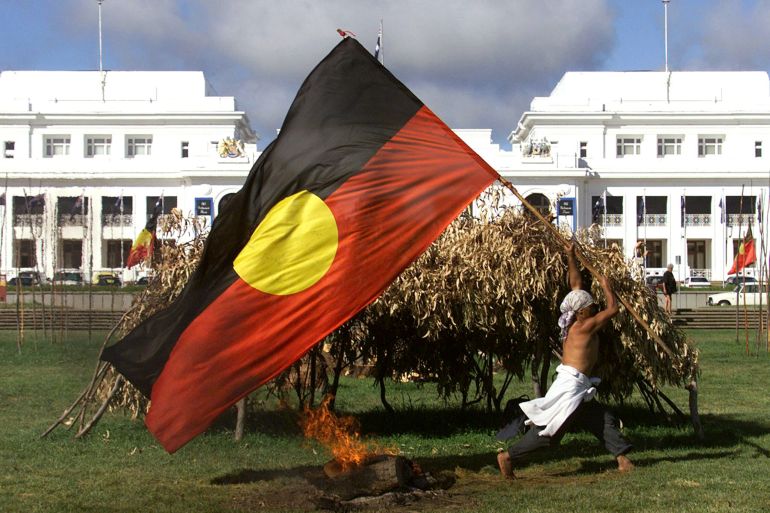
An Aboriginal protester runs past a fire and make-shift shelter with an Aboriginal flag outside the old parliament House building in Canberra
The Aboriginal Tent Embassy has been a continued site of protest outside old Parliament House in Australia’s Canberra since 1972 [File: David Gray/Reuters]

By Al Jazeera Staff

Published On 13 Oct 202313 Oct 2023

The Australian referendum on an Indigenous Voice to Parliament is part of a long history of Aboriginal people fighting for their voice to be heard.

The referendum was called after Aboriginal and Torres Strait Islander leaders issued the Uluru Statement from the Heart, a petition calling for a First Nations Voice to be enshrined in the Australian constitution.

Tiếp tục đọc “Timeline: Indigenous Voice, treaty and truth in Australia”

Explainer: Australia has voted against an Indigenous Voice to Parliament. Here’s what happened

theconversation.com

A majority of Australian voters have rejected the proposal to establish an Aboriginal and Torres Strait Islander Voice to Parliament, with the final results likely to be about 40% voting “yes” and 60% voting “no”.

What was the referendum about?

In this referendum, Australians were asked to vote on whether to establish an Aboriginal and Torres Strait Islander Voice to Parliament. The Voice was proposed as a means of recognising Aboriginal and Torres Strait Islander peoples as the First Peoples of Australia in the Constitution.

The Voice proposal was a modest one. It was to be an advisory body for the national parliament and government. Had the referendum succeeded, Australia’s Constitution would have been amended with a new section 129:

In recognition of Aboriginal and Torres Strait Islander peoples as the First Peoples of Australia:

i. there shall be a body, to be called the Aboriginal and Torres Strait Islander Voice

Tiếp tục đọc “Explainer: Australia has voted against an Indigenous Voice to Parliament. Here’s what happened”

Australia – Defence Strategic Review (2023)

Public report download >>

Statement by Prime Minister Albanese and Dep. PM cum Minister of Defence Richard Marles 

Release of the Defence Strategic Review

Joint media release

Related ministers and contacts

The Hon Anthony Albanese MP

Prime Minister of Australia

Ministerial contact

Prime Minister’s Office – 02 6277 7744 – Media@pm.gov.au

The Hon Richard Marles MP

Deputy Prime Minister

Minister for Defence

Media contact

Office of the Deputy Prime Minister
dpm.media@defence.gov.au
02 6277 7800

Defence Media

media@defence.gov.au

Release content

24 APRIL 2023

Today the Albanese Government has released the public version of the Defence Strategic Review (the Review), the Government’s response to the Review, and the National Defence Statement 2023.

Commissioned in the first 100 days of Government, the Review sets the agenda for ambitious, but necessary, reform to Defence’s posture and structure.

The Government’s response to the Review sets out a blueprint for Australia’s strategic policy, defence planning and resourcing over the coming decades.

The Albanese Government has agreed, or agreed in-principle with further work required, to the public Review recommendations, and has identified six priority areas for immediate action: Tiếp tục đọc “Australia – Defence Strategic Review (2023)”

China on campus

China on campus | 101 East
https://www.youtube.com/watch?v=DDBQcMsQteg

Al Jazeera English – 13-2-2020

Australia’s universities are embroiled in a growing geopolitical storm.

In recent months, pro and anti-Beijing groups have clashed on campuses amid rising concerns over the Chinese government’s expanding power abroad.

Universities earn billions of dollars a year from student fees and research collaborations with China, but there are growing fears these lucrative arrangements may be putting academic institutions, and even national security, at risk.

As government ministers warn that the country faces an “unprecedented level of threat” from foreign interference, 101 East investigates the infiltration of Australia’s universities by Beijing.

Australia will not be deputy sheriff in US-China tensions, Morrison declares

By Rob Harris and Anthony Galloway

November 23, 2020 — 8.00pm

Prime Minister Scott Morrison says Australia’s pursuit of its national interests on the world stage has been wrongly interpreted as siding with the United States over China, declaring his government will not make a “binary choice” between the superpowers.

Tiếp tục đọc “Australia will not be deputy sheriff in US-China tensions, Morrison declares”

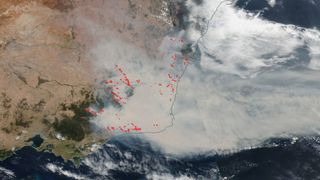
Using US map to examine scale of massive Australia wildfires

The size of the wildfires would cover a large portion of the United States.

Australia’s Deadly Wildfires in Photos: The View from Space

Wildfires devastated southeastern Australia in the final months of 2019 and in January 2020. See photos of those wildfires from space as NASA tracks them with satellites.

Wildfires devastated southeastern Australia in the final months of 2019 and in January 2020. See photos of those wildfires from space as NASA tracks them with satellites. (Image: © NASA EOSDIS)

Fueled by a lengthy and intensifying drought, an early kickoff to fire season in the Australian states of Queensland and New South Wales began in September 2019 and continued into early 2020. Upwards of 100 wildfires have devastated Australia’s southeast coast, killing at least 17 people. Tiếp tục đọc “Australia’s Deadly Wildfires in Photos: The View from Space”

Decoding Australia’s Strange Silence Over China’s Transgressions in the South China Sea

Australia’s 2017 Foreign Policy White Paper strongly advocates the geostrategic concept of the Indo-Pacific and the global rules-based order. In its first comprehensive guide-book for international engagement in 14 years, Canberra makes the case for an Indo-Pacific of openness, prosperity, and inclusiveness. Of note, the term Indo-Pacific appears more than 70 times in the document. The White Paper signals the country’s increased engagement with the Southeast Asian region in the context of China’s assertive pursuit of regional influence and territorial ambitions in the South China Sea. Tiếp tục đọc “Decoding Australia’s Strange Silence Over China’s Transgressions in the South China Sea”

Australia won’t bite its tongue, Defence Minister warns in clear signal to China

Defence Minister Marise Payne has issued a coded but clear demand on China not to bully other countries that disagree with it.

In a speech to military and political leaders from Asia and the Pacific region on Saturday, Senator Payne will say that no one country can tear up the system of international rules – which she pointedly notes has let countries such as China grow and prosper peacefully.

Senator Marise Payne listens to Foreign Affairs Secretary Frances Adamson during estimates.
Senator Marise Payne listens to Foreign Affairs Secretary Frances Adamson during estimates.Photo: Dominic Lorrimer

In the speech to the Shangri-La dialogue in Singapore, Senator Payne makes it clear Australia will continue calling out behaviour that tries unilaterally to change what Australia and its allies call “the rules-based order”.

While she doesn’t name China, Senator Payne makes thinly veiled references to China’s behaviour, making it apparent the Turnbull government means to keep pressing Beijing over issues such as the South China Sea and foreign interference even as it tries to improve the relationship after a rocky six months. Tiếp tục đọc “Australia won’t bite its tongue, Defence Minister warns in clear signal to China”