Japan and the Philippines have signed a historic defence agreement, allowing both countries to station troops on each other’s soil. The pact is the first of its kind for Japan in the region. At the same time, Tokyo and Manila have been strengthening their alliances with the US and its allies in the region, including South Korea, India and Australia. China, which seeks to extend and maintain its influence in the region, has denounced any alliance-building. Why has the latest agreement sounded alarm bells in Beijing?
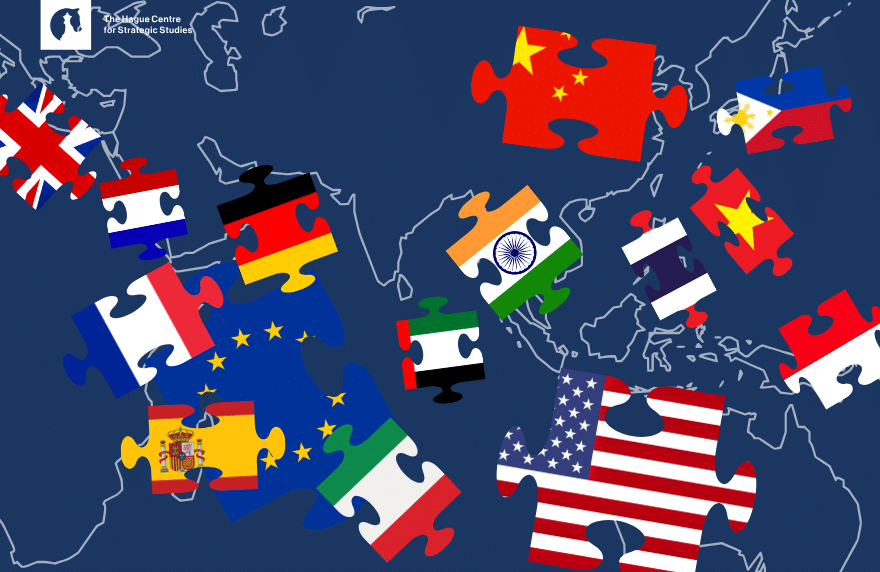
How should Europe strengthen its engagement with the Indo-Pacific? While the continent is highly dependent on trade from the region, it has limited capabilities to protect its interests in the face of growing Sino-American competition. This new HCSS report by Paul van Hooft, Benedetta Girardi and Alisa Hoenig examines how European states can engage in the Indo-Pacific by deepening cooperation with regional powers.
The Indo-Pacific comprises many actors, which are positioned along key chokepoints and share geopolitical and geoeconomic interests in protecting crucial sea lines of communication with Europe. This report does two things to establish pathways for deeper European engagement with Indo-Pacific states:
Based on relevance for maritime security and political affinity with European countries, it assesses the suitability of regional states as partners. Besides the usual suspects Australia, Japan and South Korea, it identifies an “inbetweener” group of countries, with whom cooperation can be fruitful but is not guaranteed, and states with whom engagement is unlikely to yield beneficial results.
It then zooms in on the “inbetweeners” to determine pathways for deepening ties. By comparing bilateral relations between different European and Indo-Pacific states along security, trade and investment, and capacity-building and infrastructure, the authors identify relative strengths and weaknesses of European states. Finally, they also contrast Europe’s involvement with that of China and the United States.
Based on the analysis, the report recommends to strengthen European collaboration with more ambivalent Indo-Pacific states, with a focus on trade and investment and capacity-building in the short- to medium-term.
The research for and production of this report has been conducted within the PROGRESS research framework agreement. Responsibility for the contents and for the opinions expressed, rests solely with the authors and does not constitute, nor should be construed as, an endorsement by the Netherlands Ministries of Foreign Affairs and Defence.
Though the 100 incidents in 2023 increased by 19 per cent over 2022, these were small-time robberies, with theft of items such as nominal value wires, brass ship products, engine spares and scraps, Regional Cooperation Agreement on Combating Piracy and Armed Robbery, says executive director
PTI Singapore Published 09.01.24, 06:06 PM
Representational picture.File picture
No report of piracy incidents occurred on the Asian high seas but 99 actual incidents and one attempted armed robbery against ships occurred in Southeast Asian waters in 2023, a Singapore based maritime organisation reported said on Tuesday.
Though the 100 incidents in 2023 increased by 19 per cent over 2022, these were small-time robberies, with theft of items such as nominal value wires, brass ship products, engine spares and scraps, Regional Cooperation Agreement on Combating Piracy and Armed Robbery (ReCAAP) executive director Krishnaswamy Natarajan said at the annual press conference.
Such incidents were five in India in 2023, the same as those in 2022, while Bangladesh and Malaysia reported one incident each, compared to five and two incidents in 2022, respectively.
Reviewing the year, Natarajan pointed out that the increase in incidents occurred in Indonesia, the Philippines, the Straits of Malacca and Singapore (SOMS), Thailand and Vietnam.
Of concern was the occurrence of incidents in SOMS with 63 incidents compared to 55 incidents in 2022, said the former Director General of Indian Coast Guard.
In the Sulu-Celebes Seas, there was no report of the abduction of crew for ransom by the Abu Sayyaf Group (ASG), which was achieved through the concerted efforts of the Philippine and Malaysian authorities, he highlighted.
As part of the Centre’s continuous efforts to ensure that the evolving needs of the shipping industry are met, the ReCAAP Information Sharing Centre (ISC) launched various initiatives in 2023, to keep the shipping community abreast of the latest piracy and ARAS situation in Asia and to facilitate ship masters in the timely reporting of incidents to the nearest coastal State.
The initiatives include the launch of the ReCAAP Data Visualisation Map and Panel (Re-VAMP) — an interactive dashboard to enable the viewing and analytics of past and current incidents of piracy and ARAS in Asia.
The initiative also includes the production of a poster containing the guidelines and updated contact details of law enforcement agencies of the littoral States of the SOMS; and engagement of the shipping industry through various events including conferences, forums and shipping dialogue sessions, he elaborated.
Except for the headline, this story has not been edited by The Telegraph Online staff and has been published from a syndicated feed.
HANOI, Dec 29 (Reuters) – Vietnam’s economic growth slowed to 5.05% this year from an expansion of 8.02% last year, official data showed on Friday, weighed by weak global demand while public investment stalled amid an intensified anti-graft crackdown.
This year’s gross domestic product (GDP) growth was below a government target of 6.5% and lower than average growth of 5.87% during the previous decade, according to data released by the government’s General Statistics Office (GSO).
Vietnam is a regional manufacturing hub that relies heavily on trade. Exports in 2023 fell 4.4% from last year to $355.5 billion, with shipments of smartphones, its largest foreign currency earner, dropping 8.3%, the GSO said in its report.
Tại Indonesia, một ứng viên tổng thống và bộ trưởng ngoại giao đã phát biểu về cuộc chiến ở Gaza trước hàng trăm nghìn người biểu tình. Tại Malaysia, thủ tướng, đội khăn keffiyeh của người Palestine, đã dẫn đầu cuộc biểu tình của riêng mình, mô tả tình hình Gaza là “điên rồ” và “đỉnh cao của sự man rợ.” Còn tại Singapore, chính phủ cấm treo cờ của hai bên tham chiến.
Tại Thái Lan và Philippines, sự cảm thông dành cho các nạn nhân dân thường người Palestine đi kèm với sự tức giận trước việc nhiều công dân Thái Lan và Philippines đã bị Hamas giết hoặc bắt làm con tin. Trong khi tại Việt Nam, Lào, và Campuchia, các chính phủ đã thận trọng đưa ra những tuyên bố trung lập về Gaza – dù ký ức về trải nghiệm bị ném bom của các quốc gia này đang dần nổi lên.
EXECUTIVE SUMMARY David Santoro & Carl Baker 1 1 INDONESIA POWER SECTOR Elrika Hamdi 5 2 MALAYSIA ENERGY LANDSCAPE AND REQUIREMENTS 2022-2050 Sabar Hashim 19 3 MYANMAR’S ENERGY LANDSCAPE Shwe Yee Oo 39 4 RE-ENERGIZING THE PHILIPPINES’ NUCLEAR POWER PROGRAM: OPPORTUNITIES AND CHALLENGES Julius Cesar Trajano 59 5 SINGAPORE’S ENERGY JOURNEY: NET-ZERO, NEW PERSPECTIVES & NUCLEAR? Denise Cheong & Victor Nian 75 6 THAILAND’S ENERGY LANDSCAPE AND THE POTENTIAL ROLE AND PLACE OF NUCLEAR TECHNOLOGY Doongnyapong Wongsawaeng 93 7 ENERGY LANDSCAPE AND REQUIREMENTS OF VIETNAM Nguyen Nhi Dien 107 ABOUT THE AUTHORS 127
HANOI — A web of international renewable energy deals is spreading across Southeast Asia as the region works to transition away from fossil fuels, with electricity-hungry Singapore as a driving force.
The city-state, where natural gas makes up around 95% of the energy mix, aims to import 4 gigawatts of low-carbon electricity by 2035, equivalent to 30% of its supply. This ambitious plan, in turn, is creating an opportunity for neighboring nations that are expanding power generation from renewable sources.
Imports kicked off in 2022 with the start of hydropower transmission from Laos via Thailand and Malaysia, totaling 100 megawatts over two years. Regulators have approved plans to bring in 2 GW from five solar projects in Indonesia, and the country will also buy power from a floating solar farm off Indonesia’s coast.
Published September 2023 in Comparative Connections · Volume 25, Issue 2 (This article is extracted from Comparative Connections: A Triannual E-Journal of Bilateral Relations in the Indo-Pacific, Vol. 25, No. 2, September 2023. Preferred citation: Ralph A. Cossa and Brad Glosserman, “Regional Overview: Building Partnerships Amidst Major Power Competition,” Comparative Connections, Vol. 25, No. 2, pp 1-24.)
Major power competition was the primary topic du jure at virtually all of this trimester’s major multilateral gatherings, with Russia’s invasion of Ukraine continuing to serve as a litmus test—a test many participants struggled to avoid taking. It was clear which side of the fence the G7 leaders stood on; Putin’s invasion was soundly condemned and Sino-centric warning bells were again gently sounded. At the BRICS Summit and Shanghai Cooperation Organization (sans the US), those alarms were clearly muted, as they were at the ASEAN Regional Forum, at which foreign ministers from all three were present. Headlines from the IISS Shangri-la Dialogue focused on the meeting that did not occur, as China’s defense minister pointedly refused to meet with his US counterpart. At the ASEAN-ISIS’ Asia-Pacific Roundtable, participants lamented the impact of major power tensions on ASEAN unity, even though ASEAN’s main challenges are internal ones that predate the downturn in China-US relations. Meanwhile, Beijing and Washington both expended considerable effort at these and other events throughout the reporting period fortifying and expanding their partnerships, even as many neighbors struggled not to choose sides or to keep a foot in both camps.
Japan And China: Competition Or Cooperation In Southeast Asia? | Japan’s Indo-Pacific Plan – Part 1
Japan is investing in a series of infrastructure and supply chain resilience projects in ASEAN. It’s all part of the Free and Open Indo-Pacific plan launched by the Japanese government. Is this an alternative to China’s Belt and Road Initiative? What is the current state of relations between Japan & China? Will the two Asian giants cooperate or compete?
***
How Will Japan’s Indo-Pacific Strategy Impact Southeast Asia? | Japan’s Indo-Pacific Plan – Part 2
Japan is investing in infrastructure to alleviate the economic bottlenecks in ASEAN countries. In Indonesia, it’s building the country’s first MRT project. In Vietnam, it has invested in a network of roads, rail, ports and energy infrastructure. And in the Philippines, it’s investing in a flood mitigation project. What do these projects have in common? And why has Japan chosen to invest in them?
Image: Australian Strategic Policy Institute / NASA
The Indo-Pacific is increasingly defined by strategic competition between the United States and China. But this dynamic is further complicated by the presence of a class of diverse but consequential second-tier states.
Their middling economic and military capabilities are often combined with valuable geographic positioning around the flashpoints of potential conflict, or elevated social status in elite global clubs such as the G20 or OECD – making them important regional players whose roles and preferences cannot be ignored.
It is indeed great to be back here for another Shangri-La Dialogue.
Let me thank John and everyone at IISS for their efforts to deepen our dialogue on the Indo-Pacific. You know, this is my third time speaking in Singapore at an IISS event. And so this is starting to be—it’s becoming a habit there, John.
I also want to thank our national host, Singapore, for your tremendous hospitality.
And it’s great to see Senior Minister Teo, and Minister Ng, and other distinguished guests from our host here today.
And I’m glad that we’re joined by so many defense ministers and leaders from around the Indo-Pacific and around the world.
One minister of defense made a special effort to be here today: my good friend Oleksii Reznikov of Ukraine. Oleksii’s seat is currently empty. I’m sure he’s working the room somewhere around here, but Oleskii, if you can hear me, I’d remind you that, I’d just tell you that your presence here reminds us that we can never take our peace and security for granted.
I’m also delighted to be here with Director Haines and many of our U.S. military leaders.
So thanks to everyone for being here today.
This dialogue is always a great opportunity to exchange views. And the only thing more wide-ranging than the conference agenda is the breakfast buffet.
Negotiators from 14 Indo-Pacific nations concluded negotiations in substance on a new Indo-Pacific Economic Framework for Prosperity (IPEF) Supply Chain Agreement. At a ministerial-level meeting on the margins of an Asia-Pacific Economic Cooperation (APEC) forum gathering in Detroit, Michigan, IPEF parties released a statement outlining major contours of the agreement. The first of four potential agreements that the United States aims to conclude under IPEF, the supply chains agreement represents a positive step toward further economic integration in the Indo-Pacific. However, questions remain about how binding or impactful the supply chains agreement will be and which additional agreements will come to fruition under the framework this year.
Q1: What did IPEF partners agree to under the new Supply Chains Agreement?
Today, we — Prime Minister Anthony Albanese of Australia, Prime Minister Narendra Modi of India, Prime Minister Kishida Fumio of Japan, and President Joseph R. Biden, Jr. of the United States — met for the third in-person Quad Leaders’ Summit, hosted by Prime Minister Albanese.
Together, we reaffirm our steadfast commitment to a free and open Indo-Pacific that is inclusive and resilient. The global strategic and economic environment is changing rapidly – with direct impacts on countries in the region. We believe we should navigate this time of uncertainty and opportunity together, working closely with our Indo-Pacific partners. We believe all countries have a role in contributing to regional peace, stability, and prosperity, as well as upholding international law, including the principles of sovereignty and territorial integrity, and the rules-based international order. We seek a region where no country dominates and no country is dominated – one where all countries are free from coercion, and can exercise their agency to determine their futures. Our four countries are united by this shared vision. Tiếp tục đọc “Quad Leaders’ Joint Statement”→
Issues & Insights Vol. 23, SR3 – Strategic Competition and Security Cooperation in the Indo-Pacific
Introduction
There is a growing acceptance among countries in the Indo-Pacific region that strategic competition between the United States and China is changing perceptions about security and the adequacy of the existing security architecture. While some have characterized the competition between the two as a new Cold War, it is clear that what is happening in the region is far more complex than the competition that characterized the original Cold War between the United States and the Soviet Union. First, the economic integration that has taken place since the early 1990s makes it much more difficult to draw bright ideological lines between the two sides. Further, the Asian context of the emerging competition is one where the two competitors have grown to share power. As the dominant military power, the United States has been the primary security guarantor in Asia and beyond. China, on the other hand, has emerged over the past decades as the primary economic catalyst in Asia and beyond. Currently, each side seems increasingly unwilling to accept that arrangement.