Rabies is spreading in Southeast Asia, fuelled by inequality and neglect

eco-business.com By Robin Hicks Nov. 3, 2023

Rabies is not considered to be a disease of economic importance, because it does not hurt international trade and mainly affects marginalised communities. A new study explores how the ancient zoonotic disease has spread across Southeast Asia post-pandemic, and how it can be eliminated.

One of the world’s oldest diseases has been spreading across Southeast Asia, infecting poor communities in remote parts of the region where it has not previously been considered to be a problem.

Rabies, a zoonotic disease caricaturised by aggressive, salivating dogs that is virtually 100 per cent fatal once it enters the central nervous system, has spread because the resources needed to control the disease have been diverted to control Covid-19, according to experts in a new study on the prevalence of the virus in Southeast Asia and how to fight it.

Stray_Dog_Manila
Philippines ‘failing to control’ rabies Read now →

Tiếp tục đọc “Rabies is spreading in Southeast Asia, fuelled by inequality and neglect”

US appeals court upholds limit on California’s foie gras ban

US appeals court upholds limit on California's foie gras ban
File photo of foie gras. (Photo: iStock)

07 May 2022 09:19AM (Updated: 07 May 2022 09:19AM) CNA

[TĐH: Kudo to California for fighting againt cruelty to animals]

SAN FRANCISCO: Californians can buy foie gras produced out of state despite California’s ban on the delicacy, a federal appeals court ruled Friday (May 6).

The Ninth US Circuit Court of Appeals upheld a 2020 lower court ruling that said Californians can order foie gras from out-of-state producers and have it sent by a third-party delivery service.

The ruling only applies to people who buy foie gras for individual consumption. The 2012 state law still bans foie gras production in California while restaurants and retailers are forbidden to sell it or give it away.

Tiếp tục đọc “US appeals court upholds limit on California’s foie gras ban”

Unwanted tigers face uncertain future after years of captivity

vnexpress.net

By Le Hoang   February 17, 2022 | 02:02 pm GMT+7

Financial problems and complicated procedures have created a situation in which 11 tigers raised in captivity for 15 years remain unwanted in north-central Vietnam.

In 2007, Nguyen Mau Chien, a local in Thanh Hoa Province, bought 10 tiger cubs weighing around seven kilos each from an unidentified seller and brought them from Laos to Vietnam to raise near his home in Xuan Tin Commune of Tho Xuan District.

While his intent in making the purchase was not stated, demand for tiger parts for medicinal purposes has been high in Vietnam and China for a long time.

Chien was fined VND30 million ($1,300) for animal trafficking and tasked with raising the cubs.

In 2008, Chien bought another five tiger cubs from Laos and was fined the same amount. Once again, he was asked to raise the cubs with support from local authorities and the ranger force.

Tiếp tục đọc “Unwanted tigers face uncertain future after years of captivity”

The challenges of campaigning against wildlife trafficking in Vietnam

Mongabay

by  on 1 August 2019

Part of anti-trafficking campaign in Ho Chi Minh City, Vietnam. Photo by Michael Tatarski for Mongabay.

  • “Be Their Bodhisattva,” a striking anti-wildlife trafficking campaign, was organized in Vietnam from Jan. 25 to March 25 this year.
  • The campaign caught the attention of both the public and prominent national media outlets.
  • However, record-breaking seizures of wildlife parts destined for Vietnam in the months since demonstrate the breadth and depth of the problem.

HO CHI MINH CITY, Vietnam — In late January, WildAid and the Ho Chi Minh City-based Center of Hands-on Actions and Networking for Growth and Environment (CHANGE) launched a graphic anti-wildlife trafficking campaign focused on three animals: pangolins, elephants and rhinos. Tiếp tục đọc “The challenges of campaigning against wildlife trafficking in Vietnam”

Sự kỳ diệu của tê giác

TN – By Hoàng Hải Vân     June 17, 2012

Sự kỳ diệu đó không nằm ở chiếc sừng, mà ở chỗ tê giác là một nhà nông nghiệp đại tài, một chiến sĩ chống cháy rừng kiệt xuất, một nhà bảo vệ động vật và một thầy thuốc giỏi…

Một vai trò rất quan trọng của tê giác là chống cháy rừng – Ảnh: Shutterstock

Bí ẩn địa y
“Thần dược” từ sừng tê giác hay… đất ?

Nước ta khởi thủy là vùng đầm lầy, là một trong những quê hương của loài tê giác, trong khi Trung Quốc hầu như không có tê giác. Do tổ tiên ta chủ yếu lấy sừng của những con tê giác chết già, nên số lượng tê giác ở Việt Nam trước chiến tranh vẫn rất nhiều, cho đến những năm 60 của thế kỷ trước người ta vẫn nhìn thấy tê giác trong những cánh rừng ở Đà Lạt và nhiều nơi khác. Tiếp tục đọc “Sự kỳ diệu của tê giác”

Humans Are Driving Other Mammals to Become More Nocturnal

Scientific American

The shift could change which prey animals hunt or make it harder to find food

Humans Are Driving Other Mammals to Become More Nocturnal
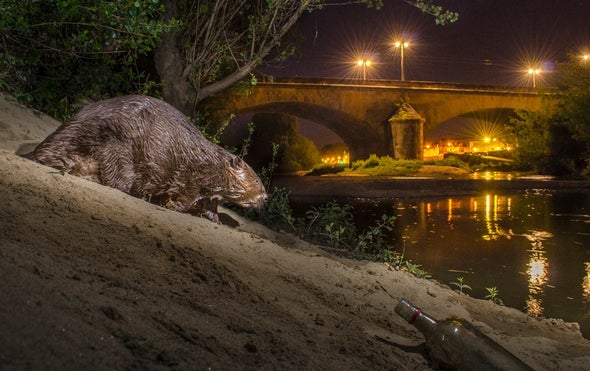
European beaver (Castor fiber) in the middle of a  French city, Orléans. Credit: Laurent Geslin

Humans dominate the animal world. Whether hunting or competing for limited space and resources, we are the planet’s superpredator. Other animals seem to understand this, avoiding people if they can help it. But as the human population expands, it is getting harder for other creatures to find somewhere to hide during the day. Now new findings indicate mammals around the world have come up with another strategy: They are becoming nocturnal. Exactly what this bizarre shift means for the future of individual species—and entire ecosystems—is unknown. Tiếp tục đọc “Humans Are Driving Other Mammals to Become More Nocturnal”

Lack of care leads to elephant rampages

Last update 11:34 | 12/01/2018
VietNamNet Bridge – For centuries, residents in Phuc Son Commune, central province of Nghe An have lived comfortably with wild elephants, but as bamboo forests – the main diet of many elephants – are replaced with industrial trees, things are changing. Many elephant herds are now finding it difficult to find enough food to survive. 
Pu Mat National Park, wild elephants, Vietnam economy, Vietnamnet bridge, English news about Vietnam, Vietnam news, news about Vietnam, English news, Vietnamnet news, latest news on Vietnam, Vietnam
Elephants at the Pu Mat National Park in the central province of Nghe An. Many elephant herds in the province are now finding it difficult to find enough food to survive. — Photo: baonghean.vn

Last October, six wild elephants went on a rampage in a commune village and destroyed family crops.

The family called neighbours for help to chase the elephants away. However, the wild beasts refused to go until they had destroyed two hectares of acacias and other trees. Tiếp tục đọc “Lack of care leads to elephant rampages”

BREAKING NEWS: Bear bile farming to be eradicated in Vietnam by 2020

21 September 2015

Animals Asia has called on all stakeholders to make a commitment to ending bear bile farming in Vietnam by 2020.

It follows today’s announcement by Vietnam’s Traditional Medicine Association that says its members must continue to pursue alternatives to bear bile and has promised a complete end to its use by 2020.

The announcement came at a press conference in Hanoi this morning – arranged by animal welfare NGO Animals Asia and the Traditional Medicine Association.

With bear numbers dropping fast and indications that the market for bear bile is also diminishing, Animals Asia is confident that bear bile farming can be entirely ended in Vietnam by 2020. The NGO – which has worked with local authorities this year to end bear bile farming in Quang Ninh province – will be pushing authorities across Vietnam to make the same commitments ahead of 2020. Tiếp tục đọc “BREAKING NEWS: Bear bile farming to be eradicated in Vietnam by 2020”