I am an attorney in the Washington DC area, with a Doctor of Law in the US, attended the master program at the National School of Administration of Việt Nam, and graduated from Sài Gòn University Law School. I aso studied philosophy at the School of Letters in Sài Gòn.
.
I have worked as an anti-trust attorney for Federal Trade Commission and a litigator for a fortune-100 telecom company in Washington DC.
I have taught law courses for legal professionals in Việt Nam and still counsel VN government agencies on legal matters.
I have founded and managed businesses for me and my family, both law and non-law.
I have published many articles on national newspapers and radio stations in Việt Nam.
In 1989 I was one of the founding members of US-VN Trade Council, working to re-establish US-VN relationship.
Since the early 90's, I have established and managed VNFORUM and VNBIZ forum on VN-related matters; these forums are the subject of a PhD thesis by Dr. Caroline Valverde at UC-Berkeley and her book Transnationalizing Viet Nam.
I translate poetry and my translation of "A Request at Đồng Lộc Cemetery" is now engraved on a stone memorial at Đồng Lộc National Shrine in VN.
I study and teach the Bible and Buddhism. In 2009 I founded and still manage dotchuoinon.com on positive thinking and two other blogs on Buddhism.
In 2015 a group of friends and I founded website CVD - Conversations on Vietnam Development (cvdvn.net).
I study the art of leadership with many friends who are religious, business and government leaders from many countries.
I have written these books, published by Phu Nu Publishing House in Hanoi:
"Positive Thinking to Change Your Life", in Vietnamese (TƯ DUY TÍCH CỰC Thay Đổi Cuộc Sống) (Oct. 2011)
"10 Core Values for Success" (10 Giá trị cốt lõi của thành công) (Dec. 2013)
"Live a Life Worth Living" (Sống Một Cuộc Đời Đáng Sống) (Oct. 2023)
I practice Jiu Jitsu and Tai Chi for health, and play guitar as a hobby, usually accompanying my wife Trần Lê Túy Phượng, aka singer Linh Phượng.
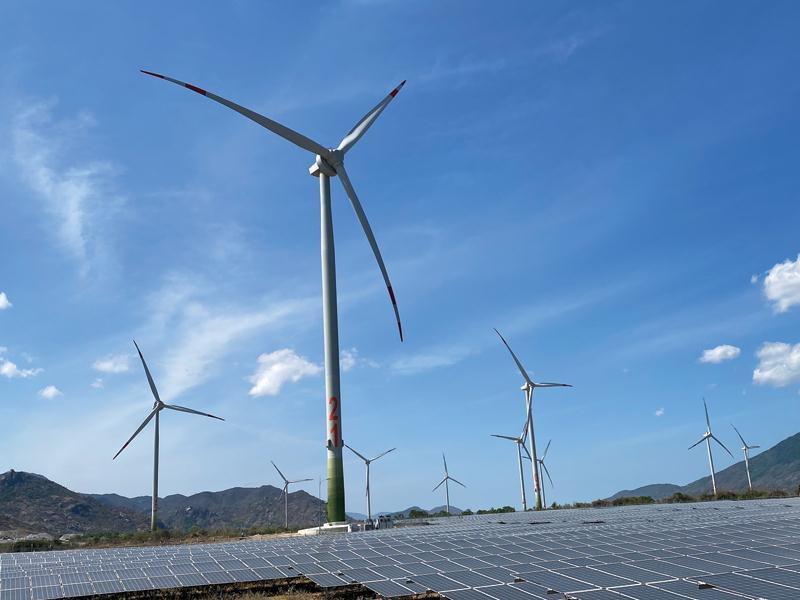
Following a proposal by 10 provinces, the Ministry of Investment and Trade (MOIT) wants to extend the deadline for FIT (Feed in Tariff) application because many wind power projects cannot become operational prior to the given date.
MOIT is consulting with relevant ministries and branches on its draft report to the Prime Minister on solutions to settle the problems of wind power projects.
On September 10, 2018, the Prime Minister released Decision 39 on wind power prices (not including VAT). EVN buys electricity from in-land wind power projects at VND1,927 per kwh (8.5 US cent), while the price of VND2.223 per kwn (9.8 cent) is applied to offshore wind power projects.
FILE PHOTO: Japanese Prime Minister Yoshihide Suga speaks to the media during a press conference in Jakarta, Indonesia, Oct 21, 2020. (Photo: Dita Alangkara/Pool via REUTERS)
TOKYO: Japanese Prime Minister Yoshihide Suga and his Australian counterpart, Scott Morrison, may agree a historic defence pact on Tuesday (Nov 17) that will closely align two key US allies in Asia as a counter to China’s growing influence in the region.
People wave Taiwanese flags during the National Day celebrations in Taipei, Taiwan, on Oct 10, 2018. (Photo: Reuters/Tyrone Siu)
16 Nov 2020 12:03PM(Updated: 16 Nov 2020 12:10PM) CNA
TAIPEI: Trade-dependent Taiwan has made “relatively” good progress towards joining the revamped version of the Trans-Pacific Partnership, but it is awaiting clearer rules on membership, the island’s chief trade negotiator said on Monday (Nov 16).
Peter Martin November 16, 2020, 9:38 PM GMT+7 Bloomberg
World could slide into catastrophe like World War I: Kissinger
Says Biden, Xi should agree not to resort to military conflict
Former U.S. Secretary of State Henry Kissinger said the incoming Biden administration should move quickly to restore lines of communication with China that frayed during the Trump years or risk a crisis that could escalate into military conflict.
“Unless there is some basis for some cooperative action, the world will slide into a catastrophe comparable to World War I,” Kissinger said during the opening session of the Bloomberg New Economy Forum. He said military technologies available today would make such a crisis “even more difficult to control” than those of earlier eras.
“America and China are now drifting increasingly toward confrontation, and they’re conducting their diplomacy in a confrontational way,” the 97-year-old Kissinger said in an interview with Bloomberg News Editor-in-Chief John Micklethwait. “The danger is that some crisis will occur that will go beyond rhetoric into actual military conflict.”
PUBLISHED FRI, NOV 13 202010:19 AM EST UPDATED FRI, NOV 13 202012:10 PM ESTSam Shead@SAM_L_SHEADCNBC
KEY POINTS
The U.K. government has rolled out new rules to protect Britain’s innovative companies from being snapped up by other nations.
But is it too little, too late? Arm was sold to Japan’s SoftBank in 2016 and DeepMind was sold to Google in 2014.
Even though DeepMind and Arm are no longer British in some people’s eyes, there are a number of other fast-growing tech companies that very much are.
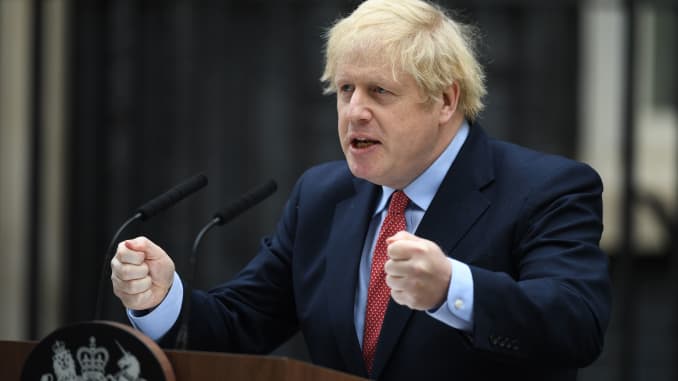
Britain’s Prime Minister Boris Johnson giving a statement in Downing Street in central London on April 27, 2020 after returning to work following more than three weeks off after being hospitalized with the Covid-19 illness.DANIEL LEAL-OLIVAS
LONDON – The U.K. government introduced new rules this week that are designed to protect Britain’s best and brightest companies from being gobbled up by other, potentially hostile, nations.
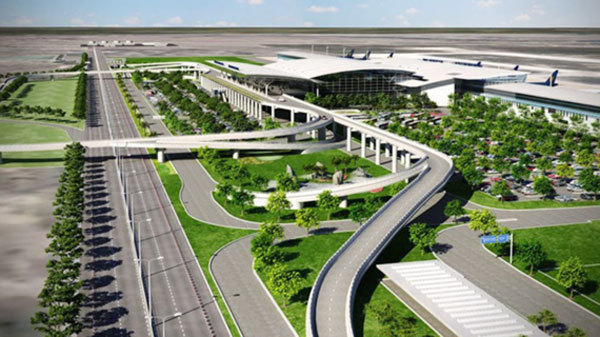
Deputy Prime Minister Trinh Dinh Dung has approved the first phase of the Long Thanh International Airport in the southern province of Dong Nai.
A rendering of the proposed Long Thanh International Airport in the southern province of Dong Nai. – Photo courtesy of Airports Corporation of Vietnam
The project has four component projects such as headquarters of State management agencies, flight management services, essential airport facilities, and other works.
Major works such as airport buildings, the aircraft apron, passenger terminals, and cargo terminals will be built by the Airport Corporation of Vietnam (ACV), which operates 21 airports across the country.
ACV has to raise funding for the construction.
The first phase of the airport, expected to cost more than US$4.6 billion, is projected to be completed by 2025.
The investment was approved by the National Assembly in 2017, which also issued a resolution on compensation and resettlement of and support for affected individuals and organisations.
Prime Minister Nguyen Xuan Phuc urged Dong Nai Province authorities to hand over the required lands in October so that construction of the airport could begin early next year.
He also set a deadline for assessing cleared land for compensation purposes by the end of this month.
The Ministry of Transport should work closely with the province to promptly resolve all challenges to ensure the project remains on schedule, he said.
The airport work requires more than 5,000ha of land and more than 364ha elsewhere to build two resettlement sites.
Around 4,800 households and 26 organisations are expected to be relocated to make way for it.
Spread over a total area of more than 5,580ha, the airport will straddle six communes in Long Thanh District. It is expected to cost VNĐ336.63 trillion ($14.47 billion), with the construction divided into three phases.
In the first phase one runway with a length of 4,000m, taxiways, an apron, and a passenger terminal with other auxiliary works involving a total floor area of 373,000 sq.m will be built to serve 25 million passengers and 1.2 million tonnes of cargo each year.
The airport is expected to have four runways, four passenger terminals and other auxiliary works to ensure a capacity of 100 million passengers and 5 million tonnes of cargo a year by 2040.
Tan Son Nhat International Airport in HCM City, the country’s largest, has been seriously overloaded for years, both in the air and on the ground.
The Ministry of Transport said Long Thanh International Airport is a key national project that would have a significant impact on the southern key economic region. VNS
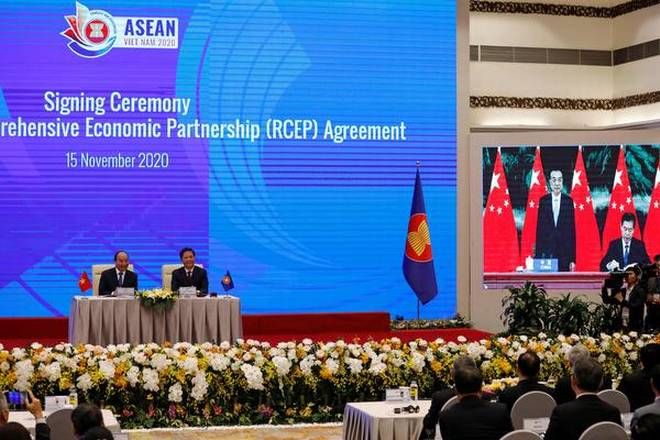
Vietnam’s Prime Minister Nguyen Xuan Phuc (L) sits next to Minister of Industry and Trade Tran Tuan Anh as they watch a screen showing Chinese Minister of Commerce Zhong Shan (R) signing next to Chinese Premier Li Keqiang during the virtual signing ceremony of the Regional Comprehensive Economic Partnership (RCEP) Agreement during the 37th ASEAN Summit in Hanoi, Vietnam November 15, 2020. | Photo Credit: Reuters
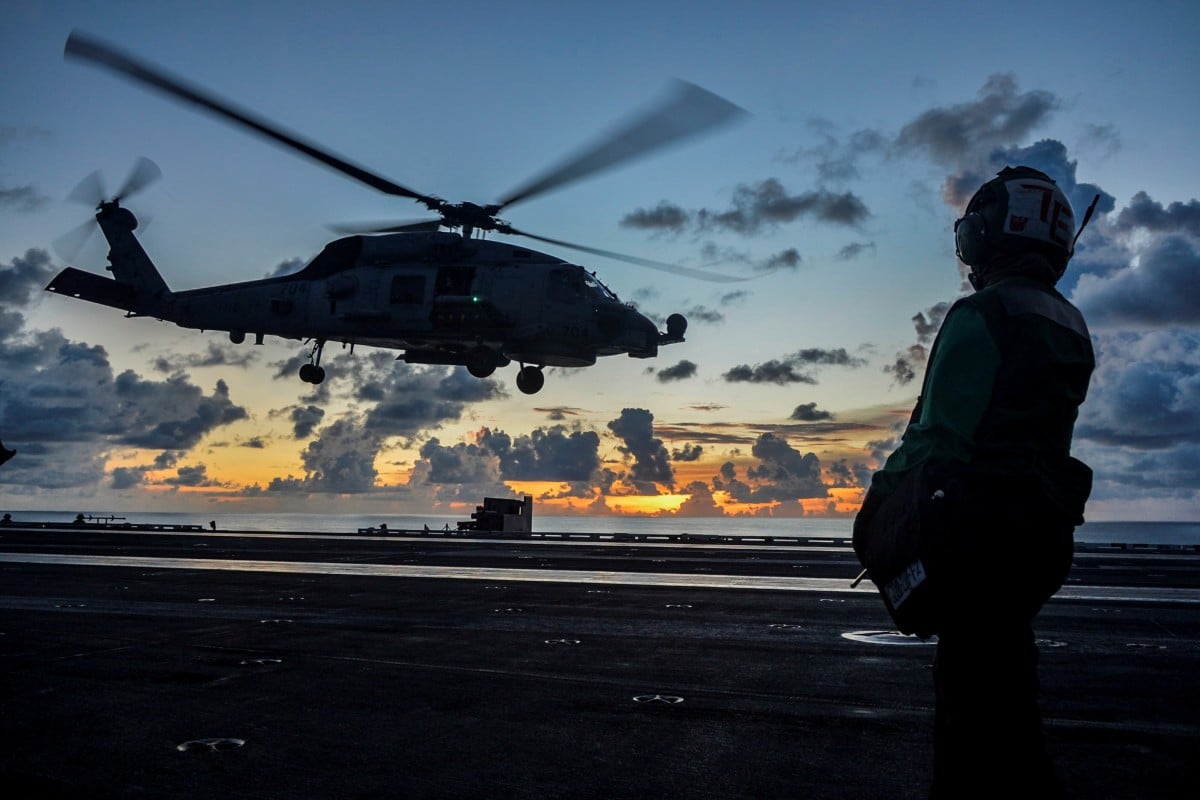
A Sea Hawk helicopter lifts off from the American aircraft carrier USS Ronald Reagan during an exercise in the South China Sea in July. Photo: Reuters
The United States is expected to take a more contained approach to the South China Sea under Joe Biden, but the disputed waters will remain a potential hotspot in the relationship between Beijing and Washington, observers say.“I think he [Biden] will take a different approach to [US President Donald] Trump,” said Wu Shicun, head of the National Institute of South China Sea Studies, which advises the government.“He is likely to pay more attention to the South China Sea but his policies will be more balanced and more contained.”
One possible change is a reduction in the number of freedom of navigation operations conducted by the US Navy in the sea, Wu said.https://www.youtube.com/embed/BcMR2ZCcheI
The patrols have been a regular feature of US military operations since Barack Obama was in the White House but became more frequent under Trump, who gave more flexibility to the Pentagon to plan its naval patrol schedules in the contested waters.ADVERTISING
American forces have conducted eight freedom of navigation operations this year, the same number as in 2019, but up from six in 2018 and four in each of the previous three years. The US says the manoeuvres are necessary to maintain balance in the region, but Beijing regards them as provocative and has condemned them.
“The US military operations in the South China Sea have affected Sino-US relations and increased tensions,” Wu said.
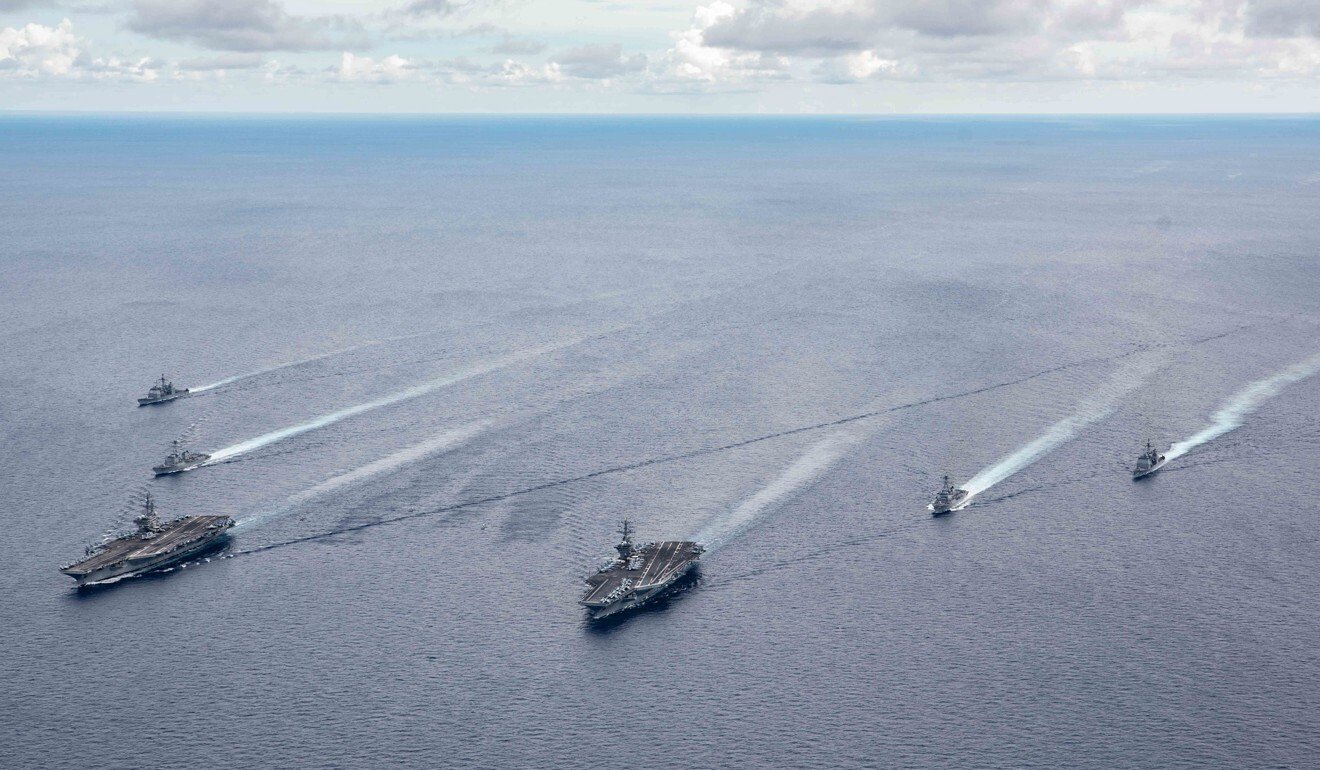
US aircraft carriers and their strike groups take part in a drill in the South China Sea in July. Photo: EPA-EFELe Hong Hiep, a fellow at the ISEAS-Yusof Ishak Institute in Singapore, said the people Biden chose to fill key defence positions would affect Washington’s relationship with Beijing in the South China Sea, but whoever they were, the tensions were unlikely to go away any time soon.
EVERY OTHER SATURDAYSCMP Global Impact NewsletterSIGN UP NOWBy registering, you agree to our T&C and Privacy Policy
Among the front-runners for the post of defence secretary is Michele Flournoy, who served as undersecretary of defence for policy under Obama and is known for advocating a tough stance on China.
“The South China Sea has become an important battleground for US-China strategic competition, where the US can mobilise countries in the region against Beijing, using China’s excessive territorial claims as the rallying call,” Le said.
“As such, under the Biden administration, the US and its allies are likely to continue to maintain or even strengthen their involvement in the South China Sea.”https://www.youtube.com/embed/8eqtl0ym1p8
Meanwhile, Beijing has been stepping up its engagement with its Southeast Asian neighbours.At a video meeting with the Association of Southeast Asian Nations on Thursday, Chinese Premier Li Keqiang said boosting relations with the 10-member bloc was one of Beijing’s priorities.He also called for the negotiations of a code of conduct for the South China Sea to be expedited. In 2018, Li proposed a three-year timeline to create such a code. A second reading of the negotiating draft began in January but the process was halted by the Covid-19 pandemic.
Wu said that Washington’s policy to reject most of Beijing’s territorial claims in the South China Sea, the political turmoil in Malaysia, and possible leadership changes in Vietnam and the Philippines over the next two years would complicate the negotiation process.
Le said that despite those hurdles, Beijing was keen to finalise the code.“[A] deepening US-China rivalry may encourage China to accelerate the negotiations,” he said.
“On the other hand, it may also prompt Washington to back nations to resist some of China’s key demands, such as excluding countries from outside the region from conducting military exercises or marine economic activities in the South China Sea.”
The European Union (EU) needs China, given their close economic ties. And China needs the EU, particularly given the sharp escalation of tensions between Beijing and Washington.
But ties are starting to fray given recognition in most European capitals that China’s economic model is not compatible with theirs, that there are security risks from China’s increasingly assertive global outreach, and that China does not place the same value on human rights as they do. Tiếp tục đọc “China-EU relations: Can the EU have its cake and eat it too?”→
The 15th East Asia Summit on Saturday hopes to give a big push to a free, open, inclusive, transparent, rules-based, peaceful and prosperous Indo-Pacific region.
The Summit Meeting will also discuss ways and means to strengthen the EAS platform and to make it more responsive to emerging challenges on its 15th anniversary. The Leaders will also exchange views on issues of international and regional interest including the COVID-19 pandemic and the cooperation among EAS participating count ..
US President Donald Trump has issued an order banning American investments in Chinese firms the government determines have ties to the Chinese military.
In the order, Mr Trump accused China of “increasingly exploiting” US investors “to finance the development and modernisation of its military”.
The ban is to go into effect in January.
It could affect some of China’s biggest publicly-listed firms, including China Telecom and tech firm Hikvision.
Throughout his administration, Mr Trump has made efforts to disentangle the US from its close economic ties with China.
He has raised border taxes on billions of dollars worth of China goods and imposed sanctions on some of its tech companies.
Relations between the two superpowers have also soured over issues such as coronavirus, and China’s moves in Hong Kong.
Officials said the new order had been under review for months. It applies to shares owned directly or indirectly in 31 firms identified by the US earlier this year as backed by the Chinese military, a list that includes tech firms and large state-owned construction companies among others.
US investors have a year to comply with the rules.
Mr Trump, who recently lost to challenger Joe Biden in the US presidential election, is due to leave the presidency shortly after the order goes into effect.
Mr Biden has not outlined his China strategy, but during the campaign he promised to challenge the Chinese government on similar issues as Mr Trump, including trade abuses and cyber-theft.
Mr Trump’s stance on China is one of the rare areas in which he has sometimes received support from both Democrats and Republicans.
Several politicians in Congress have also proposed laws to block US investment in firms the White House designates as threats.
Earlier this year, Mr Trump ordered the pension fund for government employees to abandon a plan to invest in Chinese companies. The US has also said it is considering de-listing Chinese firms from US stock exchanges if they do not comply with US audit rules.
The efforts come as US exposure to companies listed on Chinese stock exchanges has grown.
But such investments remain a small fraction of overall US holdings. In a report earlier this year, researchers for financial regulators at the US Securities and Exchange Commission estimated that US mutual funds held about $43.5bn in Chinese stocks and bonds at the end of April.
A spokeswoman for the Investment Company Institute, a trade association for mutual funds and other money managers, said it was reviewing the order and had no further comment
Thursday, October 29, 2020, 11:04 GMT+7 TUOITRENEWS
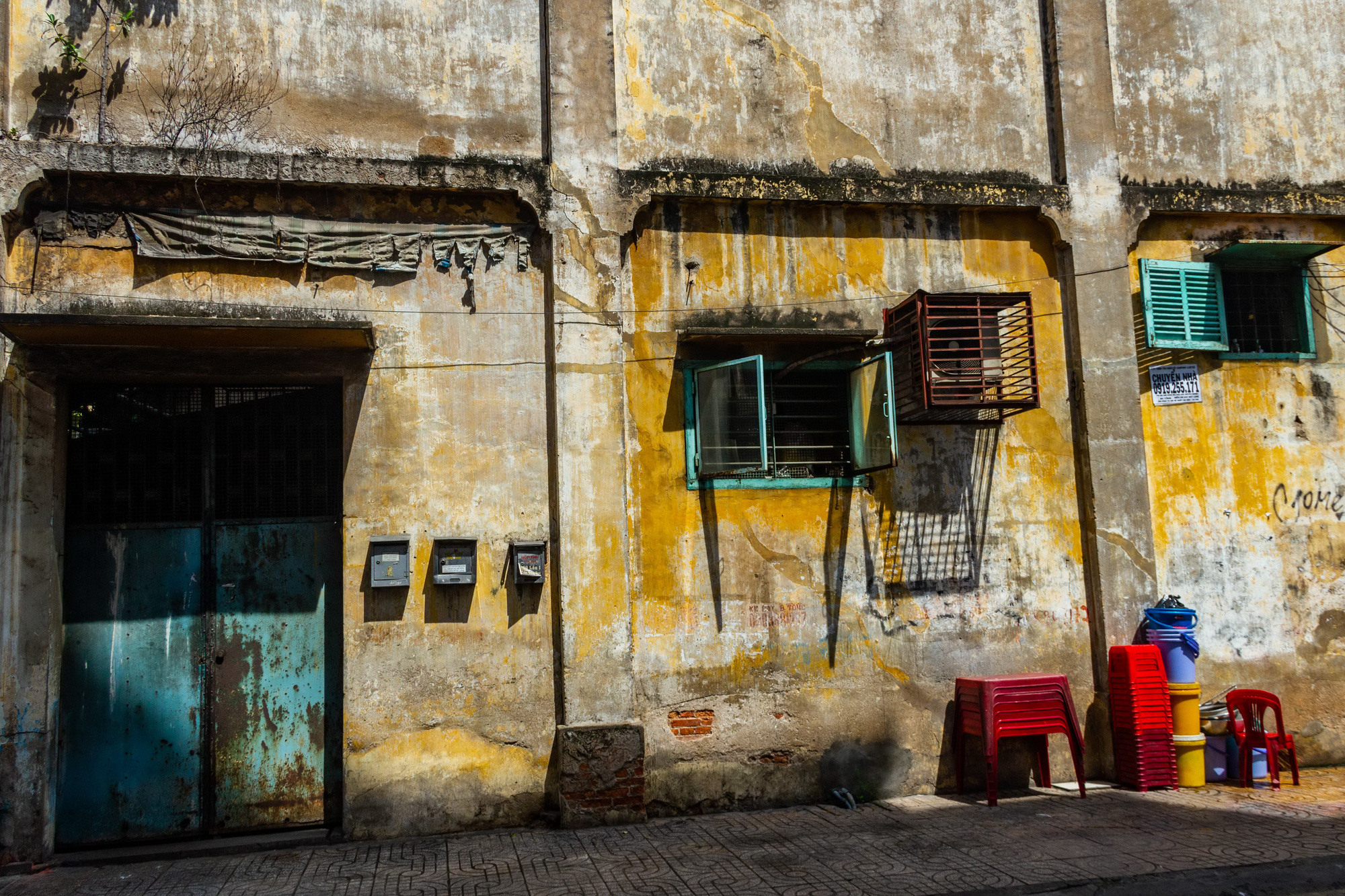
An old wall is seen in Ho Chi Minh City, Vietnam. Photo: Tran Hong Ngoc / Tuoi Tre
Ho Chi Minh City, also known as Saigon, is Vietnam’s largest city and known as the country’s economic and financial hub. Though many visit the city to check out modern life in the metropolis, they often forget about its role as a hub of culture and scientific development.
Wednesday, November 11, 2020, 09:16 GMT+7 tuoitrenews
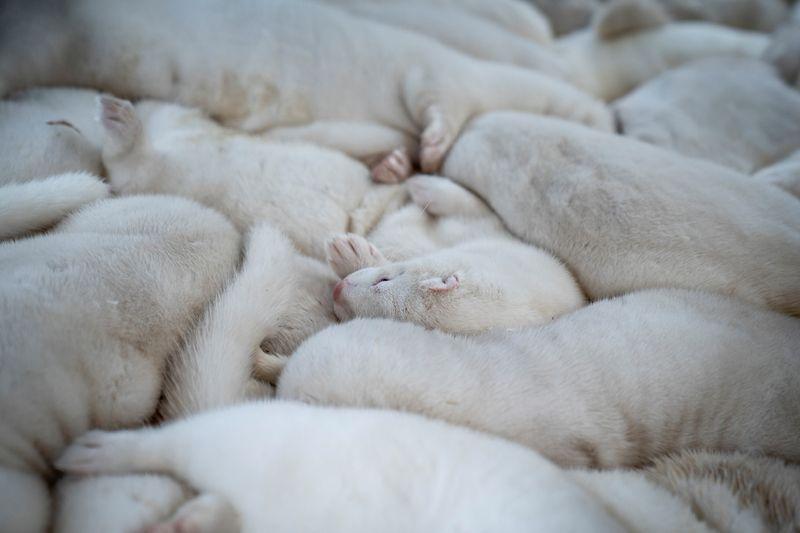
FILE PHOTO: Mink are seen at the farm of Henrik Nordgaard Hansen and Ann-Mona Kulsoe Larsen near Naestved, Denmark, November 6, 2020. Photo: Ritzau Scanpix/Mads Claus Rasmussen via Reuters
CHICAGO — More than 15,000 mink in the United States have died of the coronavirus since August, and authorities are keeping about a dozen farms under quarantine while they investigate the cases, state agriculture officials said.
Global health officials are eying the animals as a potential risk for people after Denmark last week embarked on a plan to eliminate all of its 17 million mink, saying a mutated coronavirus strain could move to humans and evade future COVID-19 vaccines.
The U.S. states of Utah, Wisconsin and Michigan – where the coronavirus has killed mink – said they do not plan to cull animals and are monitoring the situation in Denmark.
“We believe that quarantining affected mink farms in addition to implementing stringent biosecurity measures will succeed in controlling SARS-CoV-2 at these locations,” the U.S. Department of Agriculture told Reuters on Tuesday.
The USDA said it is working with the U.S. Centers for Disease Control and Prevention, state officials and the mink industry to test and monitor infected farms.
The United States has 359,850 mink bred to produce babies, known as kits, and produced 2.7 million pelts last year. Wisconsin is the largest mink-producing state, followed by Utah.
Sick mink in Wisconsin and Utah were exposed to people with probable or confirmed COVID-19 cases, the USDA said. In Michigan it is still unknown if the mink were infected by humans, according to the agency.
In Utah, the first U.S. state to confirm mink infections in August, about 10,700 mink have died on nine farms, said Dean Taylor, state veterinarian.
“On all nine, everything is still suggesting a one-way travel from people to the minks,” he said.
Coronavirus testing has been done on mink that die and randomly on the affected farms, Taylor said. Like people, some mink are asymptomatic or mildly affected, he said.
The CDC said it was supporting states’ investigations into sick mink, including testing of animals and people.
“These investigations will help us to learn more about the transmission dynamics between mink, other animals around the farms and people,” the CDC said. “Currently, there is no evidence that animals play a significant role in the spread of SARS-CoV-2 to people.”
Coronavirus is thought to have first jumped to humans from animals in China, possibly via bats or another animal at a food market in Wuhan, although many outstanding questions remain.
Monitoring U.S. mink for virus symptoms and quarantining infected farms should limit the disease’s spread if cases are caught early, said Richard Webby, a virologist at St. Jude Children’s Research Hospital in Memphis.
“I’m fairly confident that as long as they have that surveillance going and it’s strong enough, then they should be able to prevent the spread,” he said.
U.S. authorities are urging farmers to wear protective gear like masks and gloves when handling mink to avoid infecting the animals.
In Wisconsin, about 5,000 mink have died on two farms, State Veterinarian Darlene Konkle said.
One farm is composting the dead mink to dispose of the carcasses without spreading the virus, Konkle said. Authorities are working with the second farm to determine how to dispose of the mink, and dead animals are being kept in a metal container in the meantime, she said.
Michigan declined to disclose how many mink have died, citing privacy rules.
State officials said they are working with the USDA to determine whether farmers can sell the pelts of infected mink. The pelts are used to make fur coats and other items.
The coronavirus has also infected cats, dogs, a lion and a tiger, according to the USDA. Experts say mink appear to be the most susceptible animal so far.
After first visiting the capital at the height of the Vietnam War more than 50 years ago, Thomas Billhardt has kept returning to Hanoi to chronicle its changes.
However, he chose to do it not with graphic pictures of the violence, but by capturing normal, daily life that highlighted what was being destroyed.
Since October this year, the 83-year-old German photographer has been fielding numerous calls and messages from Vietnam, unable to attend an exhibition featuring 130 photos he’d taken in Hanoi during the Vietnam War.
“I am sad that I cannot be in Hanoi this time because of the pandemic, but the city is always in my heart,” he told VnExpress International from Berlin, Germany.
Billhardt has won worldwide recognition for his work in the late sixties and early seventies when the Vietnam War was at its peak. His photographs of daily life amidst the war were powerfully poignant.
Thomas Billhardt at an exhibition. Photo courtesy of Thomas Billhardt.
Billhardt loved photography as a child, being raised by a photographer mother. He graduated from the University of Graphics and Book Design in Leipzig in 1963. When he made the first of his 12 trips to Hanoi four years later, he never imagined that it would give birth to an association lasting more than five decades.
He first came to the capital city with a group of moviemakers from the German Democratic Republic (GDR) in 1967 to film a documentary about American soldiers captured in Hanoi amidst the infamous Operation Rolling Thunder, the bombing blitz unleashed by the U.S. against the north of Vietnam.
He remembers that at the Metropole, the fanciest hotel in town, “there were more mouses than guests and worms in the hotel’s water.”
Seeing the devastation of the war, the bomb craters, destroyed buildings, and the sounds of air raids and sirens calling for people to take cover, he was moved to tell the story of Hanoi and its people with a “photo chronicle.”
“I was angry on seeing the Americans destroy Hanoi… I wanted to show the world the photos I took in Vietnam so they would know exactly what was going on. Then they would understand and love Vietnam, just like me.”
He decided that his wartime photography would focus on people going about their daily lives, busy working and getting ready to fight at the same time.
A tram in 1975. The tram was a popular form of public transportation for Hanoians. Photo courtesy of Thomas Billhardt.
The photographs of crowds cycling under pouring rain, the happy faces of barefoot children attending an outdoor painting class, a stadium filled with people cheering and laughing as they watched a football match and many such scenes of love and care powerfully contrasted and resisted the extreme violence of war.
“I felt a connection with Vietnamese people when looking into their eyes as they suffered from the raging war,” Billhardt recalled, adding the bravery of Vietnamese was a lesson for him.
“Thomas’s photos hold up a mirror to the world while holding out hope at the same time. They tell of the world’s social inequalities, of poverty, of suffering, of war, but also of the life and laughter of the people who live in it,” said Wilfried Eckstein, director of the Goethe Institute in Hanoi.







 CVD
CVD