I am an attorney in the Washington DC area, with a Doctor of Law in the US, attended the master program at the National School of Administration of Việt Nam, and graduated from Sài Gòn University Law School. I aso studied philosophy at the School of Letters in Sài Gòn.
.
I have worked as an anti-trust attorney for Federal Trade Commission and a litigator for a fortune-100 telecom company in Washington DC.
I have taught law courses for legal professionals in Việt Nam and still counsel VN government agencies on legal matters.
I have founded and managed businesses for me and my family, both law and non-law.
I have published many articles on national newspapers and radio stations in Việt Nam.
In 1989 I was one of the founding members of US-VN Trade Council, working to re-establish US-VN relationship.
Since the early 90's, I have established and managed VNFORUM and VNBIZ forum on VN-related matters; these forums are the subject of a PhD thesis by Dr. Caroline Valverde at UC-Berkeley and her book Transnationalizing Viet Nam.
I translate poetry and my translation of "A Request at Đồng Lộc Cemetery" is now engraved on a stone memorial at Đồng Lộc National Shrine in VN.
I study and teach the Bible and Buddhism. In 2009 I founded and still manage dotchuoinon.com on positive thinking and two other blogs on Buddhism.
In 2015 a group of friends and I founded website CVD - Conversations on Vietnam Development (cvdvn.net).
I study the art of leadership with many friends who are religious, business and government leaders from many countries.
I have written these books, published by Phu Nu Publishing House in Hanoi:
"Positive Thinking to Change Your Life", in Vietnamese (TƯ DUY TÍCH CỰC Thay Đổi Cuộc Sống) (Oct. 2011)
"10 Core Values for Success" (10 Giá trị cốt lõi của thành công) (Dec. 2013)
"Live a Life Worth Living" (Sống Một Cuộc Đời Đáng Sống) (Oct. 2023)
I practice Jiu Jitsu and Tai Chi for health, and play guitar as a hobby, usually accompanying my wife Trần Lê Túy Phượng, aka singer Linh Phượng.
Alexander Hamilton had no illusions about what would happen to Americans if the United States collapsed.
If the newly drafted Constitution wasn’t ratified, he warned in Federalist No. 8, a “War between the States,” fought by irregular armies across unfortified borders, was imminent. Large states would overrun small ones. “Plunder and devastation” would march across the landscape, reducing the citizenry to “a state of continual danger” that would nourish authoritarian, militarized
Key officials engaged in United States relations with Pacific Islands countries discussed expanding presence and engagement in the region from development, military, and congressional policy perspectives. They explained how these moves position the United States to deepen strategic partnership with Pacific Island nations in support of a free, open, and secure Indo-Pacific. Opening comments followed by moderated discussion covered the development trajectories of Pacific Island countries, COVID-19’s impacts on the region, and US-China dynamics.
“Ngày thành lập ư, có thật quan trọng không?”, tôi đã nghĩ thế… Nhưng hôm nay, chợt nhớ về 20 năm trước, kỷ niệm lần lượt hiện về.
Lần đầu tiên tôi “nhìn thấy” Internet là vào năm 1998, nửa năm sau khi Việt Nam chính thức kết nối. Ấn tượng đầu tiên là hầu như không có gì bằng tiếng Việt để đọc. Đang làm biên tập viên báo Lao Động, tôi nhận ra đây sẽ là phương tiện phát hành mới, mảnh đất chưa khai phá cho báo chí. “Mình có thể là người đầu tiên làm điều đó?”, từ lâu tôi mong ước làm một tờ báo thực sự hữu ích cho người dùng.
Two sand-mining boats with dredgers extract sand from the Tra On River, only 100 meters away from the shore, in Vinh Long Province, Vietnam, February 23, 2021. Photo: Chi Hanh / Tuoi Tre
Despite facing furious opposition from local residents, a big barge equipped with dredgers is publicly extracting sand off the Tra On River in Vinh Long Province, located in Vietnam’s Mekong Delta.
The barge has mined sand on the river for a few days, residents of My An Village in the province’s Binh Minh Town, said in a report to Tuoi Tre (Youth) newspaper on Tuesday.
As witnessed by Tuoi Tre, a massive boat numbered LA-07135 appeared at the junction of the Hau River and the Tra On River.
It was accompanied by another boat with registration number BTr-7402, with a perceived load capacity of hundreds of cubic meters of sand.
On the morning of May 21, 2000, I woke up to a scene I had never witnessed before.
Nguyen Trong Binh
An endless stream of people driving motorbikes and cars from various provinces in the Mekong Delta like Hau Giang, Soc Trang, Bac Lieu, Ca Mau, and An Giang flooded the roads near my sister’s house in Vinh Long Province: They had come to see the inauguration of the My Thuan Bridge.
I was one of them.
Excited at the prospect of seeing the country’s first cable-stayed bridge, one that spans the Tien River, a major branch of the Mekong, to link Vinh Long and Tien Giang, I had gone to my sister’s house, eight kilometers from the bridge, the previous day, and got up early the next day for the inauguration.
With the Red River turning a surprisingly clear blue-green shade in its upstream sections, experts have blamed it on dams and polluting factories.
The Red River flowing through Lao Cai Province in February 2021 is clear and not murky. Photo by VnExpress/Pham Ngoc Trien.
For a week now, the Red River section that flows through Lao Cai Province has become so clear that there are some shallow areas towards the banks where the river bed can be seen at a depth of one meter.
The Red River, over 1,100 km long, originates in China and flows through Lao Cai, Yen Bai, Phu Tho, Vinh Phuc and Hanoi. The river section that flows through Vietnam is about 510 km long.
Nguyen Thi Lan, a resident of Lao Cai, said the water of the Red River in her town was normally a thick brown color, and if seen from afar, it looked like a pinkish strip.
“It is really strange now that the river has such a clear green shade,” she said.
Locals people swim in the Red River in 2017. Photo by VnExpress/Ngoc Thanh.
Vu Dinh Thuy, deputy director of Lao Cai’s Natural Resources and Environment Department, said this is not the first time the Red River has changed into such a color and this phenomenon has happened around this time of year for the past five years.
“Maybe the reason is that the natural alluvium that has always flowed down naturally from further upstream has been absent; and also northern Vietnam has had no rainfall this season (to muddy the waters).”
Dao Trong Tu, chairman of the Vietnam Rivers Network, also set out two possible reasons for the changes seen in the Red River.
He said a series of hydropower plants and reservoirs operated by China further upstream could have held back alluvium.
The other reason, he said, could be the pollution caused by factories operating in upstream areas and along the banks of the river.
Tu added that theory of pollution would require specific monitoring and study of the water samples to arrive at a final conclusion.Related News:
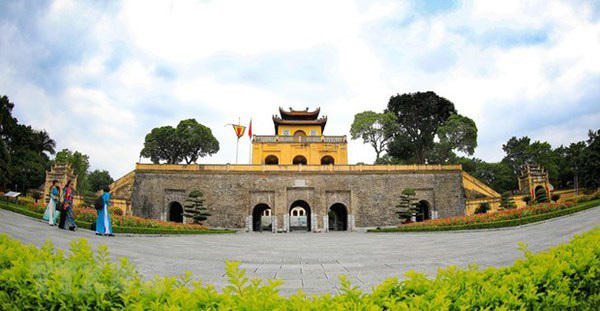
The Thang Long Imperial Citadel in the centre of Hanoi should be preserved and developed with a vision to become a Heritage Park, said Secretary of the Hanoi Party Committee Vuong Dinh Hue.
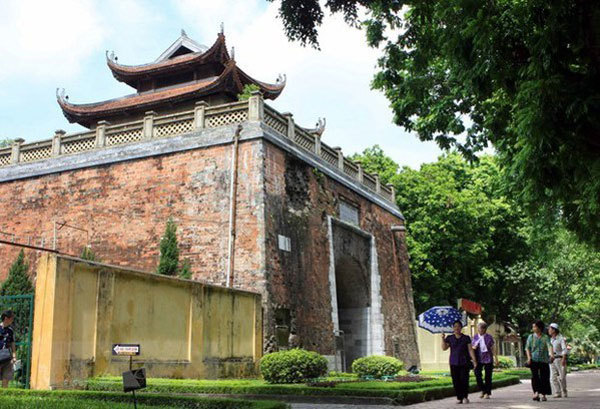
Bac Mon (northern gate) – one of the gates of the Thang Long Imperial Citadel. Photos: VNA
The Hanoi leader said at a working session with its management body – the Thang Long-Hanoi Heritage Conservation Centre on February 23 that along with the Co Loa Relic Site, the Thang Long Imperial Citadel is a precious heritage of Hanoi. He stressed the need to promote the citadel relic site’s values in line with tourism development.
He also underscored the importance of strengthening international cooperation in restoring and promoting the values of the Thang Long Imperial Citadel.
The Thang Long Imperial Citadel was built in the 11th century by the Ly Viet Dynasty, marking the independence of the Dai Viet.
The Centre Sector of the Thang Long Imperial Citadel was recognised as a special national relic site in 2009 and a UNESCO World Heritage Site in August 2010. So far, the city has showed strong performance in implementing seven out of eight commitments to the UNESCO and continued realising the commitment in unification of management.
Currently, five projects to restore and develop the site have been underway and planned.
At the meeting, experts, scientists and researchers held that unifying management is a focus of the UNESCO and Vietnam. They advised Hanoi to coordinate with relevant agencies to speed up the hand over of the remaining area of 1,729 hectares and archaeological items, while focusing on prioritsed projects at the 18 Hoang Dieu Archaeological Site and the Kinh Thien Palace restoration.
Luu Tran Tieu, Chairman of the National Cultural Heritage Council, suggested that Hanoi should add a number of additional items to the construction of an outdoor museum at the site to draw visitors. VNA
The upcoming National Assembly session, which will take place from March 24 to April 7, will elect a number of positions in the State apparatus for the 2016-2021 term.
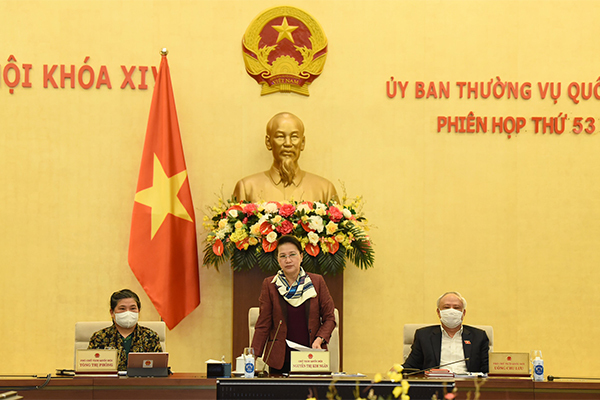
National Assembly Chairwoman Nguyen Thi Kim Ngan.
National Assembly Chair Nguyen Thi Kim Ngan said at the 53rd session of the 14th National Assembly Standing Committee which concluded on February 23 that the upcoming National Assembly session, which will take place from March 24 to April 7, will elect a number of positions in the State apparatus for the 2016-2021 term.
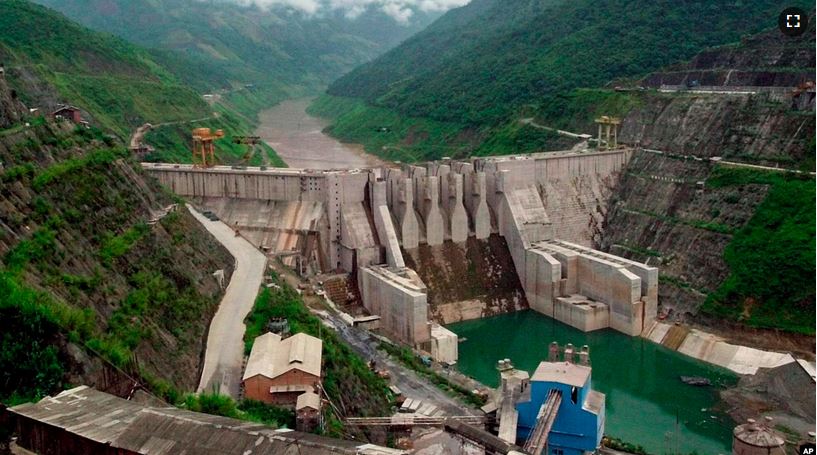
Đập Đại Triều Sơn chặn sông Mekong ở tỉnh Vân Nam, TQ.
Ủy hội sông Mekong (MRC) hôm thứ Sáu 12/2 cho hay mực nước của sông Mekong đã hạ thấp xuống mức “đáng lo ngại”, một phần do lượng xả bị hạn chế từ các đập thủy điện của Trung Quốc ở thượng nguồn. MRC kêu gọi Bắc Kinh chia sẻ tất cả dữ liệu của họ về lưu lượng nước.
Dòng sông cũng là tuyến đường thủy quan trọng đã chuyển sang màu xanh lam dọc theo biên giới Thái-Lào, thay vì có màu nâu đục thường thấy. Điều này báo hiệu về mực nước nông và lượng phù sa giàu dinh dưỡng bị giảm xuống thấp – một phần do hạn chế về lượng nước xả từ đập Cảnh Hồng ở tỉnh Vân Nam của Trung Quốc, ủy hội liên chính phủ MRC nói.
The following is a translation of the National Institute for South China Sea Studies assessment of the recently released U.S. maritime strategy, Advantage at Sea: Prevailing with Integrated All-Domain Naval Power. The China Maritime Studies Institute at the U.S. Naval War College made the translation.
The Prelude to All-Encompassing Maritime Competition Between China and the U.S. is about to Begin—An Appraisal of America’s Newest Maritime Strategy
By Shi Xiaoqin and Liu Xiaobo
On December 17, 2020, the U.S. Navy (USN), U.S. Marine Corps (USMC), and the U.S. Coast Guard (USCG) jointly issued a new maritime strategy entitled Advantage at Sea: Prevailing with Integrated All-Domain Naval Power. This tri-service strategy is a follow-on to A Cooperative Strategy for 21st Century Seapower, which the three services jointly issued in 2007 and 2015. Two characteristics of the document deserve attention: one, it directly regards China as an opponent and two, it simultaneously classifies China and Russia as opponents. Compared with the U.S. maritime strategy issued at the height of the Cold War in 1982, this document might be regarded as the first maritime strategy document issued after the inauguration of Sino-U.S. strategic competition.
Rush Limbaugh, the right-wing radio megastar whose slashing, divisive style of mockery and grievance reshaped American conservatism, denigrating Democrats, environmentalists, “feminazis” (his term) and other liberals while presaging the rise of Donald J. Trump, died on Wednesday at his home in Palm Beach, Fla. He was 70.
By Chuck Searcy February 15, 2021 | 07:40 am GMT+7Last month, completion of dioxin cleanup on a 5,300-square-meter tract of land at Bien Hoa airport marked a significant milestone.
Chuck Searcy
Officials of both the Vietnamese and U.S. governments could derive satisfaction from knowing that the Agent Orange/dioxin legacy of war is now being addressed, after a troubling post-war history of misinformation and controversy, accusations and doubts.
Not just public officials, but veterans and ordinary citizens of both countries can take pride in looking back over the remarkable transformation that has taken place in the past two decades, from early years of mistrust and recrimination to a positive, working partnership between Vietnam and the U.S. today.
That relationship is now built on mutual trust and respect.
CỘNG HÒA XÃ HỘI CHỦ NGHĨA VIỆT NAM Độc lập – Tự do – Hạnh phúc —————
Số: 2427/QĐ-TTg
Hà Nội, ngày 22 tháng 12 năm 2011
QUYẾT ĐỊNH
PHÊ DUYỆT CHIẾN LƯỢC KHOÁNG SẢN ĐẾN NĂM 2020, TẦM NHÌN ĐẾN NĂM 2030
THỦ TƯỚNG CHÍNH PHỦ
Căn cứ Luật Tổ chức Chính phủ ngày 25 tháng 12 năm 2001;
Luật Khoáng sản số 60/2010/QH12 ngày 17 tháng 11 năm 2010;
Căn cứ Nghị quyết số 02-NQ/TW ngày 25 tháng 4 năm 2011 của Bộ Chính trị về định hướng chiến lược khoáng sản và công nghiệp khai khoáng đến năm 2020, tầm nhìn đến năm 2030;
Căn cứ Chiến lược phát triển kinh tế – xã hội 2011 – 2020;
Xét đề nghị của Bộ trưởng Bộ Tài nguyên và Môi trường,
QUYẾT ĐỊNH:
Điều 1. Phê duyệt “Chiến lược khoáng sản đến năm 2020, tầm nhìn đến năm 2030” với những nội dung chính như sau:
Observer Research Foundation (ORF) is an independent think tank based in Delhi, India. The foundation has three centres in Mumbai, Chennai and Kolkata. ORF provides potentially viable inputs for policy and decision-makers in the Indian Government and to the political and business communities of India. ORF started out with an objective of dealing with internal issues of the economy in the wake of the 1990s reforms. However, today its mandate extends to security and strategy, governance, environment, energy and resources, economy and growth.
Origins
ORF was founded in part by the Dhirubhai Ambani family; it claims to operate independently, though.[1] According to some reports, until 2009, 95% of the foundation’s budget was provided by Reliance Industries, however, it is now estimated to be around 65% as the foundation diversified its source of finance to government, foreign foundations, and others.[2]
When the United Kingdom (UK) releases the highly anticipated integrated review of its foreign, defence, security and development policy in March, it will mark the first formal iteration of the UK’s Indo-Pacific strategy. This brief explores the dynamics that are driving the UK’s tilt to the Indo-Pacific. It identifies three key drivers that are prompting the shift: a reappraisal of China, the economic fallout of Brexit, and the UK’s close ties with the US. It explores the emerging trends in this churn—across security, trade, development, and diplomatic domains—and highlights the opportunities they afford the India-UK relationship.
Attribution: Harsh V Pant and Tom Milford, The UK Shifts to the Indo-Pacific: An Opportunity for India-UK Ties,” ORF Issue Brief No. 444, February 2021, Observer Research Foundation.
Introduction
The ‘Indo-Pacific’ concept is a recognition that the Indian and Pacific Ocean regions are intertwined and should be treated as one strategic space. Its very idea is an affirmation that because of how globalisation works, regional issues—from climate change to piracy—require regional cooperation. For example, it was the need for massive disaster relief following the Indian Ocean earthquake and tsunami in 2004 that was the genesis of the Quadrilateral initiative (of India, Japan, the US and Australia—or Quad). On what is perhaps a deeper level, the ‘Indo-Pacific’ idea is a recognition that the Indo-Pacific is the defining geopolitical theatre of the century: it is not only home to the fastest growing economies and military powers in the world, but it is also littered with land and maritime disputes that will require careful management to maintain stability.
To be sure, there is no consensus around the geographic scope of the Indo-Pacific. Some define it as the entire region that stretches from the eastern shores of Africa to the western coast of the US; others view it as beginning from India, and eastwards. Drawing the precise geographic borderlines, however, becomes less important when regarding the Indo-Pacific as, foremost, a geostrategic concept. As states conceptualise their geostrategic imperatives and weigh the threats they face, the geographic contours of the Indo-Pacific will only continue to evolve.

:focal(1372x660:1373x661)/https://public-media.si-cdn.com/filer/16/f6/16f6f61a-0643-490b-b363-5ee6163b2a1b/leutze_westward_course_of_empire_copy.jpg)






 CVD
CVD