UN report on human rights in Xinjiang is damning for China. But what will its impact be?

Analysis by Simone McCarthy, CNN

Updated 0945 GMT (1745 HKT) September 2, 2022
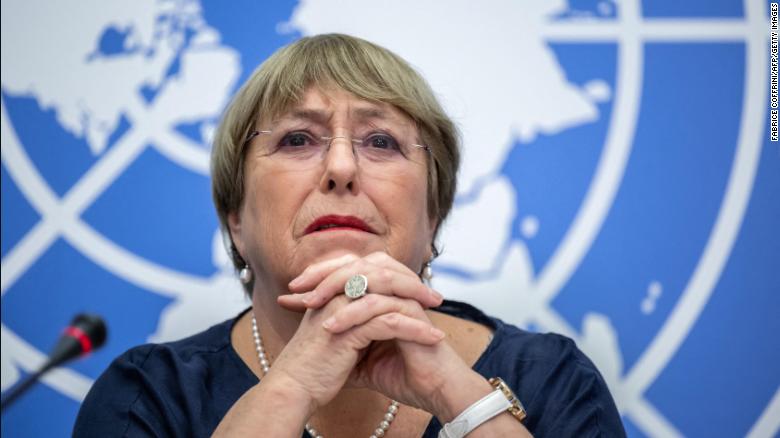
UN High Commissioner for Human Rights Michelle Bachelet gives a final press conference at the UN offices in Geneva on August 25, 2022.

A version of this story appeared in CNN’s Meanwhile in China newsletter, a three-times-a-week update exploring what you need to know about the country’s rise and how it impacts the world. Sign up here.

Hong Kong (CNN)
For Adila Yarmuhammad, the release of a damning new report from the United Nations’ top human rights official on the treatment of Uyghur and other Muslim minorities in Xinjiang brought relief, and sadness.
The Australian-born 22-year-old, whose family comes from the region in the northwest of China, woke up Thursday to a flurry of WhatsApp messages about the report from other young Uyghurs worldwide.
“Everyone is relieved that something like a report came out … (but) the sense of relief doesn’t come with complete relief,” said Yarmuhammad, a leader in an Australian Uyghur youth group.
Tiếp tục đọc “UN report on human rights in Xinjiang is damning for China. But what will its impact be?”

Council on Foreign Relations: Daily News Brief Sept. 1, 2022

Top of the Agenda

Delayed UN Report Details China’s Human Rights Violations in XinjiangA UN human rights office report [PDF] issued yesterday said the Chinese government’s detentions of Uyghurs and other predominantly Muslim groups in the Xinjiang region could constitute “crimes against humanity.” The report noted (NYT) that two-thirds of former detainees interviewed described treatment “that would amount to torture and/or other forms of ill treatment.” The report stopped short of calling China’s actions “genocide,” as the United States has done. 

Human rights groups have criticized UN human rights chief Michelle Bachelet over a nearly yearlong delay in the report’s release. The report asks that Beijing (AP) release those who have been arbitrarily detained and disclose the whereabouts of individuals who are missing. Beijing denounced the report as a fabrication, while Uyghur activists celebrated its release.   
Tiếp tục đọc “Council on Foreign Relations: Daily News Brief Sept. 1, 2022”

China’s dim prospects turn disastrous

BY DIANE FRANCIS, OPINION CONTRIBUTOR – 08/29/22 10:30 AM ET The Hill
THE VIEWS EXPRESSED BY CONTRIBUTORS ARE THEIR OWN AND NOT THE VIEW OF THE HILL

Russia’s terrible war generates headlines, but China’s growing debt crisis is mostly ignored. And yet, it will have profound negative effects on the global economy. In just three generations, Beijing built a middle class bigger than America’s entire population. But now Chinese many face ruination. China’s domestic real estate bubble, due to deregulation, is so gargantuan that much of its middle class has been damaged.

“China’s debt bomb looks ready to explode and many warning signs suggest that a debt reckoning is imminent,” warns Nikkei Asia.

Tiếp tục đọc “China’s dim prospects turn disastrous”

Daily News Brief August 29, 2022

ImageDaily News BriefAugust 29, 2022
Top of the Agenda

Over One Thousand People Killed in Catastrophic Pakistan FloodsPakistani officials are appealing for international aid (CNN) as uncharacteristically strong monsoon rains cause nationwide flooding. The floods, which climate change minister Sherry Rehman called a “climate catastrophe,” have so far displaced more than three million people, according to the International Federation of Red Cross and Red Crescent Societies. While Pakistan usually sees four rainy periods per year, it is currently experiencing its eighth, Rehman said.
The flooding comes as Pakistan experiences an economic crisis (FT). Some preliminary estimates put the cost of the damages (Reuters) around $4 billion, though Pakistan’s foreign minister said it is likely higher.
Tiếp tục đọc “Daily News Brief August 29, 2022”

Seeking Dronations: The Crowdfunded Drone War in Ukraine

August 25, 2022  Topic: Russia-Ukraine War  Region: Europe  Tags: Russia-Ukraine WarArmed DronesTurkish DronesCommercial DronesTB2 Drones

The increased accessibility and affordability of drone technology, coupled with innovations in banking and financial technologies like NFTs and cryptocurrency, have allowed the spirit of volunteerism to directly fund efforts to acquire weapons and arms.

by Andro Mathewson Lauren Kahn, The National Interest

Russia’s invasion of Ukraine has triggered a strange new phenomenon: People from all over the world are crowdfunding purchases of materiel, such as commercial off-the-shelf drones and unmanned aerial vehicles (UAVs), and gifting them to foreign militaries.

For example, within seventy-two hours of launching “The People’s Bayraktar Project,” Ukrainian television presenter Serhiy Prytula surpassed his $15 million crowdfunding goal, instead receiving $20 million, enough to purchase three Turkish Bayraktar TB2 UAVs. The charity accepts donations from anyone anywhere in the world and takes bank transfers through cryptocurrency. 

Tiếp tục đọc “Seeking Dronations: The Crowdfunded Drone War in Ukraine”

The United States Looks to Build “Enduring Strength” in Ukraine

Foreign Policy’s Sitrep Aug. 25, 2022

If the record-breaking $3 billion military aid package announced by the Biden administration on Wednesday to mark Ukraine’s Independence Day is any indication, U.S. support for Kyiv against Russia’s six-month-old full-scale invasion has entered a new phase: long-term planning.

In fact, the weapons deliveries—which will include six Norwegian-made air defense systems, nearly 250,000 rounds of 155mm artillery ammunition, and novel so-called Vampire systems that can shoot down Russian drones—will have to be contracted and provided from U.S. and international defense companies, meaning that they won’t be ready for months.

Tiếp tục đọc The United States Looks to Build “Enduring Strength” in Ukraine

Are small modular reactors the solution to growing energy and climate problems?

Download study: Small Modular Reactors: The Next Phase for Nuclear Power in the Indo-Pacific?

By David Santoro and Carl Baker

David Santoro (david@pacforum.org) and Carl Baker (carl@pacforum.org) are respectively President/CEO and Senior Advisor at the Pacific Forum. Follow David Santoro on Twitter @DavidSantoro1.

The increasingly dominant view in the energy expert community is that nuclear power has a role to play in achieving the 17 “sustainable devaelopment goals” identified by the United Nations General Assembly in 2015 (and intended to be reached by 2030). There has thus been rising interest in nuclear power development in several parts of the world, especially in the Indo-Pacific, where growth is the strongest.

This renewed interest comes not long after the failed “nuclear renaissance” of the 2000s. That renaissance never materialized primarily because the devastating accidents at Japan’s Fukushima Daiichi Nuclear Power Plant in 2011 led many countries to reconsider their nuclear power ambitions. Now, however, national energy and climate objectives are again driving these same countries to put the nuclear option back on the table. This interest has only grown in the wake of Russia’s invasion of Ukraine, the subsequent efforts to choke off Russian natural gas and oil exports, and the resulting increase in global prices for fossil fuels. Tiếp tục đọc Are small modular reactors the solution to growing energy and climate problems?

The Life of Omar Ibn Said,” a West African slave in America

US Library of Congress

Omar Ibn Said Collection

The Omar Ibn Said Collection consists of 42 digitized documents in both English and Arabic, including an 1831 manuscript in Arabic on “The Life of Omar Ibn Said,” a West African slave in America, which is the centerpiece of this unique collection of texts. Some of the manuscripts in this collection include texts in Arabic by another West African slave in Panama, and others from individuals located in West Africa.

Previous

Translation of the life of Omar ibn Said.

Tiếp tục đọc “The Life of Omar Ibn Said,” a West African slave in America”

US Dark Money Politics

Massive dark money windfall: New conservative group got $1.6 billion from single donor

By Casey TolanCurt Devine and Drew Griffin, CNN

Updated 2145 GMT (0545 HKT) August 22, 2022

[TĐH: The title “US Dark Money Politics” is my addition]

(CNN)A new group led by a prominent conservative lawyer has received $1.6 billion from one donor — the largest single contribution to a politically focused nonprofit that’s ever been made public, and a fortune that could be used to fuel right-wing interests.

The nonprofit, Marble Freedom Trust, received the contribution in the form of stock and then funneled more than $200 million to other conservative organizations last year, a tax form CNN obtained from the IRS shows.

Marble Freedom is led by Leonard Leo, the co-chairman of the conservative Federalist Society, who advised former President Donald Trump on his Supreme Court picks and runs a sprawling network of other right-wing nonprofits that don’t disclose their donors, which are often referred to as dark money groups.

Tiếp tục đọc “US Dark Money Politics”

How inflation is flipping the economic script, in seven charts

The troubling trend is spilling over into every corner of the global economy, with dramatic effects. McKinsey Global Publishing looks at the latest data.

Every morning a new headline underscores growing economic concerns: Highest inflation since the 1970s. Central banks aggressively raising rates. Consumer sentiment at record lows. Commodity prices near all-time highs. Clearly inflation has, at a minimum, altered the economic mood, and potentially reset the path of global and national economies worldwide for years to come. McKinsey’s experts have examined many of the strategic implications of inflation. Here, we use the best and most recent publicly available data to offer seven charts illustrating inflation’s insidious progress

.

Double trouble. In the past six months, inflation has far exceeded December 2021 expectations. In many countries, actual rates have doubled projections. European countries are particularly affected. For example, inflation in Lithuania is running at 15.5 percent annually, nearly five times the rate expected. Poland is at 11 percent and the United Kingdom at 9 percent, both well above projections. At 3 percent, Switzerland is an outlier. Asia is seeing a less severe change: Indian inflation is about 7 percent, only a bit above projections; and South Korea is at 5 percent. In China and Japan, inflation remains muted.

Tiếp tục đọc “How inflation is flipping the economic script, in seven charts”

Chipping away at China

Matt Haldan, SCMP, Global Impact 20 August 2022
.
The chip war between Washington and Beijing has never felt so real as it has in the past few months, which has seen a deluge of news related to the semiconductor industry as the United States seeks to reshore fabrication and China vies for technological self-sufficiency. 

Not since the early days of the chip shortage in 2020 has there been so much related news, although that now feels like a teaser for what was to come.

The biggest news for the US this month was President Joe Biden signing the Chips and Science Act. The new law will pump US$53 billion into the domestic chip industry, incentivising companies to build and expand fabrication capacity in the country. Tiếp tục đọc Chipping away at China

The U.S. Holds Limited Influence in the Taliban’s Afghanistan

By Max Boot, CFR Expert

August 16, 2022 3:56 pm (EST), Council on Foreign Relations

A year after the U.S. withdrawal, half of Afghanistan’s population faces a food emergency, and the Taliban regime acts with cruelty and indifference.

One year after the United States ended its longest war, there remains considerable disagreement over whether the war in Afghanistan was winnable or worth fighting. Congress has chartered a bipartisan commission to investigate the war and draw lessons for the future. But however one views the conflict, few would dispute that the exit from Afghanistan at the end of August 2021 was a chaotic mess—or that the United States has limited options for dealing with the Taliban regime.

Tiếp tục đọc “The U.S. Holds Limited Influence in the Taliban’s Afghanistan”

Council on Foreign Relations: Daily News Brief Aug. 18, 2022

CFR Daily Brief 

Image
Daily News Brief August 18, 2022

Top of the Agenda

Turkish, Ukrainian Leaders Hold First Face-to-Face Meeting Since Start of War

Turkish President Recep Tayyip Erdoğan is meeting (AFP) with Ukrainian President Volodymyr Zelenskyy and UN Secretary-General António Guterres in the western Ukrainian city of Lviv. They are expected to discuss diplomatic efforts to end the war in Ukraine, as well as a deal that Turkey and the United Nations brokered to resume grain exports from the country. Tiếp tục đọc “Council on Foreign Relations: Daily News Brief Aug. 18, 2022”

Amnesty International’s Attack on Ukraine

Amnesty International’s recent attack on Ukraine raises yet again the issue of how the size, governance, and influence of the largest human rights organizations may damage the cause of human rights.

Blog Post by Elliott Abrams, Council on Foreign Relations

August 16, 2022 10:55 am (EST)

The cause of human rights is now at risk from the largest organizations dedicated to its protection.

Earlier this summer I wrote, here at the CFR web site, an article entitled “Quis Custodiet Ipsos Custodes?” and a blog entry of the same title. There I argued that “the issues of oversight, governance, and bias at the two largest NGOs, which dominate the field globally, cannot be overlooked.” Those two organizations are Human Rights Watch and Amnesty International. As I wrote,

In 2021, Human Rights Watch had $256 million in assets and revenue of $130 million. It employs more than 500 staff members in 105 locations globally and has an annual budget of $97 million. Amnesty International is even larger, raising $436 million in 2020 and spending $376 million.

Tiếp tục đọc “Amnesty International’s Attack on Ukraine”

US State Secretary Antony J. Blinken’s Remarks to the Nuclear Non-Proliferation Treaty Review Conference

US Department of Staate

REMARKS

ANTONY J. BLINKEN, SECRETARY OF STATE

UN HEADQUARTERS

NEW YORK, NEW YORK

AUGUST 1, 2022Play Video

[TĐH: Bold and Italic are added by me]

SECRETARY BLINKEN:  Good afternoon.  Secretary General Guterres, President Zlauvinen – thank you – Director General Grossi:  Thank you all for your longstanding leadership on nonproliferation.

I noted that Prime Minister Kishida of Japan is here as well this morning, which sends a very powerful message.  Earlier this year, he reaffirmed Japan’s commitment to nonproliferation in a joint statement with President Biden.

And a very special thanks to the foreign ministers, the deputy foreign ministers, the teams who have traveled to New York for these meetings and to get us off to a good start.

It’s great to be with you all here in person today, especially – especially – given the critical role the NPT has played in upholding the global nonproliferation regime.

More than five decades ago, at the height of the Cold War, representatives of 18 nations drafted the Treaty on the Non-Proliferation of Nuclear Weapons.

In the years that followed, nearly every country on Earth has joined the NPT.

Tiếp tục đọc “US State Secretary Antony J. Blinken’s Remarks to the Nuclear Non-Proliferation Treaty Review Conference”