I'm from Hanoi, Viet Nam.
I'm an author of Dot Chuoi Non (dotchuoinon.com/author/hangbelu/), a blog on Positive thinking, founded by Dr. Tran Dinh Hoanh, an attorney in Washington DC.
I'm a co-founder of Conversations on Vietnam Development - cvdvn.net, a virtual think tank. I am a co-founder of two companies in Viet Nam working on children education services. I advise companies on STEAM education, English language education for children and students in Vietnam.
I'm studying the Buddha's teaching and the teaching of Jesus. I practice mindful living including meditation.
I hold a PhD on Sustainable Energy Systems from University of Lisbon and Aalto University.
I graduated from Hanoi University of Technology on Environmental Engineering. I obtained a Master degree of the same major from Stanford University and Nanyang Technological University.
My English-language blog at: hangbelu.wordpress/.
I play table tennis as a hobby.
Sự gia tăng của các phương tiện giao thông không những gây ra cảnh tắc đường mà còn thải ra môi trường một lượng khí thải vô cùng lớn.
LỜI TOÀ SOẠN:
Cùng với sự phát triển kinh tế xã hội của Việt Nam, ngày càng có nhiều người dân sở hữu các phương tiện cá nhân như xe ô tô, xe máy. Tuy nhiên, điều này đồng nghĩa với việc ngày càng có nhiều lượng khí thải được thải ra khiến môi trường trở nên ngột ngạt.
Trong những năm gần đây, ô nhiễm không khí đã trở thành vấn đề nóng và nhận được sự quan tâm lớn của cộng đồng. Ở Việt Nam, mỗi năm có khoảng 60.000 người chết có liên quan đến ô nhiễm không khí. Hiện nay, ô nhiễm không khí tiếp tục gia tăng với tốc độ đáng báo động và ngày càng ảnh hưởng đến chất lượng cuộc sống của con người.
Có thể nói, mặc dù tại Việt Nam, các cơ quan chức năng đã rất nỗ lực và đưa ra rất nhiều giải pháp, tuy nhiên, tình trạng ô nhiễm khí thải phương tiện vẫn khá nhức nhối. Để đưa ra bức tranh toàn cảnh về vấn đề ô nhiễm khí thải tại Việt Nam, Tạp chí Kinh tế Môi trường khởi đăng tuyến bài viết Giải pháp nào cho bài toán giảm ô nhiễm khí thải phương tiện giao thông tại Việt Nam? Qua đó, tuyến bài cũng mong muốn góp ý tới các cơ quan chức năng những mô hình đã khá thành công tại một số nước phát triển dưới góc nhìn của các chuyên gia.
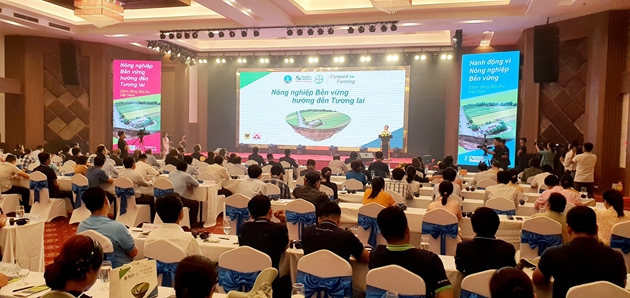
Ngày 06 tháng 09 năm 2023, tại Cần Thơ, Bayer Việt Nam phối hợp cùng Trung tâm Khuyến nông Quốc gia ra mắt mô hình “Nông nghiệp bền vững – Hướng đến tương lai” với tên gọi ForwardFarm đầu tiên tại khu vực Đông Nam Á, tọa lạc tại huyện Thới Lai, thành phố Cần Thơ.
Toàn cảnh buổi lễ ra mắt
Việc thành lập mô hình ForwardFarm tại Cần Thơ là kết quả của Biên bản Ghi nhớ (MOU) được TTKNQG và Bayer ký kết vào tháng 8 năm 2022, thống nhất hợp tác phát triển và thực hiện các sáng kiến nhằm chuyển đổi sản xuất lúa gạo với mục đích nâng cao năng suất, chất lượng gạo, thu hút các thị trường xuất khẩu quốc tế, đồng thời thúc đẩy phát triển nông nghiệp bền vững, ứng phó với tác động của biến đổi khí hậu.
(Dân trí) – Dự án nghỉ dưỡng cao cấp Vĩnh Hy (Ninh Thuận) có 11,58ha rừng thuộc quy hoạch rừng đặc dụng do Ban quản lý Vườn quốc gia Núi Chúa quản lý vừa được công khai tham vấn về môi trường.
Ngày 12/9, Bộ Tài nguyên và Môi trường công khai tham vấn cộng đồng về Báo cáo đánh giá tác động môi trường (ĐTM) Dự án khu nghỉ dưỡng cao cấp Vĩnh Hy, tỉnh Ninh Thuận.
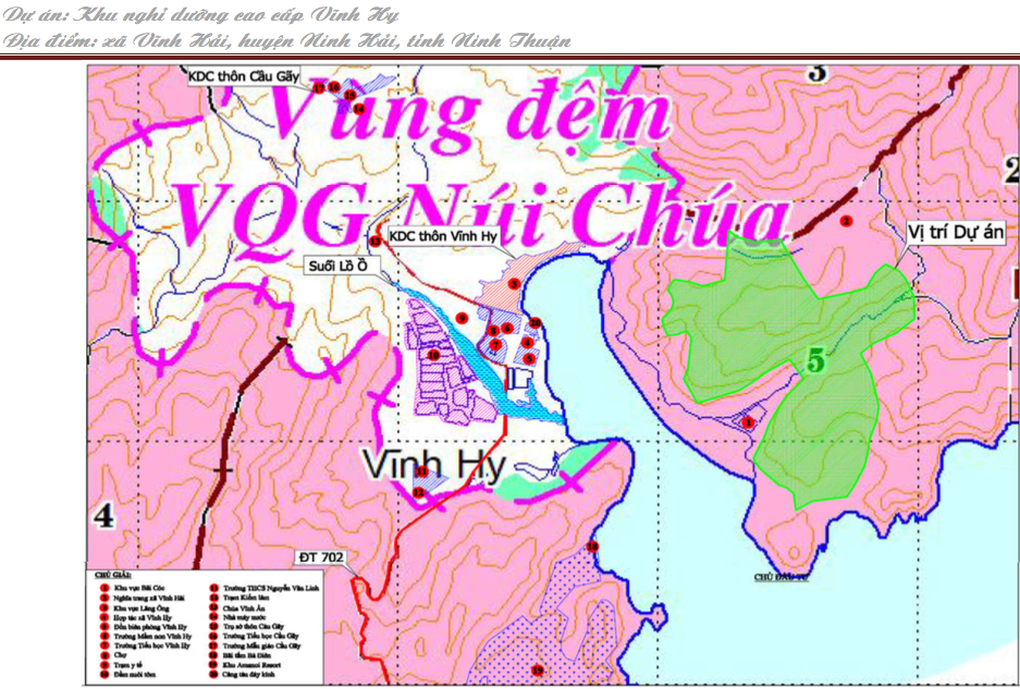
Đáng chú ý, theo ĐTM, dự án có 11,58ha diện tích rừng (rừng tự nhiên 10,60 ha; rừng trồng 0,98 ha) thuộc quy hoạch rừng đặc dụng do Ban quản lý Vườn quốc gia Núi Chúa quản lý (xã Vĩnh Hải, huyện Ninh Hải).
Vị trí dự án khu nghỉ dưỡng cao cấp Vĩnh Hy, tỉnh Ninh Thuận (Ảnh: Báo cáo ĐTM).
Thuộc thẩm quyền của Thủ tướng Chính phủ
Báo cáo ĐTM của dự án trích dẫn quy định tại khoản 2 Điều 20 Luật Lâm nghiệp nhấn mạnh việc quyết định chủ trương chuyển mục đích sử dụng rừng sang mục đích khác để thực hiện dự án khu nghỉ dưỡng cao cấp nói trên thuộc thẩm quyền của Thủ tướng.
Vì vậy, chủ dự án cần lập hồ sơ chuyển mục đích sử dụng rừng sang mục đích khác, tuân thủ Nghị định 83/2020 của Thủ tướng Chính phủ về sửa đổi, bổ sung Nghị định 156/2018 quy định chi tiết thi hành một số điều của Luật Lâm nghiệp.
Theo Quyết định số 332/2020 của UBND tỉnh Ninh Thuận về việc phê duyệt phương án quản lý rừng bền vững Vườn quốc gia Núi Chúa đến năm 2030 và Quyết định 333/2020 của tỉnh Ninh Thuận về phê duyệt Đề án phát triển du lịch sinh thái, nghỉ dưỡng, giải trí tại Vườn quốc gia Núi Chúa, khu vực dự án là khu vực 8 – dự án khu du lịch tại Vĩnh Hy, thuộc các khu cho thuê môi trường rừng.
Bringing together the findings from a range of key studies, the review highlights the serious and life-limiting risks of air pollution and how it affects multiple aspects of physical and mental health over the course of pregnancy and birth, child development, through to adulthood.
The authors looked at studies focused on the links between air pollution and ill health, including pollutants such as black carbon (or soot), small particulate matter (PM2.5), Nitrogen Dioxide (NO2), and Sulphur Dioxide (SO2).
National air pollution trends often follow the environmental kuznets curve (EKC). The EKC provides a hypothesis of the link between environmental degradation and economic development: in this case, air pollution initially worsens with the onset of industrial growth, but then peaks at a certain stage of economic development and from then on pollution levels begin to decline with increased development. Many high income nations are now at the late stage of this curve, with comparably low pollution levels. Meanwhile, developing nations span various stages of the growth-to-peak phase. I have previously written about this phenomenon in relation to sulphur dioxide (SO2) emissions here on Our World in Data.
If we take a historical look at pollution levels in London, for example, we see this EKC clearly. In the graph, we have plotted the average levels of suspended particulate matter (SPM) in London’s air from 1700 to 2016. Suspended particulate matter (SPM) refers to fine solid or liquid particles which are suspended in Earth’s atmosphere (such as soot, smoke, dust and pollen). Exposure to SPM – especially very small particles, which can more easily infiltrate the respiratory system – has been strongly linked to negative cardiorespiratory health impacts, and even premature death. As we see, from 1700 on, London experienced a worsening of air pollution decade after decade. Over the course of two centuries the suspended particulate matter in London’s air doubled. But at the very end of the 19th century the concentration reached a peak and then began a steep decline so that today’s levels are almost 40-times lower than at that peak.
The data presented has been kindly provided by Roger Fouquet, who has studied the topic of environmental quality, energy costs and economic development in great detail.1
An area in Hanoi on the morning of August 11, 2023. Photo by VnExpress/Viet AnThe air quality in Hanoi was ranked as “very unhealthy” on Friday morning and then “unhealthy for sensitive groups” at noon.
Switzerland-based air quality monitoring facility IQAir AirVisual recorded the air quality index (AQI) at over 200 in many places in Hanoi on Friday morning.
At noon, it dropped to 149 on average.
According to AirVisual, the AQI ranges from 0 to 500, though air quality can be indexed beyond 500 when there are higher levels of hazardous air pollution. Good air quality ranges from 0 to 50.
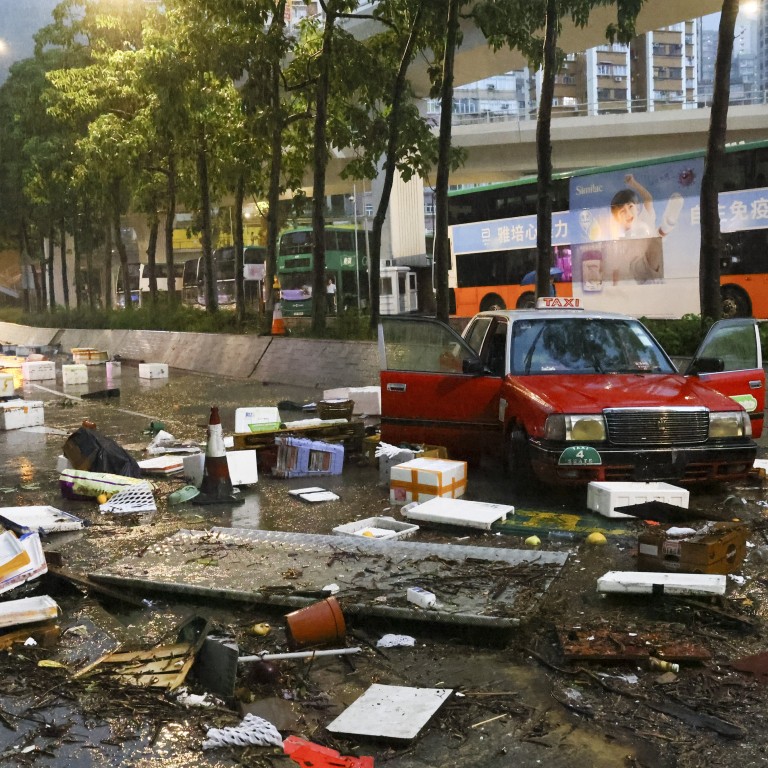
A Hong Kong road is strewn with debris, rubbish and an abandoned taxi as floodwaters recede. Photo: Dickson Lee
Hong Kong officials met the press at 2.30pm on Friday to provide details on efforts in handling the aftermath of the city’s worst downpour in more than a century amid mounting questions over a perceived lack of preparedness.
For over a century, economists have advocated taxing goods or services that impose greater costs on society than their price reflects. The idea isn’t to raise revenue, even if that’s a nifty benefit, but to discourage the overuse of things that cause unintended harm.
No bigger example of such unintended harm exists today than the air and climate pollution caused by the burning of fossil fuels. The International Monetary Fund conservatively estimates that the price of such fuels fails to account for $4.2 trillion in air and climate pollution costs each year.
By imposing a fee on fossil fuels to fairly reflect those social costs, on the other hand, we can invoke the power of the market to efficiently limit their use. That’s why more than 3,600 economists call carbon fees “the most cost-effective lever to reduce carbon emissions at the scale and speed that is necessary.”
Public support for carbon fees would be stronger if everyone grasped how they work to discourage the production and consumption of goods that cause societal harm. Unfortunately, many people don’t get it.
“The expectation that carbon taxes do not work is one of the main reasons for their rejection by people in surveys and real ballots,” an international scholarly review concluded in 2018. For example, only 39 percent of respondents in one Swedish poll understood that a carbon tax “affects my own and other people’s behavior.”
By Nadeen Ebrahim and Laura Paddison, CNN Updated 12:08 PM EDT, Fri September 15, 2023
A satellite image shows the town of Derna in the aftermath of the floods in eastern Libya on Wednesday.Maxar Technologies/ReutersCNN —
It started with a bang at 3 a.m. Monday as the residents of Derna were sleeping. One dam burst, then a second, sending a huge wave of water gushing down through the mountains towards the coastal Libyan city, killing thousands as entire neighborhoods were swept into the sea.
More than 5,000 people are believed to have been killed with thousands more missing, though estimates from different Libyan officials and aid groups have varied and the toll is expected to rise.
The eastern Libyan city of Derna, the epicenter of the disaster, had a population of around 100,000 before the tragedy. Authorities say that at least 10,000 remain missing. CNN could not independently verify the figures.
Buildings, homes and infrastructure were “wiped out” when a 7-meter (23-foot) wave hit the city, according to the International Committee of the Red Cross (ICRC), which said Thursday that dead bodies were now washing back up on shore.
But with thousands killed and many more still missing, there are questions as to why the storm that also hit Greece and other countries caused so much more devastation in Libya.
Experts say that apart from the strong storm itself, Libya’s catastrophe was greatly exacerbated by a lethal confluence of factors including aging, crumbling infrastructure, inadequate warnings and the impacts of the accelerating climate crisis.
In 1945, members of the American “Deer Team,” part of the OSS, worked with Vietnamese guerrilla fighters to throw Japanese troops out of Indochina. As the war ended, the people of Vietnam looked to the United States to support their dreams of independence.
For most of World War II, the United States considered Vietnam to be a relatively unimportant French colony to someday be reclaimed from the Japanese; but America showed little interest in enlisting Vietnamese aid in that effort. All this changed rapidly in March 1945. Though the Japanese had invaded Vietnam in 1940, they allowed French colonial authorities to retain power so long as they controlled the Vietnamese and maintained the colony as a supply base for the Emperor’s army fighting in China. However, this also allowed the French to maintain covert Allied intelligence networks that supplied information to Allied personnel aiding the Chinese in their war against Japan. By early 1945, however, the war in the Pacific had shifted in favor of the Allies and the Japanese became increasingly suspicious of French activities in Vietnam. As a result, on March 10, 1945, Japanese forces launched Operation Meigo, a swift military takeover that effectively ended French colonial rule of Vietnam.
Members of the Deer Team providing instruction to the Vietnamese on use of the M-1 carbine, August 16, 1945. Photo by the National Archives and Records Administration.
With the loss of French control over the colony during Meigo, Allied intelligence networks operating in Vietnam collapsed. One such group, known as the “GBT,” had been providing information on weather conditions, the movement of Japanese troop trains and naval vessels, and on escape routes for downed Allied airmen to the 14th US Air Force stationed in China. Up to this point the GBT refused to employ Vietnamese as agents because the French claimed they were untrustworthy and were only interested in acquiring weapons to fight the French, not the Japanese. With their normally busy wires now silent, native agents became necessary.
Both the GBT and the US Office of Strategic Services (the OSS) reached out to a Vietnamese man who had drawn positive attention from the 14th Air Force the previous year when he escorted a downed American pilot out of Vietnam and into China. OSS agent Charles Fenn tracked down the man in question—Ho Chi Minh—describing him as articulate and charismatic, and both open and friendly to Americans. Fenn was convinced Ho would be an excellent intelligence agent and the group he represented, the Viet Minh, would also be valuable assets in the war against Japan. Soon thereafter, Ho Chi Minh became OSS agent “Lucius.”
Members of the Deer Team and Viet Minh at training camp. Allison Thomas stands in the center and is flanked on his left by Vo Nguyen Giap and on his right by Ho Chi Minh. Photo by the National Archives and Records Administration.
Study finds ‘direct evidence’ of polar amplification on continent as scientists warn of implications of ice loss
An Adelie penguin in Antarctica. The icy continent is heating faster than climate models had predicted, a study has found. Photograph: Reuters/Alamy
Antarctica is likely warming at almost twice the rate of the rest of the world and faster than climate change models are predicting, with potentially far-reaching implications for global sea level rise, according to a scientific study.
Scientists analysed 78 Antarctic ice cores to recreate temperatures going back 1,000 years and found the warming across the continent was outside what could be expected from natural swings.
In West Antarctica, a region considered particularly vulnerable to warming with an ice sheet that could push up global sea levels by several metres if it collapsed, the study found warming at twice the rate suggested by climate models.
In 1995, Microsoft CEO Bill Gates published a memo entitled “The Internet Tidal Wave.” Gates outlined seven areas where Microsoft could increase its focus on internet features, including a web browser. The next year Microsoft launched its Internet Explorer web browser. Microsoft faced an antitrust lawsuit by the Department of Justice in 1998 during the height of the Browser Wars. Its Internet Explorer was quickly becoming the go-to web browser for the masses, but the U.S. government argued it stifled competition.
Amid rising geopolitical tension, Southeast Asia is fulfilling a “vital role in building bridges of understanding” worldwide said the UN chief on Thursday.
António Guterres was speaking in Jakarta, Indonesia, at the opening of the ASEAN-United Nations Summit, addressing Member States of the Association of Southeast Asian Nations and declaring “our partnership is more important than ever.”
Nghiên cứu này là sản phẩm thuộc chương trình: “Tăng cường pháp luật và tư pháp tại Việt Nam” (EU JULE), do Liên minh Châu Âu tài trợ với sự đóng góp tài chính từ UNDP và UNICEF. Chương trình do hai cơ quan này của Liên hợp quốc thực hiện với sự phối hợp của Bộ Tư pháp Việt Nam.
Một trong những mục tiêu chính của chiến lược quốc gia về xây dựng nhà nước pháp quyền của Việt Nam là cải thiện hệ thống tư pháp. Chính phủ Việt Nam đã làm rõ điều này bằng cách chấp nhận các khuyến nghị chu kỳ III của cơ chế Rà soát Định kỳ Phổ quát. Các khuyến nghị này kêu gọi “… tăng cường nhà nước pháp quyền, bao gồm cả việc phát triển hơn nữa hệ thống tư pháp hình sự có tính đến quyền con người của các nghi phạm và tù nhân cũng như thúc đẩy việc quản lý công lý công bằng và minh bạch.”
Nhằm góp phần thực hiện khuyến nghị trên, nghiên cứu này tập trung thu thập các thông lệ quốc tế tốt nhất liên quan đến ba cơ chế tư pháp hình sự quan trọng và nổi bật tại các khu vực tài phán thuộc hệ thống thông luật và dân luật, bao gồm: 1) xét xử bồi thẩm đoàn hình sự (hoặc sự tham gia của hội thẩm); 2) thỏa thuận nhận tội; và 3) hòa giải (tư pháp phục hồi). Báo cáo đồng thời xem xét lại luật pháp và thực tiễn hiện hành của Việt Nam đối với từng cơ chế này. Rút ra từ các thông lệ tốt của Việt Nam và quốc tế, nghiên cứu kết luận với các khuyến nghị nhằm hỗ trợ hệ thống tư pháp Việt Nam đạt được các mục tiêu chiến lược quốc gia.