I'm from Hanoi, Viet Nam.
I'm an author of Dot Chuoi Non (dotchuoinon.com/author/hangbelu/), a blog on Positive thinking, founded by Dr. Tran Dinh Hoanh, an attorney in Washington DC.
I'm a co-founder of Conversations on Vietnam Development - cvdvn.net, a virtual think tank. I am a co-founder of two companies in Viet Nam working on children education services. I advise companies on STEAM education, English language education for children and students in Vietnam.
I'm studying the Buddha's teaching and the teaching of Jesus. I practice mindful living including meditation.
I hold a PhD on Sustainable Energy Systems from University of Lisbon and Aalto University.
I graduated from Hanoi University of Technology on Environmental Engineering. I obtained a Master degree of the same major from Stanford University and Nanyang Technological University.
My English-language blog at: hangbelu.wordpress/.
I play table tennis as a hobby.
Gregory Brew is a historian of international energy, U.S. foreign policy, the Cold War, U.S.-Iranian relations, and modern Iran. He is currently an Analyst at Eurasia Group.
After two months, the crisis in the Middle East is poised to seriously disrupt the global economy as well as regional stability—thanks to the Houthis, a rebel Shi’a group in Yemen, and their successful effort to disrupt shipping through the Red Sea.
While attacks by the Houthis on commercial shipping began on November 19, they escalated last week, with the Yemeni rebels firing anti-ship ballistic missiles at several passing ships and hitting one (the first time such a weapon has ever been used successfully). As none of the ships were bound for Israel or owned by Israeli companies, the attacks signaled the Houthis were stepping up their efforts to pressure local commerce as a way to force Israel to suspend its campaign in Gaza.
The Israel-Gaza war has taken a severe toll on journalists since Hamas launched its unprecedented attack against Israel on October 7 and Israel declared war on the militant Palestinian group, launching strikes on the blockaded Gaza Strip.
CPJ is investigating all reports of journalists and media workers killed, injured, or missing in the war, which has led to the deadliest period for journalists since CPJ began gathering data in 1992.
As of December 21, 2023, CPJ’s preliminary investigations showed at least 68 journalists and media workers were among the more than 20,000 killed since the war began on October 7—with more than 19,000 Palestinian deathsin Gaza and the West Bank and 1,200 deaths in Israel.
The Israel Defense Forces (IDF) told Reuters and Agence France Press news agencies that it could not guarantee the safety of their journalists operating in the Gaza Strip, after they had sought assurances that their journalists would not be targeted by Israeli strikes, Reuters reported on October 27.
Journalists in Gaza face particularly high risks as they try to cover the conflict during the Israeli ground assault, including devastating Israeli airstrikes, disrupted communications, supply shortages and extensive power outages.
As of December 21:
68 journalists and media workers were confirmed dead: 61 Palestinian, 4 Israeli, and 3 Lebanese.
CPJ is also investigating numerous unconfirmed reports of other journalists being killed, missing, detained, hurt, or threatened, and of damage to media offices and journalists’ homes.
Pollution in our waterways is not only dangerous and unsanitary for humans but it also affects wildlife. That’s why it is so exciting to see an initiative aimed at preventing such waste.
The Australian city of Kwinana has designed a simple and cost-effective solution to deal with the discharge of waste from drainage systems. The town has put nets on the outlet of drainage pipes.
These nets stop waste and pollutants from leaving the sewers, preventing garbage transported by rain waters from contaminating the town’s local water reserve. It is a simple filtering system and it works like a charm.
Over the past two months, people from over 90 countries have united to call for a sustained ceasefire in Israel and the Occupied Palestinian Territories. pic.twitter.com/mstOYzzbzu
This short film pays tribute to professor Saleemul Huq, an environmental and climate change giant who died on 28 October 2023.
Professor Saleemul Huq OBE (1952-2023)
Following the passing of Professor Saleemul Huq, senior fellow of IIED. This book of remembrance is open to all who wish to share their memories of Saleem.
Article, 29 October 2023
Professor Saleemul Huq was an environmental and climate change giant and senior fellow and dear friend of IIED and many IIED colleagues past and present.
The honour was awarded in recognition of his work to build climate expertise in Bangladesh, the UK and across the world.
Saleem was an expert on the links between climate change and sustainable development, particularly from the perspective of vulnerable developing countries. A constant voice for climate action and justice for the global South, he was the lead author of chapters in the third, fourth and fifth assessment reports of the Intergovernmental Panel on Climate Change. Huq’s work with the IPCC spanned 1997 to 2014 and he contributed to reports that led to the panel being awarded the Nobel Peace Prize in 2007.
He set up the climate change research group at IIED in 2000 and was its initial director – continuing as a senior fellow until 2021 – and worked across the institute to ensure climate was at the heart of all that IIED did.
IIED executive director Tom Mitchell said: “I would like to offer my deepest sympathy and condolences to Saleem’s family and loved ones on behalf of IIED. There was no one quite like Saleem and I will remember his unique combination of warmth, generosity of spirit, academic prowess and enormous standing in climate science.
Specifically, we focus on the flow of public adaptation funds from the governments of developed countries to developing countries, since the implementation of the Paris Agreement.
In this article, we identify three major gaps in adaptation finance and explain why these gaps have emerged even as nations commit to scaling up these funds.
Financial shortfall
Adaptation costs for developing countries are estimatedat between $215bn and $387bn annually this decade, according to the latest Adaptation Finance Gap Update report.
Spending from the public funds of developed nations, while not the only source of adaptation finance, remains a crucial source, especially for low-income countries.
As it stands, people in the least developed countries(LDCs) and small-island states are often more exposedto climate hazards and more likelyto be killed by climate-related disasters. This is despite the fact that these nations bear very little responsibilityfor causing climate change.
“In the UK we’ve seen suspension of students and staff from their universities. We’ve seen cancelling of events … of student activities like protests and sit-ins. We’ve seen a few cases of students that were arrested. We’ve seen students whose visas are threatened to be revoked.“
Across parts of academia, concerns are mounting that the Israel-Gaza war is having a chilling effect on academic freedom. In the second of two episodes of The Conversation Weekly exploring how the war is affecting life at universities, we speak to an Israeli legal scholar, now based in the UK, about the pressures that academics and students are facing to rein in their views about the war.https://embed.acast.com/60087127b9687759d637bade/65804f3a3c61a300185b8044
In the two months since the October 7 Hamas attack on Israel and subsequent Israeli war on Gaza, Neve Gordon is worried that there’s been a major clampdown on academic freedom in the US, Europe and Israel.
After teaching for 17 years in southern Israel, Gordon moved to the UK in 2016 and he’s now a professor of human rights and humanitarian law at Queen Mary University of London. His research looks at the laws of war with a special focus on Israel-Palestine, and on definitions of antisemitism.
He’s also the vice-president at the British Society for Middle Eastern Studies and chair of its committee on academic freedom. In this role, he’s been following the impact of the conflict on free speech at universities, and recently hosted an international webinar on the issue.
In the UK we’ve seen suspension of students and staff from their universities. We’ve seen cancelling of events … of student activities like protests and sit-ins. We’ve seen a few cases of students that were arrested. We’ve seen students whose visas are threatened to be revoked.
In Israel, Gordon told us he was aware of 113 cases in Israel of students and staff who have been suspended or dismissed, and at least ten students who have been arrested for their criticism of Israel’s attack on Gaza. “We have several students sitting behind bars for Facebook or tweets that basically express empathy for the suffering of the Palestinians,” he says.
All this, Gordon says, is having a chilling effect across academia.
I’m getting phone calls from friends in different universities in different countries saying that they want to cancel their Israel-Palestine course for next semester because they’re afraid that things that they will say in class can be interpreted by students as antisemitic.
Listen to the full interview with Neve Gordon on The Conversation Weekly podcast, where you can also listen to the first of our two episodes on the way the Israel-Gaza war is affecting life at universities, focusing on what’s been happening at one American public university.
Trapped under the rubble of a 5-storey building in Gaza, a 13-year-old called Alma pleaded for rescuers to help free her relatives first. What happened to her family members is not known.
Thousands of people have protested in Tel Aviv after Israeli forces killed three Israeli captives in Gaza who were shirtless, waving a white flag and calling for help in Hebrew. Demonstrators are demanding the gov’t reach a deal for the safe return of remaining captives
Asylum-seeking migrants walk toward a makeshift camp to await processing by the U.S. Border Patrol after crossing into the United States past a gap in the border barrier Dec. 1, 2023 in Jacumba Hot Springs, CaliforniaPUBLISHED 5 DAYS AGO
Immigration policy has been a hot-button issue for generations, in the United States and around the world. But waves of people fled their homes by land or by sea in 2023, triggering migrant crisis after migrant crisis in multiple regions. Battles over migration policy stoked domestic political feuds and diplomatic clashes.
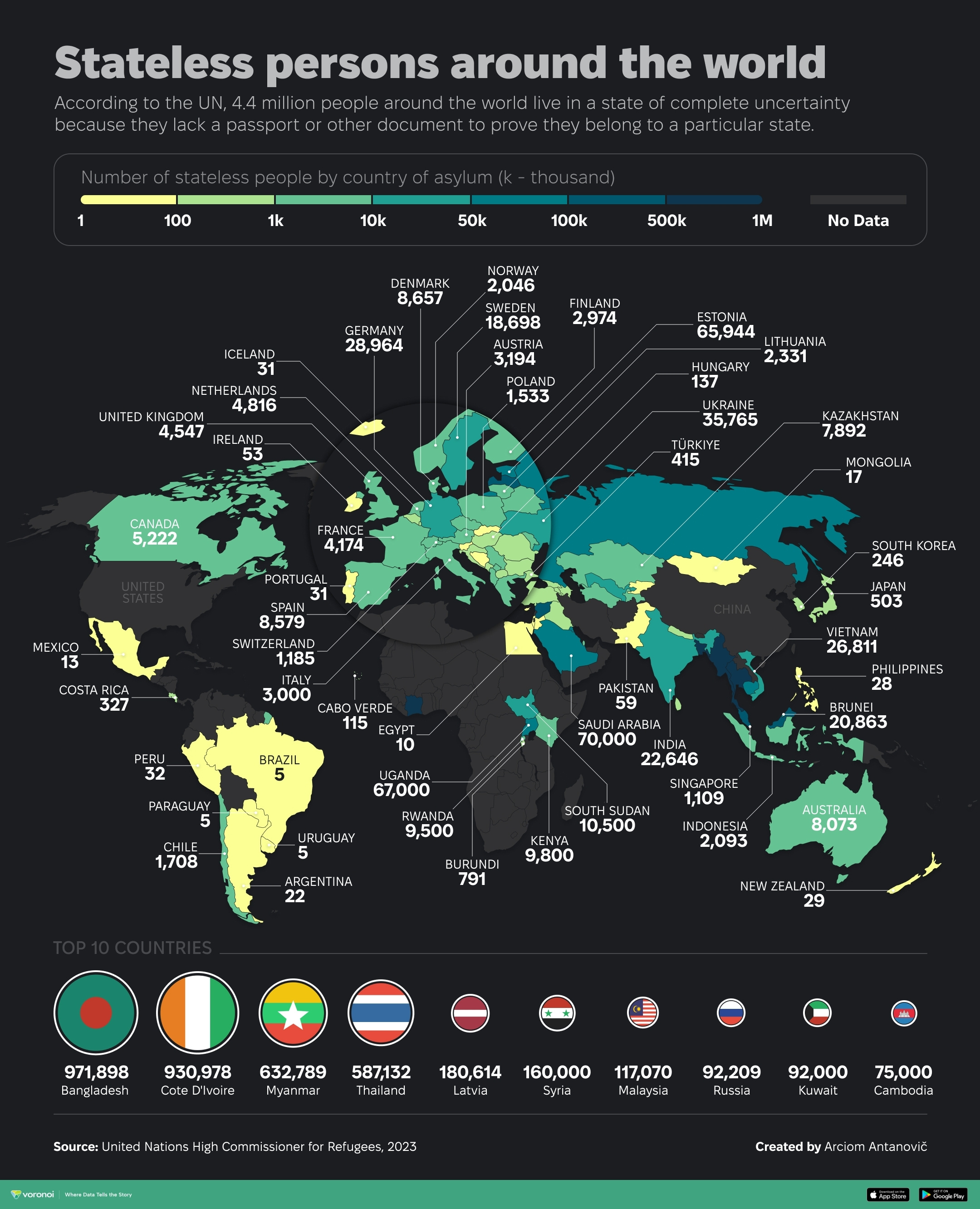
International Organization for Migration officials told delegates at the United Nations’ COP28 climate conference that more than half of forced “internal displacements,” which totaled 32.6 million people last year, were driven by climate-related events, according to Forbes. Wars, like Russia’s invasion of Ukraine and the conflict between Israel and Hamas, drove more people to seek a better life in a new country, and increased tensions once they got there.
Here are some of the migration routes where the crisis was intense in 2023:
The U.S.-Mexico border
A “growing wave of migration” exploded at the U.S.-Mexico border in 2023, The Wall Street Journal reported recently. It hit especially hard in the small border city of Eagle Pass, Texas, where Mayor Rolando Salinas Jr. declared a state of emergency as the number of migrants entering from Mexico hit 3,000 per day. “We are on pace for this to be the worst of the border crisis yet, and we’ve seen some doozies,” said Rep. Tony Gonzalez (R-Texas), whose district includes Eagle Pass. The migrants included people fleeing turmoil in Venezuela, drug cartel violence in Ecuador and other once-safe countries, gang violence in Haiti, and a broad economic downturn across Latin America blamed on the Covid-19 pandemic.
But the impact wasn’t just felt at the U.S.-Mexico border. New York City Mayor Eric Adams declared a state of emergency as thousands of migrants — more than 146,000 between spring 2022 and November 2023 — arrived from the southern border. Many were sent north by Texas’ Republican governor, Greg Abbott, to cities run by Democrats in a campaign to pressure President Joe Biden to crack down at the border. Adams warned the city was facing a humanitarian crisis that would cost $12 billion over three years, The New York Times reported. City officials said in November their homeless shelters had no room for any more asylum-seekers.
The EU and UK
European nations have faced a huge influx of migrants in recent years. The EU is on track to receive more than one million asylum seekers in 2023, the most since a wave of people in 2015 and 2016, most of them fleeing Syria’s civil war. In Germany — already home to three million refugees, the most since waves of ethnic Germans returned from Eastern Europe after World War II — Chancellor Olaf Scholz is under pressure from overwhelmed states to do something about a more than 70 percent rise in asylum applications in 2023. “I don’t want to use big words,” Scholz told reporters in November, according to Politico, “but I think this is a historic moment.”
Italy and the United Kingdom joined forces in October to lead a European effort to fight “illegal migration.” Italy’s right-wing prime minister, Giorgia Meloni, came to power last year after vowing “to clamp down on unauthorized arrivals from North Africa with harsher immigration laws, restrictions on sea rescue charities, and plans to build migrant reception camps in Albania,” Reuters reported. U.K. Prime Minister Rishi Sunak’s conservative government wants to pay Rwanda to process asylum applications for people arriving illegally in the U.K., which Sunak said would help “break the cycle of tragedy” of people-smuggling using small boats, the BBC reported. The UK also is taking steps to curb legal migration, including a higher minimum salary.
South to South
Migrant waves to Western countries get most of the headlines, but most migration occurs between countries in the same region. “That has put a significant burden on states that border conflict zones, like Uganda, which sits alongside both South Sudan and the Democratic Republic of Congo,” according to the World Politics Review. Fighting between Sudan’s army and paramilitaries has internally displaced three million people, and sent 926,841 people seeking refuge in Egypt, Libya, Chad, the Central African Republic, South Sudan, Ethiopia, and other neighboring countries, according to the United Nations International Organization for Migration.
These crises threaten to only get worse as rising global temperatures fuel mass climate migrations, according to Fortune. Global carbon emissions are rising, and climate scientists say the greenhouse gasses already accumulated in our atmosphere all but guarantee that Earth’s average temperature rise will exceed the tipping point of two degrees Celsius, which it did briefly in November 2023. This, according to Fortune, could make countries like Bolivia or Yemen “vacant states,” as their people leave seeking “fertile” ground, with their leaders unable to give them reason to stay. As Fortune put it: “Solar panels for an Eritrean village won’t keep its boys from fleeing the country’s hopeless economy and austere politics.”