The Clean Power Plan: What’s Water Got To Do With It?

WRI – The U.S. Environmental Protection Agency’s new Clean Power Plan has been heralded as a major step toward a low-carbon economy in the United States. By reducing carbon dioxide emissions from power plants by 32 percent from 2005 levels by 2030, the new policy is designed to promote the development of renewable energy sources nationwide.
Tiếp tục đọc “The Clean Power Plan: What’s Water Got To Do With It?”

ASEAN can survive great-power rivalry in Asia

4 October 2015
Author: Amitav Acharya, American University
Eastasiaforum – Pundits and policymakers increasingly see changing great-power politics in Asia as a challenge to ASEAN. China’s growing military assertiveness in the South China Sea, the US ‘rebalancing’ strategy, Japan’s moves to reinterpret its constitution, and India’s growing military presence and assertive diplomacy all press upon ASEAN’s choices in the region.A satellite image, issued by the Center for Strategic and International Studies (CSIS) think tank, showing an airstrip under construction at Fiery Cross Reef in the Spratly Islands. (Photo: AFP)Some argue that ASEAN is both toothless and clueless in responding to these changes. Seen as ‘talk shops’, ASEAN’s regional institutions — the ASEAN Regional Forum (ARF), ASEAN+3, ASEAN+6 and the East Asian Summit (EAS) — might have been sufficient when great-power relations were less volatile right after the Cold War, but they have outlived their usefulness. ‘ASEAN centrality’, and even its very survival, is being written off. Tiếp tục đọc “ASEAN can survive great-power rivalry in Asia”

Launch of Southeast Asia Energy Outlook 2015

Launch of Southeast Asia Energy Outlook 2015

Kuala Lumpur: 8 October 2015World Energy Outlook Special Report

Details

IEA – The ten countries that make up the Association of Southeast Asian Nations (ASEAN) are exerting an increasingly important influence on global energy trends. Underpinned by rapid economic and demographic growth, energy demand in the region has more than doubled in the last 25 years, a trend that is set to continue over the period to 2040. Given Southeast Asia’s role as a global growth engine, understanding what is shaping energy markets in this vibrant region and the implications for energy security and the environment is vital for policy makers and anyone with a stake in the energy sector.

The International Energy Agency, in collaboration with the Economic Research Institute for ASEAN and East Asia (ERIA) prepared the Southeast Asia Energy Outlook 2015 in response to a request from ministers at the Seventh East Asia Summit Energy in Bali, Indonesia, in 2013. Drawing on the latest data and policy and market developments, this report examines the current status and future prospects for energy markets in the region and their implications for energy security, the environment and economic development.

The report highlights:

  • Trends in domestic energy demand and supply prospects to 2040, broken down by fuel and sector.
  • The outlook for the power sector and the increasing share of coal in the region’s electricity generation.
  • The role that Southeast Asia will play in international energy trade and the implications for its energy expenditures.
  • The potential energy and environmental benefits of implementing pragmatic measures that would help limit the rise in the region’s greenhouse gas emissions.
  • An in-depth analysis of energy prospects in Malaysia to 2040.
  • A focus on four key issues that will shape the direction of the region’s energy system: power grid interconnection, energy investment, energy access and fossil fuel subsidies.

The same event will also feature the launch of the IEA publication Development Prospects for ASEAN Power Sector: Towards Electricity Market Integration.

Free Trade for Green Trade: To Support Clean Power, Open Up Trade In Green Technology

Snapshot August 4, 2015 Trade Energy

By Jonas Meckling and Llewelyn Hughes

Foreignaffair – In the run-up to the Paris talks at the end of the year, governments are preparing their strategies to negotiate national emissions reduction targets. But elsewhere, a different battle is unfolding as firms and governments compete to try to capture the benefits of the rise of the new green economy. A wave of trade disputes in clean energy industries is one result. Since 2010, at least 11 such cases have been initiated. Trade cases in solar photovoltaics, in particular, have emerged as some of the most politically charged in recent history.

Trade disputes over subsidies and price dumping have the potential to stymie the deployment of low-carbon energy technologies by increasing their price relative to fossil fuels. And they are unnecessary; most arise out of the assumption that the clean energy race is a zero-sum game between competing national and regional economies. But that isn’t how green industries work, and government policy needs to catch up with the reality that domestic firms (and efforts to protect the environment) benefit from free trade in the clean energy industry.

Sprott Power Corporation's Wind Asset Manager Peder Schlanbusch looks out from on top one of the 15 wind turbines which were officially opened in Amherst, Nova Scotia, June 25, 2012.

Sprott Power Corporation’s Wind Asset Manager Peder Schlanbusch looks out from on top one of the 15 wind turbines which were officially opened in Amherst, Nova Scotia, June 25, 2012.

GLOBAL GREEN
Tiếp tục đọc “Free Trade for Green Trade: To Support Clean Power, Open Up Trade In Green Technology”

10 things to know about refugees and displacement

Briefing papers September 2015

John Cosgrave, Nicholas Crawford and Irina Mosel

There are nearly 60 million refugees and displaced people in the world. Most have been displaced for years.

ODI – But myths and misconceptions remain about the length of displacement, where people are displaced from and how best to help them survive.

Here are 10 things to know about refugees and displacement. These graphics are based on findings from ‘Protracted displacement: uncertain paths to self-reliance in exile’, available at www.odi.org/hpg/protracted-displacement.

content”>

No toilet, no bride: The unlikely link between private toilets and marriage market outcomes in India

In this next edition of the SDGs series (with SouthAsia@LSE & Africa@LSE), the authors examine the global sanitation crisis in India, with a study on the determinants of toilet acquisition. Toilets represent an unlikely status symbol for households, and new findings suggest that household’s may see toilets acquisition as a means of improving the marriage prospects of their sons.

This post forms part of a cross-blog series on the 2030 Agenda for Sustainable Development run by the IGC, Africa at LSE, and South Asia at LSE blogs. View more posts in this series.

IGC – Ensuring access and availability of clean water and sanitation for all has been marked as the 6th Goal in the new UN Sustainable Development agenda. Within this goal, bringing an end to open-defecation is significant target, not only for its expected wide-ranging implications on community health, but because of its potential knock-on effects on education and welfare of women and girls in vulnerable. In India, open-defecation remains one of the biggest sanitation challenges today. While ‘moderate’ progress has been achieved figures show that over the last 20 years, there has been very little reduction in open defecation amongst the poor (ibid.). Assuming that the characteristic profile of the households that currently build toilets remains unchanged, back-of-the-envelope calculations suggest that the Government of India, would “have to construct 81 toilets per minute – day and night – starting 1 January 2015 to meet its goal of eliminating open defecation by the end of 2019, or 41 toilets per minute to meet the United Nation’s goal of eliminating open defecation by 2025”. Tiếp tục đọc “No toilet, no bride: The unlikely link between private toilets and marriage market outcomes in India”

Measuring Land Rights for a Sustainable Future

Leave a comment

This post is written by Kaitlin Y. Cordes, Head of Land and Agriculture at the Columbia Center on Sustainable Investment, and Jeffrey D. Sachs, Director of The Earth Institute and Special Advisor to United Nations Secretary-General Ban Ki-moon on the Millennium Development Goals.

Tiếp tục đọc “Measuring Land Rights for a Sustainable Future”

Giật mình tỷ lệ nạo phá thai độ tuổi vị thành niên ở VN

Thứ Năm, ngày 21/05/2015 15:50 PM (GMT+7)
Hiện nay, số người nạo phá thai ở độ tuổi vị thành niên của Việt Nam khoảng 300.000 ca/năm. Tỷ lệ nạo phá thai này cao nhất so với các nước Đông Nam Á.

24h – Thông tin do ông Đào Văn Dũng, Vụ trưởng Vụ các vấn đề xã hội, Ban Tuyên giáo TƯ trao đổi với báo chí bên lề hội thảo về chính sách dân số-kế hoạch hóa gia đình ngày 21/5.

Theo ông Dũng, hiện nay tỉ lệ nạo phá thai ở độ tuổi vị thành niên của Việt Nam khá cao, chiếm khoảng 20% trong tổng số ca nạo phá thai hằng năm (khoảng 300.000 ca). Tỷ lệ nạo phá thai ở độ tuổi vị thành niên vẫn cao nhất so với các nước Đông Nam Á. Ngoài ra, Việt Nam cũng là 1 trong 5 quốc gia có tỷ lệ nạo phá thai cao nhất thế giới.

Giật mình tỷ lệ nạo phá thai độ tuổi vị thành niên ở VN - 1

Hiện nay tỉ lệ nạo phá thai ở độ tuổi vị thành niên của Việt Nam khá cao, chiếm khoảng 20% trong tổng số ca nạo phá thai hằng năm.

Vụ trưởng Vụ các vấn đề xã hội cho rằng, có nhiều nguyên nhân dẫn tới tỷ lệ nạo phá thai cao nhất thế giới trong đó giáo dục giới tính còn nhiều hạn chế. Nhiều mô hình tập huấn cho trẻ vị thành niên về các biện pháp tránh thai hiện nay cho thấy, chúng ta giới thiệu còn rất khiêm tốn, chưa đáp ứng được nhu cầu trong vấn đề giáo dục, tuyên truyền về giới tính, tình dục an toàn… tới trẻ vị thành niên. Tiếp tục đọc “Giật mình tỷ lệ nạo phá thai độ tuổi vị thành niên ở VN”

Juvenile abortion rate remains high

A range of obstetrics and gynecology clinics sit along Giai Phong Street, across from Bach Mai Hospital. — Illustrative photo vietnamnet.vn

Vietnamnews.vn – HA NOI (VNS) — A range of obstetrics and gynecology clinics sit along Giai Phong Street, across from Bach Mai Hospital.

Staff members wearing white blouses wait at the front doors of those private facilities, ready to approach anyone who passes by slowly or appears to be seeking an abortion. Tiếp tục đọc “Juvenile abortion rate remains high”

What the VW Scandal Means for Clean Diesel

The cars in question include the Passat, Jetta, Beetle, Golf, and Audi A3.

MITtechnologyreview – When Volkswagen debuted the so-called “clean diesel” Jetta TDI sedan and wagon in 2009, it was regarded as something of a breakthrough. The company claimed its new diesel technology would reduce emissions—most notably soot and nitrogen oxides (NOx)—without disrupting the car’s exemplary efficiency or performance.

We now know that unsuspecting owners of some 500,000 VW diesel cars in the United States—and as many as 11 million worldwide—were all the while subjecting themselves and others on the road to extraordinarily high levels of the emissions that cause smog. The company’s CEO apologized after the U.S. Environmental Protection Agency revealed that VW used technology to produce overly forgiving results during smog tests that did not match emissions on the road. Tiếp tục đọc “What the VW Scandal Means for Clean Diesel”

Ethnic minorities in Vietnam: Out of sight

Continuing grinding poverty in Vietnam’s minority regions is a liability for the Communist Party

Economist – XU XEO GIA ekes out a living in Pho, a remote village in Vietnam’s northern mountains. Mr Gia comes from the Hmong ethnic minority. He is grateful for the education and health-care subsidies that his family receives from the government. But he struggles on marginal land to raise livestock and grow rice. The odd $25 he earns from selling a pig is just enough to clothe his children and keep creditors at bay. “Life is getting better,” he says, “but not fast enough.” Tiếp tục đọc “Ethnic minorities in Vietnam: Out of sight”

Sustainable Development Goals: Setting a New Course for People and Planet

WRI – The unveiling of the Sustainable Development Goals next week will be a milestone moment for our collective future. On September 25, the largest-ever gathering of world leaders will join together at a UN Summit meeting in New York to formally adopt Transforming Our World: The 2030 Agenda for Sustainable Development, with a set of 17 global Sustainable Development Goals (SDGs) at the center. The launch of the SDGs builds on the Financing for Development Conference in July where governments agreed to a renewed global framework on how to finance international development, and they should be followed by the adoption of a new global climate agreement in December. Taken together, these landmark agreements create breakthrough opportunities to transform economies and chart a new course for people and the planet—a future that’s more inclusive, more equitable and more sustainable. Tiếp tục đọc “Sustainable Development Goals: Setting a New Course for People and Planet”

Why interdisciplinary research matters

Scientists must work together to save the world. A special issue asks how they can scale disciplinary walls.

Article tools

Illustration by Dean Trippe

Nature – To solve the grand challenges facing society — energy, water, climate, food, health — scientists and social scientists must work together. But research that transcends conventional academic boundaries is harder to fund, do, review and publish — and those who attempt it struggle for recognition and advancement (see World View, page 291). This special issue examines what governments, funders, journals, universities and academics must do to make interdisciplinary work a joy rather than a curse. Tiếp tục đọc “Why interdisciplinary research matters”

Social enterprise: constraints and opportunities – evidence from Vietnam and Kenya

March 2014 William Smith and Emily Darko

ODI – Social enterprise has been a broadly defined term, poorly understood at the level of country and sector context specific activity. This paper synthesises findings, based on case studies of social enterprises operating in the agriculture and health sectors in Kenya and Vietnam. Main conclusions are that the concept of social enterprise needs to be clearly defined if governments and donors want to give preferential support to such organisations and that defining social enterprise as a hybrid business model facilitates identification and analysis of enterprise models that are distinct from mainstream business. The research found that the social enterprises covered in the survey were often small, personality driven, and internationally supported. Social enterprises face special constraints linked to their hybrid business model: access to finance, human resources, legal status, difficult markets, and management weakness. Market and state failure creates niches for social enterprise: serving disadvantaged communities, managing public infrastructure, and creating environmental benefits. Governments, donors and promoters should assess the niche for social enterprise in specific market contexts in place of blanket promotion of the concept.

It’s not charity: the rise of social enterprise in Vietnam

More work still needs to be done to dispel confusion surrounding social enterprises in Vietnam and help promote sustainable growth

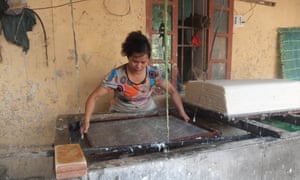
 Traditional Vietnamese paper-making
Social enterprise is keeping traditional paper-making alive. Photograph: Zó project

Tiếp tục đọc “It’s not charity: the rise of social enterprise in Vietnam”