
theconversation: The public gets a lot of its news and information from Facebook. Some of it is fake. That presents a problem for the site’s users, and for the company itself. Tiếp tục đọc “Three ways Facebook could reduce fake news without resorting to censorship”
Tác giả: Đào Thu Hằng
I'm from Hanoi, Viet Nam.
I'm an author of Dot Chuoi Non (dotchuoinon.com/author/hangbelu/), a blog on Positive thinking, founded by Dr. Tran Dinh Hoanh, an attorney in Washington DC.
I'm a co-founder of Conversations on Vietnam Development - cvdvn.net, a virtual think tank. I am a co-founder of two companies in Viet Nam working on children education services. I advise companies on STEAM education, English language education for children and students in Vietnam.
I'm studying the Buddha's teaching and the teaching of Jesus. I practice mindful living including meditation.
I hold a PhD on Sustainable Energy Systems from University of Lisbon and Aalto University.
I graduated from Hanoi University of Technology on Environmental Engineering. I obtained a Master degree of the same major from Stanford University and Nanyang Technological University.
My English-language blog at: hangbelu.wordpress/.
I play table tennis as a hobby.
This plastic toilet could save lives
January 22, 2016: 11:03 PM ET
 Jasmine Burton helped design an inexpensive, portable plastic toilet to address the lack of basic sanitation around the world
money.cnn.com: Everybody poops. But not everyone has access to a toilet.
“It’s shocking that this basic necessity is unavailable to nearly half of the world,” said Jasmine Burton, founder and president of Atlanta-based Wish for WASH. Tiếp tục đọc “This plastic toilet could save lives”
Mời tham dự buổi thảo luận: Tương lai của Du Học Sinh trong sự phát triển Việt Nam
[Scroll down for English version]
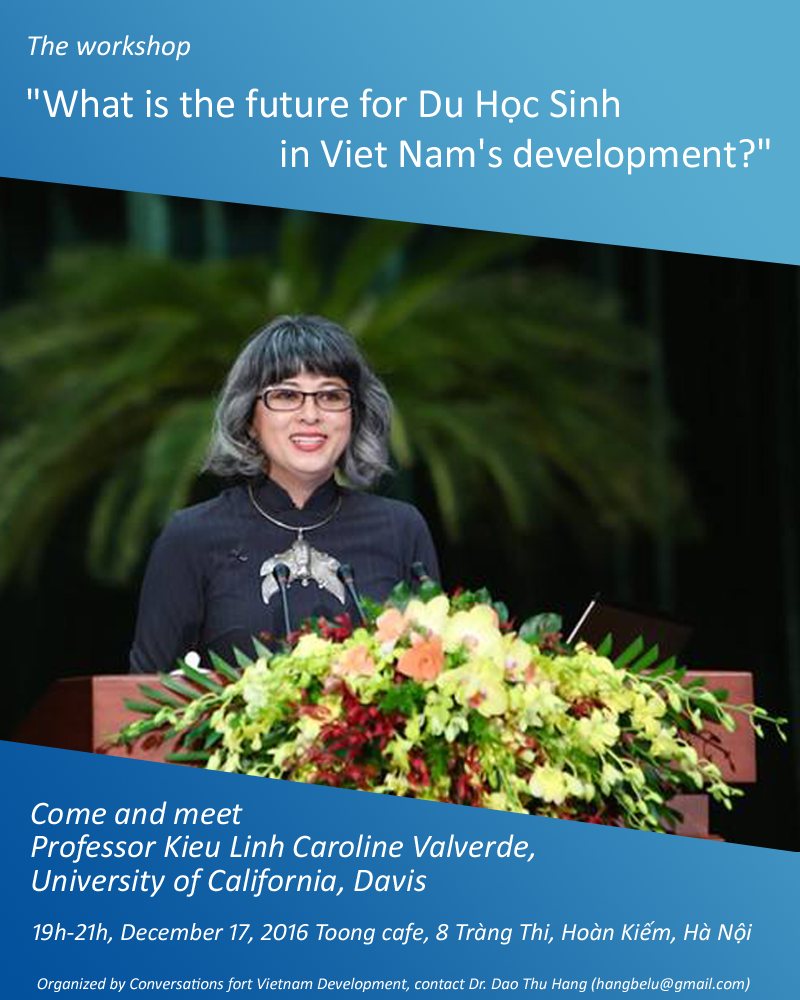
Chào các bạn,
Chị Kiều Linh là khách mời trong buổi thảo luận: Tương lai của Du Học Sinh trong sự phát triển Việt Nam do CVD tổ chức.
Chị Kiều Linh là Giáo sư Đại học UC Davis tại Mỹ, là chuyên gia nghiên cứu về người Mỹ gốc châu Á và dành nhiều thời gian nghiên cứu về mối quan hệ giữa Việt Nam và cộng đồng Việt kiều.
CVD rất vui khi đón tiếp các bạn tại Hà Nội. Tiếp tục đọc “Mời tham dự buổi thảo luận: Tương lai của Du Học Sinh trong sự phát triển Việt Nam”
Chính thức dừng dự án nhà máy điện hạt nhân Ninh Thuận
(NLĐO)- Nguyên nhân dừng dự án điện hạt nhân tại Ninh Thuận là do tình hình kinh tế – xã hội của nước ta đã thay đổi so với thời điểm quyết định chủ trương dự án năm 2009.

Bộ trưởng Mai Tiến Dũng chủ trì cuộc họp báo chuyên đề về điện hạt nhân Ninh Thuận
Bộ trưởng, Chủ nhiệm Văn phòng Chính phủ Mai Tiến Dũng tại buổi họp báo chuyên đề về điện hạt nhân chiều ngày 22-11 cho hay Quốc hội vừa biểu quyết thông qua Nghị quyết về việc dừng dự án điện hạt nhân tại Ninh Thuận. Tiếp tục đọc “Chính thức dừng dự án nhà máy điện hạt nhân Ninh Thuận”
Vietnam scraps nuclear power plans as costs double
reneweconomy_Vietnam has become the latest country to dump its nuclear power plans – and to rule nuclear out of its energy mix for the foreseeable future – after the the country’s National Assembly voted on Thursday to abandon plans to build two new plants in partnership with Russia and Japan.
The Vietnamese government said in a statement that the decision, made in a closed session of parliament, was taken for economic reasons, after the price for the proposed plants – approved in 2009 – had doubled to nearly 400 trillion dong, or $US18 billion.

Tiếp tục đọc “Vietnam scraps nuclear power plans as costs double”
Transitioning to sustainable fisheries
Economist_Discussion at The Economist’s South-East Asia and Pacific Regional Fisheries Summit examined how the fisheries sector in Southeast Asia can become sustainable
The Asia-Pacific region dwarfs the rest of the world in seafood production and consumption. Almost 70% of the world’s fishing vessels are in Asia, placing intense pressure on fish stocks. Evidence of overfishing is widespread. Countries like Indonesia, whose territorial seas are vast and whose population depends on seafood for food security, are starting to search for solutions to the problem. With this in mind, the fisheries industry and financial and governance experts from around the world gathered on July 27th and 28th at The Economist’s South-East Asia and Pacific Regional Fisheries Summit to discuss how to speed the transition to sustainable fisheries in Southeast Asia.
Trawling through options Tiếp tục đọc “Transitioning to sustainable fisheries”
A Review of Issues and Challenges in Climate Change and Agriculture in Southeast Asia
Summary
This report covers the eleven countries in Southeast Asia, namely: Brunei, Cambodia, Indonesia, Lao PDR, Malaysia, Myanmar, the Philippines, Singapore, Thailand, Vietnam, and Timor-Leste. It identifies the current issues and challenges in the agriculture sector at the national and sub-regional levels given the issues of climate change, food security, and sustainable development. The report includes information on the anticipated impacts of climate change on agriculture and food security in the region, and on the ecosystems and communities most affected or most vulnerable. The current issues and challenges that hinder the strengthening of the ability to cope with climate change and its impacts are identified at the sub-regional and national levels, to include the following: Tiếp tục đọc “A Review of Issues and Challenges in Climate Change and Agriculture in Southeast Asia”
Election Eve 2016
I write these words from Bangkok, Thailand, on the eve of the 2016 presidential election in the United States. In about 32 hours, the entire global population will rejoice that the American election is finally, at last, over. If we put half the energy and ink that went into analysis of this election into actually addressing our problems, we might make some real progress. It has become nonsensical, the endless campaigning and jockeying. Do we really need two years to get to know our presidential candidates?
Thư gửi anh Vượng & Vingroup về Hanoi Cinematheque
Gửi anh Vượng,
Đầu tiên em xin được khẳng định rằng em vô cùng ngưỡng mộ anh từ những gì em biết (qua video, “quân” của anh nói…) Anh rất cởi mở, có tâm, có tầm, nên với sức mạnh của công nghệ và mạng xã hội, chắc anh sẽ đọc được những dòng này?
Cái ngày em nghe tin Hanoi Cinematheque sắp bị dẹp cho quy hoạch dự án của Vingroup, em cảm thấy như “người con Hà Tĩnh xa quê nghe tin bão về” ấy anh ạ. Em bàng hoàng, sửng sốt, bồn chồn, rồi rất buồn và bất lực! Tiếp tục đọc “Thư gửi anh Vượng & Vingroup về Hanoi Cinematheque”
Renewable Energy Benefits: Decentralised solutions in agri-food chain
The number of people without access to electricity is estimated at more than a billion, while almost 2.9 billion still rely on traditional, unsustainable biomass sources such as firewood for cooking and heating. About 80% of those lacking modern energy access live in rural areas, which also host more than 70% of the world’s poor.
Agriculture and related agri-food activities are at the heart of the rural economy. However, rural communities struggling with expensive or inadequate power supplies are often limited to producing low-quality goods with little diversity. Extending affordable, secure and environmentally sustainable energy to underserved rural areas can drive community development, strengthen livelihoods and improve the quality of life.
Off-grid renewables can support productive activity at all stages of the agri-food chain, from irrigation to support food production, through post-harvest processes, including agro-processing and food preservation for storage and transport. Modern renewable technologies also allow sustainable food preparation and cooking.
This IRENA study analyses the benefits of introducing off-grid technologies for agriculture. Maximising the benefits of decentralised renewables depends on effective policies and regulations, appropriate business models, and integrated resource management.
This publication is available as a PDF and as a digital product.
Americans and Russians see the world differently, and that’s hurting Syrians

theconversion_U.S. Secretary of State John Kerry recently said that he sometimes feels like he’s living in a “parallel universe” compared to his Russian counterpart when it comes to Syria.
This parallel universe can be explained by analyzing the strategic narratives of the United States and Russia since the end of the Cold War. Tiếp tục đọc “Americans and Russians see the world differently, and that’s hurting Syrians”
ENERGY INVESTMENTS IN A TRANSITIONING WORLD
https://theecoreport.com/energy-investments-in-a-transitioning-world/
The ECOreport interviews Laszlo Varro, Chief Economist of the International Energy Agency (IEA) about energy investments in a transitioning world
By Roy L Hales
Though most of the world’s energy investments are still in fossil fuels, their iron grip is weakening. The largest source of power investment was the $313 billion put into alternate energy sources like wind and solar. According to Laszlo Varro, Chief Economist of the International Energy Agency (IEA), last year there were more renewables coming online than the entire growth of the energy sector. In many developing countries, wind and solar are less expensive than using imported gas to produce electricity. Laszlo Varro, Chief Economist of the International Energy Agency, described energy investments as the world transitions to a low carbon economy.
Tiếp tục đọc “ENERGY INVESTMENTS IN A TRANSITIONING WORLD”
Artificial Intelligence’s Language Problem
technologyreview_About halfway through a particularly tense game of Go held in Seoul, South Korea, between Lee Sedol, one of the best players of all time, and AlphaGo, an artificial intelligence created by Google, the AI program made a mysterious move that demonstrated an unnerving edge over its human opponent.
Who are the future consumers of South-East Asia?
Weforum_As business leaders convene for the Kuala Lumpur meeting of the World Economic Forum, they have many uncertainties to ponder, from the trajectory of China’s economy to whether the new ASEAN Economic Community (AEC) launched at the start of the year will vault South-East Asia up to a new level of economic dynamism.
Demographics and the granularity of growth needs to be part of their thinking. The question today is not so much where to find entire growth markets, but which specific demographic groups have the most potential?
Radical demographic shifts are transforming consumer markets around the world. In the past, market growth was fuelled largely by expanding populations; today, incomes are the force to reckon with.
Tiếp tục đọc “Who are the future consumers of South-East Asia?”
Stunning photos of the vanishing tribes of Vietnam
Réhahn has been photographing the people of Vietnam’s tribes for the past five years.

Réhahn Croquevielle
Tiếp tục đọc “Stunning photos of the vanishing tribes of Vietnam”
 CVD
CVD 