Ấn phẩm đầu tiên của VN về kinh tế từ góc nhìn biến đổi khí hậu

Moitruongvadothi.vn

Cuốn sách chuyên khảo “Kinh tế và Chính sách Biến đổi khí hậu” do GS.TS. Trần Thọ Đạt và TS. Vũ Thị Hoài Thu biên soạn được Nhà xuất bản Đại học Kinh tế Quốc dân ấn hành năm 2017 là ấn phẩm đầu tiên ở Việt Nam trình bày chuyên sâu về các khía cạnh kinh tế và chính sách của vấn đề biến đổi khí hậu toàn cầu.

Cuốn sách gồm 10 chương và được cấu trúc thành 3 phần, tập trung giải thích tính toàn cầu của vấn đề biến đổi khí hậu, phân tích các khía cạnh kinh tế của biến đổi khí hậu, trình bày các nội dung về kinh tế học giảm nhẹ biến đổi khí hậu và kinh tế học thích ứng với biến đổi khí hậu, phân tích các chính sách biến đổi khí hậu và hành động quốc tế về biến đổi khí hậu.

Các nội dung này được trình bày trên cả phương diện lý luận và thực tiễn, bao gồm thực tiễn ở cấp quốc gia, khu vực và toàn cầu. Tính toàn cầu, hiệu quả và công bằng là những tư tưởng xuyên suốt của kinh tế và chính sách biến đổi khí hậu.
Theo nhận xét của giới chuyên gia, kinh tế và chính sách biến đổi khí hậu là một lĩnh vực nghiên cứu rất rộng và phức tạp, huy động các ý tưởng và kỹ thuật phân tích từ rất nhiều lĩnh vực khác nhau của khoa học kinh tế như tăng trưởng và phát triển, công nghiệp, đổi mới và thay đổi công nghệ, thể chế, kinh tế quốc tế, tài chính công, thông tin và không chắc chắn, kinh tế môi trường và kinh tế công cộng. Tiếp tục đọc “Ấn phẩm đầu tiên của VN về kinh tế từ góc nhìn biến đổi khí hậu”

Biến đổi khí hậu đã tác động đến Việt Nam như thế nào?

Do ảnh hưởng của nước biển dâng, hiện các nhà dân ở chân cầu Dần Xây (huyện Cần Giờ, TPHCM) lúc triều cao bị ngập đến 1,7m khiến việc sinh hoạt, đi lại rất khó khăn. Ảnh: MINH QUÂN

The Climate – Justice – Cooperation Nexus: 10 Cornerstones of the Great Transformation towards Sustainability

IIASA

The challenge of our generation: Avert dangerous global warming – invest in social cohesion and wellbeing of people – build local, national, and transnational alliances for transformative change towards sustainability

1. We can reach the goals of the Paris Agreement – but ambitious action is needed now! Climate change is a threat to humanity. Irreversible Earth systems changes need to be avoided. This is a civilisational challenge which requires unprecedented joint action around the globe. We are under huge time pressure. Global CO2 emissions must decline to zero by mid-century in order to achieve the ambitious Paris goal, aimed at stabilising the global mean temperature well below 2 degrees C, and if possible at 1.5 degrees C. This translates into a stylised “carbon law”, whereby emissions must be halved every decade in analogy to the Moore’s law of semiconductors. We have the resources and the technology to achieve this, but do we have the political will and the resolve? Recent developments, such as the declaration by the US President to withdraw from the Paris Agreement, can be interpreted as a major setback. At the same time, they may inspire counter-movements, strengthening the determination to vigorously combat climate change. In particular, OECD countries and emerging economies should make commitments within the G 20 and within their national policies to ensure the achievement of global decarbonisation by the middle of the century. Tiếp tục đọc “The Climate – Justice – Cooperation Nexus: 10 Cornerstones of the Great Transformation towards Sustainability”

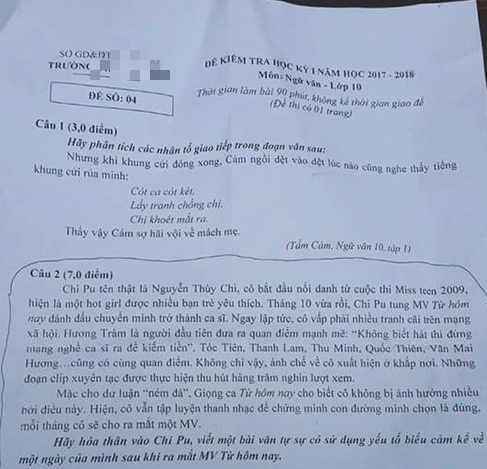
Đề thi Văn Lớp 10 yêu cầu HS hóa thân vào Chi Pu kể về cảm xúc khi bị Hương Tràm đá xéo

Hồng Đăng | 

soha_Sau khi xuất hiện trong đề thi môn tài chính ngân hàng, mới đây, Chi Pu lại tiếp tục được đưa vào trong đề kiểm tra 90 môn Ngữ văn của một trường THPT tại Phú Thọ.

Chi Pu chính thức debut với vai trò ca sĩ hôm 10/10. MV “Từ hôm nay” (Feel Like Ooh), sản phẩm âm nhạc đầu tay của Chi Pu tính đến thời điểm hiện tại đã có hơn 12 triệu view trên Youtube. Liên tục sau đó, Chi Pu nhận được nhiều ý kiến trái chiều từ khán giả.

 Tuy nhiên, mặc cho dư luận chê bai, Chi Pu vẫn chăm chỉ thực hiện kế hoạch dài hơn mà mình đề ra. Cụ thể, cô vừa tiếp tục “tấn công” showbiz bằng MV khoe vũ đạo hút hồn. Thậm chí, người đẹp sinh năm 1993 còn tuyên bố dù ai nói gì thì cô vẫn quyết định mỗi tháng đều ra một sản phẩm âm nhạc để “đập tan” định kiến trái chiều của khán giả nghe nhạc.

Sau khi bất ngờ xuất hiện trong đề thi môn tài chính ngân hàng, mới đây, Chi Pu lại tiếp tục xuất hiện trong đề kiểm tra môn Ngữ văn của trường THPT Hạ Hòa, Phú Thọ khiến dân mạng lại một lần nữa xôn xao.

Đề thi Văn Lớp 10 yêu cầu HS hóa thân vào Chi Pu kể về cảm xúc khi bị Hương Tràm đá xéo - Ảnh 3.

Đề kiểm tra môn Ngữ văn đang khiến dân tình xôn xao

Tiếp tục đọc “Đề thi Văn Lớp 10 yêu cầu HS hóa thân vào Chi Pu kể về cảm xúc khi bị Hương Tràm đá xéo”

111 – tổng đài quốc gia bảo vệ trẻ em

TTO – Phó thủ tướng Vũ Đức Đam, chủ tịch Ủy ban Quốc gia về trẻ em Việt Nam, đã bấm nút, chính thức khai trương tổng đài điện thoại bảo vệ trẻ em 111, sáng 6-12.

111 - tổng đài quốc gia bảo vệ trẻ em - Ảnh 1.

tuoitre.vn _ Phó thủ tướng Vũ Đức Đam cùng đại biểu quốc tế, đại diện trẻ em cùng lãnh đạo các bộ, ngành trung ương đã chính thức khai trương tổng đài điện thoại bảo vệ trẻ em sáng 6-12 – Ảnh: Đ.BÌNH

Tiếp tục đọc “111 – tổng đài quốc gia bảo vệ trẻ em”

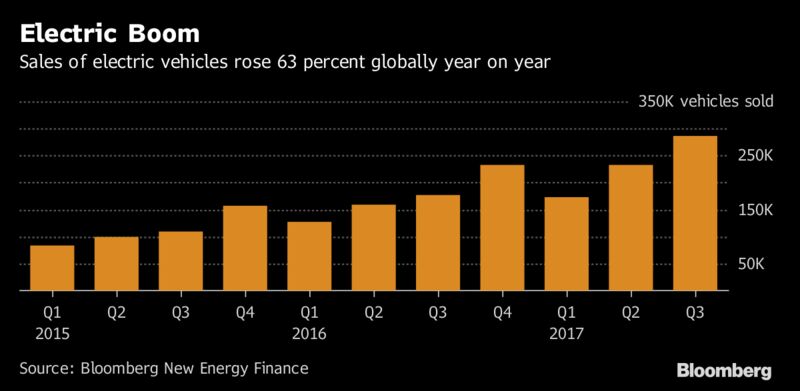
Global Electric Car Sales Jump 63 %

  • China made more than half of EV purchases in the third quarter
  • Bloomberg New Energy Finance expects 1 million sold this year

Electric vehicles sales surged to a record in the third quarter, largely driven by strong demand in China.

Sales of battery electric vehicles and plug-in hybrids exceeded 287,000 units in the three months ended in September, 63 percent higher than the same quarter a year ago and up 23 percent from the second quarter, according to a report released Tuesday by Bloomberg New Energy Finance. China accounted for more than half of global sales as its market for electric cars doubled amid government efforts to curb pollution.

“The Chinese government is very focused on pushing up EV sales,” said Aleksandra O’Donovan, advanced transport analyst at BNEF and one of the authors of the report. “One reason for that is the local pollution levels in the cities, and a second is for China to build domestic heroes to compete internationally in this market.”

BNEF expects global EV sales to surpass 1 million units this year for the first time. The market for electrified transport is starting to pick up speed as charging infrastructure becomes more accessible and manufacturers roll out models with longer driving ranges. In 2017, many established carmakers from Jaguar Land Rover to Volvo Cars announced plans to bring electric versions of their vehicles to market in the next few years. Tiếp tục đọc “Global Electric Car Sales Jump 63 %”

The architecture of resilience

Published on Monday, 04 December 2017

View of Chandigarh High Court from Secretariat. Photo by Eduardo Guiot.

ADB.org_Southern Meghalaya in far northeastern India is one of the wettest places on Earth, crisscrossed by fast-flowing rivers and mountain streams. Here bridges aren’t built – they’re grown, ensuring connectivity in a remote area.

Local tribes identified a species of Indian rubber tree with an incredibly strong root system that flourishes in this region. The roots of the ficus elastic grow on huge boulders along the riverbanks, or even in the middle of the rivers.

To make the roots grow in the right direction, local tribes use different techniques from simply pulling the roots to tying or twisting them, until over time the roots formed the desired architectural structure.

Root bridges, also used in Indonesia, are a great example of how green infrastructure can provide alternative solutions to deliver sustainable connectivity. The normal course in Meghalaya would have been a bridge, but that would have been difficult and expensive in such areas.

  Green infrastructure not yet core part of urban infrastructure planning

Unfortunately, this approach is the exception rather than the rule. Green infrastructure today falls short of being a part of urban infrastructure core planning and asset inventory. It lacks provisions for long-term maintenance and management, as is done for other essential services.

When I studied architecture and urban planning in Chandigarh, an Indian city designed in 1966 by the famous Swiss-French architect Le Corbusier, I realized that cities are like people. They have interlinked systems with dependencies on nature – land, air, and water. Tiếp tục đọc “The architecture of resilience”

Time’s Person of the Year for 2017 – the Silence Breakers – is a movement

TIME’S EDITOR-IN-CHIEF ON WHY THE SILENCE BREAKERS ARE THE PERSON OF THE YEAR

//players.brightcove.net/293884104/SJa0Thl7_default/index.html?videoId=5669003691001

It became a hashtag, a movement, a reckoning. But it began, as great social change nearly always does, with individual acts of courage. The actor who went public with the story of movie mogul Harvey Weinstein’s “coercive bargaining” in a Beverly Hills hotel suite two decades earlier. The strawberry picker who heard that story and decided to tell her own. The young engineer whose blog post about the frat-boy culture at Silicon Valley’s highest-flying startup prompted the firing of its founder and 20 other employees. The California lobbyist whose letter campaign spurred more than 140 women in politics to demand that state government “no longer tolerate the perpetrators or enablers” of sexual misconduct. A music superstar’s raw, defiant court testimony about the disc jockey who groped her.

Gánh nặng bệnh tật do nhiệt điện đốt than ở Đông Nam Á – Burden of Disease from Rising Coal-Fired Power Plant Emissions in Southeast Asia

 Department of Earth and Planetary Sciences, Harvard University, Cambridge, Massachusetts 02138 United States
 John A. Paulson School of Engineering and Applied Sciences, Harvard University, Cambridge, Massachusetts 02138 United States
§ Greenpeace International, 1066 AZ Amsterdam, The Netherlands
 Department of Geography, University of Colorado, Boulder, Colorado 80309 United States
Environ. Sci. Technol.201751 (3), pp 1467–1476
DOI: 10.1021/acs.est.6b03731
Publication Date (Web): January 12, 2017
Copyright © 2017 American Chemical Society
*Phone: 617 496 9428; e-mail: skoplitz@fas.harvard.edu.

ACS AuthorChoice – This is an open access article published under an ACS AuthorChoice License, which permits copying and redistribution of the article or any adaptations for non-commercial purposes.

Abstract

Abstract Image

Southeast Asia has a very high population density and is on a fast track to economic development, with most of the growth in electricity demand currently projected to be met by coal. From a detailed analysis of coal-fired power plants presently planned or under construction in Southeast Asia, we project in a business-as-usual scenario that emissions from coal in the region will triple to 2.6 Tg a–1 SO2 and 2.6 Tg a–1 NOx by 2030, with the largest increases occurring in Indonesia and Vietnam. Simulations with the GEOS-Chem chemical transport model show large resulting increases in surface air pollution, up to 11 μg m–3 for annual mean fine particulate matter (PM2.5) in northern Vietnam and up to 15 ppb for seasonal maximum 1 h ozone in Indonesia. We estimate 19 880 (11 400–28 400) excess deaths per year from Southeast Asian coal emissions at present, increasing to 69 660 (40 080–126 710) by 2030. 9000 of these excess deaths in 2030 are in China. As Chinese emissions from coal decline in coming decades, transboundary pollution influence from rising coal emissions in Southeast Asia may become an increasing issue.

Tiếp tục đọc “Gánh nặng bệnh tật do nhiệt điện đốt than ở Đông Nam Á – Burden of Disease from Rising Coal-Fired Power Plant Emissions in Southeast Asia”

German villages go 100% renewable

Thermal solar plant at Neuerkirch, Germany, part of the country’s transition towards clean energy. [AEE/Adelphi/Tobias Vollmer]

Local communities are at the forefront of the clean energy transition in Germany, with some villages relying 100% on renewables. EURACTIV Slovakia spoke to mayors there.

Neuerkirch and Külz are two small villages in Western Germany – of 300 and 500 souls respectively. And yet, they feel a part of something bigger that goes even beyond the country’s energy transition, the ‘Energiewende’. Tiếp tục đọc “German villages go 100% renewable”

EU mandatory register for lobbyists, a baby step towards full transparency

Lobbyisten sehen sich bei Querschnittspolitikbereichen zunehmend nach strategischen Verbündeten um.

This article is part of our special report Lawmaking in the dark.

Over time, the business of influence has been honed into a fine art in Western democracies. But that art is becoming increasingly regulated, even if the average citizen perceives lobbyists as cigar-smoking men in suits wining and dining lawmakers to gain an unfair advantage.

What they may not think of is the long-haired environmentalist who is pushing for renewable energy support, or the farmer who is trying to explain to his MP why a new pesticide regulation could put him out of business. Tiếp tục đọc “EU mandatory register for lobbyists, a baby step towards full transparency”

Ocean plastic pollution – what role can social science play?

29 November 2017

IDS is partnering with the EU, UN, Chatham House and other organisations to host a high level side event on circular economy solutions to tackling ocean plastic pollution, during this year’s United Nations Environment Assembly in Nairobi (4-6 December). The event will showcase specific examples of collaborative action and policies that aim to reduce plastic waste, address unsustainable consumption and production patterns and redirect investment for a clean, efficient and circular economy. Ahead of the event, I want to highlight the importance of a universal development approach and transformative social science research, as solutions to the ocean plastics problem.

A large sculpture of a shark made out of plastic waste found in the ocean.

Ocean plastics pollution – not just an environmental issue

Plastics pollution of oceans has emerged as a major global environmental crisis. Between 4.8 and 12.7 million tonnes of plastics enter the ocean each year. It is devastating for marine ecosystems and the accumulation of microplastics in food chains pose a risk to human health. And the issue is becoming more serious.  By 2050, plastics production is expected to increase to over 2000 tonnes per year, up from 311 million tonnes in 2014.

Plastics end up in the ocean as the result of chains of human activities in different parts of the world. We are all contributing to it. China, Indonesia and the Philippines have been identified as the top three sources of ocean plastics pollution by the Ocean Conservancy. While litter found on the sea floor around the UK has risen 150% in the last year and UK plastic waste drifts to the artic where is has a very damaging impact on one of the most vulnerable ecosystems in the world.

Tiếp tục đọc “Ocean plastic pollution – what role can social science play?”

Conserving Forests Could Cut Carbon Emissions As Much As Getting Rid of Every Car on Earth

Globalforestwatch.org

By Susan MinnemeyerNancy Harris and Octavia Payne

Cantonal Hojancha was once a major cattle ranching region. Most of this area was cleared for pasture only 30 years ago. Now, many of the residents have moved into the service industry, and the pasture land has slowly converted back to forest. Photo by Aaron Minnick (World Resources Institute)

New analysis from The Nature Conservancy, WRI and others estimates that stopping deforestation, restoring forests and improving forestry practices could cost-effectively remove 7 billion metric tons of carbon dioxide annually, or as much as eliminating 1.5 billion cars—more than all of the cars in the world today!

In fact, forests are key to at least six of the study’s 20 “natural climate solutions,” which could collectively reduce 11.3 billion metric tons of greenhouse gas emissions per year. That’s as much as halting global oil consumption, and would get us one-third of the way toward limiting global warming to 2 degrees C (3.6 degrees F) above pre-industrial levels — the threshold for avoiding catastrophic effects of climate change — by 2030.

Stopping Deforestation Offers the Biggest Benefit

Tiếp tục đọc “Conserving Forests Could Cut Carbon Emissions As Much As Getting Rid of Every Car on Earth”

Những vấn đề pháp lý thực tế của Trí tuệ nhân tạo – Artificial Intelligent

English: Artificial Intelligence: The Real Legal Issues

Nếu bạn đang đọc bài này, rất có thể bạn sẽ bắt gặp khái niệm Trí tuệ Nhân tạo – AI/Artificial Intelligent trong các nghiên cứu của mình. Giống như hầu hết các vấn đề thời thượng, có rất nhiều bài viết về chủ đề này chia thành hai loại – tài liệu hoặc giả định một mức độ kiến ​​thức dựa trên khoa học máy tính hoặc thông thường hơn là phần mềm bán hàng được cải trang dạng mỏng mà không truyền tải được nhiều.

Bài báo này dựa trên bài thuyết trình mà tôi trình bày tại Hội nghị thường niên của SCL Viện Kỹ thuật London vào tháng 6 và hy vọng sẽ cung cấp cho những người không có kiến thức và kinh nghiệm (và người có một ít kiến thức) một nền tảng vững chắc để có thể dựa vào đó để có những hiểu biết và đánh giá thực tiễn về những rủi ro pháp lý khi sử dụng trí tuệ nhân tạo. Vì vậy, bài viết sẽ hy vọng sẽ được tiếp cận được với những người có tư duy pháp lý khi quan tâm đến công nghệ này.

 Những rủi ro pháp lý mà tôi đã phân loại thành “Thách thức nguyên nhân – hệ quả” và “Thách thức về Dữ liệu lớn” Tiếp tục đọc “Những vấn đề pháp lý thực tế của Trí tuệ nhân tạo – Artificial Intelligent”