
JUNE 20, 2024 | VIEW IN BROWSER | SUBSCRIBE
By Amy Mackinnon and Jack Detsch
Welcome back to Foreign Policy’s SitRep.
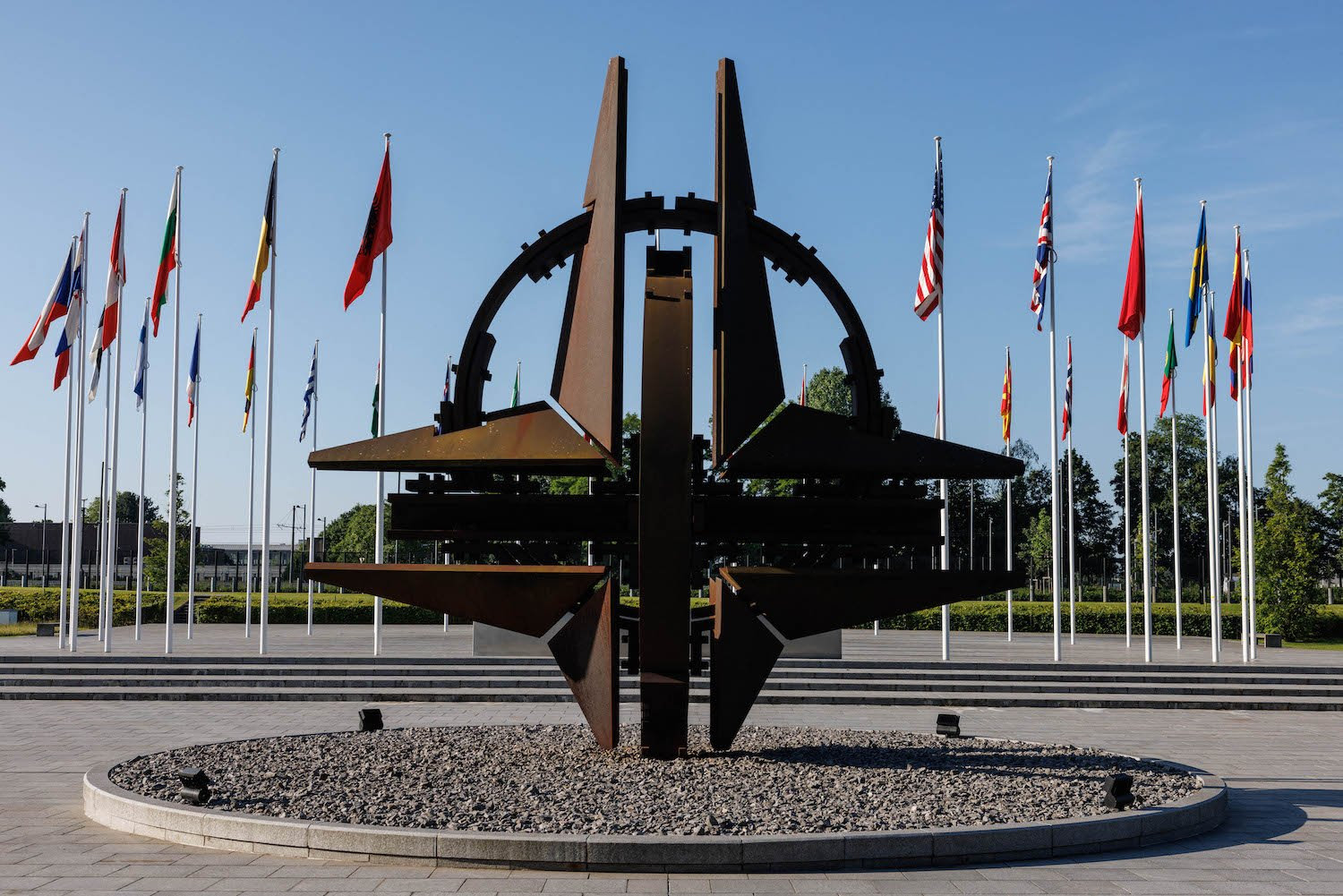
Flagpoles bearing national flags of NATO members adorn the entrance of NATO Headquarters in Brussels on June 13, 2024.SIMON WOHLFAHRT/AFP via Getty Images
NATO Secretary-General Jens Stoltenberg was in Washington this week, dotting i’s and crossing t’s ahead of the upcoming Washington NATO summit next month.
In a speech at the Wilson Center on Monday, Stoltenberg announced that a record number of NATO allies, more than 20 in all, will this year meet the alliance’s 2 percent defense spending goals, up from just three countries a decade ago, when the targets were first put in place. The alliance confirmed in newly released statistics that 23 nations will hit the mark.
Stoltenberg underscored the increased contributions of European allies as U.S. Republican presidential candidate Donald Trump suggested he would not defend NATO members that fail to meet minimum spending requirements.
“Europeans are doing far more for their collective security than just a few years ago,” Stoltenberg said.
The increase has also been a boon for U.S. businesses, he noted. “Much of this extra money is spent here in the United States,” he said. Over the last two years, more than two-thirds of European defense acquisitions—over $140 billion worth of contracts—have been made with U.S. firms. “NATO is good for U.S. security, good for U.S. industry, and good for U.S. jobs,” he said.
The Financial Times reported earlier this week that U.S. and European defense companies are on a hiring spree, recruiting workers at the fastest rate since the end of the Cold War, boosted by increased defense spending in the wake of Russia’s invasion of Ukraine and general global unease. U.S. behemoths Lockheed Martin, Northrop Grumman, and General Dynamics have close to 6,000 job openings.
The war in Ukraine will be top of the agenda at the NATO summit next month, which is set to start on July 9. The alliance will be taking over from Washington in coordinating military aid support and training for Ukraine to ensure continuity in Western support for Kyiv and insulate it from political headwinds in the United States and Europe.
Stoltenberg is also seeking an agreement on a financial pledge for Ukraine of some 40 billion euros annually, although the details are still being hashed out by allies ahead of the summit.
Signaling tectonic shifts in global security, the third item on the trans-Atlantic alliance’s agenda for the meeting next month will be global partnerships with a particular focus on the Indo-Pacific. “The war in Ukraine demonstrates that our security is not regional, it is global,” said Stoltenberg, pointing to Beijing’s support for Russia during the war.
“China is fueling the largest armed conflict in Europe since World War II,” he said.
The summit will be Stoltenberg’s last as secretary-general, after leading the alliance for a decade. He is expected to step down by Oct. 1. In the race to be his successor, Klaus Iohannis withdrew his candidacy on Thursday, leaving outgoing Dutch Prime Minister Mark Rutte as sole contender. He is expected to be confirmed as Stoltenberg’s successor in the coming days.
Rutte is a veteran of European politics, having served as prime minister of the Netherlands since 2010. Rutte’s candidacy was favored by some of NATO’s biggest member states, including the U.S., U.K., France, and Germany, although allies on the eastern flank sought a candidate from the region.
Rutte has been described as a “Trump whisperer” and will likely have his work cut out for him in the event of a second Trump presidency, said Jim Townsend, former deputy assistant secretary of defense for European and NATO policy. “I think Rutte, being the clever politician that he is, should be able to handle Donald Trump, at least the one we saw four years ago,” he said. “However, a Trump 2.0 will be surrounded by loyalists and more savvy about how to get his way and who his enemies are. That may make him harder to handle.”
FP Security Forum
Warfare has evolved since NATO’s founding 75 years ago, and the next 75 years promise even more changes in battlefield tactics and technologies. On July 8th, join Foreign Policy’s Security Forum to examine how the U.S. and its NATO allies can adapt in the face of uncertainty. Register no

 CVD
CVD 