While China’s use of maritime gray zone tactics is well known, few resources describe the actual tactics in detail. We’ve developed a publicly available systematic examination of these concrete tactics, which we will roll out for you in the coming weeks.
Gaute Friis | JULY 6, 2023
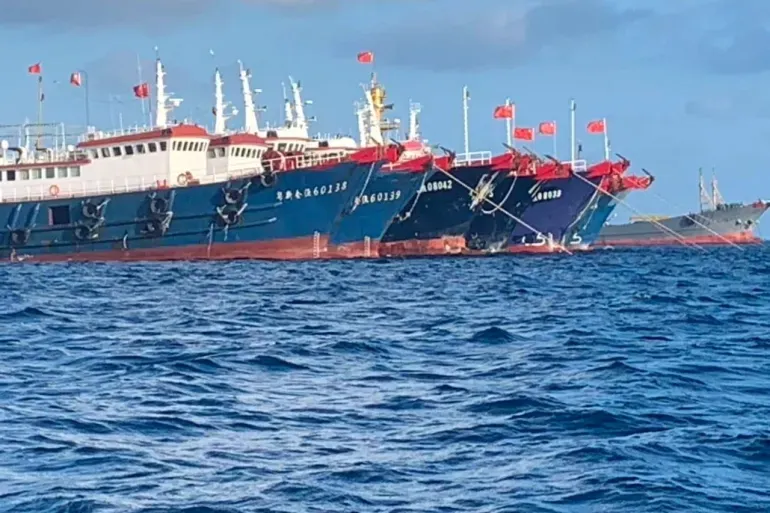
Chinese fishing vessels leave port in Fujian Province in August 2020 (Source: US Naval Institute)
Gaute Friis
Analyst
Yes, there is a playbook!
The Chinese party-state is using coast guard cutters and militarized fishing vessels (maritime militia) to enforce expansive and illegal territorial claims in the South China Sea (SCS). These “gray zone” tactics enable Beijing to gradually force other actors out of waters claimed by China, while at the same time avoiding all-out armed conflict.
While Beijing’s use of gray zone tactics is well known, it can be hard to find resources that describe these tactics in detail. These tactics are without clear precedent in nautical history, as China has invented a novel suite of maneuvers and methods to press its expansionary claims.
That’s why we have developed a new resource: China’s Maritime Gray Zone Tactics Playbook—a publicly available, systematic examination of these tactics. We’ve examined hundreds of known incidents and identified a suite of 18 core tactics used by Beijing’s gray zone actors. Over the coming weeks we will publish descriptions and examples of each of the tactics, including how and why China uses each of them to achieve its goal to dominate its maritime approaches.
Our goal is to equip journalists, researchers, analysts and the general public to better comprehend and identify the nature of activities—which often defy conventional explanation—that are visible through satellite photography, automatic information system (AIS) vessel tracking data, and on-the-ground reporting.
Descriptions are currently available for the following tactics:
I am an attorney in the Washington DC area, with a Doctor of Law in the US, attended the master program at the National School of Administration of Việt Nam, and graduated from Sài Gòn University Law School. I aso studied philosophy at the School of Letters in Sài Gòn.
.
I have worked as an anti-trust attorney for Federal Trade Commission and a litigator for a fortune-100 telecom company in Washington DC.
I have taught law courses for legal professionals in Việt Nam and still counsel VN government agencies on legal matters.
I have founded and managed businesses for me and my family, both law and non-law.
I have published many articles on national newspapers and radio stations in Việt Nam.
In 1989 I was one of the founding members of US-VN Trade Council, working to re-establish US-VN relationship.
Since the early 90's, I have established and managed VNFORUM and VNBIZ forum on VN-related matters; these forums are the subject of a PhD thesis by Dr. Caroline Valverde at UC-Berkeley and her book Transnationalizing Viet Nam.
I translate poetry and my translation of "A Request at Đồng Lộc Cemetery" is now engraved on a stone memorial at Đồng Lộc National Shrine in VN.
I study and teach the Bible and Buddhism. In 2009 I founded and still manage dotchuoinon.com on positive thinking and two other blogs on Buddhism.
In 2015 a group of friends and I founded website CVD - Conversations on Vietnam Development (cvdvn.net).
I study the art of leadership with many friends who are religious, business and government leaders from many countries.
I have written these books, published by Phu Nu Publishing House in Hanoi:
"Positive Thinking to Change Your Life", in Vietnamese (TƯ DUY TÍCH CỰC Thay Đổi Cuộc Sống) (Oct. 2011)
"10 Core Values for Success" (10 Giá trị cốt lõi của thành công) (Dec. 2013)
"Live a Life Worth Living" (Sống Một Cuộc Đời Đáng Sống) (Oct. 2023)
I practice Jiu Jitsu and Tai Chi for health, and play guitar as a hobby, usually accompanying my wife Trần Lê Túy Phượng, aka singer Linh Phượng.
Xem tất cả bài viết bởi Trần Đình Hoành



 CVD
CVD 