
Improved aid access means there is no longer famine in Gaza, but the war-ravaged territory still faces emergency conditions, a UN-backed global hunger monitor said on Friday. Israel denied that there is a food shortage in Gaza, where around 1.6 million people are expected to face crisis levels of food insecurity in the coming months.
Thẻ: War crime – starving people
Is it too late for Gaza’s Children
| Thomson Reuter Foundation | |
| By Sadiya Ansari | Contributor | |
| This newsletter contains images that may be disturbing. Harrowing images of malnourished children in Gaza have intensified international pressure on Israel to increase humanitarian aid to the enclave.This week, Hamas-run health authorities in Gaza said that 93 children were among the 180 people who have already died from hunger-related causes. These deaths come on top of more than 60,000 Palestinians, mostly civilians, the health authorities in Gaza say have been killed since Israel launched its military offensive in the strip in October 2023. Almost 470,000 people in Gaza are enduring famine-like conditions, according to the World Health Organization (WHO), with 90,000 women and children in need of specialist nutrition treatments. WHO chief Tedros Adhanom Ghebreyesus described the situation as “mass starvation” that was “man-made”, laying the blame squarely at the Israeli blockade.While Israel has denied a policy of starvation, it controls most aspects of how food reaches and is distributed in Gaza. This includes access into Gaza, transport logistics and who is permitted to distribute aid. Today we’ll unpack the policy on aid entering the territory. 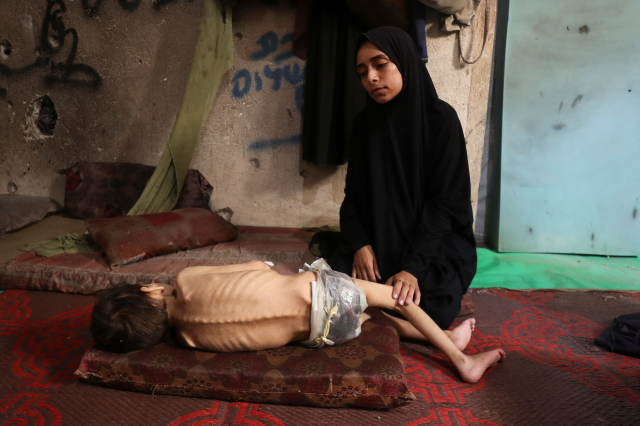 A Palestinian mother sits next to her malnourished son, at a school where they shelter amid a hunger crisis, in Gaza City, July 24, 2025. REUTERS/Mahmoud Issa A Palestinian mother sits next to her malnourished son, at a school where they shelter amid a hunger crisis, in Gaza City, July 24, 2025. REUTERS/Mahmoud IssaThe policy Israel controls access into Gaza, including for humanitarian organisations, as a result of a blockade by land, air and sea<a | |
The mathematics of starvation: how Israel caused a famine in Gaza
Israel controls the flow of food into Gaza. It has calculated how many calories Palestinians need to stay alive. Its data shows only a fraction has been allowed in
Emma Graham-Harrison Chief Middle East correspondentThu 31 Jul 2025 15.49 BSTShare
The mathematics of famine are simple in Gaza. Palestinians cannot leave, war has ended farming and Israel has banned fishing, so practically every calorie its population eats must be brought in from outside.
Israel knows how much food is needed. It has been calibrating hunger in Gaza for decades, initially calculating shipments to exert pressure while avoiding starvation.
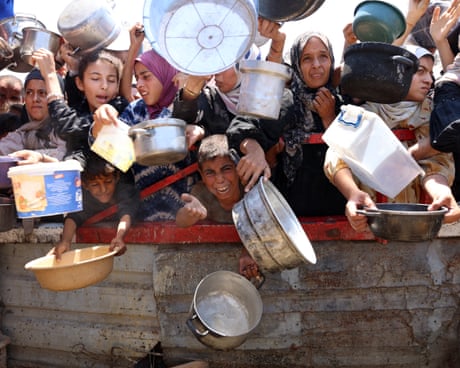
“The idea is to put the Palestinians on a diet, but not to make them die of hunger,” a senior adviser to the then prime minister, Ehud Olmert, said in 2006. An Israeli court ordered the release of documents showing the details of those macabre sums two years later.
Cogat, the Israeli agency that still controls aid shipments to Gaza, calculated then that Palestinians needed an average minimum 2,279 calories per person per day, which could be provided through 1.836kg of food.
Today, humanitarian organisations are asking for an even smaller minimum ration: 62,000 metric tonnes of dry and canned food to meet basic needs for 2.1 million people each month, or around 1kg of food per person per day.
Tiếp tục đọc “The mathematics of starvation: how Israel caused a famine in Gaza”
I see Gaza
I See Gaza | EP 1: From Oslo’s Streets to Gaza
See Gaza’s first episode takes us to Oslo, where artists, students, and citizens fill the streets in support of Gaza. Though far from Palestine, their voices echo beyond Norway’s borders. Watch the first episode to see how they demand justice, resist violence, and call for accountability. Tiếp tục đọc “I see Gaza”
Gaza hunger crisis: Desperate crowds storm US aid distribution site in Rafah as operation collapses
May 27, 2025 #Palestine #Israel #Gaza
Chaotic scenes unfolded in Rafah, southern Gaza, as Palestinians rushed a US aid distribution site in Tal as-Sultan, prompting American security personnel to fire warning shots. Israeli forces reportedly intervened remotely to disperse crowds. Israeli Army radio cited security sources distancing Israel from the incident while confirming US contractors regained control. The aid was distributed by the Gaza Humanitarian Foundation, a controversial organisation established after Israel blocked UN access in March. Footage shows desperate civilians amid strict aid restrictions. The foundation’s private contractor-led operations have drawn criticism for lacking UN neutrality protocols. This incident highlights escalating tensions over aid delivery in the besieged enclave.
Al Jazeera’s correspondents are tracking developments across key locations, including Hind Khoudary and Hani Mahmoud in Gaza, and Kristen Saloomey at the United Nations in New York. We’re also joined by analysts and experts: Tamer Qarmout, Associate Professor of Public Policy at the Doha Institute for Graduate Studies, speaking from Doha; Ahmed Bayram, Middle East Spokesperson for the Norwegian Refugee Council, joining us from Amman; and Chris Gunness, former Chief Spokesperson for the United Nations Relief and Works Agency for Palestine Refugees, speaking from London.
Palestinians in Gaza are facing a death sentence
Doctors Without Borders / MSF-USA
We are running out of time to save lives. The humanitarian situation in Gaza is catastrophic, as a result of the ongoing Israeli-imposed siege that has lasted for over two months. We call on the Israeli authorities and their supporters to abide by International Humanitarian Law and follow the principles which allow for unhindered humanitarian aid for people trapped inside the Strip. Tiếp tục đọc “Palestinians in Gaza are facing a death sentence”
Gaza: Aid groups running out of food
For nearly 60 days, no food, fuel, medicine or other item has entered the Gaza Strip, blocked by Israel. Aid groups are running out of food to distribute. Markets are nearly bare. Palestinian families are left struggling to feed their children. We discussed that with out guest Arwa Damon, founder of the International Network for Aid, Relief and Assistance (INARA)
The World Food Programme runs out of food in Gaza as Israeli blockade continues
The World Food Programme has run out of food 54 days after Israel imposed a complete blockade on the Gaza Strip. NBC News’ Matt Bradley reports on what families in Gaza are facing as Israel’s blockade continues.
WFP runs out of food stocks in Gaza, warns of famine
Starving civilians is an ancient military tactic, but today it’s a war crime in Ukraine, Yemen, Tigray and elsewhere

Dogukan Keskinkilic/Anadolu Agency via Getty Images“>
Published: June 21, 2022 12.51pm BST The Conversation
Authors
- Tom DannenbaumAssociate Professor of International Law, Tufts University
- Alex De WaalResearch Professor and Executive Director of the World Peace Foundation at The Fletcher School, Tufts University
- Daniel MaxwellHenry J. Leir Professor in Food Security, Friedman School of Nutrition Science and Policy, Tufts University
Disclosure statement
Alex de Waal is affiliated with the World Peace Foundation.
Daniel Maxwell receives funding from the US Agency for International Development (USAID) and the British Foreign, Commonwealth and Development Office (FCDO). He is a member of the Famine Review Committee for IPC analysis.
Tom Dannenbaum does not work for, consult, own shares in or receive funding from any company or organisation that would benefit from this article, and has disclosed no relevant affiliations beyond their academic appointment.
Partners
Tufts University provides funding as a founding partner of The Conversation US.
 We believe in the free flow of information
Republish our articles for free, online or in print, under Creative Commons licence.
______
A hideous contradiction is playing out in war-torn Ukraine. Thousands of Ukrainians are starving in cities besieged by Russian forces. Meanwhile, the country’s grain stores are bursting with food, and the government is begging for international assistance to export Ukrainian grain to world markets.
Tiếp tục đọc “Starving civilians is an ancient military tactic, but today it’s a war crime in Ukraine, Yemen, Tigray and elsewhere” CVD
CVD 