“WHO khuyến cáo, Việt Nam cần xây dựng lộ trình thuế suất thuế tiêu thụ đặc biệt với đồ uống có đường để đến năm 2030 thuế suất đạt 20% giá bán lẻ (tương đương mức thuế tiêu thụ đặc biệt 40% theo giá xuất xưởng ở Việt Nam). Đây là mức thuế đủ mạnh để đạt hiệu quả bảo vệ sức khỏe theo khuyến cáo của WHO.”
TP – Với gần một triệu doanh nghiệp, khoảng 5 triệu hộ kinh doanh cá thể, khu vực kinh tế tư nhân hiện đóng góp khoảng 51% GDP, hơn 30% ngân sách Nhà nước, tạo ra hơn 40 triệu việc làm, chiếm hơn 82% tổng số lao động trong nền kinh tế, đóng góp gần 60% vốn đầu tư toàn xã hội.
Dù được coi là thành tố quan trọng để phát triển nền kinh tế, đóng góp ngày càng lớn, kinh tế tư nhân hiện vẫn đối mặt với nhiều rào cản, không thể bứt phá về quy mô và năng lực cạnh tranh.
Bài 1: Nguồn lực chưa được khơi thông
Những hạn chế phát triển của doanh nghiệp tư nhân thời gian qua xuất phát một phần từ những bất cập của hệ thống thể chế, chính sách kinh tế và môi trường kinh doanh. Những điểm nghẽn này không chỉ kìm hãm tốc độ tăng trưởng của khu vực kinh tế tư nhân, khiến tỷ trọng đóng góp của khu vực này trong GDP gần như không thay đổi trong hơn một thập kỷ qua, mà còn cản trở nền kinh tế nâng cao giá trị gia tăng, thoát khỏi bẫy thu nhập trung bình.
Doanh nghiệp tư nhân còn gặp nhiều rào cản trong tiếp cận nguồn lực, đặc biệt là vốn tín dụng, đất đai, tài nguyên và nhân lực chất lượng cao, nhất là trong các ngành công nghệ, kỹ thuật và tài chính. Ảnh: Nguyễn BằngTiếp tục đọc “Đòn bẩy cho một Việt Nam thịnh vượng (13 bài)”→
[1/3]A logo on a Vinfast electric car and Vietnam’s national flag sticker at the ’80 Years Journey of Independence – Freedom – Happiness’ expo ahead of the country’s Independence Day celebration, at the National Exhibition Center in Hanoi, Vietnam, August 31, 2025. REUTERS/Athit Perawongmetha/File Photo Purchase Licensing Rights, opens new tab
Summary
Hanoi backs national champions with ‘preferential’ policies
Vingroup encouraged to bid for $70 billion railway, sources say
Central bank, finance ministry, Fitch flag financial risks
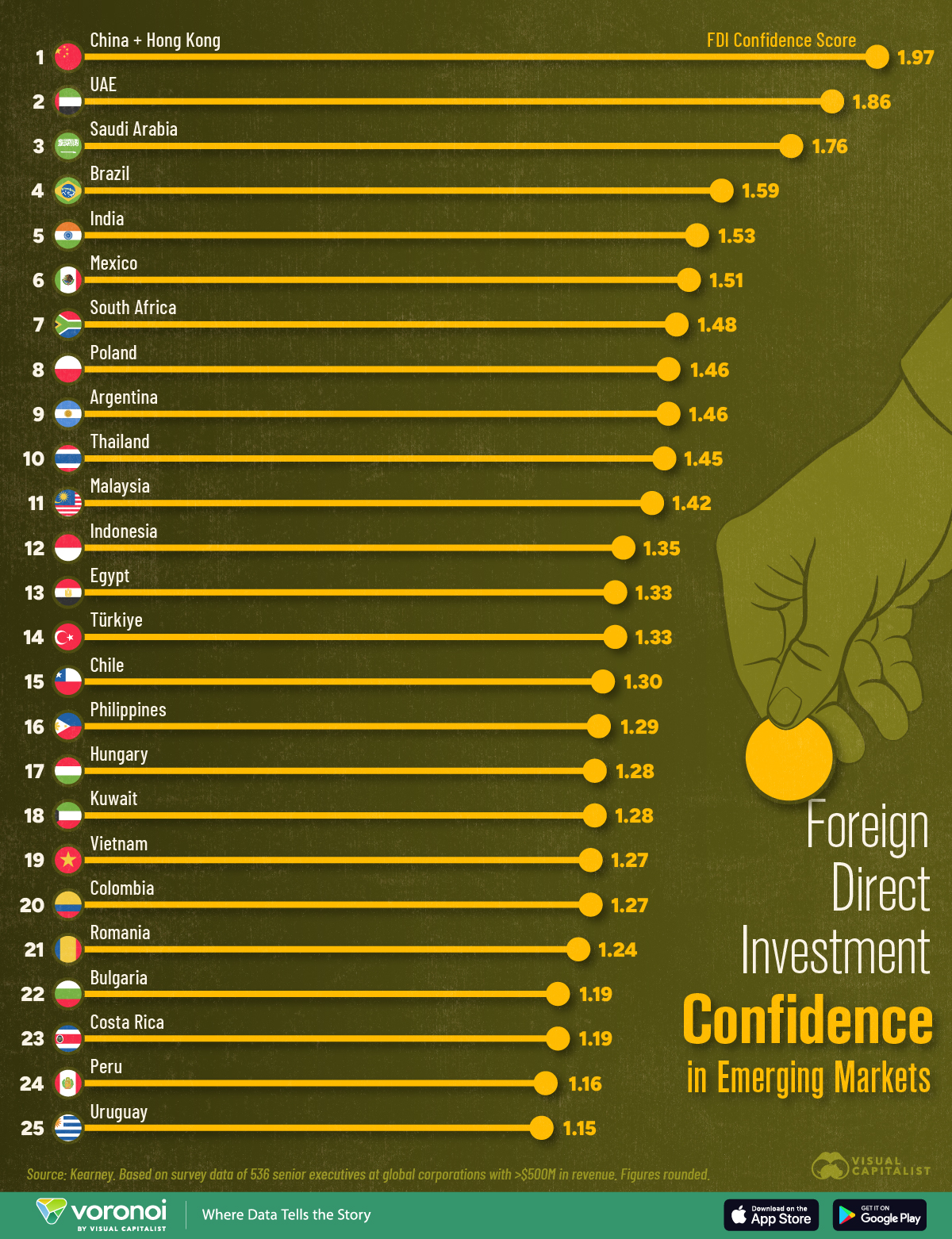
China, the UAE, and Saudi Arabia are the top three emerging markets by FDI confidence in 2025
Brazil overtook India to take the fourth spot, with both countries making the top five
Domestic economic performance and efficiency of legal and regulatory processes were the top two priorities for FDI investors
Emerging markets often attract foreign investors with prospects for higher economic growth and diversification.
Where are global business leaders placing their foreign direct investment (FDI) bets in 2025?
This chart highlights the top 25 emerging markets by FDI confidence score in 2025, based on a survey conducted by Kearney. The rankings are drawn from responses by 536 senior executives at global companies with annual revenues above $500 million.
China Leads in Foreign Investor Sentiment
China (including Hong Kong) remains the top emerging market for foreign investor confidence in 2025. However, FDI inflows have slowed in recent years, hitting multi-year lows in 2023.
Following China, the UAE and Saudi Arabia also retain their places as the second and third-most favored developing economies for FDI.
Here’s a look at the full list of top emerging markets for FDI confidence in 2025:Search:
Rank
Country
FDI Confidence Score
1
China (including Hong Kong) 🇨🇳🇭🇰
1.97
2
United Arab Emirates 🇦🇪
1.86
3
Saudi Arabia 🇸🇦
1.76
4
Brazil 🇧🇷
1.59
5
India 🇮🇳
1.53
6
Mexico 🇲🇽
1.51
7
South Africa 🇿🇦
1.48
8
Poland 🇵🇱
1.46
9
Argentina 🇦🇷
1.46
10
Thailand 🇹🇭
1.45
Brazil and India—two of the biggest emerging economies by GDP—round out the top five, with Brazil overtaking India in FDI confidence in the 2025 rankings.
These rankings align with investors’ FDI priorities from the same survey, where the efficiency of legal and regulatory processes and domestic economic performance top the list.
South Africa made the largest upward move in 2025, jumping from 11th to 7th in the rankings. It also recorded FDI inflows of around $661 million in Q1 2025, up 56% from the fourth quarter of 2024.
Overall, 11 of the top 25 emerging markets for FDI confidence are in Asia and the Middle East.
What’s Driving Investor Confidence?
The factors driving FDI confidence vary for each economy.
In China, tech innovation was the leading driver of investor confidence, while economic performance ranked highest for the UAE and Saudi Arabia.
Meanwhile, the talent/skill of the labor pools in India and Mexico were the strongest factors attracting investors.
Laos is facing one of its worst economic crises in decades, with the country experiencing galloping inflation and staring at a debt default.
Inflation in Laos has hit a 22-year high, causing a scarcity of essential commodities like fuel
Laos’ economy has been on the brink of collapse due to a spiraling debt crisis that is crippling the country’s finances and bringing it perilously close to default.
In June, the Southeast Asian nation’s Statistics Bureau announced that inflation hit a 22-year high of 23.6%, causing staple goods to become scarce and eroding the population’s purchasing power.
TTCT – Áp lực nợ công được dự báo sẽ còn tăng mạnh với các nước đang phát triển. Việt Nam cần sẵn sàng cho những kịch bản xấu hơn hiện giờ.
Ảnh: Reason Magazine
Trong khi nợ công của Việt Nam hiện được đánh giá chưa phải là nỗi lo quá lớn, thì những diễn biến bất ổn ở khu vực châu Á, cũng như tình trạng nợ của khối FDI, doanh nghiệp nhà nước và sự yếu kém của hệ thống ngân hàng nói chung sẽ gây ra những áp lực lên tài chính khu vực công. Sự cẩn trọng và tiên liệu là không bao giờ thừa, nhất là trong hoàn cảnh đầy bất trắc hiện tại.
Phải tung gói hỗ trợ y tế và kích thích kinh tế vì đại dịch, đối phó với khủng hoảng giá năng lượng, lạm phát, cộng thêm đồng USD lên giá, nhiều quốc gia đang phải đối mặt áp lực chi trả nợ công ngày một lớn.
Quỹ Tiền tệ quốc tế (IMF) cảnh báo nhiều nước đang phát triển ở châu Á có thể lún sâu vào nợ nần và đối mặt rủi ro từ các khoản nợ chồng chất. Sri Lanka không còn có khả năng trả nợ nước ngoài và lâm vào khủng hoảng kinh tế. Hay gần đây, các nhà đầu tư bắt đầu lo ngại Pakistan có thể gặp rắc rối khi đồng nội tệ giảm giá mạnh so với đồng USD.
Rising prices are hurting wallets across the world. The crisis is particularly bad in Sri Lanka and Turkey, and in Japan, people are facing inflation for the first time in decades.
Nikkei staff writersMay 20, 2022 07:38 JST
NEW YORK — Welcome to Nikkei Asia’s podcast: Asia Stream.
Every episode, Asia Stream tracks and analyzes the Indo-Pacific with a mix of expert interviews and original reporting by our correspondents from across the globe.
Vietnam’s new industrial policy, Resolution No. 23-NQ/TW outlines big goals and solutions to boost industrialization in Vietnam, notably with the ambition to be among the top ASEAN economies in terms of industrial competitiveness.
Looking at the current top-performing industries, Vietnam is well on track to achieve its goals
However, more needs to be done if the country wants to remain competitive in the future, especially with the advent of Industry 4.0.
In September 2020, the Vietnamese government issued an action plan implementing Resolution No 23/NQ/TW, which sets out a national industrial policy until 2030 with a vision towards 2045. The resolution was first signed in March 2018.
What are the goals outlined in the policy, and how does Vietnam intend to accomplish these goals? We assess the current status of industrialization in the country, take a closer look at the contents of the national policy and action plan, and identify future opportunities and challenges.
What’s in the new industrial policy?
The action plan to implement the national industrial development policy contains six main goals:
As it emerges from COVID-19, Vietnam’s domestic economy is set to return to growth, but not until the global economy bounces back.
It’s been two months since the last known case of community transmission of the coronavirus in Vietnam, enabling the country, hailed recently as one of the 11 outperformers among emerging economies, to be among the first to fully reopen its domestic economy.While recurrence remains an ever-present threat, Vietnam’s government is now turning its attention to repairing a damaged economy. Vietnam has fared better economically than many countries, but it has not been completely spared. GDP growth in the first quarter was at its lowest level since 2010, although it was still in positive territory at 3.8 percent. With exports and tourism severely affected, domestic consumption has been (and is expected to continue to be) critical to hold the economy together.
Staying afloat in 2020, largely thanks to spending on essentials
Vehicles travel on Vo Van Kiet Avenue in HCMC. This road was funded by official development assistance loans – PHOTO: VNA
HCMC – If the Vietnamese Government continues its fiscal consolidation, the public debt-to-gross domestic product (GDP) ratio could be further reduced, possibly reaching below 57% by 2021, said an HSBC report.
Vietnam has been repeating the goal of “industrialization and modernization” like a mantra and has treated these goals as a given without critical thought applied to what it really means
In copying other countries’ development mistakes, Vietnam has paid a heavy price for not deploying due foresight. Now, we cannot ignore hindsight wisdom.
Nguyen Dang Anh Thi
When he was 18, my eldest brother faced a tough decision – should he go to university or take up vocational training?
Although he wanted to persist with his academic pursuit, he deferred to the family’s economic needs and decided to join the workforce to support the family.
So, instead of going to university, he decided to go to Tay Loc District in my home province, Thua Thien Hue, and learn tailoring.
One year, with a sudden surge in the need for making windcheaters in HCMC, my brother left home and headed for the southern metropolis in search of better work opportunities. He boarded the crammed bus, not daring to look behind at his sobbing family.
This picture taken on May 2, 2014 shows the first wind turbine towers from Vietnam’s first wind power plant along a sea coast at the southern coastal province of Bac Lieu. Up until 2014 Southeast Asian communist nation had been relying mainly on power produced from thermo and hydro power plants. Source: AFP /Duy Khoi
VIETNAM is facing a number of environmental pitfalls and policy hurdles on its path towards a sustainable energy sector, Frauke Urban, Giuseppina Siciliano, Linda Wallbott, Markus Lederer and Dang Nguyen Anh write.
Vietnam has experienced rapid economic growth over the past two decades, making it one of the strongest and fastest growing economies in Southeast Asia.
At the same time, the country has experienced increasing levels of urbanisation, industrialisation and high population growth.






 CVD
CVD 