The U.S.-South Korea Alliance

Developments at home and abroad are testing U.S.-South Korea relations.
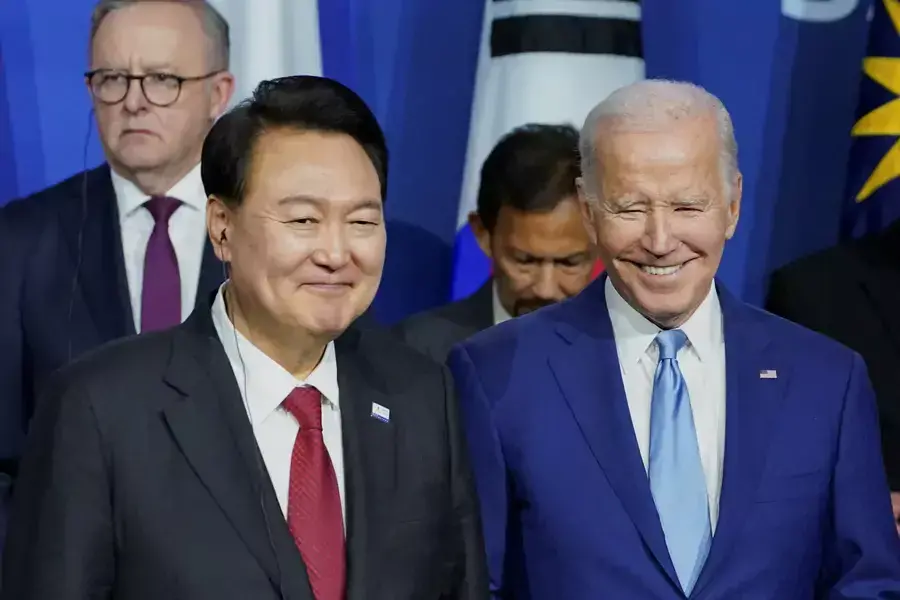
U.S. President Joe Biden and South Korea's President Yoon Suk Yeol at the Asia-Pacific Economic Cooperation summit in San Francisco on November 16, 2023.
U.S. President Joe Biden and South Korea’s President Yoon Suk Yeol at the Asia-Pacific Economic Cooperation summit in San Francisco on November 16, 2023. Kevin Lamarque/Reuters

Blog Post by Michelle Kurilla

December 15, 2023 11:05 am (EST)

The latest episode of The President’s Inbox is live! This week, Jim sat down with Scott Snyder, senior fellow for Korea studies and director of the program on U.S.-Korea policy at the Council. They discussed Scott’s new book, The United States-South Korea Alliance: Why It May Fail and Why It Must Not.The President’s Inbox

The U.S.-South Korea Alliance, With Scott A. Snyder

Scott A. Snyder, a senior fellow for Korea studies and director of the program on U.S.-Korea policy at CFR, sits down with James M. Lindsay to discuss the importance of the U.S.-South Korea military alliance and how domestic and international forces could be undermining it.

Here are five highlights from the discussion:

1.) The U.S.-South Korea alliance is critical to the U.S. interest in preventing China from dominating the Indo-Pacific region. Scott argued that the United States is better equipped to “defend its interests” in East Asia with the “alliance architecture” that includes the U.S.-South Korea alliance as well as the U.S.-Japan alliance. The alliances help deter aggressive Chinese behavior that could roil the region.

Tiếp tục đọc “The U.S.-South Korea Alliance”

US deploys attack drones to South Korea amid tension with North

SEOUL: The United States has started to deploy attack drones to South Korea, a U.S. military spokesman said on Monday, days after it began to deploy an advanced anti-missile system to counter “continued provocative actions” by isolated North Korea.

The drones, Gray Eagle Unmanned Aerial Systems (UAS) coming to South Korea are part of a broader plan to deploy a company of the attack drones with every division in the U.S. Army, the spokesman said. Tiếp tục đọc “US deploys attack drones to South Korea amid tension with North”

Seoul finding looming THAAD deployment a hot potato politically, economically

japan  times AP Mar 8, 2017

As South Korea begins the deployment of an advanced U.S. anti-missile system that it says will allow it to better cope with North Korean threats, the reaction from its belligerent rival is hardly its only concern.

The plan to deploy the Terminal High-Altitude Area Defense system, or THAAD, this year has angered not only North Korea, but also China, South Korea’s largest trade partner, which considers the system a security threat.

Residents in a rural South Korean town where THAAD is planned to sit have furiously protested over rumored health hazards they link to the system’s powerful radar, and some of the country’s potential presidential candidates have vowed to walk back on the deal if they win office. Tiếp tục đọc “Seoul finding looming THAAD deployment a hot potato politically, economically”

US, Japan, S Korea request UN Security Council meeting on N Korea

WASHINGTON: The United States, Japan and South Korea on Sunday (Feb 12) requested an urgent UN Security Council meeting to discuss North Korea’s latest missile test.

“The United States, along with Japan and the Republic of Korea, have requested urgent consultations on the DPRK’s launch of a ballistic missile on February 12,” said a US mission spokesperson.

The test was seen as a challenge to Donald Trump’s young presidency.

The request comes after North Korea’s state media quoted officials as saying the ballistic missile test was a “success”.

North Korean leader Kim Jong-un “guided” the test, the KCNA report said, adding it was carried out in a way that took the “security of the neighbouring countries into consideration”. Tiếp tục đọc “US, Japan, S Korea request UN Security Council meeting on N Korea”

U.S. warns North Korea of ‘overwhelming’ response to use of nuclear weapons

jAPAN TIMES

AP Feb 3, 2017

In an explicit warning to North Korea, U.S. Defense Secretary Jim Mattis on Friday said any use of nuclear weapons by the North on the United States or its allies would be met with what he called an “effective and overwhelming” response.

U.S. defense secretaries have long offered assurances to South Korea and Japan that its nuclear “umbrella” will protect them, but Mattis’ statement was perhaps more pointed than most. He made the remarks during an appearance with his South Korean counterpart, Defense Minister Han Min-koo. Tiếp tục đọc “U.S. warns North Korea of ‘overwhelming’ response to use of nuclear weapons”

Trump Tells South Korea That Alliance With U.S. Is ‘Ironclad’

Hwang Kyo-ahn, the acting leader of South Korea, spoke by phone with President Trump from Seoul on Monday. The call followed North Korea’s warning that it could test an intercontinental ballistic missile “anytime.” Credit Yonhap/European Pressphoto Agency

SEOUL, South Korea — President Trump assured South Korea’s acting president on Monday of the United States’ “ironclad” commitment to defend the country, agreeing with Seoul to strengthen joint defense capabilities against North Korea.

Mr. Trump’s assurances came amid anxiety in South Korea over the future of the alliance with the United States. During his campaign, Mr. Trump cast some doubt on the United States’ defense and trade commitments, saying that South Korea was not paying enough to help keep 28,500 American troops in the country.

But speaking by phone to Hwang Kyo-ahn, the acting president of South Korea, Mr. Trump said that the coming visit to South Korea by Defense Secretary Jim Mattis reflected the close friendship of the two countries and the importance of their alliance. Mr. Mattis is scheduled to visit South Korea on Thursday on his first official trip abroad, which also includes a stop in Japan.

“President Trump reiterated our ironclad commitment to defend the R.O.K., including through the provision of extended deterrence, using the full range of military capabilities,” the White House said in a statement after Mr. Trump’s phone conversation with Mr. Hwang, using the initials for South Korea’s official name, the Republic of Korea.

Continue reading on New York Times