Impact of Trump 2.0 on Southeast Asia’s Energy Geopolitics

Fulcrum.sg Published 3 Mar 2025 Mirza Sadaqat Huda

Trump’s rent-seeking foreign policy pertaining to energy and critical minerals will force Southeast Asian countries to do what they least desire: making a choice between China and the US.

The Trump administration’s insular and rent-seeking foreign policy will significantly alter the geopolitics of energy transition in Southeast Asia. This will manifest in two ways. First, the potential cessation of US involvement in the region’s energy sector will heighten fears of China’s dominance in energy infrastructure projects — including the ASEAN Power Grid (APG). Second, Trump’s intentions of using critical minerals as a bargaining chip for providing military assistance, if applied to the ASEAN region, will impact the regional vision for sustainable mineral development.

The shutting down of the United States Agency for International Development (USAID), an important player in the energy sector, will intensify existing fears of China’s dominance in electricity transmission and generation. As shown in Table 1, China provided approximately US$534 million in aid to the region’s energy sector in 2022, accounting for more than a quarter of the total share. Comparatively, the US provided only US$23.7 million, or 1 per cent of total energy-related aid to Southeast Asia. In addition, the China Southern Power Grid Company and State Grid Corporation of China own and operate significant portions of the national grids in Laos and the Philippines, respectively.

China Leads in Energy Aid

Table 1 Energy-related aid to Southeast Asia 2022 (excerpt) (USD, in %)

Donor Amount Contribution
China 534 million 26
ADB 368 million 18
Germany 274 million 13
Canada 231 million 11
South Korea 211 million 10
Japan 167 million 8
World Bank 90.0 million 4
EU Institutions 42.3 million 2
France 42.2 million 2
AIIB 34.8 million 2
United States 23.7 million 1

The table is modified from Lowy Institute’s (2024) Southeast Asia Aid Map.

Tiếp tục đọc “Impact of Trump 2.0 on Southeast Asia’s Energy Geopolitics”

Biden to sign strategic partnership deal with Vietnam in latest bid to counter China in the region

politico.com

The new strategic partnership agreement opens the door to closer diplomatic, economic and technological cooperation with former foe — and China’s neighbor — Hanoi.

Close-up of Joe Biden.

The deal adds to President Joe Biden’s string of successful diplomatic initiatives aimed to reassert U.S. influence in Asia in the face of China’s growing economic, diplomatic and military muscle in the region. | Alex Brandon/AP Photo

By PHELIM KINE08/18/2023 05:42 PM EDT

President Joe Biden will chalk up a fresh victory in his campaign to boost U.S. influence in the Indo-Pacific by sealing a deal with Vietnam next month aimed to draw Hanoi closer to Washington at a time of rising tensions with Beijing.

Biden will sign a strategic partnership agreement with Vietnam during a state visit to the Southeast Asian country in mid-September, according to three people with knowledge of the deal’s planning. They were granted anonymity because they weren’t authorized to speak on the record about the agreement.

The agreement will allow for new bilateral collaboration that will boost Vietnam’s efforts to develop its high technology sector in areas including semiconductor production and artificial intelligence.

Tiếp tục đọc “Biden to sign strategic partnership deal with Vietnam in latest bid to counter China in the region”

US aircraft carriers return to South China Sea amid rising tensions

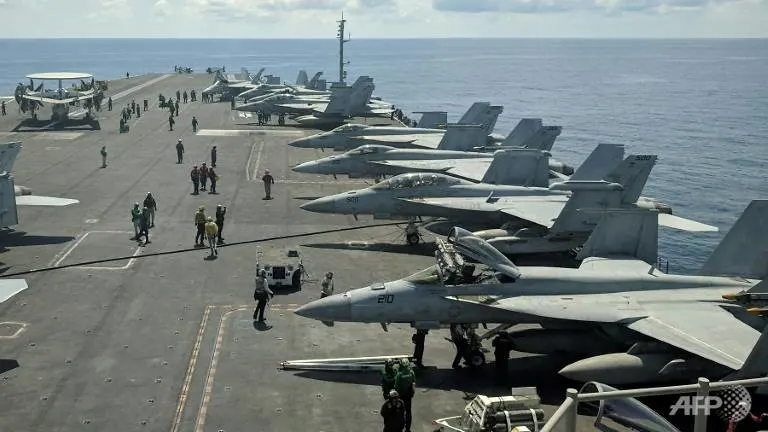
The United States runs regular operations in the South China Sea. (AFP/Catherine LAI)

HANOI: For the second time in two weeks, the United States has deployed two aircraft carriers to the South China Sea, the US Navy said on Friday (Jul 17), as China and the United States accuse each other of stoking tensions in the region. Tiếp tục đọc “US aircraft carriers return to South China Sea amid rising tensions”

Beijing denies intercepting US ‘sniffer plane’ over Yellow Sea

China says its aircraft were acting ‘in accordance with the law’ when they approached the American WC-135 plane

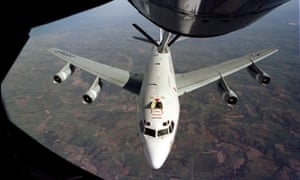
A US WC-135 Constant Phoenix aircraft can detect signs of nuclear activity.
A US WC-135 Constant Phoenix aircraft can detect signs of nuclear activity. Photograph: HANDOUT/Reuters

China has denied US allegations that two of its fighter jets intercepted an American “radiation-sniffing” plane earlier this week, saying that its aircraft were acting “in accordance with the law”.

“Related remarks from the US side are inconsistent with fact,” the Chinese defence ministry said in a statement posted to its website late on Friday.

“On 17 May, a US reconnaissance aircraft was carrying out an operation in airspace over the Chinese Yellow Sea (the northern part of the East China sea), and Chinese aircraft acted to identify and investigate in accordance with the law,” the statement said, calling the action “professional” and “safe”.

The US air force said in an earlier statement on Friday that its plane, a WC-135 Constant Phoenix, was conducting a “routine mission” in international airspace when it was intercepted by two Chinese Sukhoi SU-30 fighter aircrafts.

The WC-135 is a so-called “sniffer plane” designed to scan the atmosphere for signs of nuclear activity.

“The WC-135 was operating in accordance with international law. While we are still investigating the incident, initial reports from the US aircrew characterised the intercept as unprofessional,” the US air force said.

Mid-air interceptions occur routinely in international airspace, but the US military will often call out foreign pilots if it judges the manoeuvres to be risky or unprofessional.

Meanwhile, China urged the US to halt such reconnaissance exercises in order to prevent future incidents.

“The American military’s frequent reconnaissance operations are the root cause of security issues between the Chinese and US navy and air forces,” the Chinese defence ministry’s statement said.

Donald Trump speaks directly to Taiwan’s Tsai Ing-wen

ALJAZEERA

Donald Trump speaks directly to Taiwan’s Tsai Ing-wen

President-elect speaks with Taiwan’ leader in a break from the US’ “one China” policy triggering protest from Beijing.

US President-elect Donald Trump has spoken with Taiwanese President Tsai Ing-wen, in a major break with Washington’s policy on China, triggering protest from Beijing.

During Friday’s discussion, Trump and Tsai noted “the close economic, political and security ties” between Taiwan and the United States, according to the president-elect’s transition team. Tiếp tục đọc “Donald Trump speaks directly to Taiwan’s Tsai Ing-wen”

US warns China of countermeasures if it provokes ahead of court decision

Tankler News

Speech by Dai Bingguo at China-US Dialogue on South China Sea Between Chinese and US Think Tanks 2016/07/05

China Ministry of Foreign Affairs
5 July, Washington D.C

I am delighted to attend the China-US dialogue on South China Sea between Chinese and US think tanks jointly organized by the Carnegie Endowment for International Peace and Chongyang Institute for Financial Studies at Renmin University and meet with old and new friends. I would like to take this opportunity to thank both organizations for putting this dialogue together and my sincere thanks go to all of you here who have for long cared for and supported the development of China-US relations. Tiếp tục đọc “Speech by Dai Bingguo at China-US Dialogue on South China Sea Between Chinese and US Think Tanks 2016/07/05”

Chiến lược toàn cầu Mỹ – Nga – Trung trong trật tự thế giới mới và đối sách của Nga

  •  VHNA – ĐINH CÔNG TUẤN
  • Thứ năm, 10 Tháng 3 2016 15:04

 Đặt vấn đề

Mấy năm qua, thế giới đã chứng kiến những bất ổn và biến động khôn lường, từ khủng hoảng kinh tế đến bạo lực khủng bố, khủng hoảng di cư , ly khai biệt lập, đối đầu ngoại giao, an ninh quân sự… với quy mô và cấp độ chưa từng thấy kể từ sau chiến tranh thế giới thứ  II đến nay. Rõ ràng, trật tự thế giới thay đổi sâu sắc, với xu hướng bất ổn ngày càng gia tăng. Trong đó, nổi bật lên sự cạnh tranh khốc liệt về chiến lược toàn cầu  của tam giác Nga – Mỹ – Trung. Bài viết này sẽ cố gắng luận giải những đối sách của Nga trong quan hệ với Mỹ và Trung Quốc hiện nay. Tiếp tục đọc “Chiến lược toàn cầu Mỹ – Nga – Trung trong trật tự thế giới mới và đối sách của Nga”

Let China win. It’s good for America.

January 15

Joshua Kurlantzick is a senior fellow for Southeast Asia at the Council on Foreign Relations.

When Chinese officials announced in 2013 that they would open an Asian Infrastructure Investment Bank to primarily fund big construction projects across the Pacific, they launched a slow-motion freak-out in Washington. As they went around the world inviting governments to join, Obama administration officials pressured their allies in Asia, Europe and elsewherenot to. The AIIB, headquartered in Beijing, would allow China to expand its influence throughout Asia, the White House fretted. “We are wary about a trend toward constant accommodation of China,” one Obama aidecomplained to the Financial Times after Britain joined 56 other nations in signing up to fund power plants, roads, telecommunications infrastructure and other ventures. It was a rare public critique of a U.S. ally.

Tiếp tục đọc “Let China win. It’s good for America.”

The U.S. Navy Wants to Show China Who’s Boss

FP Report

The U.S. Navy Wants to Show China Who’s Boss

Worried about China’s increasing naval might, the U.S. Navy is scrambling to buy new anti-ship missiles for the first time in decades, and throwing out its old playbook for war strategy in the Pacific.

Since the end of the Cold War, the American military has enjoyed unrivaled dominance on the high seas, with no other navy posing a serious threat. But over the past decade, China has rapidly built up a naval force to be reckoned with, spending tens of billions of dollars annually to produce dozens of new warships of every size, and a formidable arsenal of missiles aimed at undercutting America’s naval reach. Tiếp tục đọc “The U.S. Navy Wants to Show China Who’s Boss”

Trying not to choose: A region pulled between China and America

Simon Long
Mon Nov 02 2015

http://cms-worldin.economist.com/sites/default/files/styles/1190x560l/public/Asia-Trying-not-to-choose-3570×1680.jpg?itok=7M4J9Efm
ASIA
East Asia is the scene for an unprecedented experiment in international relations. Never before have so many countries been so intertwined economically with one big power (China) while looking to another (America) as the ultimate guarantor of their security. So far the experiment has seemed a stunning success. For 40 years, America has not just kept the peace; it has enabled a continental economic boom. And the biggest beneficiary of that has been China. Yet that order is now fraying, as China chafes under what it sees as an American-led world order that is impeding its rise and its natural regional predominance. In 2016 the tensions that this fraying produces may become acute, posing awkward questions for other countries in Asia.

When Xi Jinping, China’s president, paid his first state visit to America in September 2015, the two countries were already at odds on a number of issues: the perennial bugbears such as China’s human-rights record and repression in Tibet and Xinjiang; and new concerns over cyber-security and the militarisation of space. The visit was marked, as always, by an effort to stress areas of co-operation, for example on climate change; but the two big powers are now rivals in a growing number of spheres. Asia is where the rivalry is most intense. It will become more so in 2016 for three main reasons.
Tiếp tục đọc “Trying not to choose: A region pulled between China and America”