Sino-Russian Arctic cooperation is real but limited – and should not distract from the broader strategic challenges each country poses individually. While the partnership merits attention, some aspects are more symbolic than substantive, with Russia ultimately controlling the pace and direction.
Media narratives often highlight the growing alignment between China and Russia in the Arctic and the potential threat this poses to other states. Yet the partnership remains constrained by diverging priorities, Russia’s wariness of Chinese influence, and China’s reluctance to expose itself to sanctions or engage in risky ventures.
At the same time Russia’s increasing dependence on China since its full-scale invasion of Ukraine in 2022 has given Beijing opportunities to pursue deeper access to the Russian Arctic on its own terms and in areas that align with its long-term objectives. Rather than engaging broadly, China is selective in how and where it invests or participates – a dynamic that could intensify underlying frictions between the two even as global geopolitical shifts continue to draw them closer in the region.
From violent westward expansion to interwar isolationism to ruinous military interventions, discover which U.S. foreign policy decisions left the most tarnished legacies.
From securing America’s sovereignty to expanding its continental reach to creating the post-World War II institutions that ushered in unprecedented peace and prosperity, discover which U.S. foreign policy decisions left the most positive legacies.
China dominates global rare earth mining, but undeveloped reserves elsewhere could reshape future supply chains.
Greenland holds an estimated 1.5 million metric tons of rare earth reserves despite having no commercial production.
U.S. President Donald Trump has once again put Greenland at the center of global attention.
His renewed threat to assert U.S. control over the Arctic territory has drawn sharp reactions from European leaders and Denmark, which governs Greenland as an autonomous territory.
While the island’s strategic location is often cited, another underlying motivation is increasingly tied to its vast mineral potential. In particular, Greenland’s rare earth reserves have become a focal point in a world racing to secure critical resources.
This visualization compares rare earth mine production and reserves across countries, placing Greenland’s untapped resources in a global context.
China remains the backbone of the global rare earth market. In 2024, it produced roughly 270,000 metric tons, accounting for well over half of global output.
China also controls the largest reserves, estimated at 44 million metric tons. This combination of scale and integration gives Beijing significant leverage over industries ranging from electric vehicles to defense systems.
Country
Reserves (Metric Tons)
Rare Earth Production 2024 (Metric Tons)
🇨🇳 China
44.0M
270,000
🇧🇷 Brazil
21.0M
20
🇮🇳 India
6.9M
2,900
🇦🇺 Australia
5.7M
13,000
🇷🇺 Russia
3.8M
2,500
🇻🇳 Vietnam
3.5M
300
🇺🇸 United States
1.9M
45,000
🇬🇱 Greenland
1.5M
0
🇹🇿 Tanzania
890K
0
🇿🇦 South Africa
860K
0
🇨🇦 Canada
830K
0
🇹🇭 Thailand
4.5K
13,000
🇲🇲 Myanmar
0
31,000
🇲🇬 Madagascar
0
2,000
🇲🇾 Malaysia
0
130
🇳🇬 Nigeria
0
13,000
🌍 Other
0
1,100
🌐 World total (rounded)
>90,000,000
390,000
Large Reserves, Limited Production Elsewhere
Outside China, many countries with sizable reserves play only a minor role in production.
Brazil holds an estimated 21 million metric tons of rare earth reserves yet produces almost nothing today. India, Russia, and Vietnam show similar patterns.
Why Greenland Matters
Greenland’s estimated 1.5 million metric tons of rare earth reserves exceed those of countries like Canada and South Africa. Yet the island has never had commercial rare earth production.
Environmental protections, infrastructure constraints, and local political opposition have slowed development. Still, as supply chain security becomes a priority for major economies, Greenland’s position is becoming harder to ignore.
Trump’s interest in Greenland is driven by more than symbolism. Rare earths are essential for advanced manufacturing, clean energy technologies, and military hardware. With China firmly entrenched as the dominant supplier, policymakers in Washington are increasingly focused on alternative sources.
CNA Few countries are better prepared against China threatening their rare earth supplies than Japan, says David Fickling for Bloomberg Opinion.
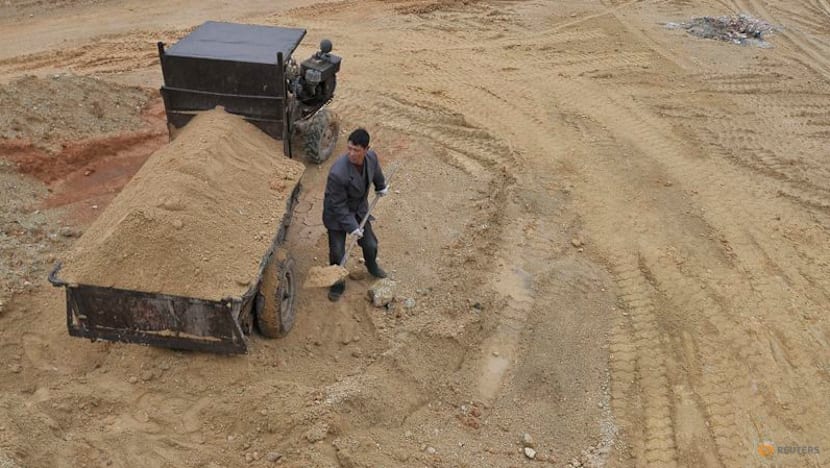
A labourer works at a site of a rare earth metals mine at Nancheng county, Jiangxi province, China, on Mar 14, 2012. (File photo: Reuters)
David Fickling 09 Jan 2026 05:59AM(Updated: 09 Jan 2026 09:30AM)
SYDNEY: To a hammer, every problem is a nail. If your most potent means of geopolitical leverage is threatening supplies of high-strength magnets, rare earth elements will always be the solution.
The most obvious victim of this threat will be rare earth magnets made with the elements neodymium and praseodymium, and increasingly spiced up with rarer samarium, dysprosium and terbium. They’re used everywhere from charging cables to the switchgear in wind turbines to motors powering electric vehicles, missile guidance systems and aircraft flaps.
Where Beijing once celebrated its manufacturing and export prowess, it now openly discusses the need to curb “involution”. This is a dramatic departure from its previous stance, says Enodo Economics’ Diana Choyleva.
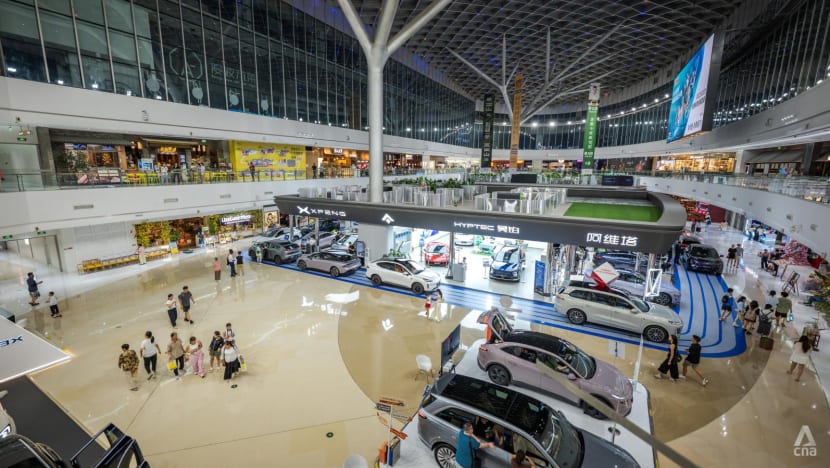
People browse in electric car showrooms located on the 5th floor in a popular shopping mall in Beijing on Jul 21, 2025. (Photo: CNA/Hu Chushi)
LONDON: For years, Beijing dismissed Western concerns about Chinese overcapacity as protectionist rhetoric. When the United States and European Union complained about cheap Chinese exports flooding global markets, China’s response was predictable: These were simply competitive advantages in a free market economy.
That narrative has now fundamentally shifted. In a remarkable policy U-turn, China has not only started acknowledging the overcapacity problem but is treating it as a national priority that requires urgent intervention.
While there have been signs of this narrative change for a while, the clearest signal of this messaging transformation came through recently on China’s own policy channels.
In July, the Communist Party’s leading journal Qiushi warned that “disorderly competition has destroyed entire industry ecology”. This wasn’t diplomatic language about market dynamics – it was an admission that destructive competition had reached crisis proportions.
Generation Z is coming of age at a particularly difficult time. Zoomers, as they’re known, are aged between 13 and 28 and have already lived through a global financial crisis, a historic pandemic, and several wars. Now, many of them confront an entry-level job market muddled by advances in AI.
Ngày 2/4, Tổng thống Mỹ Donald Trump công bố mức thuế nhập khẩu với hàng chục nền kinh tế, trong đó Việt Nam chịu mức 46%.
Tại sự kiện, Tổng thống Mỹ cũng mang theo tấm bảng ghi mức thuế áp dụng với từng nền kinh tế. Trong đó, Anh, Brazil, Singapore sẽ chịu 10% thuế. Liên minh châu Âu, Malaysia, Nhật Bản, Hàn Quốc, Ấn Độ chịu 20-26%. Trung Quốc và Việt Nam nằm trong nhóm các nước bị áp mức thuế cao nhất, lần lượt là 34% và 46%.
Khoảng nửa giờ sau khi cầm chiếc bảng công bố mức thuế đối ứng với từng đối tác thương mại, Tổng thống Trump ký sắc lệnh áp thuế.
Are you ready to be liberated?Donald Trump’s ingenious plan to escalate his global trade war is set to start tomorrow, which the president vows will lay the groundwork for a golden era for the US economy. What the hell does that mean?
In the simplest terms, “Liberation Day” will impose significant tariff increases on all imports, while forcing companies to relocate supply chains to the US. That’s because, in Trump’s mind, foreign countries have “really abused us” for decades.
Are you ready to be liberated?Donald Trump’s ingenious plan to escalate his global trade war is set to start tomorrow, which the president vows will lay the groundwork for a golden era for the US economy. What the hell does that mean?
In the simplest terms, “Liberation Day” will impose significant tariff increases on all imports, while forcing companies to relocate supply chains to the US. That’s because, in Trump’s mind, foreign countries have “really abused us” for decades.
WSJ’s Shelby Holliday breaks down why President Trump and Elon Musk have targeted USAID, the DC-based international aid organization with more than 10,000 employees and relief operations around the world. Photo: Kenny Holston/The New York Times/Zuma Press/Will Oliver/Shutterstock
FILE – The Supreme Court is seen at sunset in Washington, on Jan. 24, 2019. The Supreme Court will be taking its first look in the 156-year history of the 14th Amendment at a provision, Section 3, that’s meant to keep former officeholders who “engaged in insurrection” from ever regaining power. The stakes couldn’t be higher in arguments taking place on Thursday, Feb. 8, 2024. (AP Photo/J. Scott Applewhite, File)
BY MARK SHERMAN AND NICHOLAS RICCARDIUpdated 12:04 PM GMT+7, February 6, 2024Share
WASHINGTON (AP) — From civil rights to privacy, the 14th Amendment has been a foundation for forging the norms of American law and democracy. But one of its provisions, adopted after the Civil War in 1868, has gotten almost no attention until now: That’s Section 3, the part that’s meant to keep former officeholders who “engaged in insurrection” from ever regaining power.
Donald Trump’s packing of the supreme court, to which he appointed three members, to create a reliable conservative majority, has been hailed by the right as his greatest achievement. The Wall Street Journal editorial page has stated that the most important prospect of a second Trump term would be his appointment of federal judges in their mold. But Trump’s candidacy for that second term now poses an existential threat to the legitimacy of the court’s conservative majority.



 CVD
CVD 