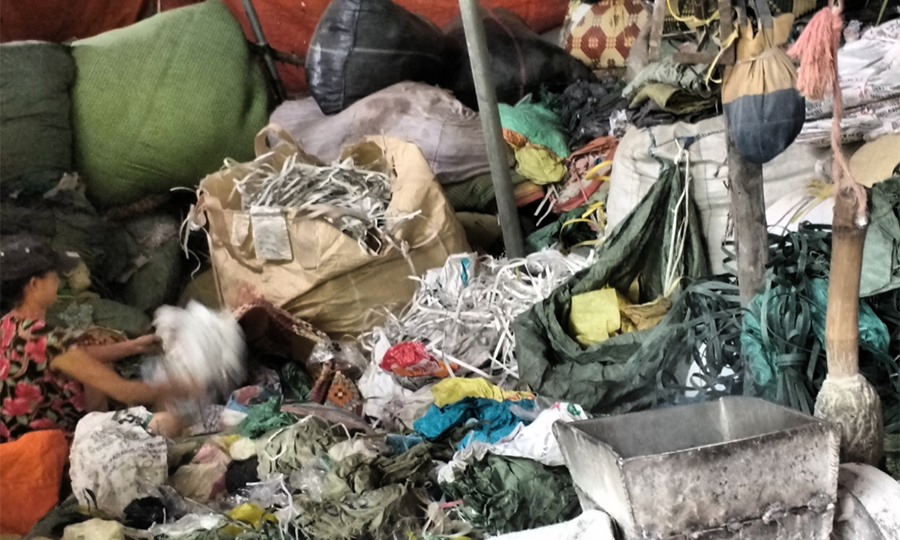
Unclear delineation of the roles of state agencies in managing waste has made a mess of sorting and collecting trash in Vietnam.
Vietnam is sorting trash in four different ways and one type of trash is put under the eyes of up to six ministries.
Conversations on Vietnam Development

Unclear delineation of the roles of state agencies in managing waste has made a mess of sorting and collecting trash in Vietnam.
Vietnam is sorting trash in four different ways and one type of trash is put under the eyes of up to six ministries.
VietNamNet Bridge – For once, an online viral craze is making a positive change to the world, instead of enticing kids to eat washing up liquid.
![]() |
| A group of young people take the #trashtag challenge to clean up rubbish at the Old Church in Ba Vi National Park in Hanoi’s Ba Vi District. — Photo courtesy of Cao Manh Tuan |
The so-called #trashtag challenge has gone viral in recent days and inspired people the world over to clean up rubbish in public areas, and Vietnam is no exception.
The challenge encourages people to clean up littered places and post before-and-after pictures on social media.
The #trashtag challenge began gaining popularity on March 5, after a Facebook user shared a before-and-after photo of a messy area that had been cleaned in an unknown location. The post grabbed attention with more than 330,000 shares on Facebook. Tiếp tục đọc “#trashtag challenge accepted in Hanoi”
A methane gas treatment plant will produce electricity from the decomposing garbage
![]() |
| Garbage are dumped on a street in Hanoi. |
![]() |
| Untreated wastewater discharged from the Triều Khúc plastic craft village in the capital city into ponds, rivers and canals. About 1,350 craft villages in the city are discharging a total amount of 156,000cu.m of wastewater per day into the environment. — VNA/VNS Photo Minh Nghĩa |
He was speaking at a session on waste collection, solid waste treatment, medical waste and lake management yesterday in Hà Nội, saying these problems had annoyed local residents for a long time. Tiếp tục đọc “Dire need for waste treatment in Hà Nội”
![]() |
| The solid waste treatment plant operated by Tam Sinh Nghia Investment Development JSC in Cu Chi District, Ho Chi Minh City. Photo: Tuoi Tre |
VietNamNet Bridge – Residents of Huong Khe Town in Ha Tinh Province have blocked garbage trucks’ access to the local landfill for the past 10 days, to protest the use of the overflowing dump.
![]() |
| Uncollected trash piled on in the Son Market, Huong Khe Town, Huong Khe District in the central province of Ha Tinh. |
The protest has led to waste accumulation in the area, and all waste treatment activities have come to a halt, worsening the already bad situation in Huong Khe District. Tiếp tục đọc “Ha Tinh residents block access to overflowing landfill”

eco-business_Auto City is an unlikely place for one of corporate Malaysia’s more ambitious zero waste initiatives.
Located on mainland Penang, it is a busy commercial hub spread over eight hectares and dedicated to retail, dining and entertainment. Given the nature of its business, kitchen waste is inevitable but waste going to a landfill is not, the company’s founder Gary Teoh believes.
![]() |
| The NEDO Factory, the first industrial waste-to-energy facility, is considered a pioneering project of Việt Nam’s industrial waste treatment industry.—VNA/VNS Photo Mạnh Khánh |
HÀ NỘI — Hà Nội on Monday inaugurated its first industrial waste-to-energy (WtE) facility in Nam Sơn Waste Treatment Complex, supplying electricity to the national power grid.The plant, the first of its kind in Việt Nam, completed its first production batch of 1.93MW of electricity on March 16, of which 1.2 MW was successfully connected to the national power grid. The remaining power was used for the factory’s production. Tiếp tục đọc “Hà Nội inagurates first waste-to-energy plant”
VietNamNet Bridge – HCM City faces a shortage of garbage collection stations, with empty pavements in public areas often used as makeshift stations.
![]() |
| A garbage collection station in District 3 of HCM City. |
At the collection stations, rubbish is collected, sorted for disposal and then transferred to dumping sites or treatment zones, but these unhygienic tasks have been performed in public areas.
Meanwhile, current garbage stations are dilapidated and overloaded, polluting the environment and becoming a nightmare for those living nearby.
A garbage collection station located at the Quang Trung-Tan Son Intersection in Go Vap District is an example. The station has become a nightmare for local people, including hundreds of students and teachers from the school nearby.
Le Van Truc, resident in Ward 8, told Ha Noi Moi (New Ha Noi) newspaper that the garbage collection station was built ten years ago, causing a terrible odour and traffic chaos.
He said locals asked authorised agencies to move the station, but received no reply.
In the area near September 23 Park in District 1, three stations plague the downtown area of the city. The one on Hai Ba Trung Road has become overloaded due to the large amount of rubbish collected from Ben Nghe and Ben Thanh wards.
Pham Le Nghia, resident in Ben Nghe Ward, said garbage was collected twice a day. Tiếp tục đọc “HCM City residents plagued by overloaded dumps”
VietNamNet Bridge – Shrimp waste – heads and shells – are being used to produce animal feed and biological derivatives, resulting in high profits and a reduction of air pollution at processing plants.

Six years ago in Ca Mau province, the ‘metropolis’ of the aquaculture and seafood processing industry, shrimp shells discharged from processing were in piles as high as a mountain.
Every day, Minh Phu Seafood JSC threw away 50-100 tons of shrimp heads and shells. The mountain of shrimp waste produced a bad odor after being exposed to the sun and rain.
This prompted Hoang Viet Tung, a member of the board of directors of VNF, to draw up a plan to take advantage of the waste. He signed contracts with large seafood companies on buying shrimp waste from them.
VNF collects more than 100 tons of waste products every day. The company undertakes all the steps of the waste collection process to ensure quality and hygiene of the waste.
| Shrimp waste – heads and shells – are being used to produce animal feed and biological derivatives, resulting in high profits and a reduction of air pollution at processing plants. |
In the past, shrimp heads and shells thrown on the ground contained impurities. Now, VNF sets up conveyor belts to put shrimp waste into tanks.
With the belts, VNF can collect shrimp heads and shells just 30 minutes after the waste is split from seafood processing factories. The biggest value is that it can help settle environmental problems using high technology. Tiếp tục đọc “Shrimp waste used to make animal feed, biological derivatives”

COLOMBO – The collapse of a massive garbage mound near Sri Lanka’s capital has killed at least 20 people, officials said on Sunday, and residents feared more victims could be buried underneath the debris. Tiếp tục đọc “Massive mound of garbage collapses in Sri Lanka, killing 20”
Updated : 03/26/2017 12:51 GMT + 7
Rubbish has turned into a perennial problem in Vietnam’s Mekong Delta as current waste treatment projects barely meet the rising demand from rapid urbanization.
Local authorities are scratching their heads over the aching issue since the existing waste treatment factories are becoming overloaded.
Vinh Long is among the very few provinces in the ‘rice bowl of Vietnam’ to have a local waste treatment facility, which was developed by Phuong Thao Joint Stock Company. Tiếp tục đọc “Vietnam’s Mekong Delta struggles with garbage amid lack of treatment plants”